Every week a Shopify merchant asks us some version of the same question: "Which SEO app should I install?" Fair question, and an expensive one to answer wrong. The Shopify App Store has hundreds of SEO tools, most of them solving problems Shopify already solves for free, and a few quietly breaking things while they charge you monthly.
We've been a Shopify Partner and Shopify Plus Partner agency for years, and apps are part of nearly every build we ship. That means we've installed, configured, fought with, and uninstalled just about everything on that list. Some of these apps are genuinely excellent. Some are fine but redundant. A couple are on here mainly so we can tell you to avoid them.
Here's our honest ranking of the nine best Shopify SEO apps in 2026, what each one actually does well, and the situations where you should save your money. If you'd rather have us pick, install, and configure the right stack for your store, that's part of our Shopify SEO service.
A Quick Disclaimer Before the List
No app ranks your store. Apps fix technical issues, save you time on bulk edits, and surface data you might miss. Rankings still come from content, architecture, and authority. Any app promising page one in 30 days is selling you something that doesn't exist.
Also, audit your app list before adding anything. On most stores we review, the biggest SEO win is removing four apps, not installing a fifth.
The 9 Best Shopify SEO Apps
1. Plug In SEO: Best All-Around for Most Stores
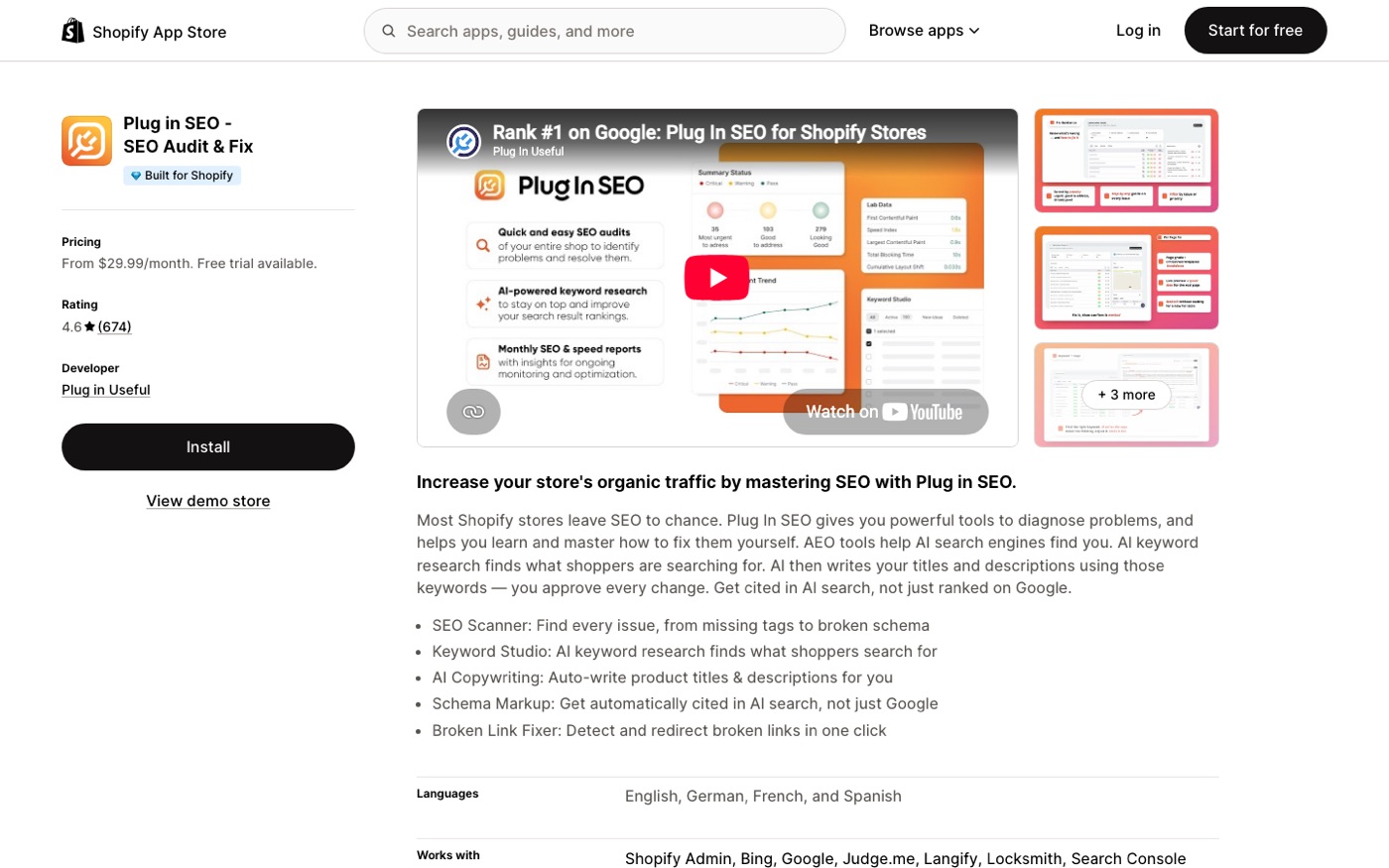
Plug In SEO is the closest thing to a standard recommendation we have. It audits your store on an ongoing basis: title tags, meta descriptions, alt text, broken links, structured data, speed. The interface is honest: it tells you what's wrong without inventing emergencies.
What we like: the templating system. You can write rules like "if a product has no meta description, use this template," which fixes thousands of pages without hand-editing each one. That's genuinely useful on stores with big catalogs.
Where it falls short: the audit findings sometimes flag things that don't matter much. Treat it as a checklist, not a to-do list. Skip it if your catalog is under 50 products and you already manage titles manually.
2. Smart SEO: Best for Bulk Automation
Smart SEO does fewer things than Plug In SEO but does them faster. Its bulk alt-text and meta-tag generators run against your whole catalog in minutes, and its JSON-LD structured data handling is clean.
We've deployed it most often during migrations, when a client brings 3,000 products over with no metadata at all. You write the templates once, run the job, then hand-polish the top 100 revenue pages.
One caution: auto-generated metadata is a floor, not a ceiling. If every product description reads like a mail merge, Google notices and so do customers.
3. Search & Discovery: Best Free App, Period
This is Shopify's own free app, and it belongs in almost every store we touch. It doesn't do traditional SEO work. It controls on-site search, synonyms, and product recommendations, which matters more than people realize.
Here's why: your internal search data is a goldmine for SEO keywords. When customers repeatedly search "waterproof boots" on your store and you don't rank for that phrase externally, that's your next collection page. The app makes those searches visible and lets you tune results.
Install this one regardless of what else you use. It's free, maintained by Shopify, and conflicts with nothing.
4. TinyIMG: Best for Image SEO and Speed
Images are where Shopify SEO and speed overlap, and TinyIMG handles both. It compresses existing images in bulk, converts to WebP, adds alt text, and can lazy-load or preload as needed.
We've seen this app cut total page weight by 30–40% on image-heavy fashion and furniture stores. Since Core Web Vitals feed into rankings, that translates directly into SEO benefit.
It also fixes the broken-image 404s that large catalogs accumulate. Small app, real impact. Our one gripe: run compression outside peak traffic hours on very large stores.
5. JSON-LD for SEO: Best for Rich Results
If you want review stars, pricing, and availability showing in Google's results, you need clean structured data. Shopify outputs basic product schema, but apps like JSON-LD for SEO fill in the gaps: reviews, video, FAQ, and variant-level pricing.
Rich results don't boost rankings directly, but the click-through rate lift is real and measurable. On competitive SERPs, a starred result next to a plain one wins the click almost every time.
This app is a niche tool. If your theme already outputs complete schema (check Google's Rich Results Test first), skip it.
6. Screaming Frog SEO Spider: Not a Shopify App, But Essential
Strictly speaking, this one isn't in the App Store; it's a desktop crawler you point at your store. We include it because no Shopify-specific app replaces it, and any serious SEO work runs through it.
The free version crawls up to 500 URLs, which covers most small stores. It will find your duplicate titles, broken links, redirect chains, missing H1s, and orphaned pages faster than any app. We run it on every client site before writing a single recommendation.
If you learn one tool from this list, learn this one. There's a learning curve, but it's a weekend's worth, not a semester's.
7. Klaviyo: Best for the SEO You Don't Think About
Yes, an email platform on an SEO list. Hear us out. Email drives repeat traffic, and repeat visitors behave better: longer sessions, more pages per session, lower bounce rate. Those behavioral signals correlate with rankings.
Kaviyo earns its spot because of its back-in-stock and browse-abandonment flows, which recover traffic that would otherwise bounce back to Google after a sold-out product page. Keeping engaged users on your domain matters.
This only counts if you actually run the flows. Installing Klaviyo and sending one newsletter a month does nothing for SEO.
8. Sherlocks: Best for Redirect Management During Migrations
Every store migration we've done, including our Shopify migration guide walkthrough, lives or dies on redirects. Sherlocks handles bulk 301 redirects and tracks 404s as they appear, which is exactly what you need when URLs change en masse.
Shopify's native URL redirects work but are painful at scale. Sherlocks makes bulk import and monitoring sane. Keep it installed for a quarter after any migration, fix what surfaces, then decide whether to keep it.
9. Judge.me: Best for Review Content (Used Carefully)
Review apps aren't SEO tools by design, but product reviews add unique text to pages that are otherwise near-duplicates of manufacturer copy. That content has real ranking value on the right store.
Judge.me is our usual pick because it's fast, reasonably priced, and its schema output plays well with Google. The caution: some review widgets tank page speed, which erases the SEO benefit. Test before and after with PageSpeed Insights. If the widget costs you more speed than the reviews add in content, turn off the widget and keep collecting reviews.
Apps We'd Skip Entirely
Keyword-stuffing "SEO optimizers" that rewrite your titles with trending terms are worse than useless; they overwrite good metadata with spam. Apps that promise automated blog posts generate thin content Google increasingly ignores. And anything offering "backlinks" through a network is a manual action waiting to happen.
We've cleaned up after all three categories. The cleanup always costs more than the app ever earned.
What Our Typical Stack Looks Like
For a mid-size store, our default configuration is lean: Search & Discovery (free) for internal search and keyword data, TinyIMG for image compression, one metadata app (Plug In SEO or Smart SEO, rarely both), and Screaming Frog run quarterly from a laptop. Add JSON-LD if the theme needs it, Klaviyo if email is active, and a redirects tool only around migrations.
That's it. The stores ranking well aren't the ones with ten SEO apps installed. They're the ones with three apps doing real work and a human doing the strategy. Apps support the work; they don't replace it.
Frequently Asked Questions
Do I really need a paid SEO app for Shopify?
Often, no. If your catalog is small and your theme is well-built, Search Console, Screaming Frog's free tier, and Shopify's built-in settings cover most of it. Paid apps earn their cost through bulk editing and automation on stores with hundreds or thousands of pages.
Can Shopify SEO apps hurt my rankings?
Yes, in a few ways. Speed-draining widgets, apps that overwrite your metadata with auto-generated spam, and apps creating crawlable duplicate pages have all caused ranking drops on stores we've audited. Vet anything that changes your templates.
What's the first SEO app I should install?
Shopify's free Search & Discovery app, full stop. It's useful on day one, costs nothing, and conflicts with nothing else. After that, let your actual problems, from missing metadata to broken links, dictate what you add.
Are SEO apps worth it for a brand-new store?
Not most of them. New stores have a handful of pages; you can optimize them by hand in an afternoon. Spend your budget on content and product photography first, then add automation when the catalog grows past what manual work can handle.
How many SEO apps is too many on Shopify?
More than two or three dedicated SEO apps is usually a sign of overlap, and overlap means cost and speed drag. Consolidate. Every app you remove that injected JavaScript onto every page is a small speed win, and speed is SEO.
Not sure which of these belongs in your stack? Book a Shopify SEO audit and we'll map your store's actual issues to the tools (or the manual fixes) that solve them.
