WOOCOMMERCE SEO WITHOUT THE PLUGIN BLOAT
WooCommerce can rank as well as any platform, but only when hosting, plugins, and templates stay disciplined. Most stores we audit run 40 plugins on shared hosting with a page builder theme, so Core Web Vitals fail and categories stay thin. We fix the foundation, rebuild the templates, then grow organic revenue, all on the platform you already run.
200+ WooCommerce stores ranked, 2.8x typical organic lift in six months
Your WooCommerce store is held together by plugins
Shared hosting and a page builder theme push load times past four seconds, so Google demotes you before content gets a chance
Category pages are a product grid with a sentence of copy, which cannot compete for category terms against real guides
Four SEO plugins disagree over titles, sitemaps, and schema, and the combined output still fails validation
Every new plugin adds CSS and JavaScript sitewide, so the store slows down as traffic climbs
Tag archives, attachment pages, and internal search URLs bloat the index and split authority across URLs nobody chose
We make WooCommerce fast, clean, and crawlable
WooCommerce inherits whatever WordPress gives it, which is the problem and the opportunity. Hosting quality, PHP version, object caching, plugin count, and theme weight are all decisions somebody made once and nobody reviewed. We review all of it: move the store to proper hosting or tune what it has, cut the plugin stack to what the business actually uses, replace page builder templates with lightweight block or custom themes, and get Core Web Vitals passing at template level, not just on the homepage. On top of that foundation we rebuild category and product templates with real copy, validated schema, and internal links that follow a written rule set. Content lives in WordPress, still the best publishing tool in ecommerce, so the blog and buying guides finally point their authority into the catalog instead of leaking it.
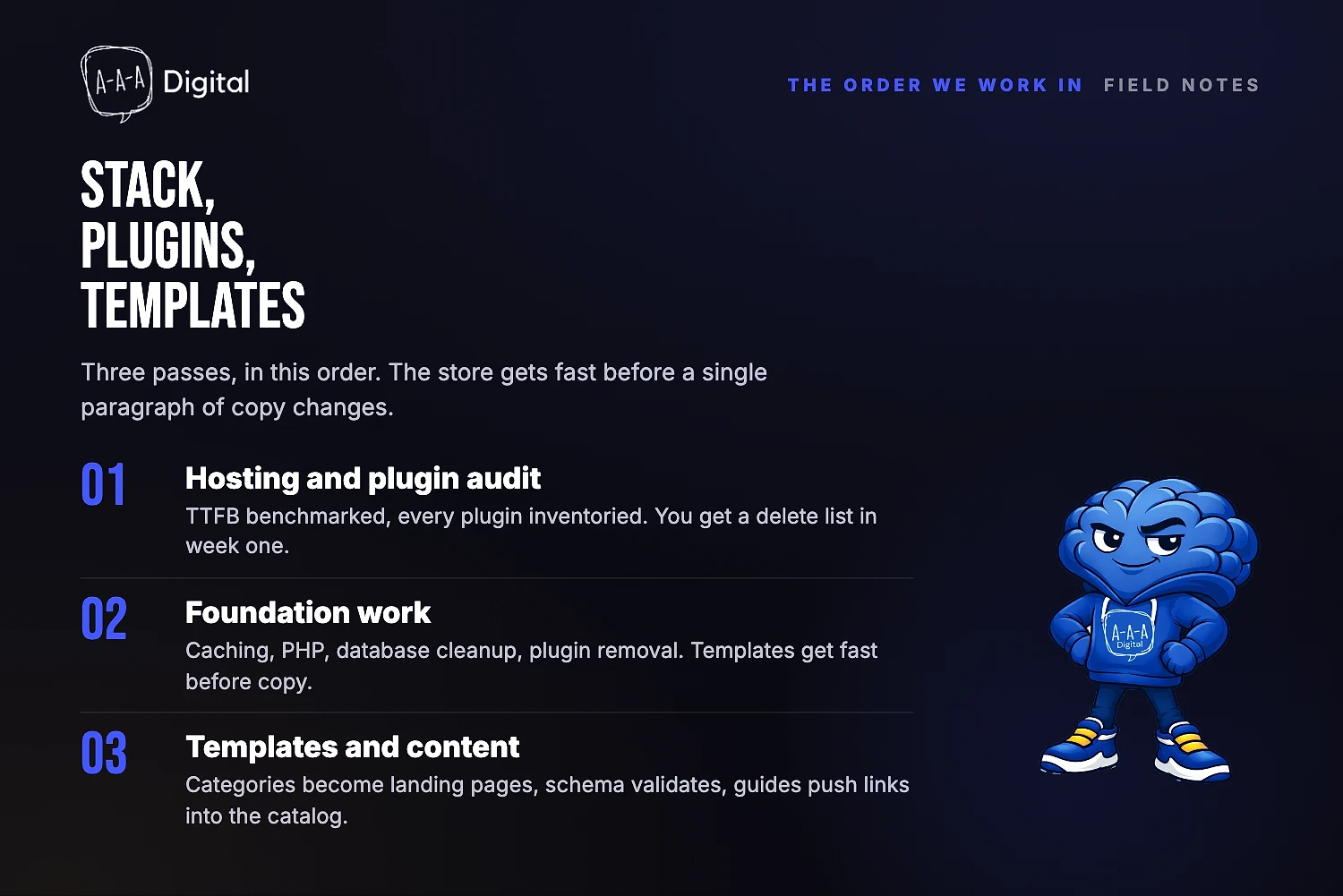
The first 90 days run in order: audit and benchmarks in weeks one and two, hosting and plugin work through week five, template and index rebuilds by week eight, then content aimed at the categories closest to page one. Every month you get revenue by template, crawl health, and a short list of what we would delete next. When a store outgrows plugin maintenance, our WooCommerce to Shopify migration moves the catalog, orders, and customers with a 1:1 redirect map, the same approach we document in our migration guide on the blog.
Hosting and Stack Triage
We benchmark TTFB, PHP version, database queries, and object caching, then either tune the current host or manage the move to managed WordPress hosting. No SEO plugin fixes a four-second server response.
Plugin Stack Reduction
We inventory every plugin, remove the ones that overlap or duplicate, replace five-purpose plugins with one purpose-built tool, and cut the CSS and JavaScript each one injects sitewide. Typical result: 40 plugins down to 18 and a measurable LCP improvement.
Category and Product Templates
Copy above the grid, FAQ sections, breadcrumbs, and Product, Offer, Review, and FAQ schema wired into the templates. Categories stop being grids and start being pages buyers and Google both want.
Index and Taxonomy Cleanup
Tag archives, attachment pages, internal search, and paginated feeds get noindexed or removed, XML sitemaps get rebuilt to include only canonical URLs, and canonicals get fixed so products in multiple categories resolve to one URL.
Content That Feeds the Catalog
WordPress is the best blogging platform in ecommerce when it is wired properly. We build buying guides and comparison posts whose internal links push authority into categories, instead of posts that rank and send visitors nowhere.
Schema Without the Plugin Lottery
One clean schema implementation, validated across every template and monitored in Search Console, instead of three plugins outputting conflicting Product markup. Rich results stop being a coin toss.
Results that speak for themselves
Every figure below comes out of the client's own analytics, not a slide.
2.8x
Average organic lift in six months
200+
WooCommerce stores optimized
1.6s
Median LCP after stack and theme work
22
Plugins removed per store, median
How it works
Store and Stack Audit
We benchmark hosting, crawl the store, inventory every plugin, and classify URLs by template. You get a ranked fix list with revenue at risk, plus the plugins we would delete in week one.
Foundation Work
Hosting or server tuning, caching layers, PHP and database cleanup, plugin removal. The store gets fast at the template level before we touch a single paragraph of copy.
Template and Index Rebuilds
Category and product templates get copy, schema, and internal link rules. Tag archives, attachment pages, and search URLs get cleaned out of the index.
Content and Authority
Buying guides target the terms your categories almost rank for, and internal links push that authority into the catalog. Digital PR builds the external side.
Iterate or Migrate
Monthly reporting by template, steady iteration on near-page-one keywords.
Related services
Grow your store with our other Shopify services
Ecommerce SEO
Category architecture, product schema, faceted navigation fixes, and internal links that make a catalog crawlable. Built…
Explore our ecommerce seo servicesSEO Audit
Crawl, Search Console, and log data scored by template, then ranked by revenue at risk and effort. Your developer gets t…
Explore our seo audit serviceseCommerce Marketing
Most stores do not have a channel problem, they have a coordination problem. SEO, paid, email, and CRO planned against o…
Explore our ecommerce marketing servicesShopify Migration
Migrations from WooCommerce, Magento, BigCommerce, Wix, and custom stacks, planned around the URLs you already rank with…
Explore our shopify migration servicesFrequently asked questions
The ceiling is as high as any platform because you control everything: URLs, schema, hosting, templates. The floor is lower because nothing enforces discipline, and most stores drift into plugin bloat and thin categories. A well-run WooCommerce store outranks a neglected Shopify store every time. Our job is making yours well-run.
Your WooCommerce store can outrank the SaaS crowd
Book a free WooCommerce SEO audit. We benchmark your stack, crawl your catalog, and hand you a fix order ranked by revenue at risk.
Book My Free Strategy CallNo commitment. No sales pitch. Just pure strategy.