EMAIL THAT EARNS 25-35%
OF STORE REVENUE, ON PURPOSE
Klaviyo lifecycle marketing for Shopify stores: welcome, abandoned cart, browse abandonment, post-purchase, and winback flows. RFM segmentation, campaign cadence, and deliverability that lands in the primary tab, not Promotions. Built for stores, measured in revenue.
25-35% of store revenue is what a mature email program earns. Most stores we audit sit under 10%.
Your list earns a tenth of what it should
You send a campaign when sales are slow and call it email marketing. There is no system behind the send button
Abandoned carts get one reminder, maybe two, timed by guesswork instead of a four-send sequence built on purchase windows
Your emails land in Promotions because DMARC, DKIM, and SPF were never set and you share a sending domain with everyone
Half your list has not opened in 90 days, and every campaign to them drags sender reputation down for the subscribers who actually buy
You cannot name revenue per email. Opens and clicks get reported, money does not
We build the email program your store should have shipped with
This is the ecommerce-only email service, and it is deliberately narrower than our /services/content-email/ offering, which pairs blog content with nurture for brands that need both. This page is about store revenue: the five Klaviyo flows every Shopify store needs, segmentation by RFM, a campaign cadence that does not burn the list, and deliverability treated as engineering instead of hope. A mature program earns 25-35% of store revenue. If yours is under 15%, the cause is almost always missing flows, not missing subscribers.
We work in Klaviyo because it is Shopify-native, prices by list size rather than send volume, and attributes revenue honestly enough to manage against. Flows go live within three weeks, segmentation and cadence follow in week four, and from then on the program is judged weekly on revenue per recipient, repeat purchase rate, and what holdout groups prove email actually caused. The first thing we fix is almost never the copy. It is authentication, list hygiene, and sending domains, because a beautiful email that lands in Promotions earns nothing, and a clean program on a poisoned domain never gets the chance. Every hour is billed at $100, with monthly caps agreed up front, so the fee never grows faster than the channel it manages.
The five core flows, built properly
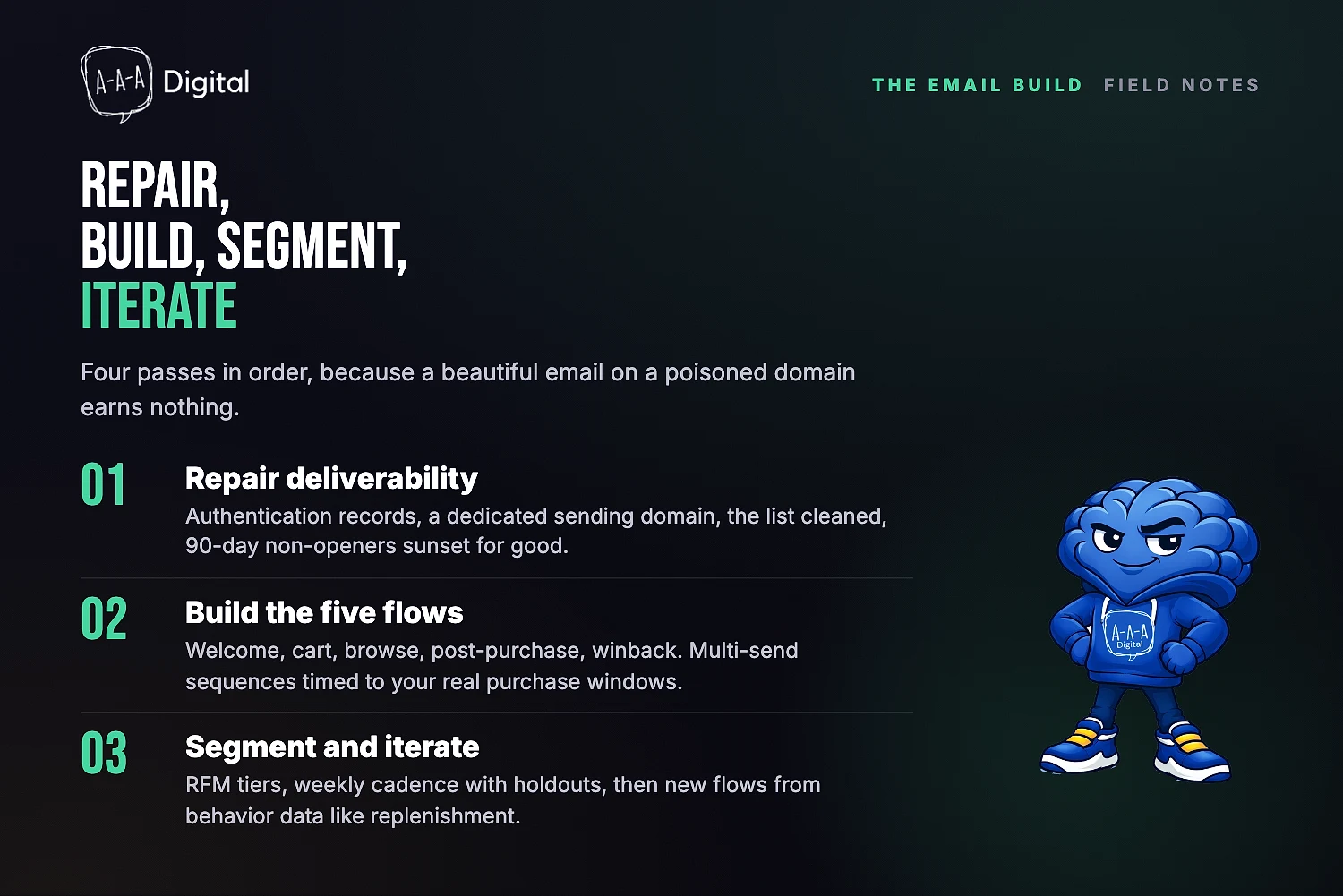
Welcome, abandoned cart, browse abandonment, post-purchase, and winback. Multi-send sequences timed to your real purchase windows, with dynamic product pulls and discount logic that does not train buyers to wait for coupons. The money is in sends two and three, not the first reminder.
RFM segmentation
Recency, frequency, monetary tiers rebuilt monthly from your Shopify orders. VIPs get early access, at-risk customers get a reason to return, churned segments get sunset or a winback, and one-time buyers get a deliberate path to order two. Every tier gets its own cadence and offer ceiling.
Campaign cadence that does not burn the list
A weekly calendar coordinated with product drops and paid campaigns, offer rotation so margins survive the month, and holdout groups on every send so you know what email caused and what would have happened anyway.
Deliverability as a workstream
SPF, DKIM, and DMARC set correctly, a dedicated sending domain, list cleaning, sunset policies for 90-day non-openers, and seed testing before big sends. The goal is the primary tab, because a 60% open rate in Promotions is worth less than a 40% open rate next to the emails buyers actually read.
Revenue attribution that survives an audit
Klaviyo attribution reconciled against GA4, reported per flow and per campaign with holdout deltas. You will know what email earned, what it assisted, and what it merely claimed credit for.
Retention measurement
Repeat purchase rate, time to second order, and LTV by cohort, reviewed monthly against the segments that receive email and holdout groups that do not. Email is judged on what it changes in buyer behavior, not on how much of it gets sent.
Results that speak for themselves
Every figure below comes out of the client's own analytics, not a slide.
31%
Typical email share of store revenue at maturity
38%
Typical cart recovery with a four-send abandoned cart flow
42x
Typical ROI on email program spend
+26%
Typical lift in repeat purchase rate within two quarters
How it works
Audit and deliverability repair
We audit flows, list health, authentication records, and sending domains, then clean the list and sunset the dead weight. Nothing scales on a poisoned sender reputation.
Flow build
The five core flows get written, designed, and QA'd across clients and inbox providers, then switched on in order of revenue impact: cart first, welcome second.
Segmentation and cadence
RFM tiers go live, the weekly campaign calendar starts, and holdout groups begin measuring what email actually causes.
Iterate weekly
Revenue per recipient decides what stays. Behavior data feeds new flows like replenishment and back-in-stock, and the cadence tightens around what buyers respond to.
Related services
Grow your store with our other Shopify services
Content & Email
Email sequences that recover abandoned carts, content that ranks and converts, and nurture campaigns that turn subscribe…
Explore our content & email servicesShopify CRO
Research first, then tests. We find where your store loses ready-to-buy visitors, size the revenue at stake, and run the…
Explore our shopify cro servicesPerformance Marketing
Google Ads management, Meta, LinkedIn. We build paid campaigns optimized for ROAS, not impressions. Every dollar tracked…
Explore our performance marketing servicesShopify SEO
Organic search should be your most profitable channel. We make it one: technical fixes, collection architecture, content…
Explore our shopify seo servicesFrequently asked questions
Klaviyo, for ecommerce almost without exception. It is Shopify-native, segments on real-time store behavior, prices by list size rather than send volume, and attributes revenue well enough to manage against. We will maintain other ESPs on request, but new builds go on Klaviyo because the alternatives charge more for less store data. If you already pay for Klaviyo and it is underperforming, the problem is almost never the tool. It is the missing flows and unsegmented list inside it.
Find out what your list should be earning
Book a free email audit. We will score your flows, segmentation, and deliverability, then show you the revenue gap in numbers.
Book My Free Strategy CallNo commitment. No sales pitch. Just pure strategy.