We've rebuilt more than 200 Shopify stores, and roughly a third of them came to us after another agency did the damage. Bad migrations. Broken checkouts. Themes held together with duct-tape JavaScript that broke the moment Shopify pushed an update. Every one of those store owners told us the same thing: "I didn't know what questions to ask."
That's the real problem. Choosing a Shopify agency isn't hard because the good ones are hiding. It's hard because every agency's website says the same thing. "Results-driven." "Full-service." "Proven track record." None of it means anything without evidence.
This is the checklist we wish every merchant ran before signing a contract, including the one they'd use on us. Work through it, and you'll filter out 80% of the bad fits in the first call. And if you want a shortcut, our Shopify development team works through this exact evaluation process with every prospect, because we know it cuts both ways.
The Quick Answer: How to Choose a Shopify Agency
Here's the short version, then we'll get into each point.
- Verify they're an actual Shopify Partner or Shopify Plus Partner (check the partner directory, don't take their word for it)
- Ask for live store URLs they've built, then check those stores' PageSpeed scores yourself
- Demand a written scope with milestones and payment tied to delivery, not dates
- Talk to a past client, not just the case study
- Ask who specifically will work on your store, and meet them
- Walk away from anyone who quotes after a 15-minute call
If an agency fails more than one of these, keep looking. The details matter, though, so let's get into why.
Red Flag #1: They Can't Prove Shopify Partner Status
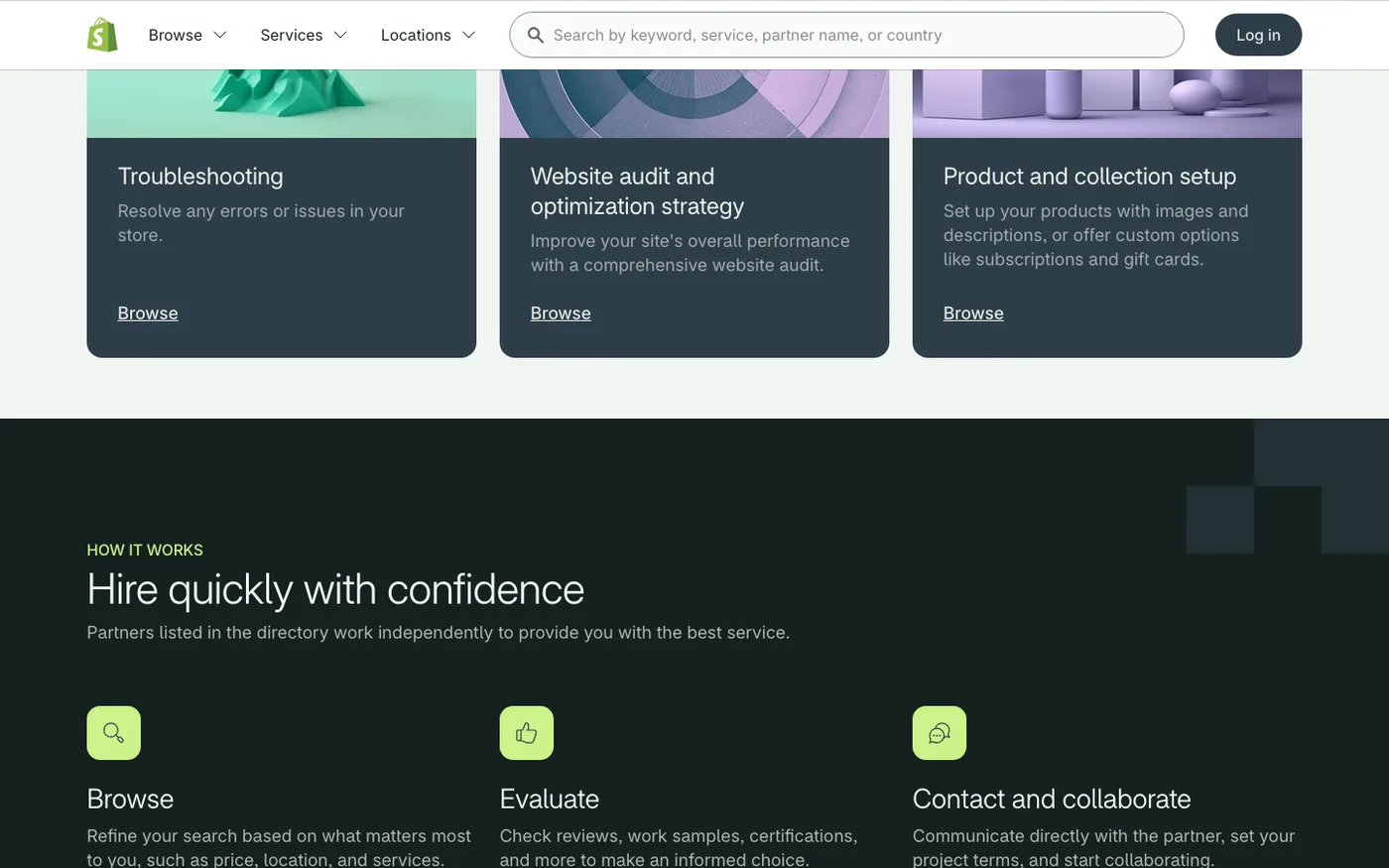
Shopify runs an official Partner program, and the Plus tier is harder to earn. It requires a track record of Plus builds and certified staff. Any agency claiming deep Shopify expertise should show up in Shopify's partner directory. This takes 30 seconds to verify. Do it.
We hold both Partner and Plus Partner status, and it's not a vanity badge. It's how we get early access to platform changes, direct support escalation when a client's checkout breaks at 2 AM, and Plus-specific tooling. An agency without partner status is working with one hand tied behind its back, and it'll be your store that feels it.
Red Flag #2: A Portfolio of Mockups, Not Live Stores
Every agency has a Behance page full of beautiful screenshots. Screenshots don't matter. Live stores matter, because a design that loads in 6 seconds and throws console errors is a liability, not a portfolio piece.
When they send you store URLs, don't just admire the homepage. Open PageSpeed Insights on three of them. Check the mobile score. That's what your customers experience. Then open the store on your phone and try to buy something. Count how many taps it takes. If the agency's own portfolio stores feel slow or clunky, that's your store's future.
Ask what they did on each store, too. "We designed this" and "we built and still maintain this" are very different claims. We've taken over stores where the "agency-built" store was actually a lightly modified premium theme, which is fine if that's what you paid for, but it should never be presented as custom work.
Red Flag #3: Quotes Without Discovery
No honest agency can price your project after one call. A real estimate requires looking at your current store or your requirements doc, checking your app stack, understanding your SKU structure, and asking about integrations. Our discovery calls typically take 45–60 minutes and we still sometimes find surprises mid-project.
If someone quotes you $4,000 for "a full store rebuild" before seeing a single thing, one of two things is true. Either the number is fictional and will triple once the contract is signed, or the "rebuild" is installing a theme and uploading your logo. We've audited enough stores to know how that second story ends: you pay us later to untangle it.
Red Flag #4: No Written Scope, No Milestones
The scope document is the single most important artifact in the entire engagement. It should list every deliverable, every revision round, every third-party cost, and exactly what "done" means for each item. "Optimize the store" is not a deliverable. "Reduce LCP below 2.5s on the top 20 collection pages, verified in PageSpeed Insights" is.
Payment structure tells you everything about an agency's confidence. The standard is 30–50% upfront, with the rest tied to milestones. If someone demands 100% upfront, run. If someone asks for nothing upfront, be careful too. It usually means they're planning to make their money somewhere opaque, like marking up app subscriptions or padding "maintenance" hours.
One thing clients rarely think to check: who owns the code and accounts when the engagement ends? Your Shopify store, your apps, your Klaviyo account, your Google Search Console property. All of it should be registered under accounts you control. We've inherited stores where the previous agency owned the domain. Don't let that be you.
Red Flag #5: You Never Meet the Actual Team
This is the trick agencies pull most often, and it works. You have three great calls with a polished sales lead or the founder. You sign. Then your project gets handed to a junior developer you've never spoken to, and the founder vanishes until the invoice.
Ask directly: "Who will do the actual work on my store, and can I meet them before signing?" A good agency says yes immediately. At ours, the people on your discovery call are the people who build yours. Our team is remote-first and spread across time zones, and every client knows their developer by name within the first week.
Also ask about support after launch. "What happens if something breaks three months from now?" Vague answers here predict ghosting later.
Red Flag #6: They Sell SEO and CRO as Magic
Every agency now claims "SEO and CRO" on their services page. Most of it is installing an app and calling it optimization. Real SEO work on Shopify means handling canonicalization on filtered collection pages, fixing duplicate content from variant URLs, configuring the Shopify Search & Discovery app properly, setting up Google Search Console and actually reading it, and restructuring collection architecture. Real CRO means structured A/B testing and heatmap analysis, not "we made the button bigger."
Ask a candidate agency to explain their last CRO win in detail. What did they test, what was the sample size, what did the data say? If they can't walk you through one concrete experiment, their "CRO service" is a line item, not a capability.
The Green Flags: What a Good Agency Looks Like
Red flags tell you who to avoid. Green flags tell you who'll actually be good. The strongest signal, in our experience, is honest disagreement. An agency that pushes back on your idea, respectfully and with reasoning, cares about your outcome more than your signature. We've lost deals by telling merchants their planned $30,000 headless rebuild was a $3,000 theme fix. Those merchants come back when they're actually ready.
Other green flags: they ask about your unit economics before recommending apps. They mention maintenance unprompted. They show you a realistic timeline that includes a QA phase, because a build with no QA buffer isn't a plan, it's a hope. And they can explain technical decisions in plain language. If you leave a call more confused than you started, communication will be a problem for the entire engagement.
A Quick Vetting Script for Your First Call
Use these questions verbatim. The answers matter less than how they're answered.
- "Show me three live stores you've built in the last year." (Live URLs, not screenshots.)
- "What's your discovery process before you quote?" (There has to be one.)
- "Who exactly works on my project, and can I talk to them?" (No handoffs to mystery staff.)
- "What breaks most often after a build like mine, and how do you handle it?" (Honesty about failure modes is a green flag.)
- "What do you need from me to hit the timeline?" (Good agencies know client delays kill projects.)
The pattern to watch for: specifics. Specific stores, specific processes, specific people. Vague confidence is cheap. Specifics cost an agency years of real work, and they can't be faked for long.
Frequently Asked Questions
Should I hire a Shopify agency or a freelancer?
For a well-defined small task (a theme tweak, an app setup, a bug fix), a vetted freelancer is often the right call and will cost a fraction of an agency's minimum. For builds, migrations, and anything touching your checkout, SEO, or conversion rate, go with an agency. You need process, QA, and accountability that a single person can't provide. We broke down the full cost math in our Shopify agency vs freelancer comparison, and the honest answer is it depends on scope and risk.
What should I budget for a Shopify agency?
In 2026, expect roughly $3,000–$10,000 for a full theme build, $5,000–$15,000 for a migration, and $2,500–$6,000/month for ongoing retainers. Enterprise and Plus work runs higher. Anyone quoting dramatically below these ranges is cutting corners somewhere, usually in QA, which is the invisible part you'll pay for later.
Is Shopify Plus Partner status actually important?
For Plus stores, yes. Plus builds involve checkout customization, higher API limits, and enterprise integrations that standard Partner agencies rarely touch. If you're on Plus or planning to be, Plus Partner status is a reasonable proxy for having done it before. For a standard store on Basic or Advanced, regular Partner status plus a strong portfolio is enough.
How long does a Shopify agency build take?
A custom theme build typically runs 6–10 weeks including design, development, content migration, and QA. Migrations take 4–8 weeks depending on SKU count and data cleanliness. If an agency promises a full custom build in two weeks, either it's a modified premium theme (fine, if priced accordingly) or they're skipping QA. Ask which.
What questions should I ask references?
Skip "were they good?" Everyone says yes. Instead ask: "What surprised you during the project?" and "If you did it again, what would you do differently?" These surface the real friction. Also ask whether the store is still running the code the agency built, two years on. That's the truest quality test there is.
Get Help With This
If you'd rather skip the vetting gauntlet, our Shopify experts will audit your store, give you an honest scope (including telling you when the fix is smaller than you think), and build it with the same team you meet on day one. No handoffs, no mystery invoices.
