
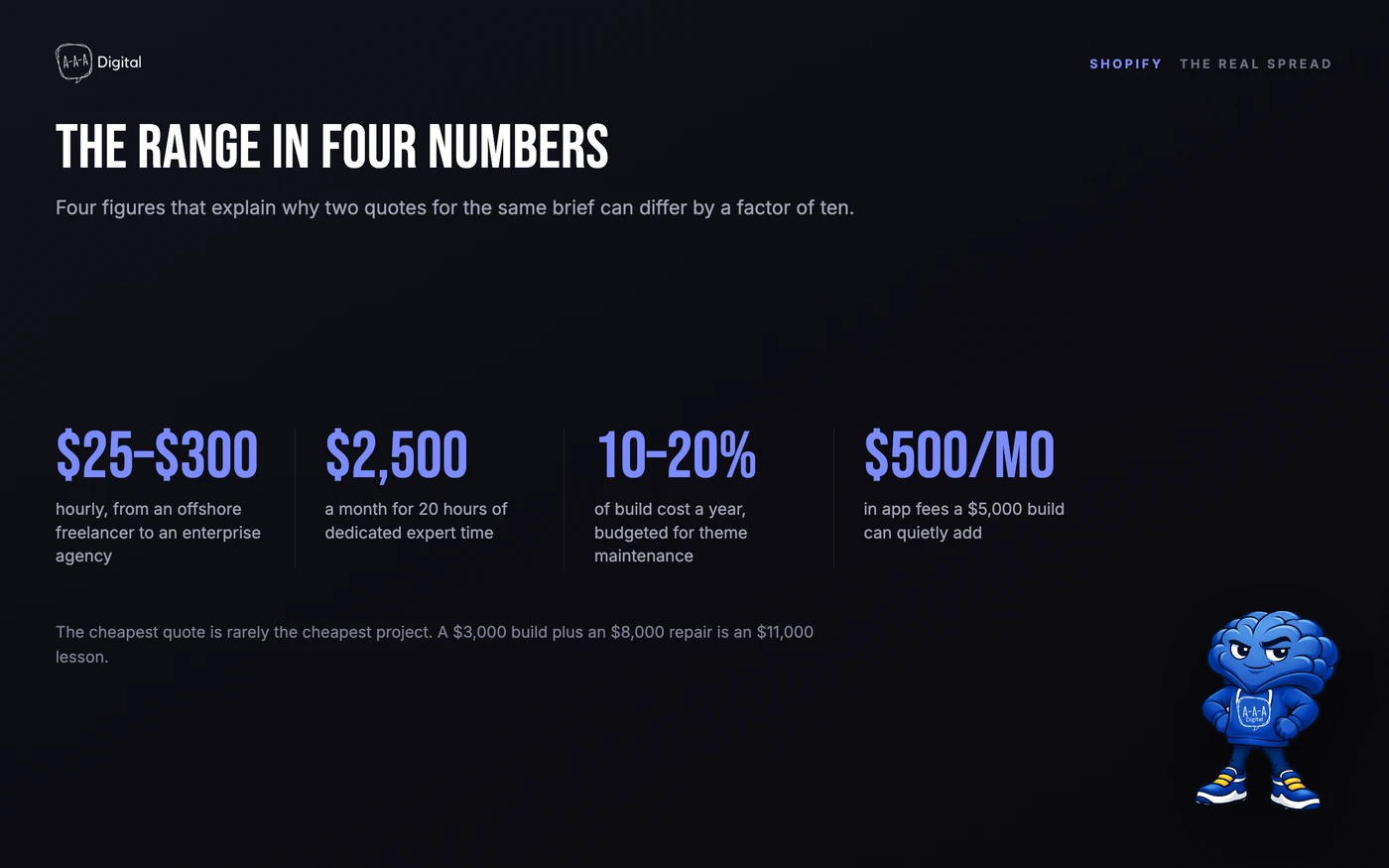
A Shopify expert costs $100 an hour at the task level, $2,500 a month on a retainer for 20 hours of senior time, and $8,000 and up for a custom theme. The spread between the cheapest quote you will get and the most expensive is roughly 40x, and the price almost never tells you which one will fix your store.
That 40x gap is why this question is hard to answer in one line. Below is what each tier actually charges, what moves the number, and how to tell whether a quote is cheap or just small.
The short answer
| What you need | Typical price | Who does it |
|---|---|---|
| One scoped task, a few hours | $150 to $600 | Freelancer or agency on demand |
| App setup, small section build | $400 to $2,000 | Freelancer or boutique agency |
| Theme customisation | $3,000 to $10,000 | Boutique agency |
| Custom theme from scratch | $8,000 to $25,000 | Agency with a design team |
| Migration, under 500 products | $2,000 to $5,000 | Specialist agency |
| Migration, 5,000+ products | $15,000 to $50,000 | Specialist agency |
| Monthly retainer, 20 hours | $2,500 to $6,000 | Agency |
| Shopify Plus build | $25,000 to $200,000 | Plus Partner agency |
| Headless storefront | $25,000 to $100,000+ | Plus Partner with Hydrogen experience |
Two things about that table. The ranges are wide because scope is what drives price, not seniority. And the cheapest column is where most of the expensive mistakes start.
Why the quotes vary so much
Three factors explain nearly all of it.
What the person can actually do. A Liquid developer who can read a theme's object model and debug a broken cart is a different purchase from someone who edits CSS in the theme editor. Both call themselves Shopify experts. Only one can fix a checkout that breaks on a Wednesday.
Who carries the risk. A freelancer carries almost none. If they disappear mid-project you have a half-finished theme and no recourse. An agency carries delivery risk, which is why it costs more and why it will sometimes refuse the job.
How much discovery happened first. A quote given on a 15-minute call is a guess with a number attached. A quote given after someone has read your theme code, your app stack, and your analytics is a commitment. You are paying for the difference.
The four ways to hire
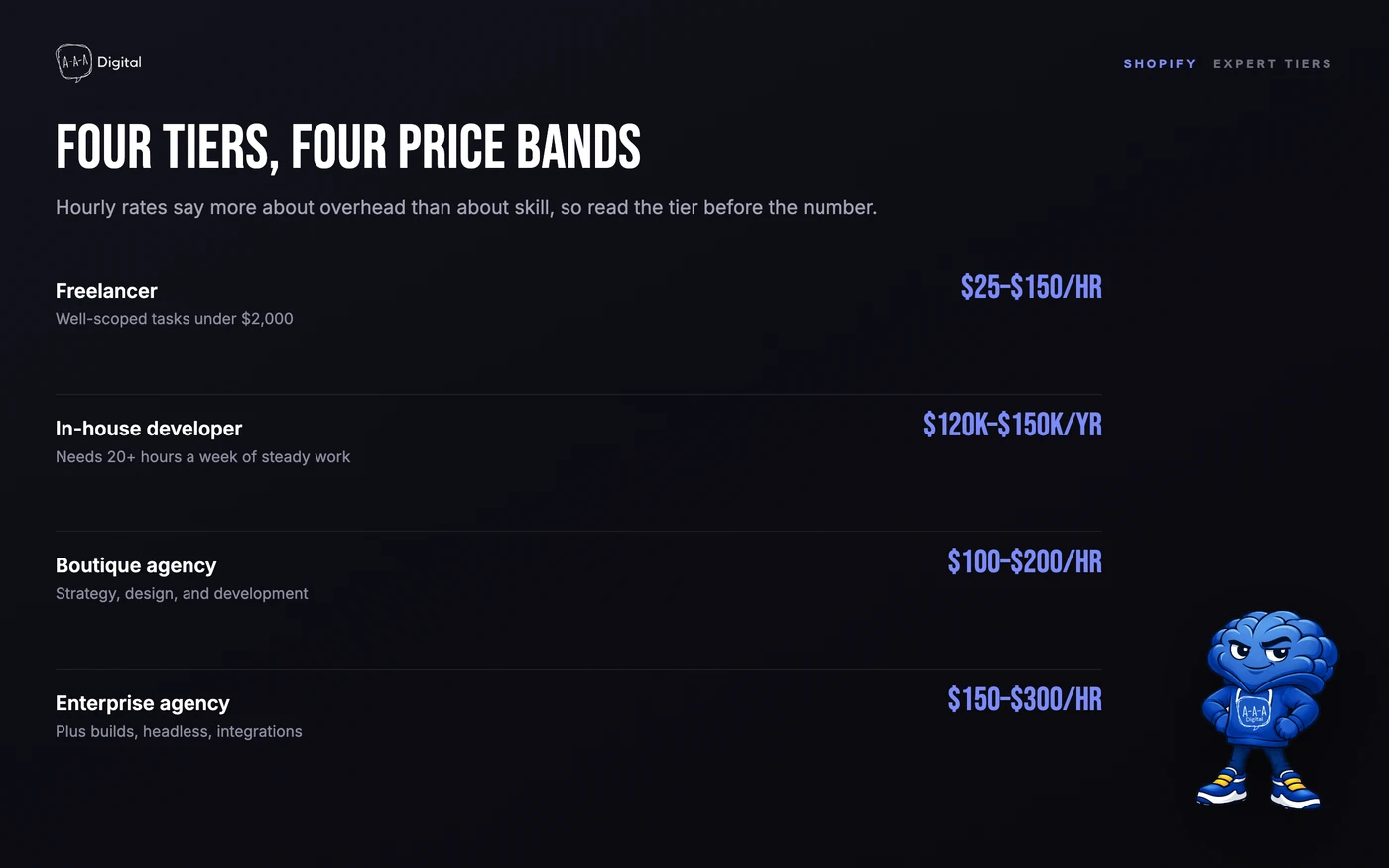
Freelancers, $25 to $150 an hour
Best for one clearly defined task where you already know the answer and just need hands.
Rates cluster by region. North America and Western Europe run $75 to $150 an hour. Eastern Europe and Latin America run $40 to $80. South Asia runs $25 to $50. The rate reflects the market, not the skill, which is why a $40 developer can outperform a $150 one who learned Shopify last quarter.
The failure mode is not quality, it is continuity. A freelancer who vanishes in week three leaves you with a theme nobody else can read.
In-house, $60,000 to $120,000 a year
Best for a brand doing $5M or more with a constant queue of development work.
A US-based Shopify developer costs $80,000 to $120,000 in salary. Benefits, recruitment, and training push the all-in figure to roughly $120,000 to $150,000. In Eastern Europe or Latin America, $40,000 to $60,000 covers the same role.
You get someone who lives in your codebase and answers on Slack in four minutes. You also get a single point of failure, and a hiring process that takes three months.
Boutique agencies, $100 to $200 an hour
Best for work that needs design, development, and strategy at once, which is most of it.
Agencies in the 2 to 10 person range charge $100 to $200 an hour, or $3,000 to $8,000 a month on retainer. The premium buys process: a scope document, a QA pass, someone who notices the mobile checkout is broken before you do, and a named person who answers when it is not.
The failure mode here is a small agency that sells like a large one and staffs like a freelancer. Ask who specifically will do the work.
Enterprise and Plus partners, $150 to $300 an hour
Best for Shopify Plus, custom checkout, ERP integrations, and headless builds.
Firms with 50+ people and Plus Partner status charge $150 to $300 an hour, or $10,000 to $50,000 a month. A full Plus build runs $25,000 to $200,000.
You are buying insurance as much as code. At this level a failed launch costs more than the build.
Project pricing for common tasks
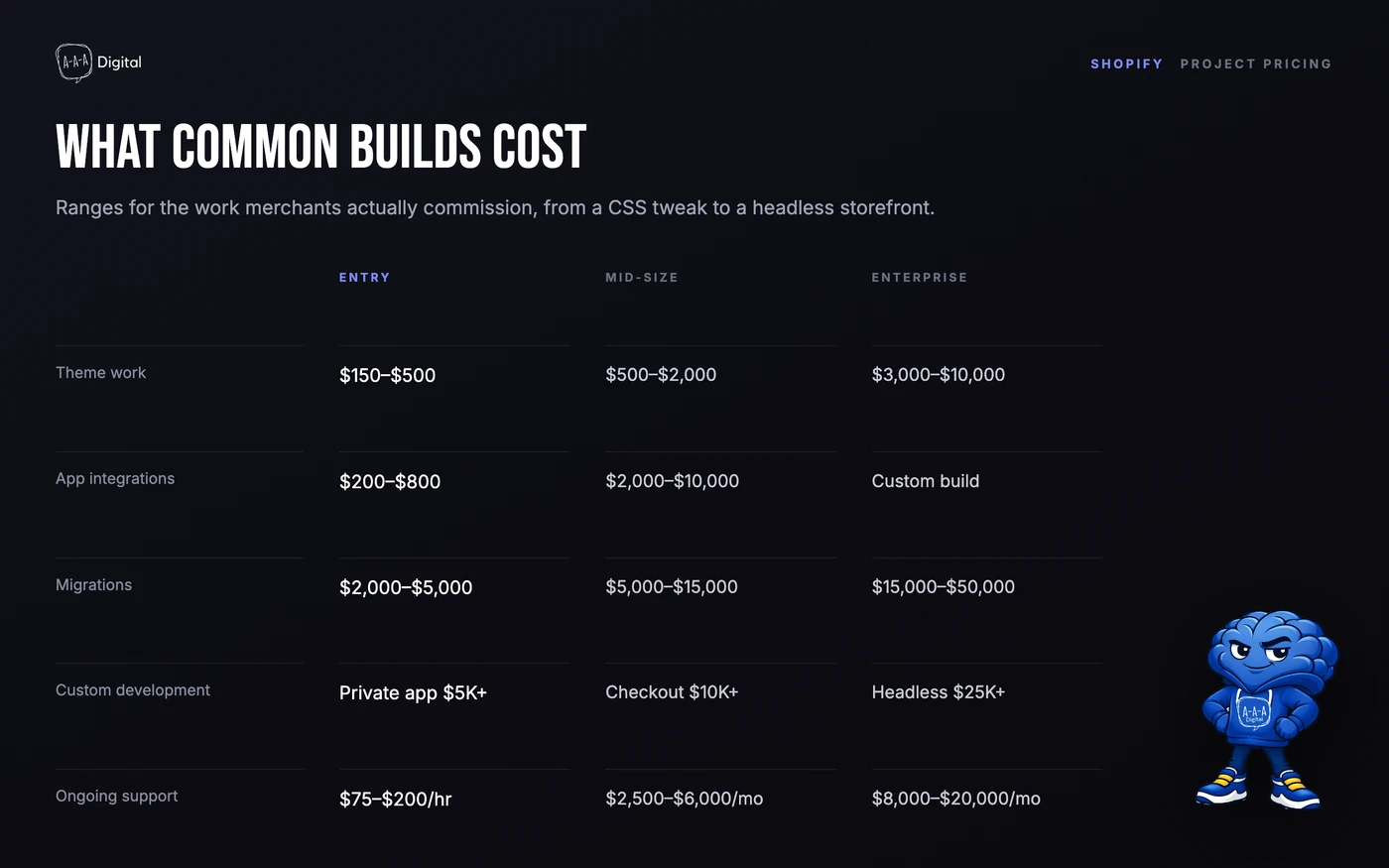
Theme customisation. Minor CSS work $150 to $500. A custom section $500 to $2,000. Full theme customisation $3,000 to $10,000.
App integrations. Klaviyo or a review app, $200 to $800. ERP or custom API work, $2,000 to $10,000.
Custom development. A private app $5,000 to $25,000. Custom checkout on Plus $10,000 to $50,000. A headless Hydrogen storefront $25,000 to $100,000.
Migration. Under 500 products, $2,000 to $5,000. Five hundred to five thousand products, $5,000 to $15,000. Above that, $15,000 to $50,000. We broke the line items down separately in what a Shopify migration costs.
Ongoing support. Ad hoc $75 to $200 an hour. A 20-hour retainer $2,500 to $6,000 a month. A dedicated 80-hour team $8,000 to $20,000 a month.
What actually moves the price
Four levers, in the order they matter.
Scope clarity. A fixed, written scope with screenshots turns a $20,000 estimate into a $12,000 one, because the agency is no longer pricing uncertainty. Vague briefs get padded.
Existing technical debt. Rebuilding a theme that three freelancers have already patched costs more than building on a clean one. If your theme has 40 unmerged code snippets, expect a surcharge and a conversation.
Integration count. Every third-party system that touches the store (ERP, 3PL, subscription billing, tax) adds a failure surface. A build with two integrations is a different project from one with six.
Deadline. A 12-week timeline is the standard quote. A four-week timeline costs 25% to 50% more, and it should. Anyone who says otherwise is planning to work nights and miss the date.
The costs that never appear in the proposal
Scope creep. "While you're in there" is how a $4,000 build becomes $9,000. Put the out-of-scope list in writing, with a rate for changes.
App subscriptions. A $5,000 build can add $300 to $800 a month in app fees. Ask what the build depends on before you sign, then add the subscriptions to your annual number.
Revisions. Some freelancers charge per round. Ask how many are included, and whether a change of mind counts as a revision.
Post-launch support. Who fixes a bug in week three? For how long, at what rate? Get a number, not a promise.
Theme maintenance. Custom code breaks when Shopify updates its theme framework or deprecates an API. Budget 10% to 20% of the build cost per year for maintenance, or the build quietly rots.
Choosing by budget
Under $1,000. One well-scoped task, one vetted freelancer, escrow, and a written deliverable. Do not attempt a build.
$1,000 to $5,000. An experienced freelancer or a small agency. You need judgement, not just execution. This is the band where agency versus freelancer is a real decision rather than a formality.
$5,000 to $25,000. A boutique agency with a Shopify specialism. You are buying QA, a scope document, and someone accountable for launch day.
$25,000 and up. A Shopify Plus Partner. See our breakdown of what Plus partners do differently before you shortlist.
Red flags in a quote
"I can do anything." Shopify is deep enough that specialists beat generalists. Someone who claims design, Liquid, CRO, paid media, and SEO at a high level is usually mediocre at four of them.
No live stores. Any portfolio should include URLs you can open, on a phone, and click through a checkout.
A quote with no discovery. If the number arrived before anyone read your theme, it is a guess.
No scope document. Verbal agreements produce disputes, and the dispute is always about money.
100% payment upfront. Standard is a deposit with milestone or completion payments. A full upfront ask is a warning.
Suspiciously cheap and offshore with no reviews. You might get lucky. The cleaner pattern we see is a $500 build followed by $8,000 of repair work.
The cost of hiring badly
This is the part nobody budgets for.
Suppose you pay $3,000 for a theme build that ships with a broken mobile checkout for a month. On a store doing $50,000 a month, with mobile at 70% of traffic and a checkout failure that costs even a quarter of mobile orders, you lose more than the build saved. Then you pay again to fix it.
The same arithmetic applies to speed. A theme that adds 1.5 seconds to mobile load costs conversion every day, for as long as it is live. A $2,000 saving on the build is not a saving if it costs 0.3 percentage points of conversion on $600,000 of annual revenue.
Cheap work is not the problem. Cheap work that nobody tested is.
What we charge
We publish this because price opacity is how the industry keeps its margins.
On-demand tasks. $100 an hour with a two-hour minimum, usually delivered in 24 to 48 hours. Theme tweaks, app setup, small fixes.
Monthly retainer. From $2,500 a month for 20 hours of dedicated expert time, with a named pod, a roadmap call, and priority Slack. The retainer is priced as a bundle, not as task hours multiplied out, which is why the effective rate is higher than the on-demand figure.
Projects. Fixed price after discovery. Custom themes from $8,000. Plus builds from $25,000. Migrations from $5,000.
We are not the cheapest option in any of the tables above, and we turn down work we think a $400 theme tweak would solve. If you want a quote rather than a number, talk to our Shopify expert team and we will scope it in writing.
FAQ
Is $100 an hour too much for Shopify work?
It sits at the top of the mid market, not the ceiling. US and UK agencies working on Plus stores run $150 to $300 an hour, and an in-house hire costs more once you count salary, benefits, and the months they spend learning your theme. What $100 buys here is a senior person inside a fixed scope with a written cap, not an open meter. When a quote lands well below it, ask who actually does the work and what happens when their first attempt misses.
Freelancer or agency, which is cheaper overall?
The freelancer is cheaper on the invoice almost every time. The agency is often cheaper in total once you count the second attempt, the lost conversion while it was broken, and the management time you spent chasing. Below roughly $2,000 of work the freelancer usually wins. Above $5,000 the difference tends to disappear.
How long does a Shopify project take?
A scoped task takes one to three days. A custom theme takes four to eight weeks from approved designs. A migration takes two to six weeks depending on catalogue size and how many systems touch the store. A Plus or headless build runs 8 to 12 weeks. Anyone promising a custom theme in a week is shipping a modified stock theme.
Do I pay for discovery?
Good agencies charge for it or fold it into the project, and either way it should produce a document: scope, exclusions, timeline, price, and what happens if the scope changes. A free discovery call is fine. Free discovery that produces a fixed price for a complex build is a guess wearing a suit.
What is a retainer actually for?
A retainer buys priority access and continuity, not a block of cheap hours. You are paying so that when checkout breaks on a Friday the person who fixes it already knows your theme. If your queue is predictable and small, pay per task instead.
Can I hire a Shopify expert for SEO or CRO only?
Yes, and you should, if that is the actual constraint. Development does not fix an organic traffic problem, and a theme rebuild rarely fixes conversion on its own. Our Shopify SEO and CRO engagements exist as separate scopes for that reason.
The bottom line
Expect to pay $150 to $600 for a scoped task, $3,000 to $15,000 for a mid-size project, $15,000 to $100,000 for a complex build, and $2,500 to $20,000 a month for ongoing support.
The right expert is not the cheapest or the most expensive. It is the one who tells you what you actually need, puts the scope in writing, and can show you a store they shipped that still works. A $10,000 build that lifts conversion by 20% pays for itself inside a quarter. A $2,000 build that breaks checkout costs more than either.
Need a Shopify expert for your store? Hire our Shopify team: on-demand tasks, monthly retainers, or full builds. Written quotes, clear timelines.
