
Your paid ads stop working the day you stop paying. Your SEO keeps working, and compounding, for years.
This is not marketing philosophy. It is math.
The True Cost of Customer Acquisition
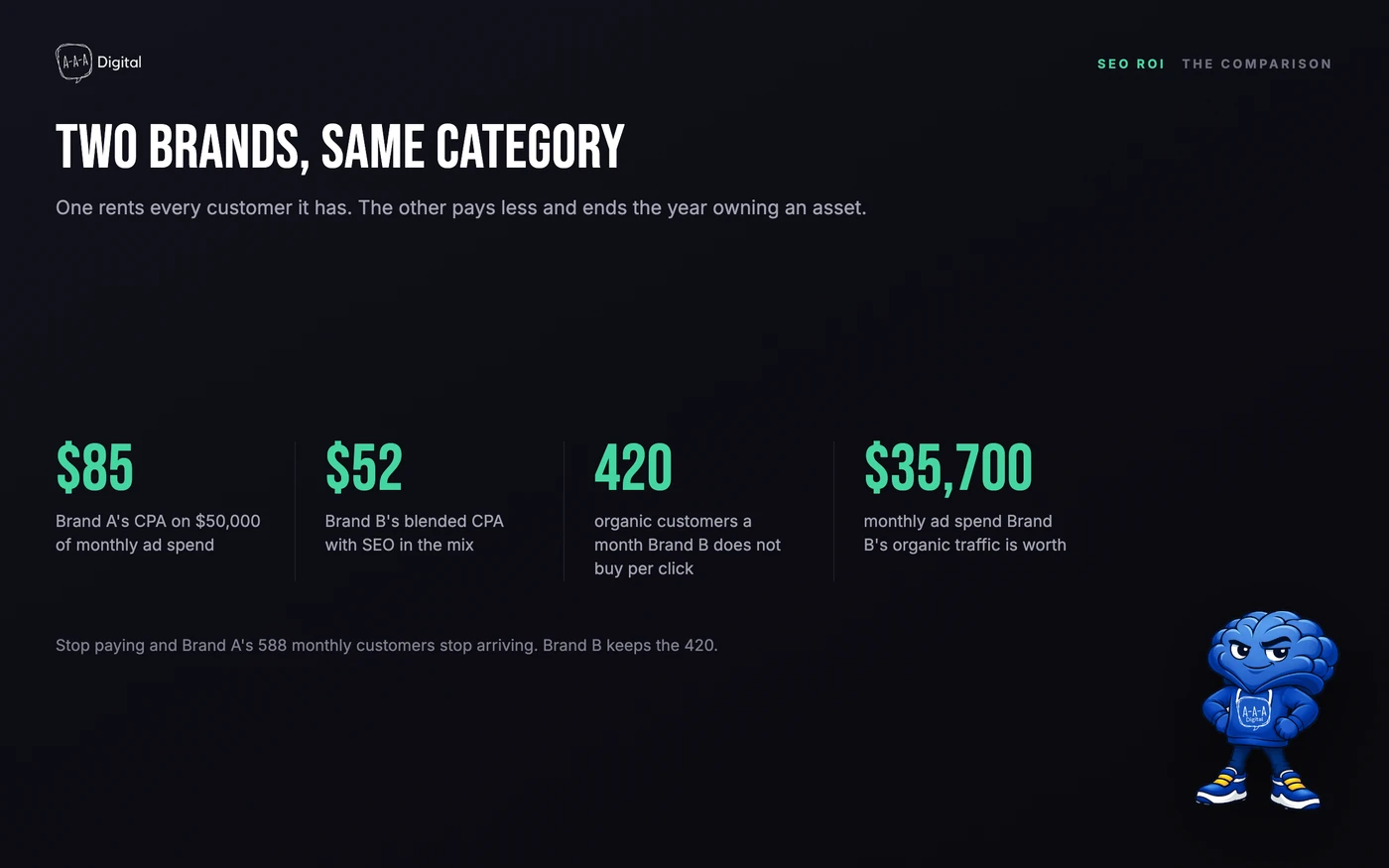
Let us compare two brands acquiring customers in the same category:
Brand A: Paid Ads Only
- Monthly ad spend: $50,000
- Average CPA: $85
- Customers per month: 588
- Cost if they stop spending: $50,000/month forever
Brand B: SEO + Paid Ads
- Monthly ad spend: $30,000
- SEO investment: $8,000/month
- Content production: $2,000/month
- Paid CPA: $85
- Organic customers per month (from SEO): 420
- Blended CPA: $52
- Organic traffic value equivalent: $35,700/month in ad spend
The $52 is $40,000 of total marketing cost divided by 773 customers: 353 paid at an $85 CPA plus 420 organic.
Brand B spends less, acquires more customers, and owns an asset that appreciates over time.
Why SEO Compounds and Ads Don't
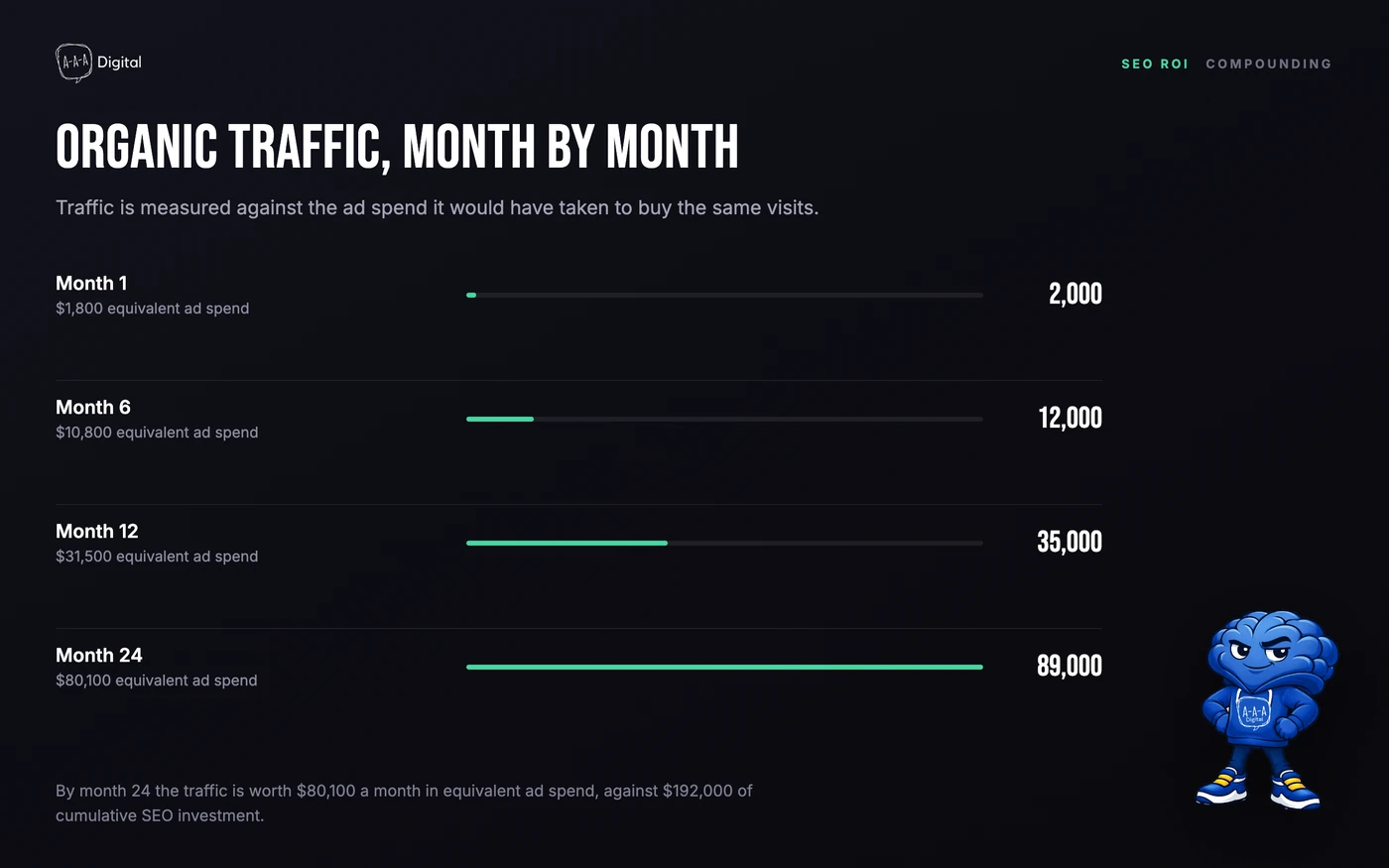
Every blog post, every optimised product page, every backlink is a permanent asset. Here is what that looks like in practice, at an equivalent ad cost of $0.90 per visit:
| Month | Organic Traffic | Equivalent Ad Spend | Cumulative SEO Investment |
|---|---|---|---|
| 1 | 2,000 | $1,800 | $8,000 |
| 6 | 12,000 | $10,800 | $48,000 |
| 12 | 35,000 | $31,500 | $96,000 |
| 24 | 89,000 | $80,100 | $192,000 |
The Payback Maths, Done Properly
Most SEO payback claims divide one month of traffic value by the entire cumulative investment. That flatters the channel badly.
Payback is the month where cumulative value passes cumulative cost. Run the table above on a straight line between the stated points and it looks like this:
| Month | Monthly cost | Cumulative cost | Monthly traffic value | Cumulative value | Net |
|---|---|---|---|---|---|
| 3 | $8,000 | $24,000 | $5,400 | $10,800 | -$13,200 |
| 6 | $8,000 | $48,000 | $10,800 | $37,800 | -$10,200 |
| 8 | $8,000 | $64,000 | $17,700 | $69,750 | +$5,750 |
| 12 | $8,000 | $96,000 | $31,500 | $175,050 | +$79,050 |
| 24 | $8,000 | $192,000 | $80,100 | $868,950 | +$676,950 |
Payback lands in month 8. By month 24 the cumulative return is about 4.5 times the investment. That is more believable than 2.4 months, which only works if the first seven months of spend did not happen.
There is a second honesty problem. Equivalent ad spend is what the traffic would have cost, not what it earned. If your organic conversion rate is 1.5% and paid is 2.5%, the traffic is worth less than the paid equivalent. Multiply by your own conversion rate and average order value before you call it revenue.
What the Same Budget Buys Three Different Ways
"SEO" is not a line item. It is four or five different services that happen to share a name, and they return very different amounts for the same money.
First Page Sage publishes ROAS and break-even figures from campaigns run between 2021 and 2025. Their service-type split is the most useful part:
| SEO service | ROAS | Time to break-even |
|---|---|---|
| Technical SEO (fixes, keyword research, title tags) | 1.35 | 6 months |
| Basic content (about 4 average articles a month) | 1.05 | 15 months |
| Thought leadership (6 to 8 strategic pages a month) | 9.10 | 9 months |
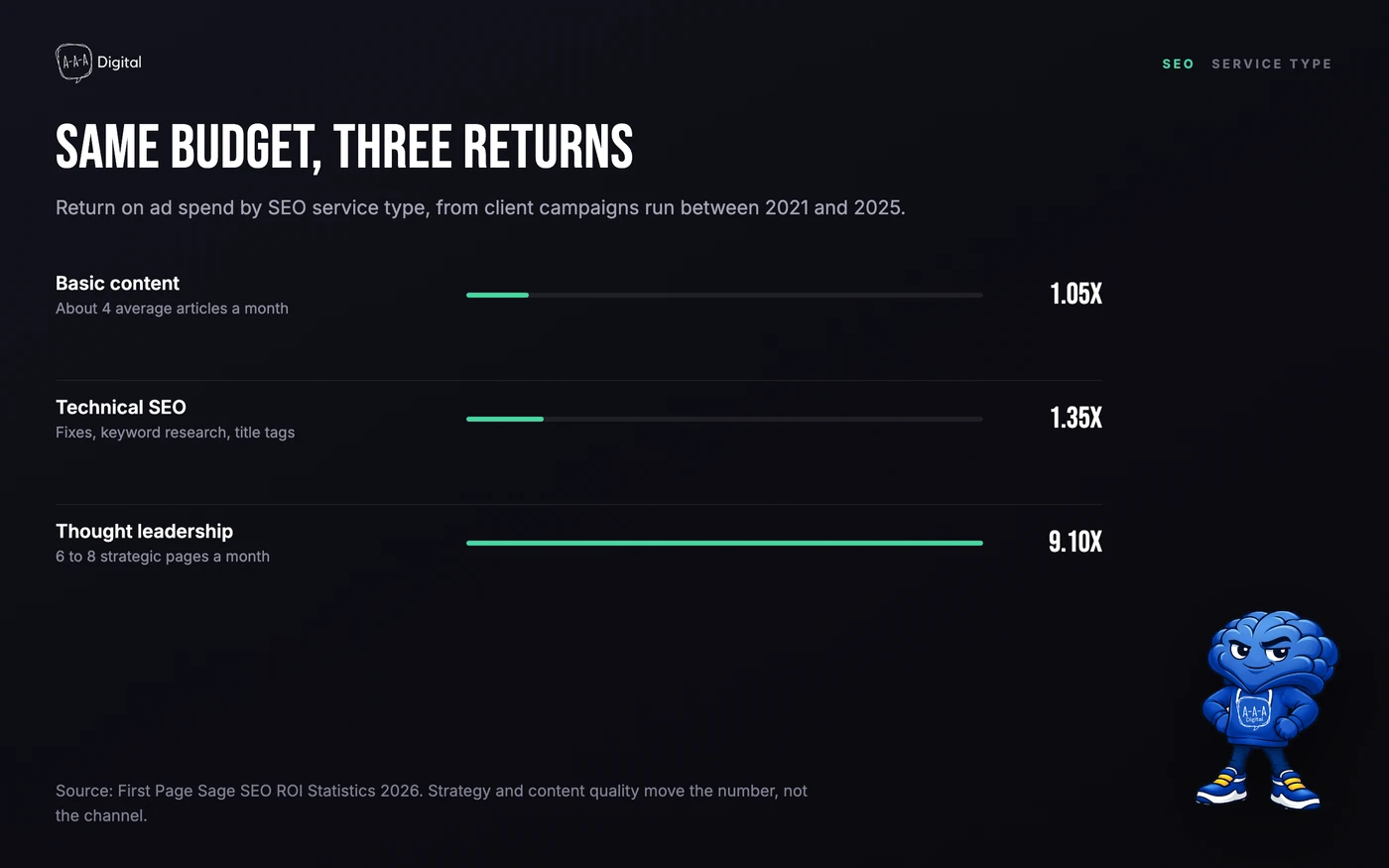
The same dataset puts ecommerce SEO at a 3.65 ROAS with a 9-month break-even, and B2B SaaS at 8.75 with a 7-month break-even.
Read that table before you approve a retainer. A basic content programme at 1.05 is a subscription to average articles that will never outrank anyone. The 9.10 comes from pages chosen by commercial value, organised into hubs, and written to answer a buyer's specific question.
This is where most SEO budgets leak. Paying for volume without keyword research that ranks by buying intent produces the 1.05 outcome.
When to Shift Budget from Ads to SEO
You should start investing in SEO when:
- Your paid CAC is rising month-over-month
- You have product-market fit and need sustainable growth
- Your competitors rank for keywords that should be yours
- You are spending $10,000+/month on ads with flat revenue
The fourth condition is the one that forces the decision. If paid is buying customers profitably, keep buying them. SEO is not morally superior to ads. It is a fixed cost that gets cheaper per customer as it matures, and that only matters if the variable cost is already painful.
The SEO Mistake That Costs Brands Millions
The biggest mistake we see: treating SEO as a content factory instead of a revenue channel. Random posts about "industry trends" do not drive revenue. Pages built around what a buyer types when they are ready to choose do.
Someone searching "SEO agency for Shopify stores" is not browsing. They are comparing. Our Shopify SEO checklist covers the technical fixes that decide whether those pages can rank at all.
When SEO Stops Compounding
Every SEO pitch shows a curve that goes up forever. Real curves flatten, and knowing where yours flattens is worth more than another 20 articles.
Three things stop the compounding.
You run out of commercial queries. If you already hold the top three results for every keyword that carries buying intent in your category, more content adds traffic and very little revenue. The marginal page earns a fraction of the first one.
Your pages start competing with each other. Two articles targeting the same query split the links and the rankings. Pruning and merging older posts often beats publishing new ones, and costs nothing in media.
The results page changes under you. Search Engine Land reported organic click-through drops of 15% to 64% on queries where Google shows an AI Overview. Gartner projected a 25% decline in traditional search volume by 2026 as assistants answer directly. Neither number is a forecast for your category, but both mean the visit is becoming a less reliable unit of value.
The practical response is to measure marginal return per page, not average return per channel. When the last ten pages you published earn less than the ten before them, stop publishing and put the budget into conversion. Our guide to building distribution that outlasts an ad budget covers where that money can go.
The 90-Day SEO Sprint
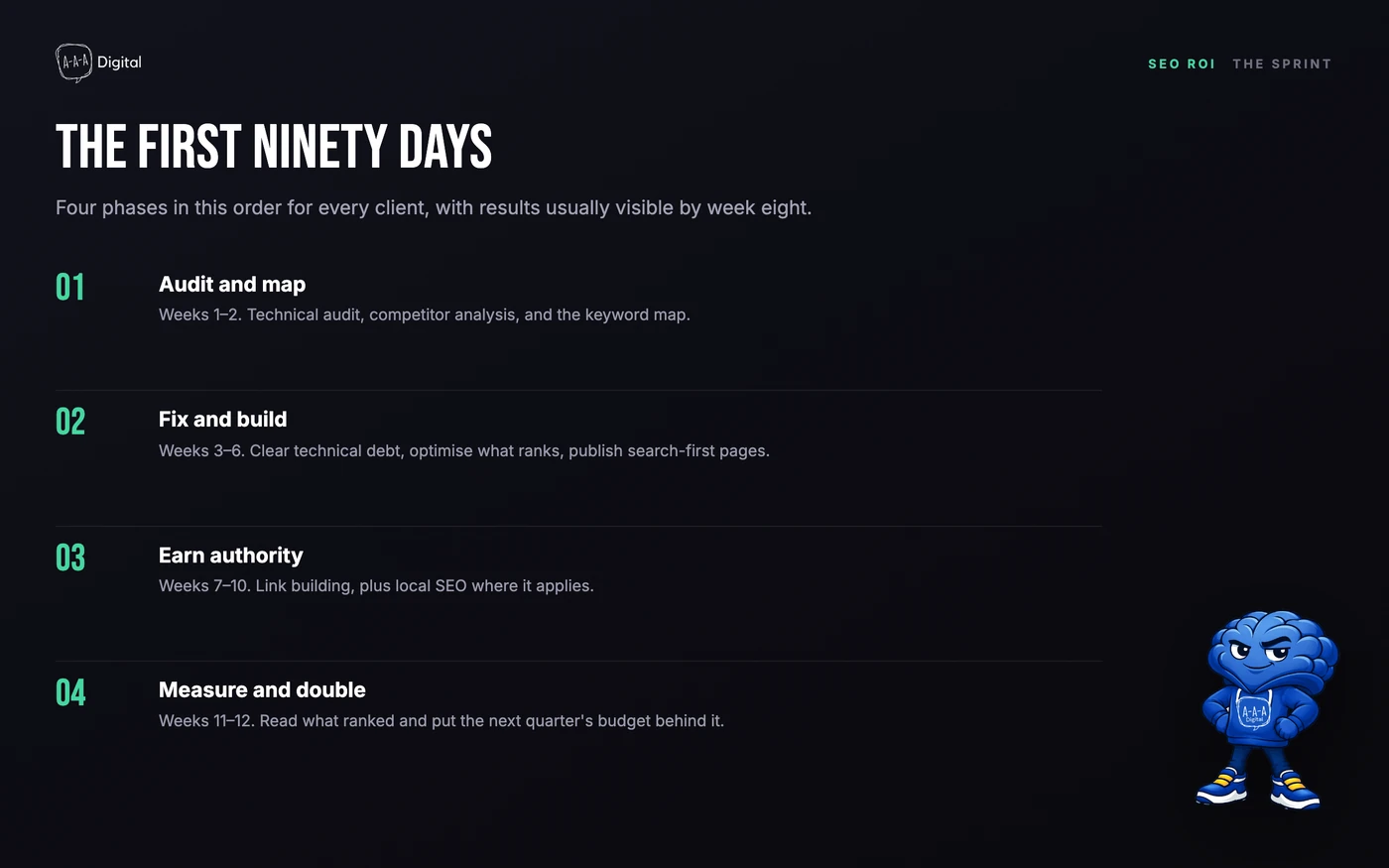
Here is what we execute in the first 90 days for every SEO client:
- Weeks 1 and 2: Technical audit, competitor analysis, keyword mapping
- Weeks 3 to 6: Fix technical debt, optimise existing pages, create search-first content
- Weeks 7 to 10: Authority link building, local SEO (if applicable)
- Weeks 11 and 12: Measure, iterate, double down on what's ranking
Most clients see measurable traffic increases by week 8. By month 6, organic becomes their lowest-CAC channel.
How to Take This to a CFO
A CFO does not need a traffic chart. They need three numbers and one assumption.
Customer acquisition cost by channel, last 90 days. Paid CAC is easy. Organic CAC is total organic spend divided by organic new customers, including content production.
Payback month. The month cumulative contribution passes cumulative spend. Eight months is a strong answer for ecommerce. Fifteen is a hard sell unless margins are high.
Marginal return on the next $10,000. What did the last $10,000 of SEO spend return, not the average since launch. Averages hide flat tails.
The assumption to state out loud is the ramp. Ask for a 12-month commitment, not a monthly decision, because a channel with an 8-month payback looks like a failure at month 3 if it is judged month to month.
When SEO Is the Wrong Investment
We turn down this work more often than you would expect. SEO is the wrong choice when:
- You have less than six months of runway. The payback month is real. If you need revenue this quarter, buy it.
- You have not found product-market fit. Ranking for a product nobody repeats is an expensive way to learn that.
- Nobody searches for your category. Check search volume before you check an agency.
- Nobody can publish. SEO needs pages shipped monthly. A team that takes six weeks to approve a title tag will not compound.
Frequently Asked Questions
How long does SEO take to pay for itself?
For ecommerce, plan on 8 to 9 months. The compounding table above breaks even in month 8, and First Page Sage's client data puts ecommerce at 9 months. Technical SEO can break even in 6, while thin content programmes often take 15.
Is SEO actually cheaper than paid ads?
Per customer at maturity, usually yes, because the cost is fixed and the customer count grows. Per month, no. Paid ads can be switched off and SEO cannot, which is why the comparison has to be made over 12 months and not over one invoice.
Can I do SEO without publishing a blog?
Yes. Product and collection pages usually carry the buying intent in ecommerce, and technical fixes alone return 1.35 in the dataset above. A blog is one way to capture research-stage demand, not a requirement.
What ROI should I expect in year one?
Lower than the steady-state number, because year one carries the ramp. Model month 12 and month 24 separately. Our guide to what Shopify SEO costs shows what each service tier buys before you commit to a number.
Ready to own your category on Google? Our Shopify SEO team will show you the pages worth building first, and a free SEO audit will tell you why the current ones are not ranking.
