Last quarter I cancelled eleven AI subscriptions across four client stores. Combined saving: $1,140 a month. Revenue impact since: nothing I can measure, in either direction.
That is the AI tools question in one audit. I run paid media for Shopify stores, so I watch what happens after the click, and the gap between the AI tools sellers pay for and the AI tools that move numbers is enormous. The generic lists rank forty tools by feature count. This one ranks them by the job each does for a store that has to make payroll: product photos, product copy, support, merchandising, email and SMS, pricing, and the small stack a one-person store can actually run.
Two ground rules before the list. First, every price below was checked this month (November 2026) and will drift, so verify before you budget. Second, a tool earns its place by surviving one test: if I cancelled it tomorrow, would revenue or working hours notice within thirty days?
AI product photography: paying for speed, not magic
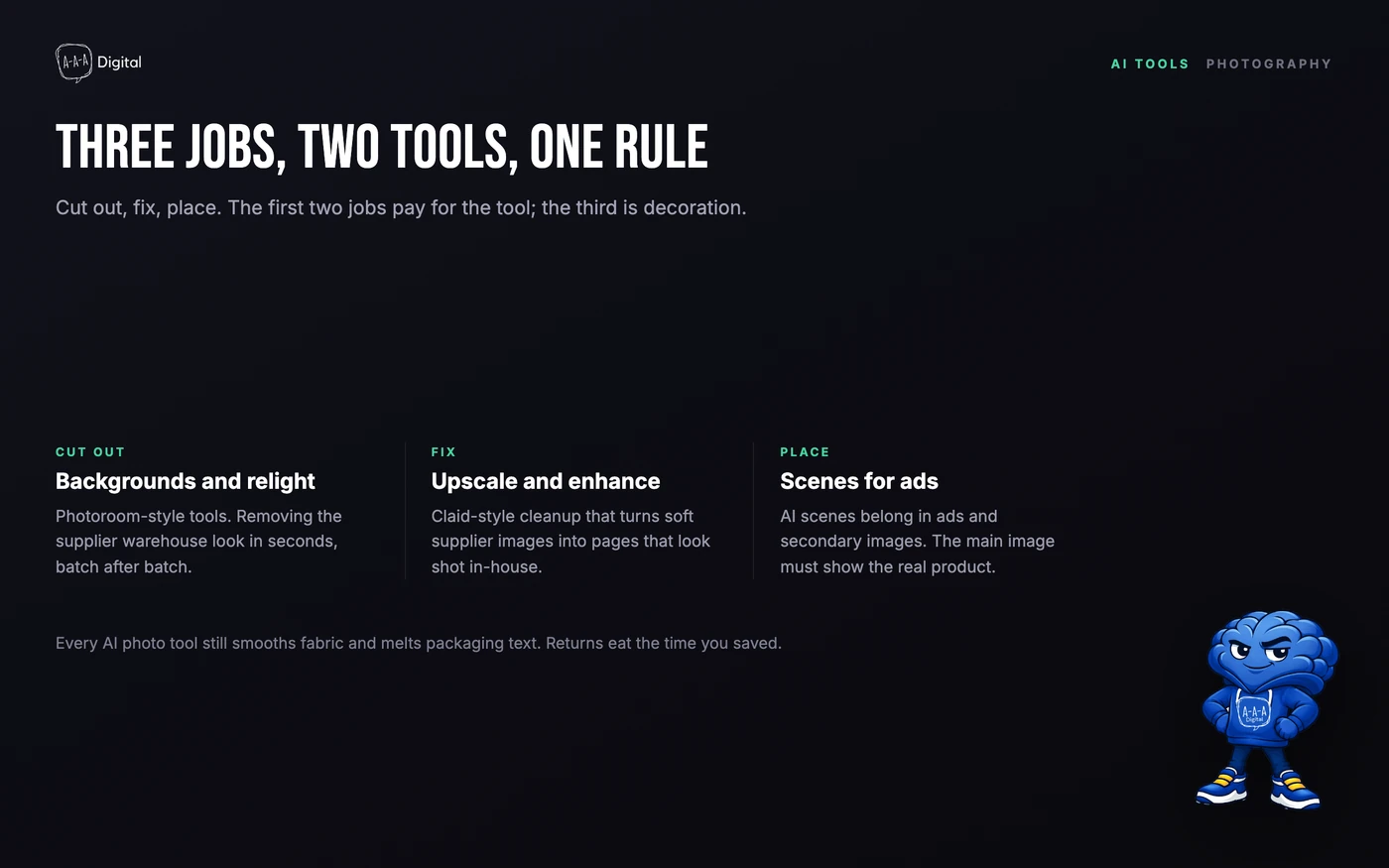
The job: supplier photos arrive dark, cropped wrong, shot on a warehouse floor. Before those images touch a product page or an ad, someone has to cut them out, fix them, and put them somewhere believable. That used to be a designer day per batch. Now it is minutes.
Photoroom is the tool I see do this most often, and for good reason. Pro runs about $13 a month, less billed annually, the free tier covers a hundred exports, and batch mode chews through a supplier drop while I am still writing the campaign brief. Claid.ai plays the same game at the pipeline end: enhancement, upscaling, and cleanup priced in credits, with entry plans around $15 a month. When a supplier sends soft, low-resolution images, Claid-style enhancement is the difference between a product page that looks shot in-house and one that looks scraped.
Where sellers overspend: AI scenes. Generated lifestyle backgrounds are fine for secondary images and ad creative, and I use them there constantly. The primary product image has to show the real item, accurately. Every AI photo tool still smooths fabric texture, melts text on packaging, and lies about jewelry reflections. Returns and marketplace disapprovals eat the time you saved.
AI product descriptions and SEO copy: the draft is free, the judgment is not
Every AI tool pitch says it writes product descriptions. Technically true. The question is what the description has to do.
Shopify's built-in AI, Sidekick and the Magic features included with your plan, writes a serviceable first paragraph from a spec sheet, and for a ten-product store that is genuinely all you need. ChatGPT Plus or a Claude subscription at around $20 a month covers the next tier: batch drafting, meta descriptions, alt text, email subject lines, and the ad variations I test every week. I still write every ad angle myself, because the angle is the strategy, and the tool cannot know which margin we are protecting this month. Jasper, at roughly $40 to $50 a month, only earns its price for teams that need one enforced brand voice across five writers. Solo sellers are paying for coordination they do not have.
Where AI copy hurts: fabricating specifications it was never given. Ask a model to improve a description and it will quietly invent materials, certifications, and performance claims. On a product page that is not a style problem; it is a refund and a possible chargeback. We covered the craft side in our guide to product page copywriting, and the same failure at store scale in what AI store builders actually produce.
On SEO: Google does not penalize AI-assisted copy; it ignores thin copy. A hundred stores prompting the same model get near-identical paragraphs, and none of them rank or get cited. What makes copy rank is choosing the right keyword, matching the searcher's intent, and adding facts competitors do not have. That judgment work is the job behind our AI SEO service, and no $20 subscription replaces it. The discovery half of the question, getting the store itself cited by AI answer engines, is a separate topic our AI search and AI Overviews breakdown covers properly.
AI support automation: close the boring tickets
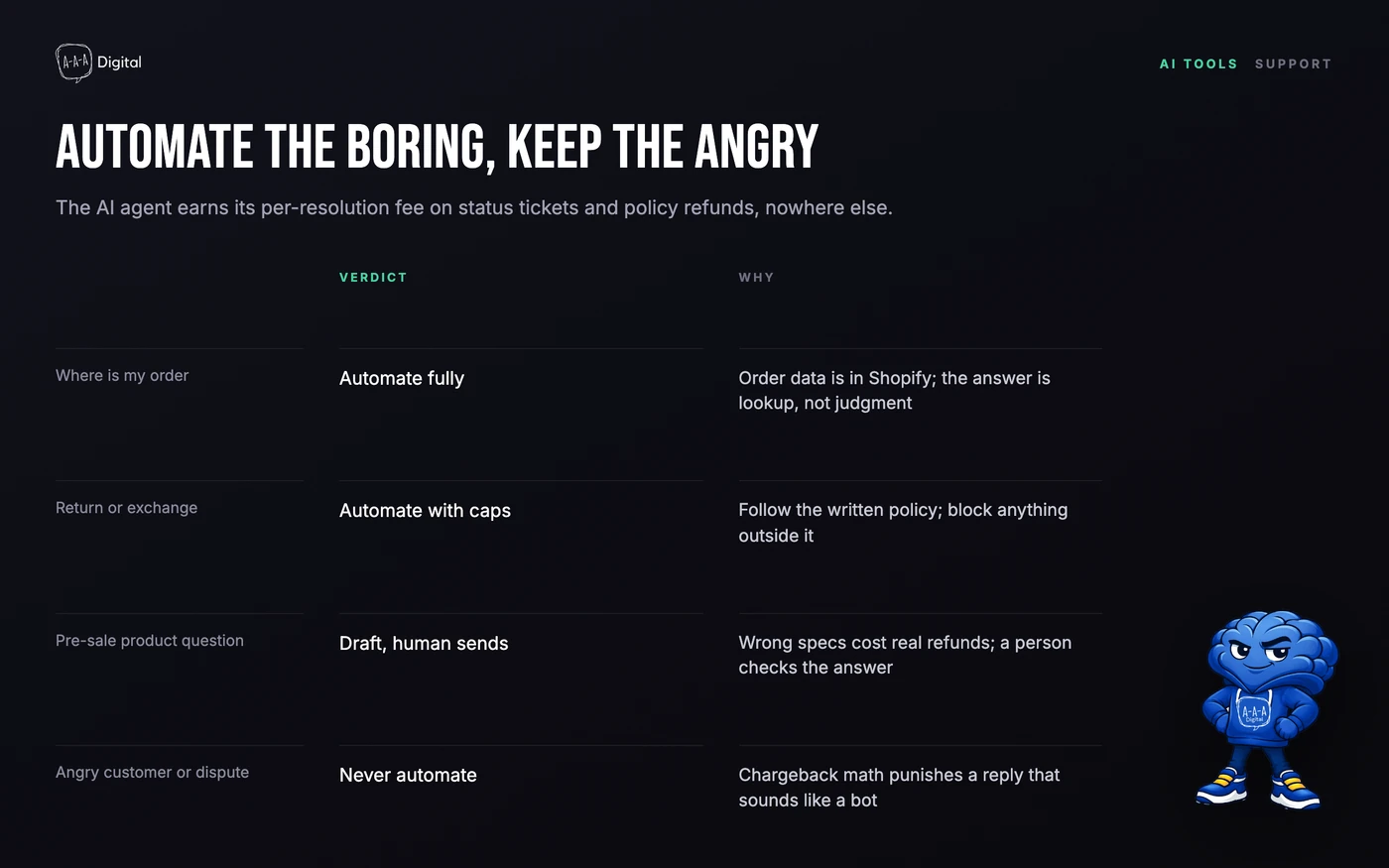
Support is where AI pays back fastest, because "where is my order" is lookup work, and lookup work is what machines are for.
Gorgias is the default for Shopify and the pricing is honest: plans from $10 a month, ticket bundles above that, and the AI Agent charged per automated resolution, around a dollar each once you pass the included allowance. The agent reads your Shopify order data, so it can answer a tracking question, start a return against your written policy, and process a refund under a cap you set. Zendesk and Intercom sell a similar per-resolution model if you are already on those desks.
The guardrails matter more than the tool. I would not let a chatbot process a refund above $50 without a human check, and I never let one touch an angry customer or a payment dispute, because chargeback math punishes a reply that sounds like a bot. Also check what the refund action actually does in your stack: some agents cancel the Shopify order but leave the 3PL shipment running, which is how a store ends up refunding an order that still ships.
Set expectations on deflection too. Vendors pitch 60 to 70 percent automation; on real stores I see 20 to 40 percent of tickets fully close without a person, and that is still a hire you did not make. The order I run for clients: helpdesk first, AI agent second, and macros for everything repetitive before you automate anything a customer can see.
AI merchandising and product recommendations
Recommendation engines are the oldest AI in ecommerce, and the most oversold to small stores. Rebuy, the app I install most, starts around $99 a month and personalizes upsells, the cart drawer, and post-purchase offers. Shopify's own Search and Discovery app does basic recommendations free.
The catch is sample size. AI merchandising needs behavior data, and a store doing 3,000 sessions a month does not have enough of it for the model to beat well-merchandised defaults. I tell clients under roughly $50 average order value, or under five figures of monthly traffic, to skip the app and fix the manual recommendations first: complete-the-look on the product page, bundle logic in the cart. Our Shopify product recommendations guide covers where the native setup ends and a paid engine starts.
AI email and SMS: Klaviyo's quiet features beat its loud ones
Klaviyo starts free to 250 active profiles and runs about $20 a month around 500, with one pricing quirk that bites: it counts unsubscribed profiles toward billing, so list hygiene is a money habit, not a deliverability habit.
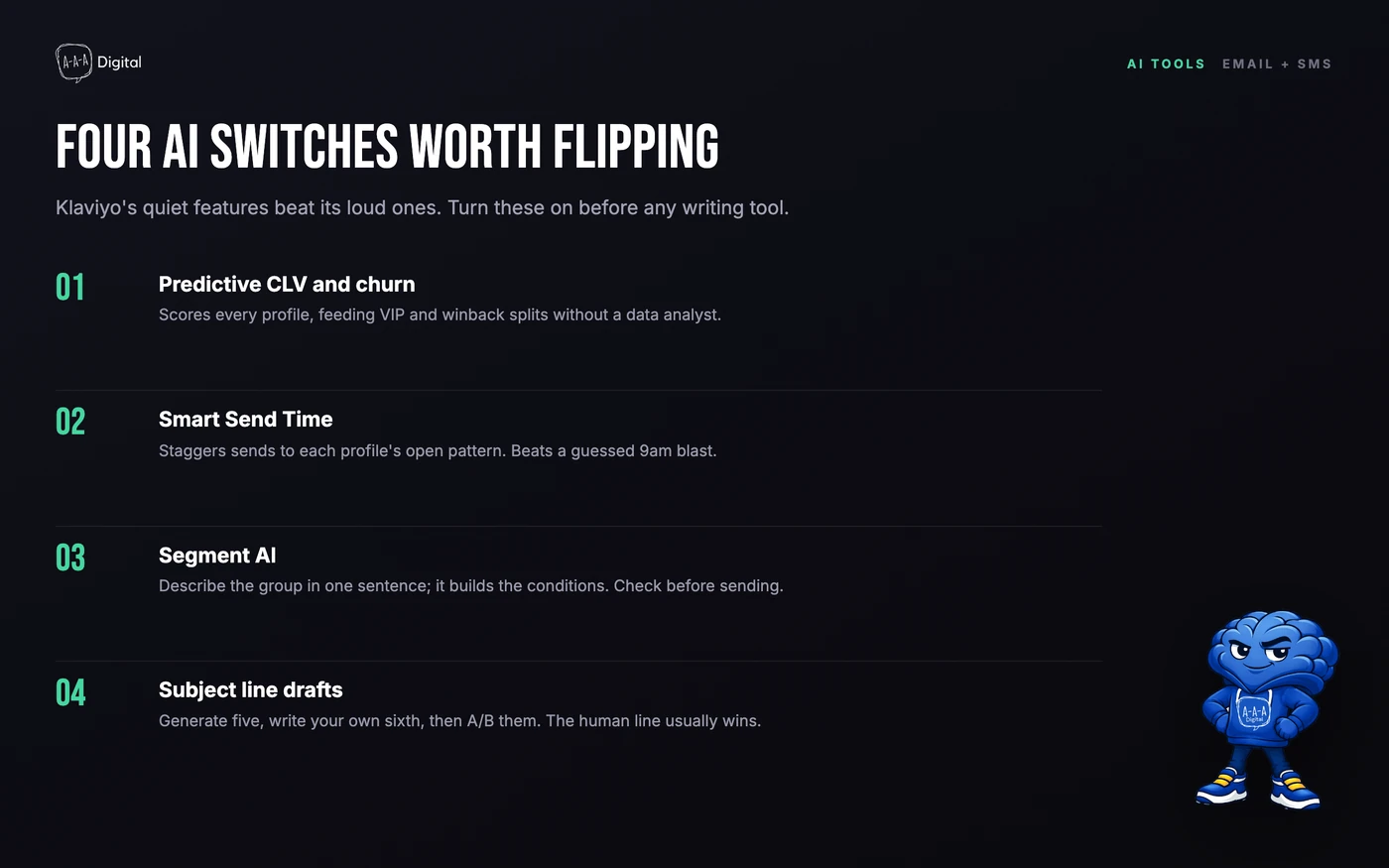
The AI features worth attention are not the copywriter. Three quiet ones do the revenue work. Predictive CLV and churn scores every profile, which feeds your VIP and winback splits without a data analyst. Smart Send Time staggers sends to each profile's open pattern, and it beats the guessed 9am blast in nearly every account I have tested it in. Segment AI builds a segment from a plain-language sentence, which saves the twenty minutes of clicking conditions nobody enjoys. The subject line and SMS generators are fine for five drafts; then write your own sixth. A human line with a specific number in it still wins my A/B tests most weeks.
For SMS at scale, Attentive's AI handles reply classification and quiet-hour send logic. Most stores under eight figures do not need it, and Klaviyo's combined email and SMS plan is the cheaper route. One rule across both channels: AI segments are a starting point. Look at the segment before you send to it. A "likely to churn" segment built by a model once mailed a discount to my happiest repeat buyers, and a 15 percent off code sent to a full-price loyalist is a real cost.
AI pricing and demand intelligence
Pricing intelligence is unfashionable and profitable. Prisync tracks competitor prices from $99 a month for a hundred products, updates daily, and can reprice your catalog against rules you set. Pricefy and similar tools start cheaper, with free tiers for small catalogs. If your products have close competitors, knowing within a day that the market moved is worth more than any copy tool on this list.
The free floor is worth naming: Google Trends, marketplace best-seller ranks, and your ad platform's own search-term data tell you what demand is doing before your supplier does. I check search interest on a client's hero SKU before every big budget increase; twice this year it talked me out of scaling spend into a category that was already cooling.
Two warnings. Fully automated repricing without a floor is a race to the bottom that your margin loses, so set minimums and let the tool move inside them. And use the data to decide what to stock and what to kill, not only what to charge. Demand intelligence read that way changes purchasing, which is where the compounding money is.
The one-person AI stack, priced
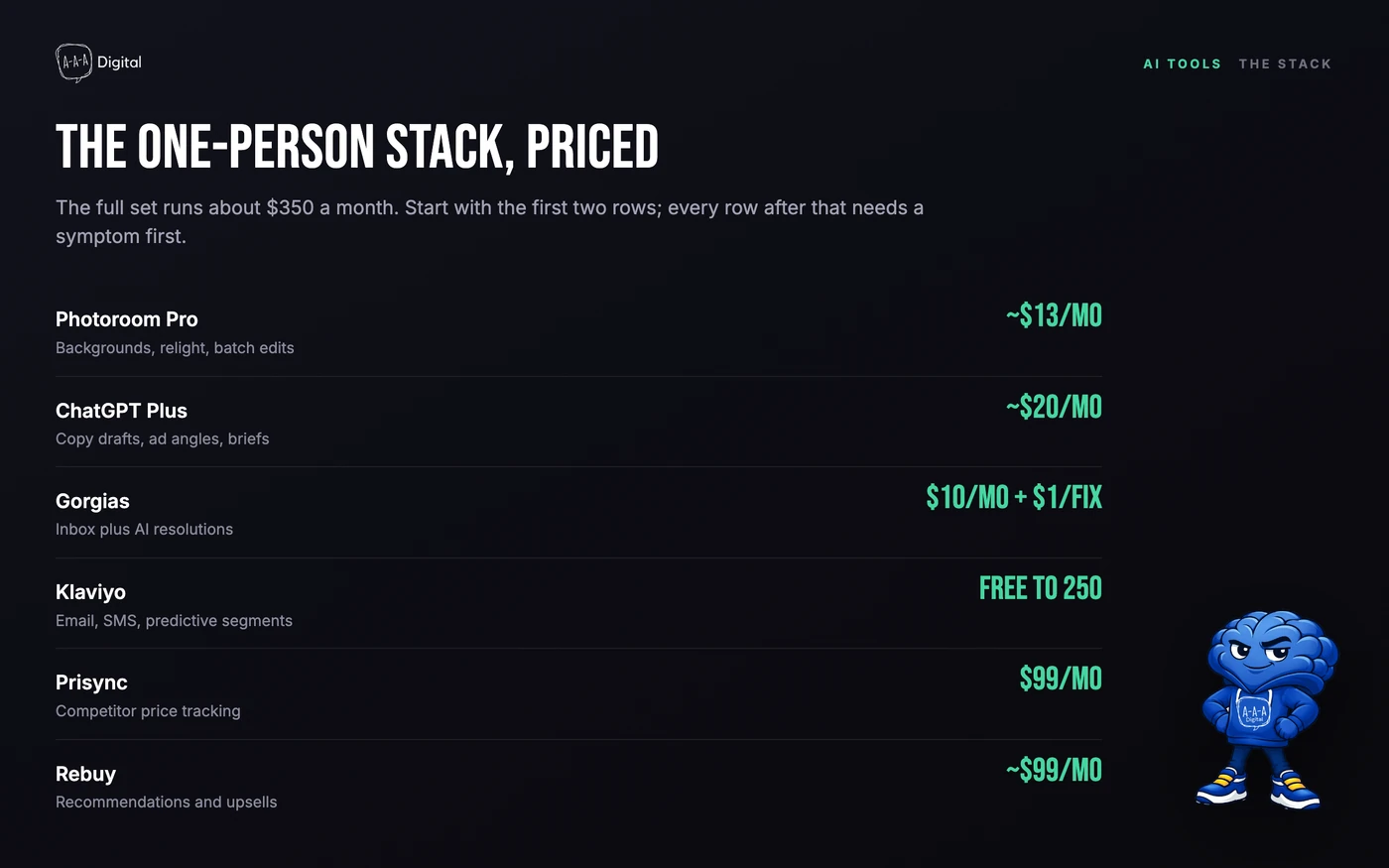
Everything above collapses into one table. Add tools in order, and only when the job in column two is actually hurting.
| Tool | Job it does | Entry price | Skip if |
|---|---|---|---|
| Photoroom Pro | Backgrounds, relight, batch edits | ~$13/mo | Supplier photos are already clean |
| ChatGPT Plus | Copy drafts, ad angles, briefs | ~$20/mo | You already have a copywriter |
| Gorgias | Inbox plus AI resolutions | $10/mo + ~$1 per fix | Under ~50 tickets a month |
| Klaviyo | Email, SMS, predictive segments | Free to 250 profiles | Pre-revenue |
| Prisync | Competitor price tracking | $99/mo | No close competitors |
| Rebuy | Recommendations and upsells | ~$99/mo | Under ~5,000 sessions a month |
The floor version of this stack costs under $40 a month: free Photoroom tier, a free chatbot account, Shopify Inbox, free Klaviyo. The full version runs about $350, which is what one part-time hire costs for a weekend. That is the honest comparison for every row, and it is the argument I use when a client wants to add a twelfth subscription.
Skip these AI tools
The gimmicks, in order of money burned.
AI review writers. Generating "customer" reviews is fake-review territory. The FTC fines it, platforms suspend for it, and detection is good. Real reviews, earned with photo incentives and follow-up emails, are the only growth path here.
One-click "AI SEO" apps. The kind that auto-generate meta titles, descriptions, and alt text across the catalog overnight. The output is thin and duplicated, and it ships without review. You will spend longer cleaning it up than writing the metas yourself.
Generic chatbots with no store data. A chatbot that cannot see orders invents refund policies and promises discounts you never approved. If it is not grounded in your catalog and order data, it is a liability wearing a widget.
AI logo and brand generators. For a real brand you get the same mark as a thousand other prompts. Spend the few hundred dollars on a designer once; the logo is amortized over every impression you ever buy.
Autonomous repricing with no floor. Covered above, but it earns a second mention because it is the one that can quietly bleed a category's margin.
FAQ
Are AI product photos allowed on Shopify and Amazon?
Yes, with a caveat. Both allow AI-assisted and AI-generated imagery, but the product shown must match what ships. Amazon has removed listings where AI "improved" the product into something the camera never saw. Keep AI scenes on secondary images and ads, and keep the main image honest.
Will AI-written product descriptions hurt my SEO?
Not because they are AI-written. Google ignores thin, duplicated copy regardless of who wrote it, and a hundred stores using the same prompt produce exactly that. Feed the model real specifications, edit the draft until it sounds like your brand, and the page can rank and get cited like any other.
What is the cheapest AI tool stack for a new Shopify store?
Under $40 a month, sometimes zero: Shopify's built-in AI for descriptions, the free Photoroom tier for photo cleanup, a free chatbot account for copy help, Shopify Inbox for support, and Klaviyo's free plan to 250 profiles. Add paid tools only when a specific job starts hurting.
Should I let AI process refunds automatically?
For small, policy-clear refunds, yes, with a dollar cap and a weekly log review. Anything above the cap, or anything involving a dispute or an angry customer, gets a human. The per-resolution fee is cheap; the chargeback a bot triggers is not.
Where to start
If you want the AI conversation aimed at revenue rather than tools, that is our AI SEO service: choosing what to rank for, making the copy worth citing, and measuring it against sales instead of word counts. Bring your current stack to a strategy call and we will tell you which rows of that table to keep, which to cut, and what to add next.
