A founder sent us a link last month. He had typed a paragraph into an AI store builder on a Sunday, picked a template on Monday, and had a live store with forty products by Wednesday. He wanted to know why nobody was buying.
The store looked fine. That was the problem. It looked fine the way a stock photo looks fine: correct lighting, no reason to exist.
What he had was a first draft of a website. What he needed was a retail operation: a collection structure a stranger can shop, product data that can be filtered and shipped, a reason to trust the checkout, and a brand that does not read like everyone else who used the same prompt.
AI can produce the first draft. The gap between draft and store is the job.
What "AI store builder" means in 2026
Three products share the label and they are not interchangeable.
Prompt-to-storefront builders. You describe the business; the tool returns pages, copy, stock imagery, and a basic commerce layer. Durable and 10Web are the ones we get asked about most. These are site builders with selling bolted on.
AI inside a platform you already chose. Shopify Magic and Sidekick, plus the copy and image features theme and app vendors have added. You already have a store; AI makes parts of running it faster.
Agencies using AI internally. Same deliverable, less time on the first pass. Most of the real productivity gain sits here, and it is invisible to buyers.
Only the second and third produce something we would put paid traffic against. A prompt-to-storefront builder has no data model behind the pages. It can write a product description, but it cannot tell you that your filters need a compatibility attribute before you import 400 SKUs. That decision belongs to whoever owns the catalog, and it has to be made before the pages exist.
Shopify's own AI, and what it is actually for
Shopify Magic handles the small stuff well: product descriptions from a spec sheet, blog drafts, image edits, alt text. At the time of writing it is included with Shopify subscriptions, and output quality depends on what you feed it. Three bullet points gets you three paragraphs of nothing. Materials, dimensions, use case, and the competitor set gets you something an editor finishes in five minutes instead of twenty.
Sidekick is the admin assistant: plain-language requests to build a discount, find a report, or explain a metric drop. At the time of writing, what it can touch varies by plan and region, so check your own admin before planning around a capability.
Neither will tell you what to sell, how to group it, what the offer is, or which twenty products deserve the homepage. Those are merchandising decisions, and they decide whether the store works. Shopify's AI is a fast pair of hands attached to a brain you supply.
Best for: Anyone selling physical products at volume, including stores that started on an AI builder
The AI features are useful, but the real argument is the data model: variants, metafields, markets, and a checkout that already handles wallets. You are paying for the plumbing under the pages.
See current pricingWhere third-party AI builders fit, and where they stop
Durable is the strongest prompt-to-storefront tool we have used. It generates a working site in under a minute, includes a CRM and invoicing, and handles the "credible site by Friday" case better than a page builder. For a service business or a one-product test, that is a real answer. It is not a catalog system: once you need variant logic, tiered shipping, or a Google Shopping feed, the tool becomes the constraint.
10Web generates a WordPress site and hosts it. Legitimate stack, and it inherits WordPress's flexibility and WordPress's maintenance. Pick it and you are choosing WordPress with an AI head start. If you are comparing that class of tool to a real platform, our Shopify vs Wix comparison is the honest version.
Best for: Service businesses, one-product tests, and founders who need a credible site this week
Fastest prompt-to-site we have tested, and the CRM is genuinely useful. Treat it as a landing page generator with a cart, not as a store you can grow into.
See current pricingBest for: Teams that want AI-generated pages on WordPress, with hosting included
Capable WordPress build with AI on top. You inherit plugin maintenance, and every Shopify-specific advantage in this article does not apply.
See current pricingWhere the output breaks
The failures are consistent. None are the AI's fault, exactly. They are the parts of the job nobody put in the prompt.
Information architecture
A template gives you pages, not a hierarchy. The builder will generate three nav items and twenty overlapping collections because it infers structure from product titles rather than from how people shop.
The decisions that matter are unglamorous: how many shelves, what sits on each, what the nav promises, where paid traffic lands. Most ad traffic should hit a purpose-built page, not your homepage. Our guide to where ecommerce traffic should land covers the structural miss we see most.
Collection taxonomy
AI groups by keyword. Shoppers group by intent. Those are different trees.
The symptom: "Sale", "New Arrivals", "Best Sellers", "Featured", and eleven other collections holding the same forty products in a different order. Filters are generated from tags that do not exist, so a shopper looking for a size or a compatibility match finds nothing.
Fix it before import. Decide attributes first — size, use case, price band, material, compatibility — then build collections and filters from them, stored in metafields so they survive a theme change.
Product data
Copy is what AI does best, which is why it gets the attention and why the rest of the record stays empty.
PDP text does not drive shipping rates, feeds, filters, returns, or support tickets. Attributes, weights, dimensions, variant structure, and identifiers do. A builder will produce a beautiful page for a product it knows four facts about. You find out when a customer asks whether it fits, or the feed gets disapproved.
Trust
Every AI-generated store we have audited contains at least one claim with nothing behind it. "Trusted by thousands." "Award-winning support." A returns policy copied from a template that does not match what the founder will do when a parcel goes missing.
Trust is evidence: named reviews, shipping times you can hit, a contact method a human answers, a policy you honor when it costs you money. None of that comes out of a prompt.
Checkout
This is where the gap gets expensive.
Shopify's checkout carries the wallets, address autocomplete, and fraud screening. Shop Pay removes most of the form for a returning buyer, and our breakdown of how Shop Pay's one-tap checkout works explains why that matters more on mobile. A builder that hands you a bare card form with three fields is quietly taxing every mobile visitor.
You also cannot customize what you do not own. If your plan needs a post-purchase offer, confirm support before you commit.
App stack
Two opposite failures. A prompt-to-storefront tool has almost no integrations, so you build workarounds. A Shopify store installs anything, so teams install forty apps and wonder why the site is slow.
Apps are scripts: a request, a render, a maintenance obligation. Our guide to Shopify page speed puts cutting apps ahead of every technical fix.
SEO
Two problems, one obvious.
Generated copy is generic, and the same prompt produces the same paragraphs on hundreds of stores. Thin, duplicated descriptions do not rank, and they give an AI answer engine nothing to cite.
The other problem is control: URL structure, redirects, canonical tags, structured data, and the ability to change markup without waiting on a roadmap. AI can draft a meta description if you give it the page and the keyword. It cannot fix a crawl problem it created with 200 near-identical collection pages.
Brand differentiation
The template is the product, and thousands of businesses run it.
Differentiation comes from the offer, the photography, the voice, and the merchandising — things a builder has no opinion about. An AI draft is a competent generic. Competent generic is the most expensive thing in retail: you pay for the traffic and get no memory.
The workflow that actually works
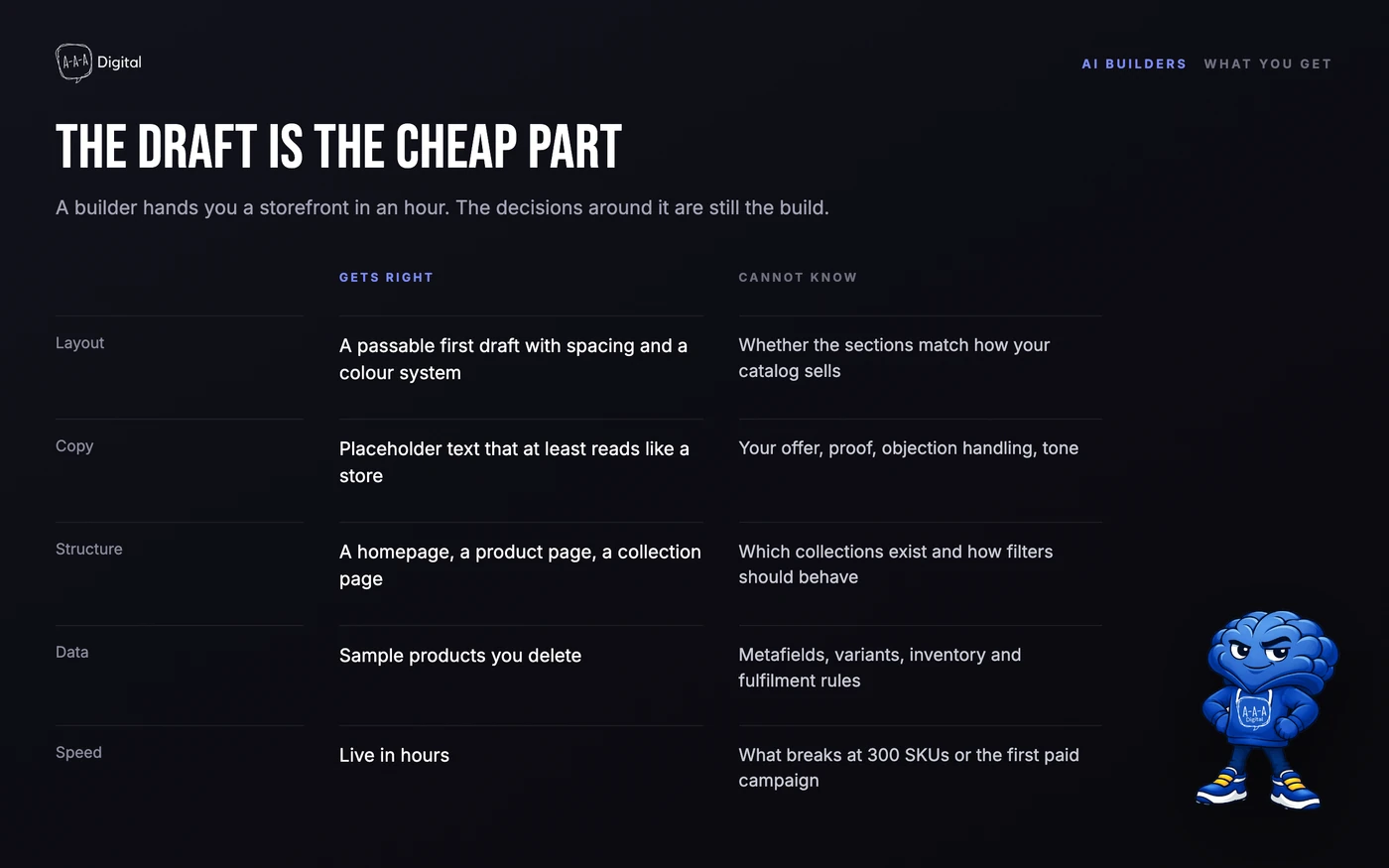
AI for the draft. Humans for the architecture. The division of labour is the method.
Humans own the catalog and the offer. Before a builder is opened, someone writes down every SKU with its attributes, then writes one page: who the product is for, what it costs, why it wins, what the buyer gets after checkout, what the guarantee is. If that page cannot be written, no amount of generated copy fixes the store.
AI owns the volume. First drafts of hero copy, PDP skeletons, meta descriptions, alt text, policy text — three variants of everything, then a human keeps the one that sounds like a person. AI also owns the tedious half of data cleanup: normalizing titles and mapping one attribute across 300 products from specs you supply.
Humans own the architecture again on the way out. Nav to five or six items. Collections as shelves, not keywords. Filters from attributes. A landing page per traffic source. A trust layer made of evidence instead of adjectives. Analytics and a mobile test order before the first ad click.
That last pass is the one teams skip, and it decides whether the store converts at 0.8% or 2.4%.
What AI cannot do
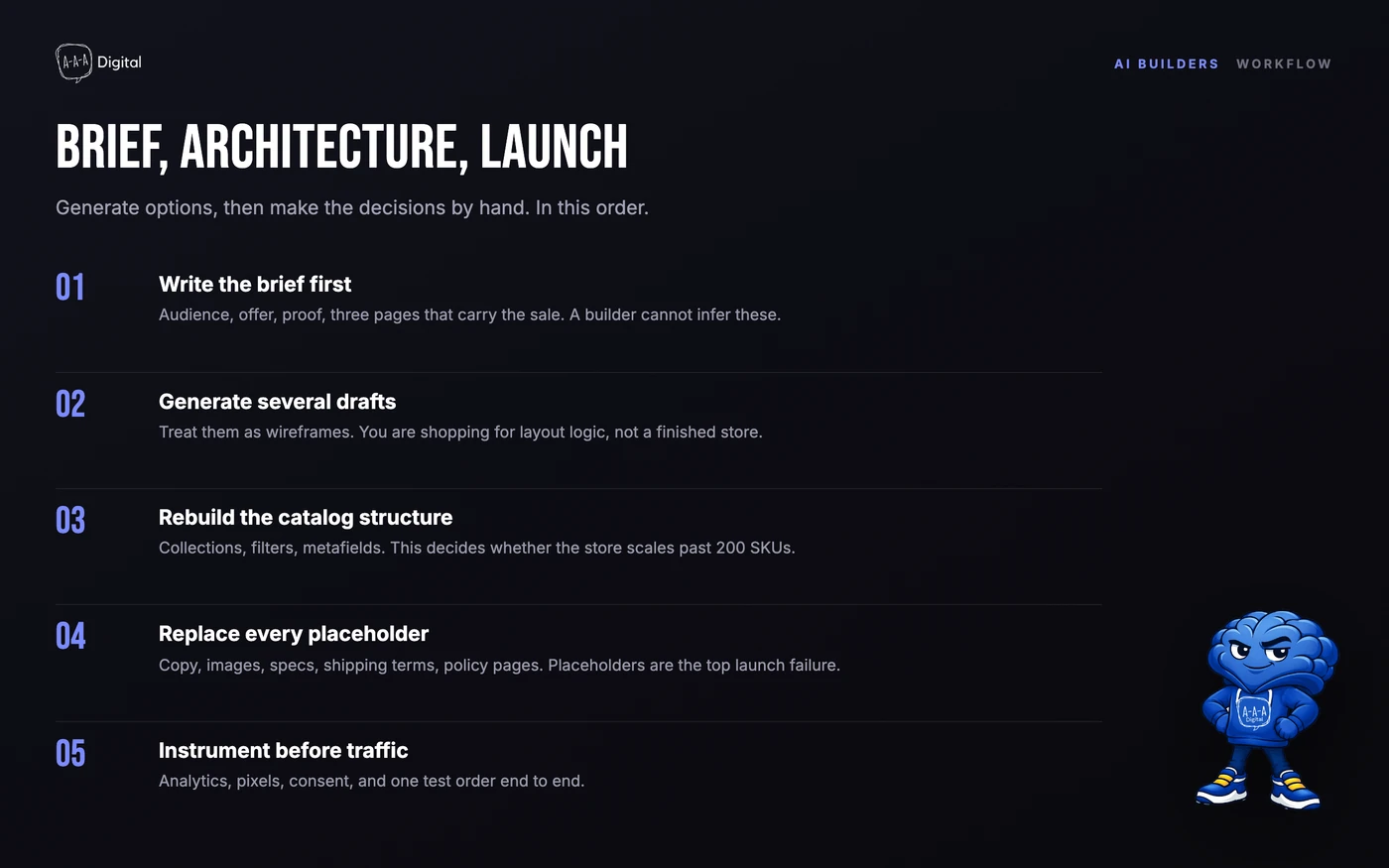
Merchandising. What is on the shelf, in what order, at what price, bundled how. Judgment calls about margin and inventory, and they change monthly.
The offer. Free shipping threshold, bundle pricing, subscription vs one-time, guarantee length. AI will write copy about your offer. It will not design one.
The data model. Attributes, metafields, variant structure, the taxonomy that lets you filter, feed, and personalize in year two. Get this wrong and you rebuild. Our post on what a Shopify migration actually costs is mostly a list of the ways a bad data model gets paid for later.
Customer research. Why people hesitated, what they compared you to, what almost stopped the order. That comes from support tickets, recordings, and asking.
The back office. Refunds, address changes, supplier follow-ups, the Monday numbers. AI will draft a storefront; it will not run the queue behind it. That is workflow automation, and it is where a surprising amount of margin sits once the traffic finally arrives.
Cost comparison: AI builder vs agency vs theme and DIY
We sell agency builds, so discount this section. The categories are still the right frame.
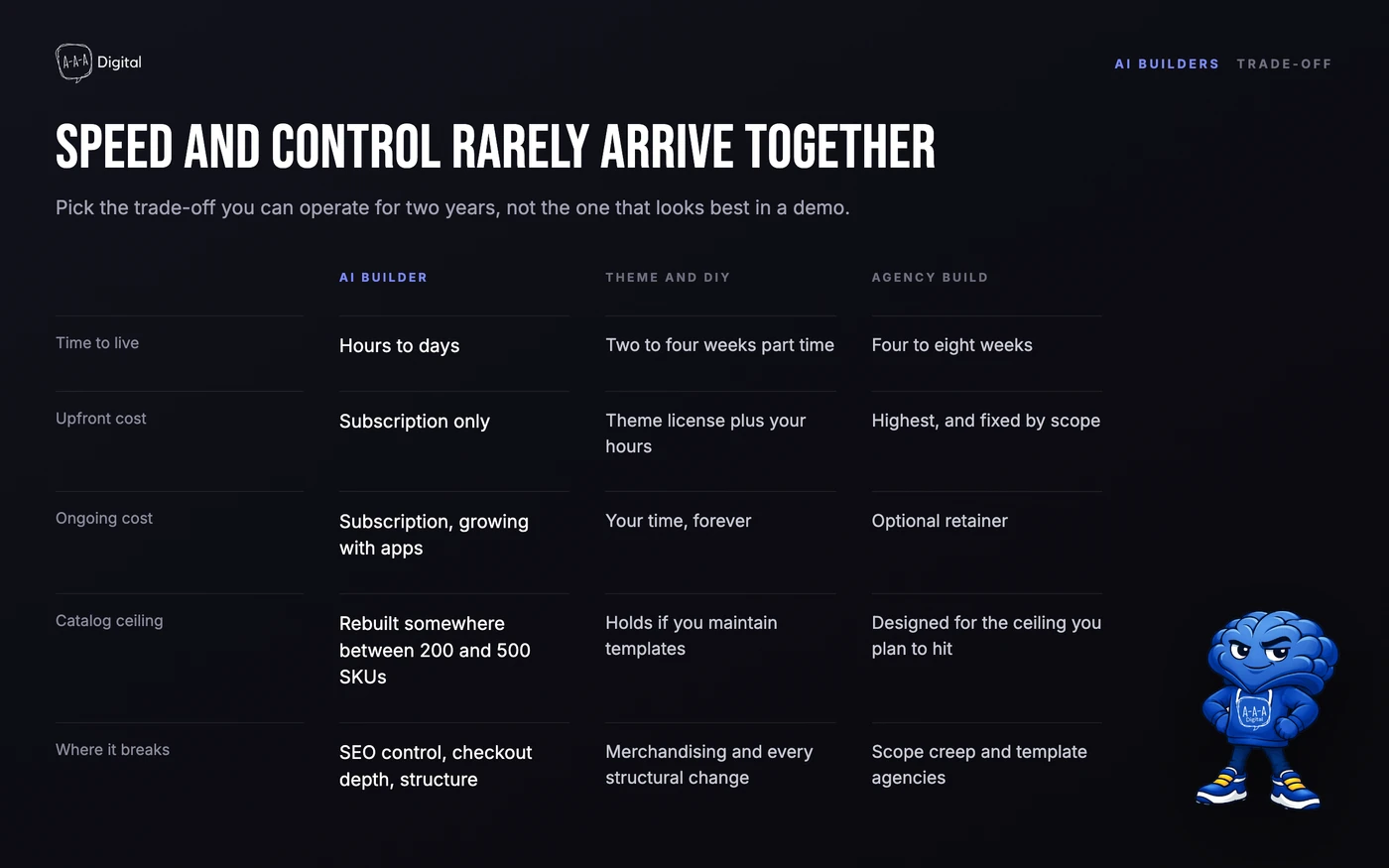
| Upfront | Ongoing | Time to live | What you still pay for | Where it breaks | |
|---|---|---|---|---|---|
| AI builder | Low | Subscription | Hours to days | Copy editing, product data, apps, a human review | Catalog growth, SEO control, checkout depth |
| Theme + DIY | Theme license | Subscription + apps + your hours | Two to four weeks part-time | Your time, forever | Merchandising, CRO, every structural change |
| Agency build | Highest | Optional retainer | Four to eight weeks | Nothing on day one | Scope creep, and agencies that ship templates |
The number nobody puts in the comparison is the rebuild. A store built on a builder at forty SKUs usually gets rebuilt between 200 and 500 SKUs, or the first time paid traffic gets serious. That rebuild costs more than the difference between the three columns.
The cheapest-looking option is rarely the cheapest at 300 orders a month. We made that argument about platform choice in Shopify vs Wix in 2026, and it holds here: the subscription is the small number.
Before you choose, model the revenue side. Our Shopify ROI calculator tells you what a conversion-rate improvement is worth on your traffic. A few hundred dollars a month means use the cheapest tool that works. Five figures means the build is not the expensive part.
Decision table by store stage
| Your situation | Sensible starting point |
|---|---|
| Testing an idea, under ten SKUs, no paid traffic | AI builder, or a Shopify trial with a free theme |
| Launching with paid traffic, 20–200 SKUs | Shopify, a paid theme, human architecture |
| 200+ SKUs, or filters decide the sale | Shopify with a custom collection and metafield structure |
| Selling wholesale alongside retail | Shopify with native B2B — see our B2B setup guide |
| Currently on WooCommerce, Magento, or Wix | A planned migration, not a builder |
| Content or service business with a small shop attached | A site builder, and we mean that |
That last row is not a consolation prize. If you sell a service and stock twelve items, a builder is the right call and Shopify is overhead.
AI draft to launch: a seven-step checklist
- Spreadsheet of every SKU with attributes, dimensions, weight, and variant logic.
- One-page offer document, agreed by whoever owns the P&L.
- Draft copy edited until it does not sound like a language model. Every claim checked.
- Nav rebuilt by hand. Duplicate collections deleted.
- Attributes and metafields populated so filters, feeds, and shipping rules work.
- Trust layer finished: reviews, policies that match reality, tested shipping times, a live contact route.
- Pre-launch audit: analytics firing, mobile test order, redirects mapped, page speed measured, Search Console verified.
If you only do three, do one, four, and seven.
FAQ
Can an AI store builder replace an agency? For a brochure site with a small shop, yes. For a store spending real money on traffic, no. The work that decides the outcome is architectural, and nobody has automated it yet.
Is Shopify Magic free? It is included with Shopify subscriptions at the time of writing, with availability varying by plan and region. There is no separate Magic fee. Verify in your own admin before building a content workflow around one feature.
Will AI-written product descriptions hurt SEO? They can. The risk is not detection; it is thin, duplicated copy across every store that used the same prompt, plus the missing attributes that make a product page useful. Use AI for the draft and supply the facts.
Can I move an AI-built store to Shopify later? Copy and images move. Structure does not. Product data, collections, and URLs usually have to be rebuilt, which is why planning the data model on day one saves money even if you start elsewhere.
How long does a proper Shopify build take? Four to eight weeks for us, depending on catalog size and how much data already exists. DIY with a paid theme is two to four weeks of evenings, and the architecture step is the one most people underestimate.
If you have an AI-built draft and you are not sure whether to keep it or rebuild, send us the URL. We will tell you which parts are worth saving. Book a free strategy call or look at how our Shopify development service handles the architecture work.
