Last October, two weeks before Diwali, a skincare founder sent me her ad account with one question: why was her ROAS stuck at 2.1x when a friend's supplement brand was clearing 4x on the same budget? I opened her ads manager and found the usual suspects. Studio-shot product videos. An English voiceover on every creative. Zero creator content. A brand handle nobody recognised, running ads to cold audiences. We did not touch her budget. We swapped the creative system, and her Diwali campaigns closed at 3.8x.
That gap, between what beauty brands spend and what their creative actually earns, is the whole story of this category. Beauty and personal care is the highest-margin, fastest-growing D2C sector in India, and the most forgiving place to learn paid social. Our benchmark data says it plainly: BPC is the only category where you can burn ₹50K and still see same-day purchases. It is also the easiest category to lose money in slowly, through overpriced CPPs, COD drag, and studio content that politely underperforms while it drains your budget.
This post is the creative read of our D2C benchmark data for India. The numbers for all eight beauty subcategories, where the margin actually lives, and the operational settings (budget floor, platform mix, COD mitigation, seasonality) that decide whether your creative wins reach the bank account. The full 12-category dataset is in our D2C benchmarks report, and the cross-category ROAS picture is in our D2C ROAS benchmarks for India. If beauty is your category, start here.
The numbers: beauty D2C benchmarks by subcategory
Every figure below comes from our internal benchmark data for India, aggregated across the beauty accounts we run and audit. These are ranges, not point estimates, because your AOV, price point, and creative quality move every one of them.
| Subcategory | CPM | CTR | CPC | CPP | ROAS | COD% | RTO% |
|---|---|---|---|---|---|---|---|
| Skincare (serums, clinical, organic) | ₹180-₹380 | 1.8-2.8% | ₹12-₹30 | ₹450-₹1,080 | 3.0x-5.0x | 35-45% | 12-18% |
| Haircare (oils, growth, styling) | ₹160-₹340 | 1.6-2.5% | ₹11-₹30 | ₹400-₹960 | 3.2x-5.2x | 38-48% | 14-20% |
| Cosmetics & makeup (clean beauty) | ₹200-₹420 | 2.0-3.2% | ₹14-₹30 | ₹500-₹1,140 | 2.8x-4.5x | 40-50% | 15-22% |
| Men's grooming (beard, shaving) | ₹140-₹290 | 1.4-2.2% | ₹9-₹20 | ₹350-₹840 | 3.5x-5.5x | 42-52% | 16-24% |
| Fragrances (artisanal, dupes) | ₹220-₹460 | 1.5-2.4% | ₹15-₹30 | ₹600-₹1,320 | 2.5x-4.0x | 40-50% | 18-25% |
| Oral care (electric, eco-friendly) | ₹170-₹360 | 1.3-2.0% | ₹13-₹30 | ₹550-₹1,200 | 2.8x-4.2x | 35-45% | 12-18% |
| Bath & body (shower, lotion) | ₹150-₹310 | 1.7-2.6% | ₹10-₹20 | ₹380-₹900 | 3.2x-5.0x | 38-48% | 14-20% |
| K-Beauty / J-Beauty imports | ₹240-₹480 | 1.9-3.0% | ₹16-₹40 | ₹700-₹1,440 | 2.5x-4.0x | 35-45% | 15-22% |
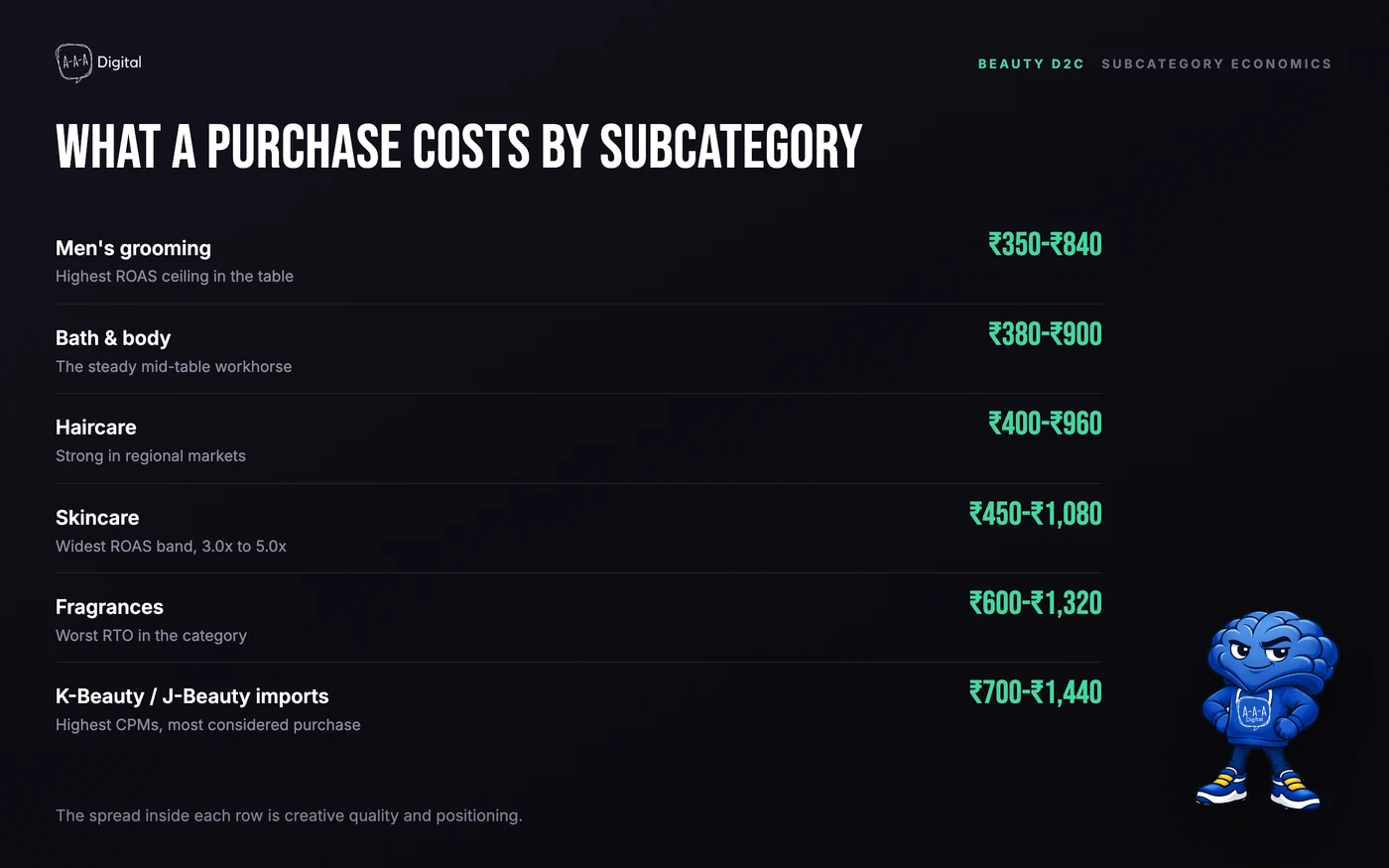
Read the table by CPP first, not ROAS. CPP is what a purchase actually costs you, and it is the number your creative controls. Skincare buys a customer for ₹450-₹1,080 depending on how good your funnel is. Fragrances and K-Beauty imports cost ₹600-₹1,440 no matter what, because the CPMs are higher and the purchase is more considered. If your skincare CPP sits near ₹1,080 while your ROAS claims 4x, one of those numbers is lying, and it is not the CPP.
Where the margin lives (and where it pretends to)
The beauty accounts I creative-direct all share one trait: the founders who can quote their CPP by subcategory beat the founders who can only quote ROAS. ROAS is an outcome. CPP is a decision.
Skincare and haircare are the volume engines of the category. Skincare runs the widest ROAS band, 3.0x-5.0x, because the market is huge and the products photograph well in UGC. A ₹999 serum with a clear claim can carry a ₹600 acquisition cost and still clear contribution margin on the first order, then print money on reorder two. Haircare behaves similarly at slightly cheaper clicks, with hair oil and growth products especially strong in regional markets where the audience already believes in the ritual.
Men's grooming is the sleeper. It posts the cheapest clicks in the table (₹9-₹20 CPC) and the highest ROAS ceiling at 5.5x. But look right: COD runs 42-52% and RTO up to 24%. The margin is real, and it leaks after the click, in courier returns and refused deliveries. Brands that win here treat RTO as a media problem, not an ops afterthought.
Cosmetics and bath & body sit in the middle of the table and behave like it. Cosmetics posts the highest CTR of the group (2.0-3.2%) because makeup content is inherently watchable, but converts at middling ROAS (2.8x-4.5x) with COD at 40-50%. It is a retargeting-rich subcategory: people watch five tutorials before they buy the lipstick. Bath & body is the quiet workhorse, cheaper to acquire (₹380-₹900 CPP) and steady, with gift sets that punch far above their weight during the October-January window.
Fragrances and K-Beauty imports are where budgets go to look expensive. Fragrances buy at ₹600-₹1,320 per purchase and return 2.5x-4.0x, with the worst RTO in the category at 18-25%. People order a scent, hate it on skin, and send it back. Cold traffic for a dupe brand without a community behind it is a slow bleed. K-Beauty carries the highest CPMs (₹240-₹480) and the highest CPP (₹700-₹1,440), which only works when the audience arrives already wanting the aesthetic. If you are launching one of these, build the community first and let paid media amplify it, not replace it.
What separates the ₹450 CPP skincare brand from the ₹1,080 one is usually not media buying. It is positioning. A serum with one clear claim, aimed at one buyer, with a reason to believe that fits in a single sentence will always buy customers cheaper than a brand that needs three sentences to explain itself. That is brand work, not bidding work, and it is the difference we chase in our branding engagements before a rupee goes into ads.
The creative that actually moves ROAS
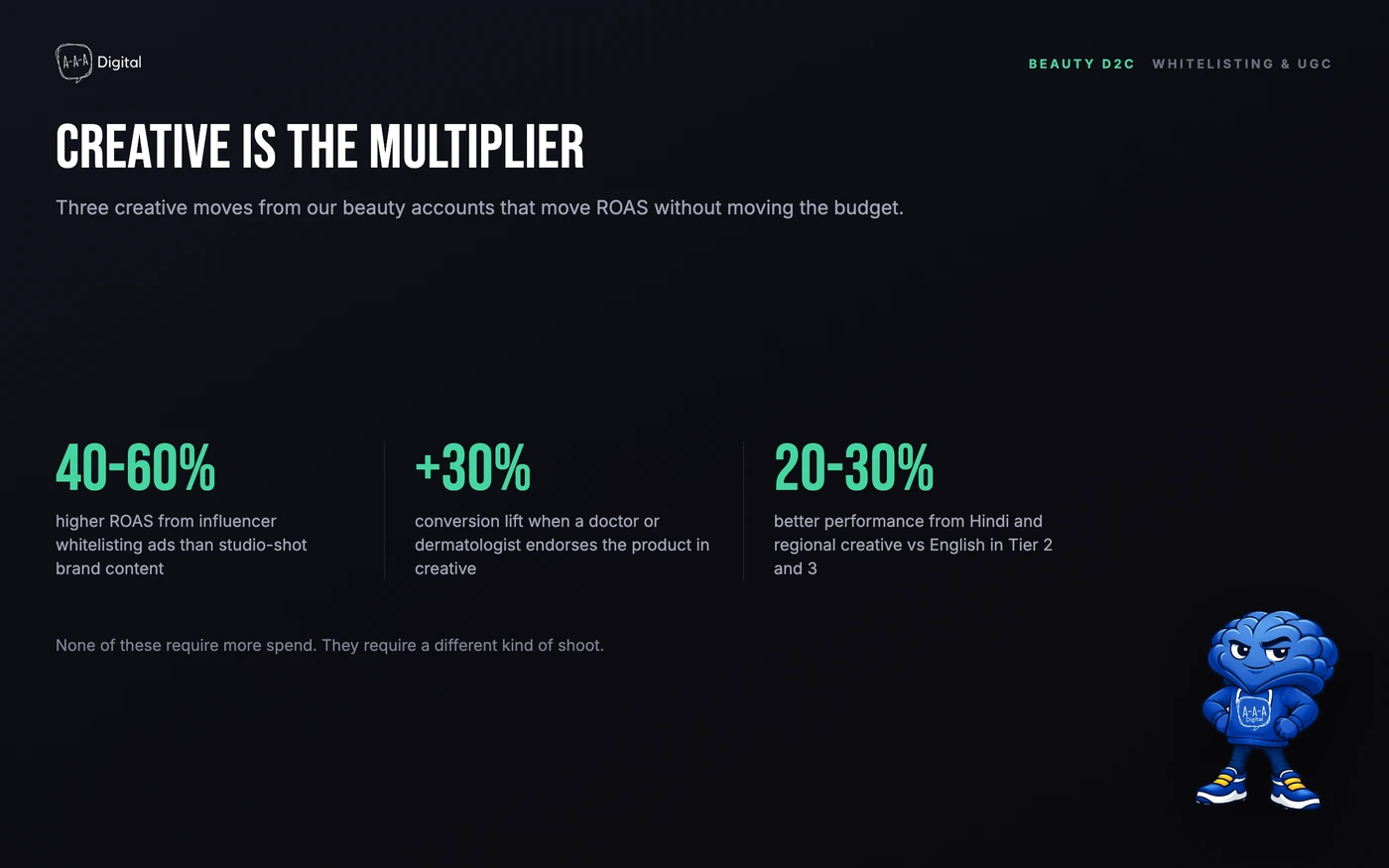
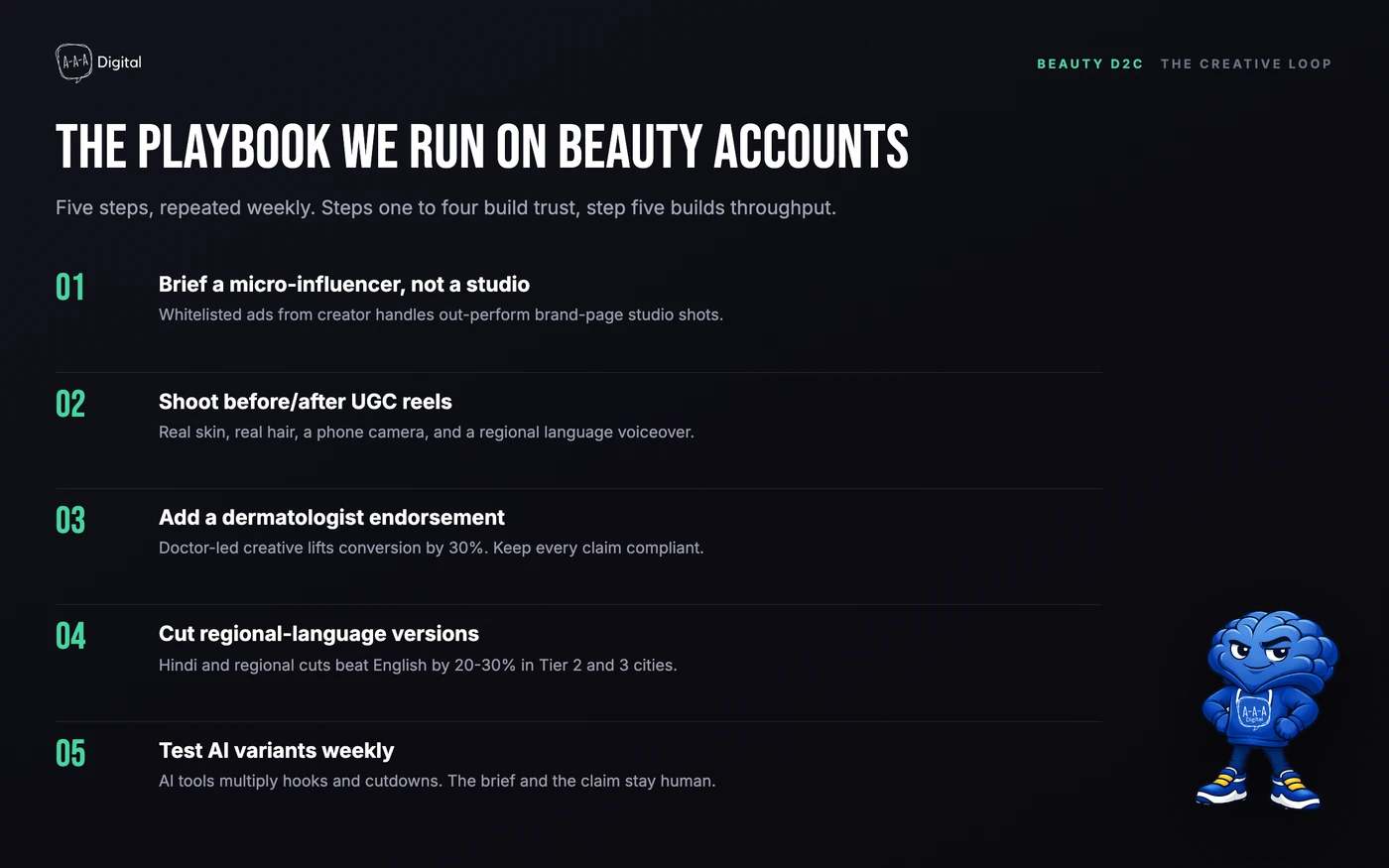
I have killed ₹2 lakh of studio shoots that lost, head to head, to a phone-shot reel from a micro-influencer with 40K followers. Not once, repeatedly. The data backs the pattern: influencer whitelisting ads, where the creator's handle runs the ad instead of your brand page, deliver 40-60% higher ROAS than studio-shot content. The ad reads as a person, not a pitch, and beauty buyers have been trained to scroll past pitches.
Three creative moves do most of the lifting in this category:
Before/after UGC reels with regional voiceovers. Real skin, real hair, shot on a phone, narrated in the viewer's own language. This is the single most reliable format we run. Hindi and regional creative outperforms English by 20-30% in Tier 2/3 cities, and those cities are where the next crore of beauty buyers lives.
Doctor and dermatologist endorsements. Endorsed creative lifts conversion rates by 30%. The credibility of a white coat does work that a discount code cannot, especially for clinical skincare, anti-hairfall, and oral care. Keep claims compliant, but do not skip this because the founder is shy on camera.
Regional-language versions of everything. Not a translated caption, a reshot or re-voiced ad. A lip-synced Hindi reel and an English reel are two different ads, and the regional one usually wins where the money is moving.
How you test matters as much as what you shoot. We run a simple weekly loop on beauty accounts: three new hooks against the account's best-performing body, one variable changed per test, and a kill criterion agreed before spend starts (usually a CPP 30% above target after ₹8,000-₹10,000 of delivery). Creative that survives two rounds earns a regional-language cutdown and a whitelisted version. Creative that dies gets archived with a note on why, because the same idea in a different subcategory is often a winner. Accounts that skip the kill criterion end up with twenty mediocre ads and no data; accounts that enforce it compound learnings every single week.
Where do AI tools fit in all this? In the production line, not the judgment. We use them to generate hook variants, cut one reel into fifteen, and test thumbnails at a pace a human editor cannot match. The brief, the casting, and the claim still come from a person who knows the account. Our breakdown of what is worth automating is in AI tools for ecommerce.
The honest caveat: none of this rescues a weak product. UGC with real customers will surface your refund rate faster than it will surface your ROAS. Fix the product first, then point the creative at it.
The operational settings that decide everything
Creative sets your ceiling. Operations decide whether you reach it. Four settings do most of the work in beauty:
Minimum budget: ₹1.5-2.5L/month. Below this floor, Meta never exits the learning phase and your tests never reach statistical honesty. You are not buying data, you are donating to it. If ₹1.5L/month is uncomfortable, the answer is a narrower subcategory, not a smaller budget spread thinner.
Platform mix: Meta 70%, Google 30%. Meta is where beauty demand is created and harvested; Google captures the search demand your Meta ads generate (yes, people search the brand after seeing the ad). Beauty benchmarks to 3.0x-5.0x on Meta and 3.5x-5.5x on Google, with Google usually the smaller, steadier book.
COD mitigation: a 10% prepaid discount. COD sits at 35-52% across beauty subcategories, and every COD order carries RTO risk with it. A 10% prepaid discount pushes COD below 30%, and RTO drops to 8-10% on prepaid orders. On one skincare account we run, moving the prepaid incentive from 5% to 10% took COD from 41% to 27% in a month, and the margin math still worked because we stopped paying for round trips to doorsteps that refused delivery. That trade is almost always margin-positive, do the math against your courier fees before you reject it.
Seasonality: Diwali plus wedding season, October to January, runs 2.5x volume. Stock up 45 days early. CPMs spike, but so does intent, and brands that stocked and briefed creators in August are the ones that harvest it.
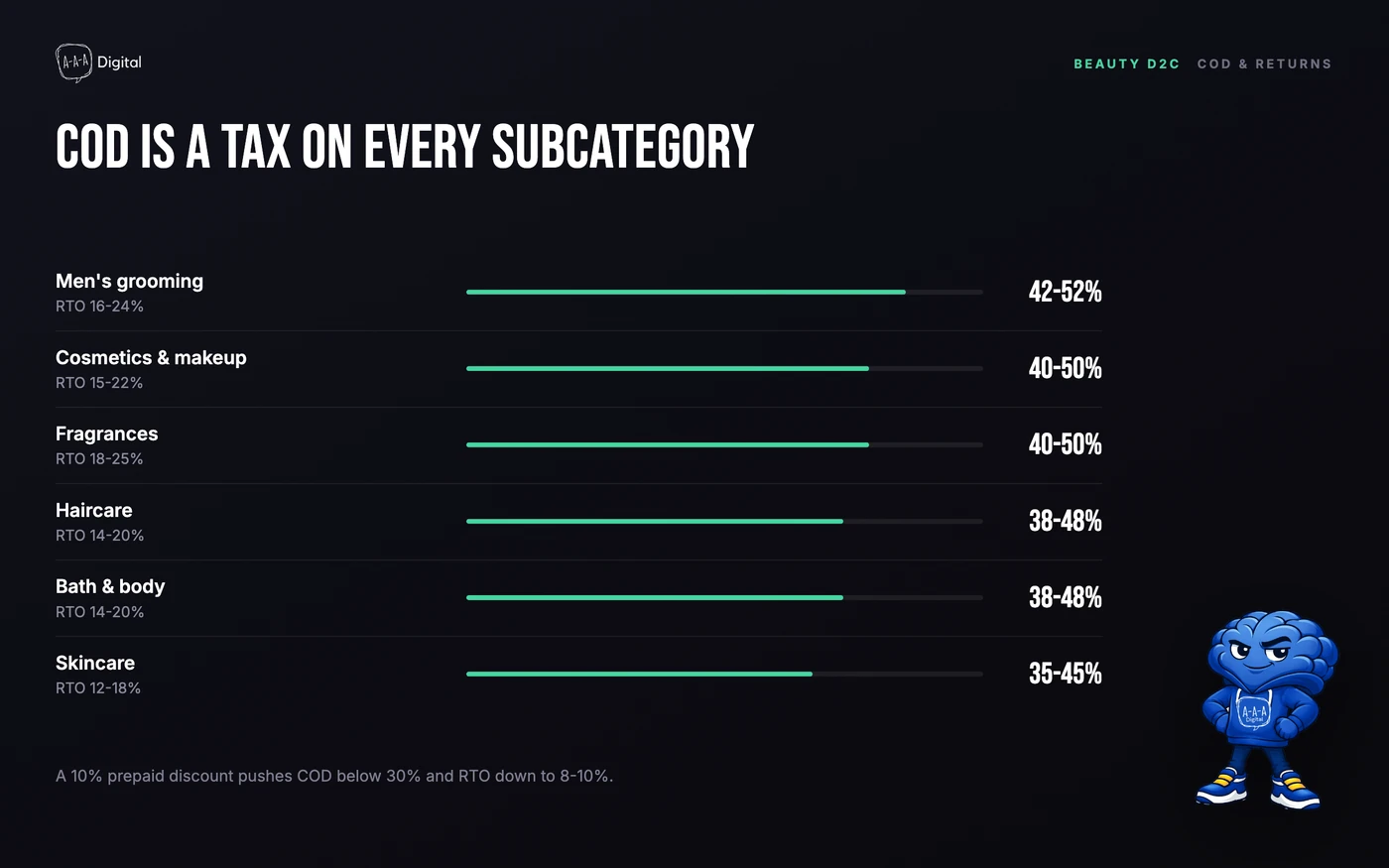
Put together, the playbook is unglamorous. Hold the budget floor, run the 70/30 split, bribe customers off COD with a discount that costs less than returns do, and treat October like a storm you can see on the radar. The brands that do this boring part well are the ones whose creative gets to shine.
Get help with this
If your numbers sit outside these ranges, the cause is almost always findable: wrong subcategory economics, studio creative that should have been whitelisted UGC, or COD drag eating the margin your ads bought. The full dataset across all 12 categories is in our D2C benchmarks report, and our performance marketing team runs beauty accounts against exactly these numbers, creative included. Bring your ad account; we will tell you where the money is going.
FAQ
What is a good ROAS for beauty D2C in India?
Category-wide, beauty benchmarks to 3.0x-5.0x on Meta and 3.5x-5.5x on Google. Inside the category, skincare and haircare above 4x is strong, and men's grooming can justify chasing 5x given its cheap clicks. If you are below 3x on Meta, the problem is usually creative, not audience or bid. Fix the creative system before you touch anything else.
Does UGC really outperform studio content?
Yes, consistently. Influencer whitelisting ads deliver 40-60% higher ROAS than studio-shot content, and before/after UGC reels with regional voiceovers are the strongest single format we run. The caveat is that weak UGC loses to weak studio content just as reliably. The win comes from authenticity plus a real claim, not from filming on a phone alone.
How much budget does a beauty D2C brand need to start?
₹1.5-2.5L per month as a floor, split roughly 70% Meta and 30% Google. Below ₹1.5L, campaigns cannot exit learning and you are paying tuition without earning a degree. Remember that BPC forgives small mistakes faster than any other category, ₹50K in testing can still produce same-day purchases, but plan the full floor before you scale what works.
Which beauty subcategory is easiest to scale in India?
Skincare, for most founders. It has the deepest demand, the widest ROAS band (3.0x-5.0x), and creative that is easy to produce in UGC form. Haircare is a close second, especially for regional-first brands. We would not start with fragrances or K-Beauty imports unless you arrive with an existing community, their CPPs (₹600-₹1,440) punish beginners.
