
The best Shopify review app for most stores is Judge.me: free to start, $15 a month at any order volume, with photo reviews and the review markup Google reads. Loox earns its $49.99 when the catalogue is photogenic, Okendo and Yotpo only make sense once volume justifies segmentation and a support contract, and Shopify's own free app is a placeholder rather than a choice.
Prices below were checked on the Shopify App Store this month, in USD, billed through Shopify. Vendors change tiers, so confirm on the listing before you commit.
The short answer
| App | Best for | Price | The trade-off |
|---|---|---|---|
| Judge.me | Almost every store under 5,000 orders | Free, then $15/mo | Widgets look plainer than Loox out of the box |
| Loox | Visual catalogues: beauty, apparel, home | Free to 500 orders, then $49.99/mo | Heaviest page weight of the cheap options |
| Okendo | 1,000+ orders, segmentation and loyalty | Free, then $19 to $299/mo | Priced per order band, so growth costs money |
| Yotpo | Enterprise and multi-brand groups | Free, then $15/mo, quoted after that | Most scripts, slowest to configure |
| Stamped | Reviews plus loyalty in one bill | From $23/mo, no free tier | The cheapest tiers cap orders hard |
| Shopify Product Reviews | A store with no budget at all | Free on every plan | No control over markup, styling or syndication |
The pattern is simple. You are not paying for review collection. Every app on this list collects reviews. You are paying for how the reviews look, who can be targeted, and how much script the page has to carry.
What a review app is actually selling
Three jobs sit inside every one of these products.
Collection is the request email, the reminder, the photo incentive and the moderation queue. It is the part that gets commoditised fastest, and the free tiers are genuinely usable now.
Display is the widget: star row, gallery, review tab, highlight carousel, Q&A. This is where the paid tiers separate, and where a photogenic catalogue gets real value.
Distribution is the plumbing nobody sees: AggregateRating and Review markup, Google Shopping and Shop app syndication, Meta and TikTok feeds. Every store needs the first, most stores ignore the second, and the third matters only once you run paid social at volume.
Judge a vendor on which of those three it actually improves, not on the feature list length. Most stores end up paying for display they never configure and distribution they never check.
What does not matter, despite the listing pages: the number of widgets bundled, the word "AI" in front of sorting or summaries, and a stack of integrations you will never connect. A review app that sorts smartly but loads 400KB to do it has made your store worse. The question is always whether the widget earns the weight it adds.
Judge.me and Loox: the two we install most
Judge.me
Best for: Stores under 5,000 orders a month that want photo reviews and rich results without a subscription
The cheapest credible way to get photo reviews and Google markup. Flat pricing at every order volume, decent widget library, and it will not wreck your product page. This is our default install.
See current pricingThe free plan covers unlimited review requests, photo reviews, moderation and review snippets. The $15 Awesome plan adds the full widget library, curation, custom questions and product grouping.
What it does not do well: the widgets look functional rather than premium, and the email designer is basic. If your brand is built on visual proof, that gap is the reason to look at Loox. If it is not, $15 flat is very hard to argue with at 8,000 orders a month.
Loox
Best for: Visual catalogues where the customer photo is the sales argument
The best-looking photo and video galleries on Shopify, and the free tier covers 500 orders a month. You pay for merchandising, and you pay again in page weight.
See current pricingLoox charges by order volume: free to 500 orders, $49.99 on Convert with 300 orders included and $50 per additional 300, and $299.99 on Unlimited. The referral program and AI sorting sit on paid tiers.
The honest caveat is weight. Photo grids and video thumbnails are heavy, and Loox ships more of both than anyone else here. Put the widget below the fold, lazy load it, and measure the product page before and after. On a fast theme it is fine. On a theme that was already slow, it is the straw.
Okendo and Yotpo: order volume buys segmentation
Okendo
Best for: Stores past 1,000 orders a month that want reviews, Q&A and loyalty in one place
The most thoughtful mid-market option. Attribute-based segmentation lets you show different proof to different customers, and the implementation support is better than the price suggests.
See current pricingOkendo's free plan stops at 50 orders a month, then Essential runs about $19, Growth about $119 up to 1,500 orders and Power about $299 up to 3,500. Beyond that you are on a call.
You are buying segmentation here: review attributes, customer cohorts, Q&A, and a loyalty module that shares the same data. For a brand with several product lines and different proof needs per line, that is worth the jump in price. For a single-category store, it is overhead.
Yotpo
Best for: Multi-brand groups and enterprise teams that need syndication and an account manager
Powerful and slow. The free tier is real but thin, the useful features sit on quoted plans, and the script load is the highest on this list. Only worth it when syndication across brands is the requirement.
See current pricingYotpo's reviews product has a free plan up to 50 orders a month and paid plans from $15, scaled by order volume, with Premium quoted. Seller ratings, retail syndication and AI summaries land on the higher tiers.
The reason to choose Yotpo is breadth: reviews, loyalty, SMS and a visual UGC suite that can be syndicated across domains. The reason to avoid it is that you inherit all of that JavaScript whether you use it or not.
Stamped and Shopify's own app
Stamped
Best for: Stores that want reviews and a loyalty program on one invoice
A solid middle option with good Google and Klaviyo integrations. No free tier, and the cheap bands cap orders quickly, so model the year two bill before you switch.
See current pricingStamped runs $23 a month to 200 orders, $99 to 1,000 and $199 to 5,000, with reviews sold as one product alongside loyalty and repeat-purchase automation. The feature set is comparable to Okendo's, and bundling loyalty onto the same invoice is the reason most of its customers pick it.
Shopify Product Reviews
Best for: A brand new store that needs stars on the page this week and has no budget
Free, server-rendered and almost weightless, which is more than the paid apps can claim. It is also the least capable: minimal styling, no Q&A, no syndication, and no review markup you control.
See current pricingWorth knowing for two reasons. It is the lightest thing you can install, and it proves the point that review collection is a commodity. Where it stops is exactly where the paid apps start: the widgets look like a default, the review content is hard to merchandise, and you cannot rely on it for star snippets.
Pricing, side by side
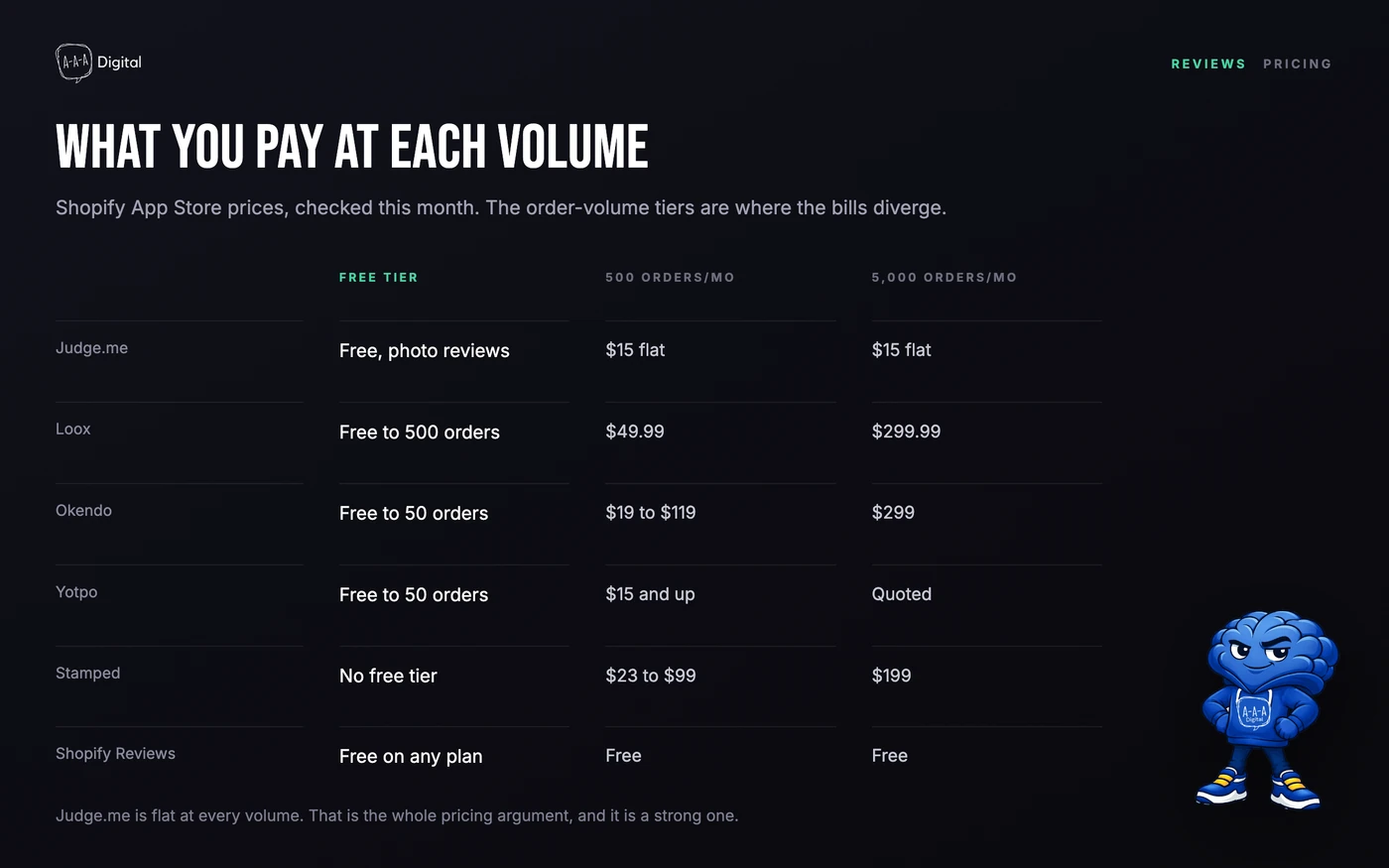
Two pricing models are in play. Judge.me charges a flat fee and ignores volume. Everyone else charges by order band, which means the app gets more expensive precisely when the store is working.
At 500 orders a month the difference is small: $15 against $23 to $49.99. At 5,000 orders it is $15 against $199 to $299.99. Over three years that gap is a hire, or a year of creative production. Model it at your projected volume rather than today's, because switching later costs you the review base.
Then add the costs that never appear on a pricing page: theme work to place the widget, developer time if the app's output conflicts with your theme, and the migration itself. A $15 app plus two days of developer time is not a $15 app in year one. Ask for the import tool before you sign, and test it on a duplicate theme rather than the live store.
What each one costs you in page speed
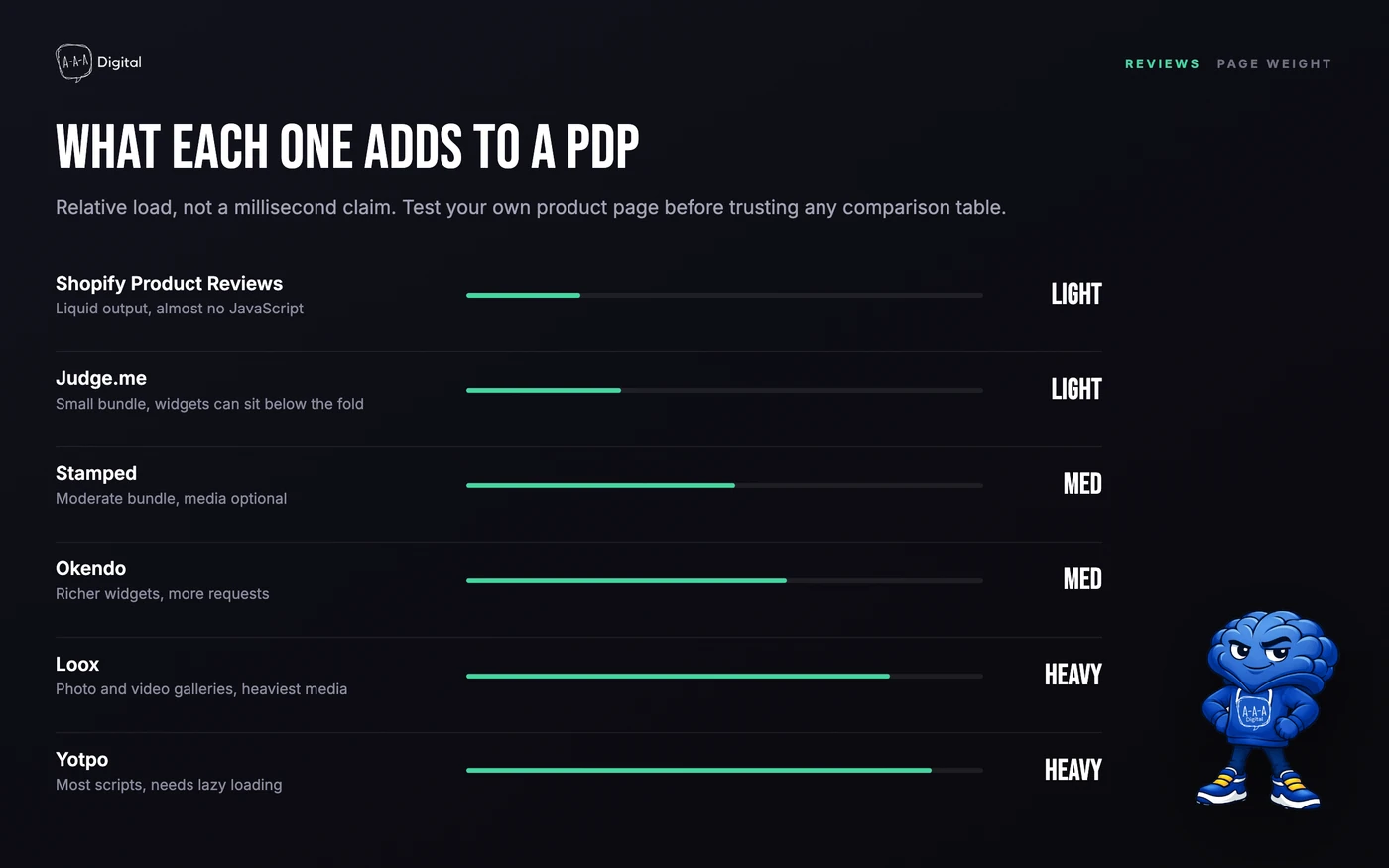
Almost every widget on this list is injected by JavaScript, so almost every one costs something in main-thread time. The differences come from three places: how many separate requests the widget makes, whether it loads images and video thumbnails, and whether it waits for the fold.
Shopify's own app wins by default because it renders in Liquid. Judge.me is next, with a small bundle and widgets you can place low on the page. Okendo and Stamped sit in the middle. Loox and Yotpo carry the most media and the most script.
You can fix most of it without switching apps. Load the widget below the fold, defer the app script, cap the gallery to a handful of images on mobile, and never put a video carousel above the buy button. Then check the result in PageSpeed Insights on a real product page rather than the vendor's demo. If the theme is already slow, fix that first; page speed work pays back on every template, not just this one.
Google rich results: what you get, and what changed
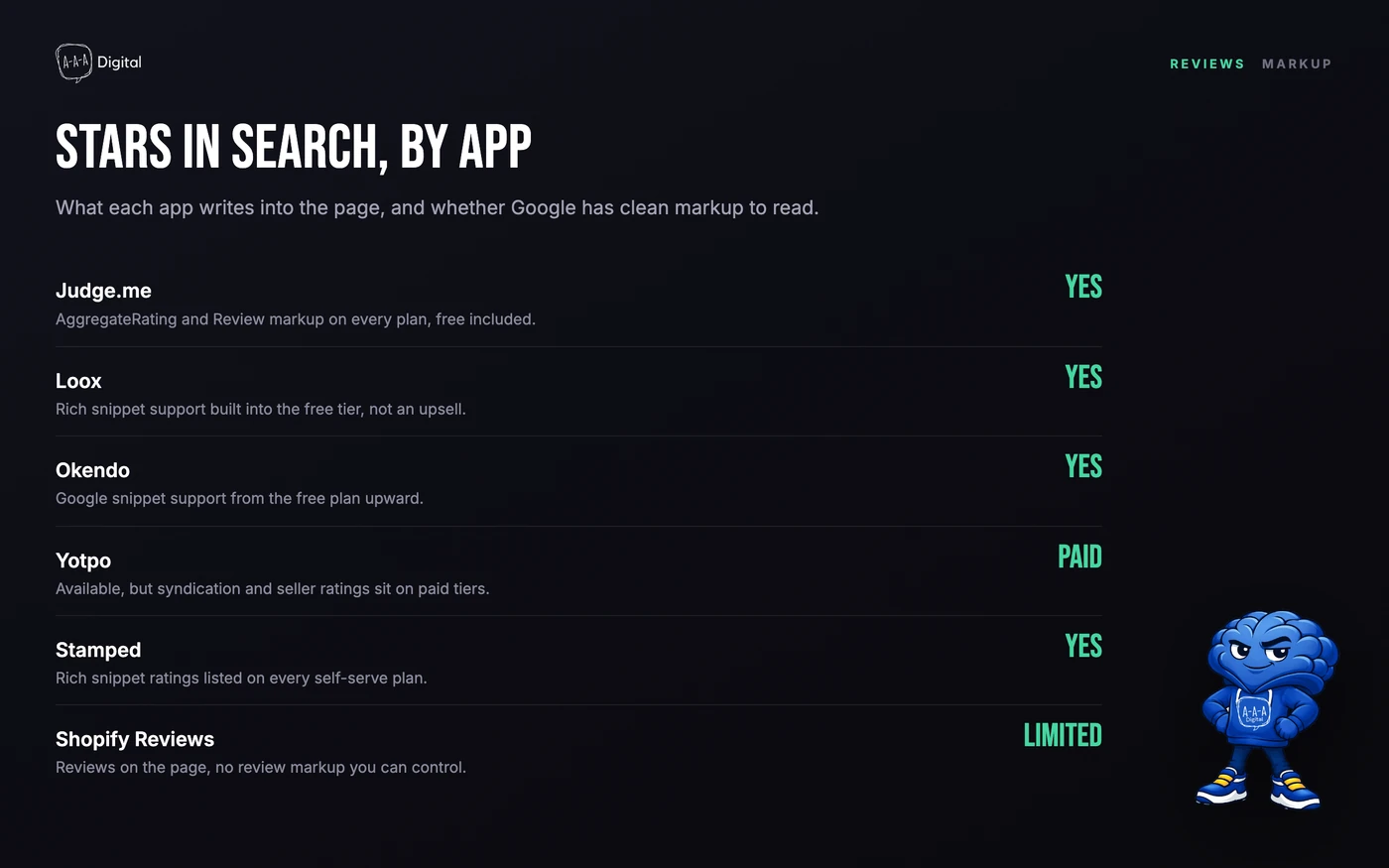
Five of the six apps output AggregateRating and Review markup on Product pages, which is what makes a page eligible for stars in Google results. Judge.me, Loox and Okendo include it on the free plans. Yotpo includes it, with syndication and seller ratings on paid tiers. Stamped lists rich snippets across its self-serve plans. Shopify's app leaves you with reviews on the page and no markup you control.
Two things to keep in perspective. Google shows star snippets on a much smaller share of queries than it did a few years ago, so an app's schema support is a tiebreaker rather than a strategy. And the stars buyers see in Shopping ads come from merchant feeds and Google Customer Reviews, not from your theme. Neither is a reason to skip the markup. Both are a reason not to choose an app on markup alone.
The mistake that actually costs people stars is running two apps at once. Two sets of review markup on one product page is duplicate structured data, and Google will pick one or ignore both. Uninstall the old app fully, including its snippet, before the new one goes live. If you want the schema details, our structured data guide covers the fields that matter.
Which store size each suits
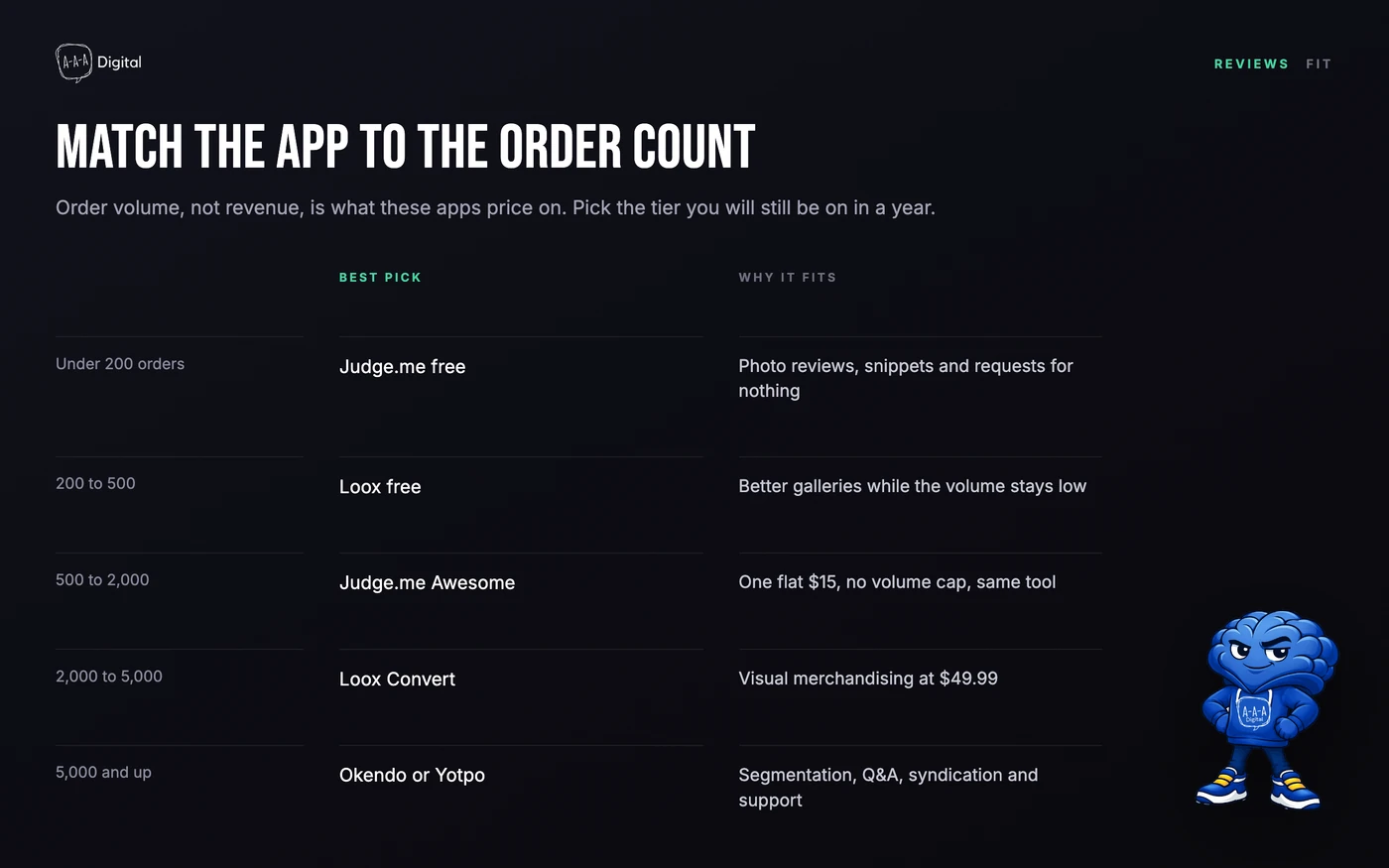
Under 200 orders a month, install Judge.me free and spend the money on product photography instead. Between 200 and 500, Loox free is a defensible pick if the catalogue is visual, because you are paying nothing either way.
From 500 to 2,000 orders, Judge.me Awesome at $15 is the value answer and Loox Convert at $49.99 is the merchandising answer. Stamped's 1,000-order tier sits at $99, which is harder to justify unless you also want its loyalty product. What you are buying at this volume is display quality and support speed, not collection.
Then the band nobody quotes for: 5,000 orders and above. At that point look at what each app does when something breaks in December, whether you get a named contact, and whether the app can syndicate reviews across storefronts. That is Okendo and Yotpo territory, and it is a procurement decision rather than a widget decision.
What we deploy on client stores, and why
Judge.me is our default, on roughly four out of five builds.
The reasons are unglamorous. Flat pricing means the app does not get more expensive as the store succeeds. The free tier is good enough to run for months, so a new client is not paying for software before the traffic exists. The markup is clean, the widget code is light, and migration out of it is straightforward if the store outgrows it. Most stores never do.
We move clients to Okendo when they need attribute-based segmentation, a loyalty program on the same data, or multi-market storefronts with different proof requirements. We use Loox when the product is genuinely visual and the client will invest in photo collection, because the galleries sell in a way Judge.me's cannot. We rarely recommend Yotpo below enterprise scale; the cost and the script weight need a real justification.
One rule we hold to: the app has to earn its place on the product page. If the widget sits at the bottom and nobody scrolls to it, the money is better spent on review requests. Placement and photo quality move conversion more than the vendor logo does, which is the same argument behind our product page conversion work.
Switching apps without losing reviews
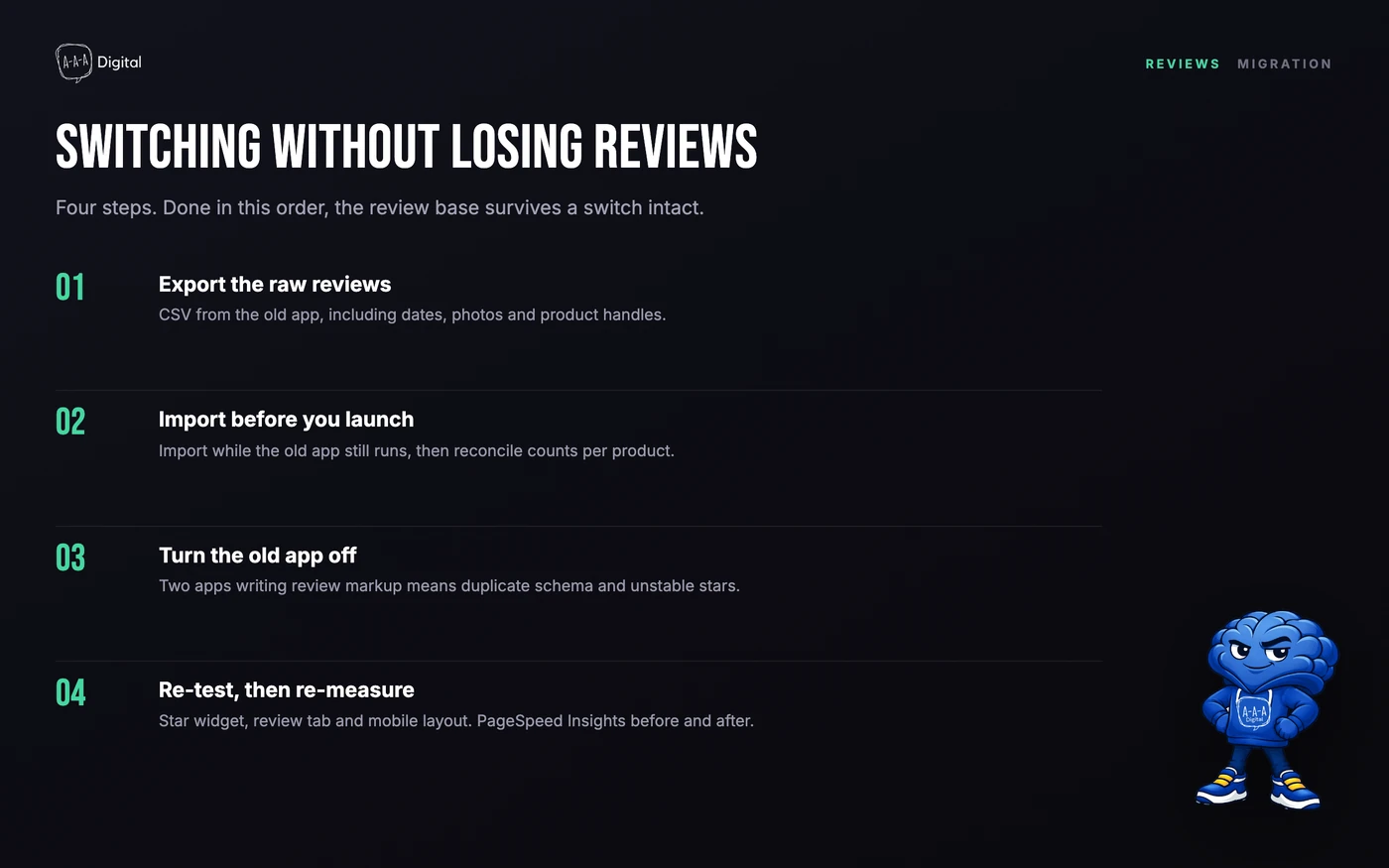
Reviews are the one asset a theme change or app swap can destroy permanently, and support tickets do not bring them back.
Export the raw data before anything else: dates, ratings, review text, photo URLs and product handles. Import into the new app while the old one is still running, then reconcile counts per product, because imports silently drop rows with mismatched handles. Only then turn the old app off. Finish by checking the star widget, the review tab and the mobile layout on your three best sellers, and compare PageSpeed Insights before and after.
Two compliance points while you are in there. Incentivising reviews with a discount is allowed in most markets if it is disclosed and applies to all reviewers. Filtering out negative reviewers before they can post is not, and the FTC has been explicit about it. Trust badges and review counts only work when the reviews are real.
Before you install anything
Decide two things first: your order volume next year, and whether photo reviews are central to how the product sells. Those two answers pick the app.
Then install one app, place the widget where people actually scroll, and set up a request email that goes out seven to fourteen days after delivery. That sequence, not the vendor choice, is what produces reviews.
Run the install as a small project rather than a click. Export the existing reviews. Install on a duplicate theme. Place the widget below the buy box, never inside it. Send one test request to yourself and check the email on a phone. Validate the markup in Google's Rich Results Test. Measure the product page on mobile before and after. Only then publish, and only then remove the old app.
One more constraint worth weighing: pick a vendor you can leave. A documented export, a CSV import and clean theme snippets matter more than a widget you will use twice a year. The store that can switch in a day negotiates from strength at renewal time.
If conversion is the real project rather than the app, our Shopify CRO team can audit the product page and the review placement together.
