
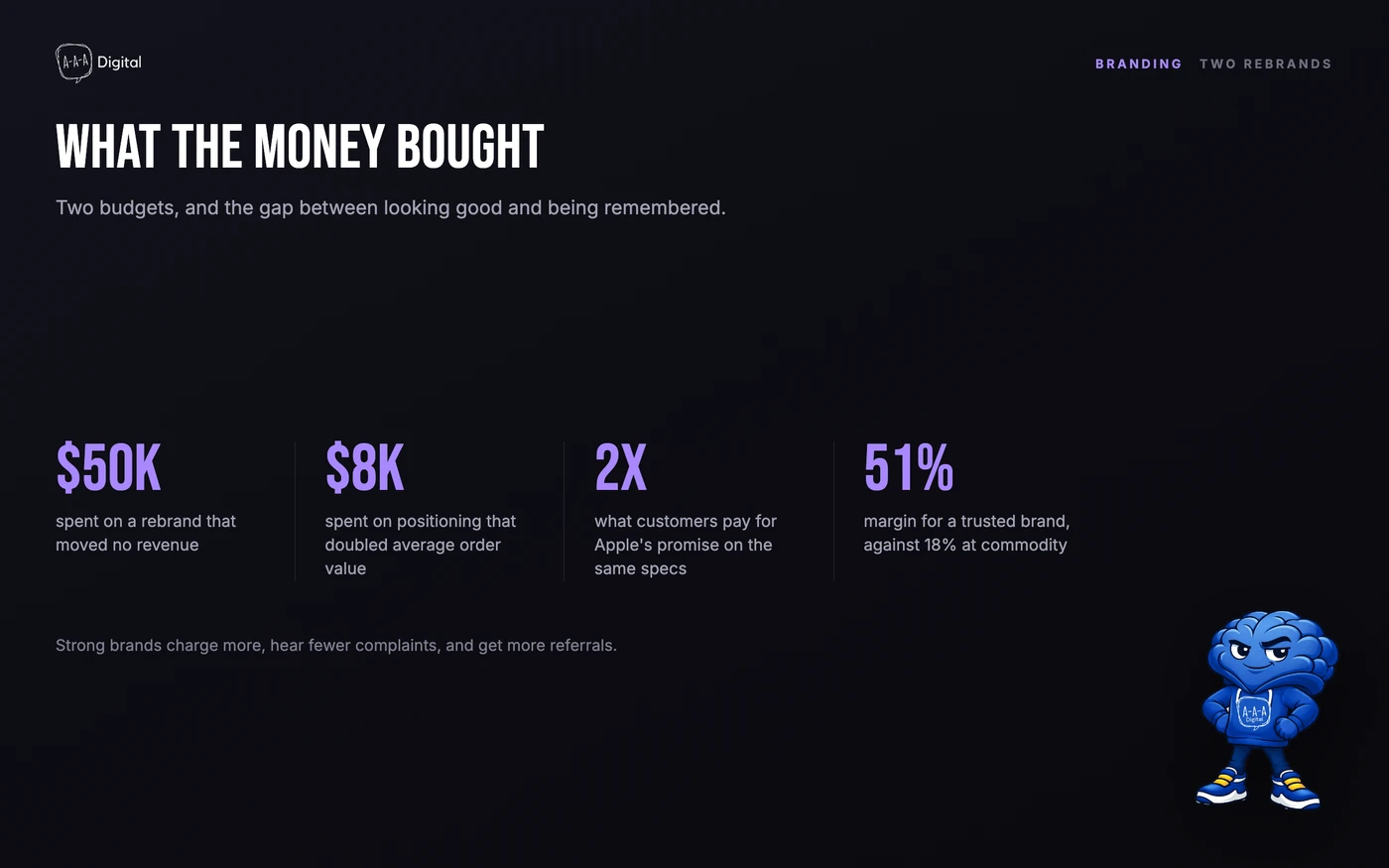
We have worked with brands that spent $50,000 on a rebrand and saw zero revenue impact. And brands that spent $8,000 on strategic positioning and doubled their average order value.
The difference? One focused on looking good. The other focused on being remembered.
What a Brand Actually Is
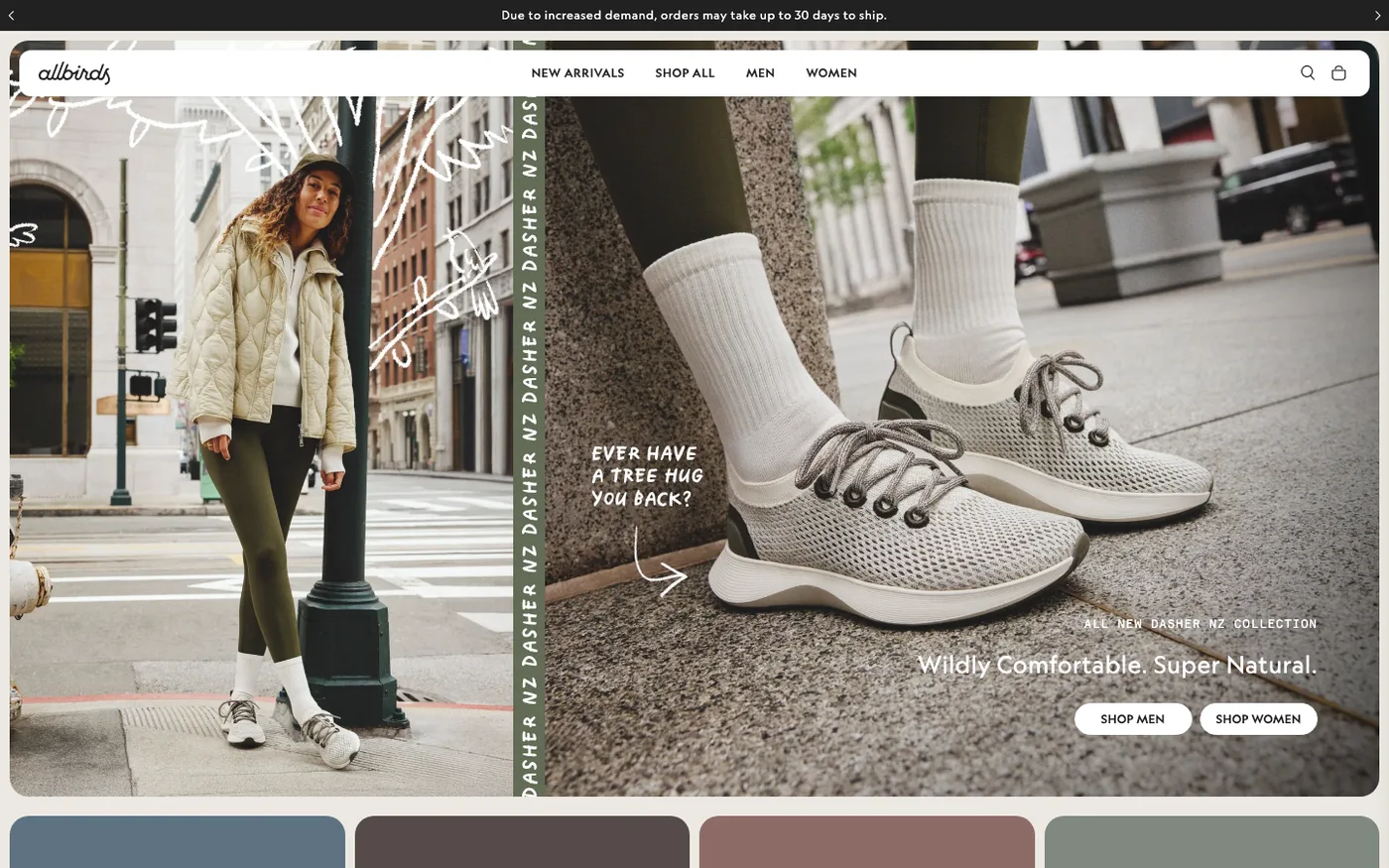
Your brand is not:
- Your logo
- Your colour palette
- Your Instagram aesthetic
Your brand is:
- The promise you make to customers
- The emotion they feel when they see your product
- The reason they choose you when a cheaper alternative exists
Apple does not win because of their logo. They win because their brand promise, "technology that just works, beautifully," is so deeply embedded that customers pay 2x for the same specs.
The Brand-Price Relationship
Here is what we see across our client base:
| Brand Strength | Price Sensitivity | Average Margin |
|---|---|---|
| Weak (commodity) | High | 18% |
| Moderate | Medium | 32% |
| Strong | Low | 51% |
Strong brands charge more. Customers complain less. Returns drop. Referrals increase.
The Four Numbers That Prove a Brand Is Working
"Brand" sounds unmeasurable until you decide which numbers stand in for it. These four live in your analytics, your store and your search console.
| Number | What it measures | How to read it | What moves it |
|---|---|---|---|
| Branded search share | Share of organic clicks from people typing your name | Rising means the promise is sticking. Flat means you are renting attention | PR, packaging, repeat purchase, word of mouth |
| Direct traffic share | Sessions with no referrer | The closest proxy to "I typed your name" | Naming, memorability, offline presence |
| Price realisation | Your average order value against the median for a comparable basket | A premium with no reason behind it shows up as discounting | Positioning and proof |
| Repeat rate within 12 months | Share of first-time buyers who buy again | The cheapest growth number you own | Product, post-purchase, the promise being kept |
If all four are flat while ad spend rises, the problem is specific: people meet you and forget you. The post-purchase experience is usually where that is fixed, because the promise is kept or broken in the week after the first order.
The Maths of Charging More
The claim that strong brands charge more is only useful if you know what a price rise costs you in volume. That number is arithmetic.
Take a $100 product with a 30% contribution margin, so $30 per unit. Raise the price 5% to $105 and contribution becomes $35, up 16.7%. You break even if you lose 14.3% of your units, because 30 divided by 35 is 85.7%.
The formula is one minus (old margin divided by new margin). At two different margin structures:
| Price rise | Volume you can lose at 30% margin | Volume you can lose at 50% margin |
|---|---|---|
| 3% | 9.1% | 5.7% |
| 5% | 14.3% | 9.1% |
| 8% | 21.1% | 13.8% |
| 10% | 25.0% | 16.7% |
| 15% | 33.3% | 23.1% |
At 30% margin, a 10% price rise can cost you a quarter of your units before profit falls. That cushion is why a brand with a reason to exist can raise prices while a commodity cannot. The margin maths is in our guide to improving ecommerce margins.
The 3-Part Brand Audit
Before we design a single visual element, we run every client through this audit:
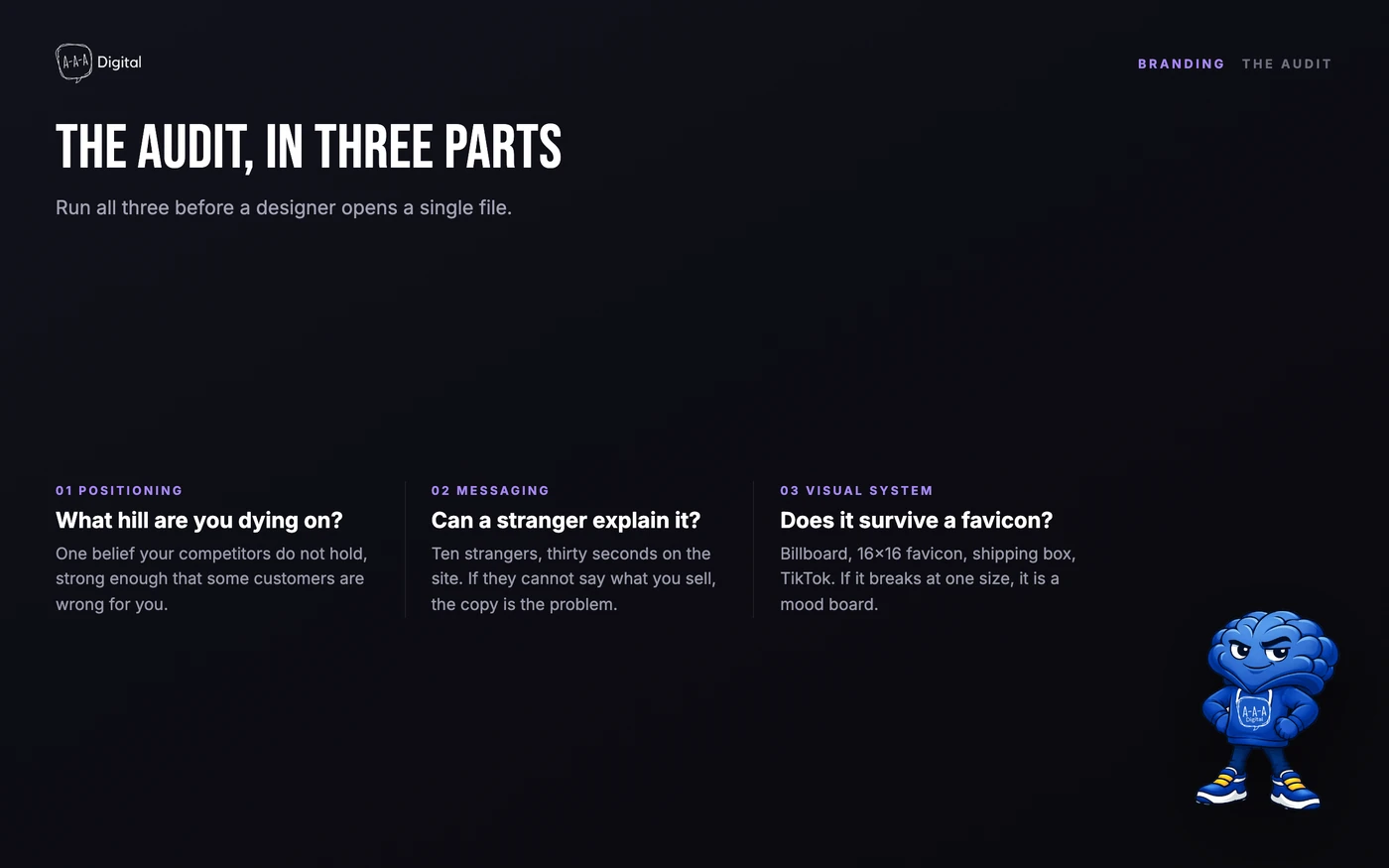
1. Positioning: What Hill Are You Dying On?
What is the one thing you believe that your competitors do not? What do you stand for that makes some customers wrong for you?
Example: Patagonia stands for environmental responsibility, even when it costs them sales. That conviction is what makes their brand magnetic to the right customers.
2. Messaging: Can a Stranger Explain What You Do?
Ask 10 people who do not know your brand to explain what you sell after 30 seconds on your website. If they cannot, your messaging is broken.
Fix: Write a one-sentence value proposition that a 12-year-old could repeat. Everything else is noise.
3. Visual System: Does It Scale?
Your brand needs to work on:
- A billboard
- A 16x16 favicon
- A shipping box
- A TikTok video
If your visual system breaks at any of these sizes, it is not a system, it is a logo with a mood board.
How to Write a Positioning Statement a Designer Can Use
Most positioning documents are three pages of adjectives. A designer cannot build from that. Use one sentence.
For [specific customer] who [situation], [brand] is the [category] that [single promise], because [proof]. Unlike [the default alternative], we [difference].
Strong: "For home espresso beginners tired of sour shots, Northwind is the espresso subscription that ships beans roasted within 48 hours of your order, because we roast to order and print the date on every bag. Unlike supermarket beans, ours are never more than two weeks old."
That sentence can be designed. It has a customer, an enemy, a proof point and a colour scheme hiding inside it.
Run three tests before you approve it.
The swap test. Replace your brand name with a competitor's. If it is still true, it is a category description.
The stranger test. Read it to someone outside the company. If they ask what you actually sell, rewrite it.
The exclusion test. Name three customers you are happy to lose. If you cannot, it is too broad to be remembered.
Once it holds, the same sentence should govern your product page copy and your packaging, not just the About page.
Where the Money Goes in an $8,000 Brand Project and a $50,000 One
The opening example is not a coincidence. The two budgets buy different things, and only one starts with strategy. Here is how we would split each.
| Line item | $8,000 positioning sprint | $50,000 full rebrand |
|---|---|---|
| Strategy and positioning | $3,000 | $10,000 |
| Naming and verbal identity | $1,500 | $6,000 |
| Visual identity | $2,000 | $12,000 |
| Site templates and build | $1,000 | $14,000 |
| Packaging and print re-runs | $0 | $6,000 |
| Launch assets | $500 | $2,000 |
| Total | $8,000 | $50,000 |
In the $8,000 version, 37% goes to strategy before anything visual exists. In the $50,000 version, more than 40% goes to work that has to be re-shot or rebuilt, and that is where budgets quietly double. Packaging reprints, new photography, ad creative showing the old logo, redirects and lost recognition are not in the design fee. A founder who approves $50,000 without a line for those has approved half a project.
Why Most Rebrands Fail
Rebrands fail when they are driven by boredom instead of strategy.
If your CEO is tired of looking at the old logo, that is not a reason to rebrand. If your conversion rate is dropping because customers cannot tell you apart from 5 competitors, that is.
When to Invest in Branding
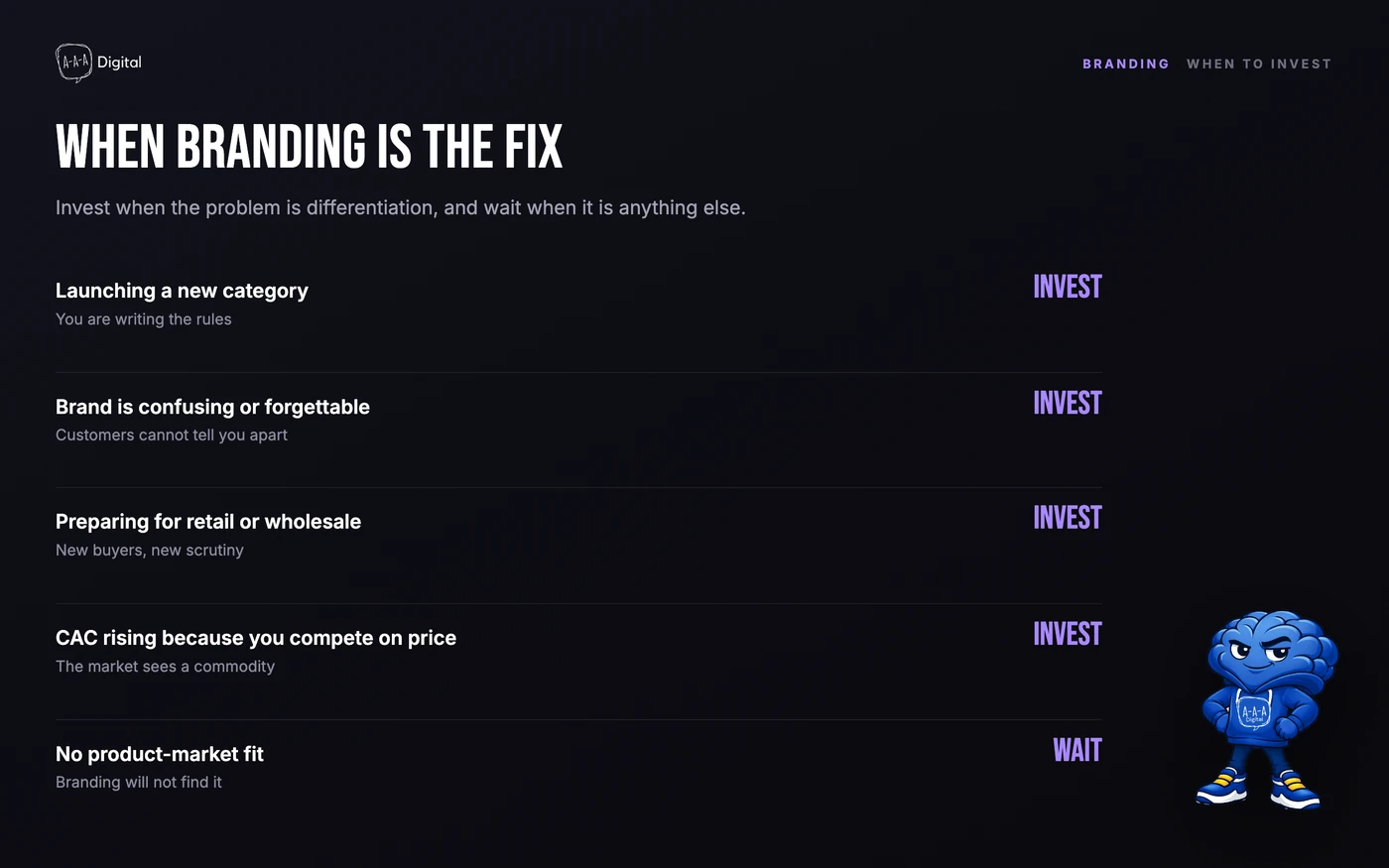
Invest in branding when:
- You are launching a new category
- Your current brand is confusing or forgettable
- You are preparing for retail/wholesale expansion
- Your customer acquisition costs are rising because you compete on price, a pattern our CAC benchmark breakdown explains
Do not invest in branding when:
- You have not found product-market fit
- Your problem is traffic, not conversion
- You just want "something fresh"
The 90-Day Brand Sprint
A positioning project does not need a year. It needs a baseline, a decision, and eight weeks of applying it.
Weeks 1 and 2: baseline. Pull the four numbers. Interview eight customers and ask what they would have bought instead. Skip this and the rest of the project becomes an argument about taste.
Weeks 3 and 4: decide. Write the positioning sentence, run the three tests, and kill every variant that fails the swap test. This is the week that decides whether the project changes revenue.
Weeks 5 to 7: build the system. Logo, type, colour, photography rules, and two page templates. Test the mark at favicon size and on a shipping box before you approve it.
Weeks 8 to 10: apply it. The ten highest-traffic pages, the packaging, the ad account, the email templates. Narrow and complete beats a half-finished rollout everywhere.
Weeks 11 and 12: launch and measure. Compare the four numbers against the baseline. Anything that has not moved is a promise problem, not a design problem.
Frequently Asked Questions
Does a rebrand increase sales?
Not on its own. A new logo changes recognition, not preference. Sales move when the promise and the proof behind it move, which is why the $8,000 positioning project beat the $50,000 rebrand.
How much should I spend on branding?
Enough to test the positioning before committing to visuals. A strategy sprint at roughly a sixth of a full rebrand budget tells you whether the promise is distinctive. If it is not, a bigger design budget makes a forgettable brand look better.
How do I know if my brand is the reason customers leave?
Look for discount requests before purchase and a flat repeat rate. If customers ask for a code before they buy, the brand is not carrying the price. If they buy once and do not return, the promise was not kept.
Can I rebrand without changing the logo?
Yes, and it is often the better move. Change the promise, the proof and the language, and keep the mark people already recognise. A new logo costs recognition. A new promise earns preference.
Want to find out if your brand is helping or hurting your revenue? Our branding team runs the 3-part audit, and a free brand discovery call will tell you whether the problem is the promise or the design.
