Last year, a client came to us with a familiar problem: $40,000 a month in ad spend, flat revenue. The obvious move would've been to cut the ad spend or rebuild the landing pages. But when we dug into their store, the checkout wasn't the leak. The leak was everything after it.
Customers ordered once and vanished. No confirmation flow worth the name. A default "Thanks for your order" email. Shipping updates that never came until the package showed up (or didn't). Reviews never requested, support emails answered a week late. They were spending money to acquire customers and then doing almost nothing to keep them.
The post-purchase experience is where most Shopify stores quietly lose their margins. We've worked on 200+ stores at AAA Digital, and this is the pattern we see over and over: merchants pour budget into acquisition while the retention side runs on autopilot. In this post, we'll walk through the exact system we build for clients: order confirmation, shipping communication, review requests, loyalty, and the metrics that actually tell you if any of it is working.
Why Retention Beats Acquisition on a Shopify Budget
The math is not close. Acquiring a new customer in most categories costs five to twenty-five times more than retaining an existing one. For a Shopify store paying $30–$60 per first purchase through Meta or Google ads, a repeat buyer who costs nothing to re-engage is pure margin.
There's also a compounding effect most merchants miss. Repeat customers convert at higher rates, spend more per order over time, and refer friends without being asked. A store with a strong retention engine can spend more on ads than competitors and still win, because each customer is worth two or three times more than the competitor's.
And yet. When we audit stores, the budget split is usually 95/5 in favor of acquisition. Nobody owns retention. Nobody gets measured on it. If that sounds like your store, this is the section to read twice.
The Post-Purchase Experience Touchpoints Every Store Gets Wrong
Before apps and automation, fix the basics. These four moments decide whether a first-time buyer comes back.
Order confirmation. Shopify's default confirmation email is fine. "Fine" doesn't build a brand. The confirmation is the highest-open email you will ever send, customers are waiting for it, refreshing their inbox. Use it. Thank them by name, set expectations for shipping times honestly, and give them one next step: follow you on Instagram, read your care guide, use their product the right way. Don't stuff it with a discount code. They've already bought. Pitching them again this early reads desperate. State your cancellation window plainly in the same email; it prevents the back-and-forth our guide to cancelling Shopify orders describes.
Shipping communication. "Where is my order?" is the single most common support ticket in ecommerce, and most of it is preventable. Send a shipping confirmation the moment the label is created, a transit update if the carrier provides one, and a delivery confirmation. If you ship with calculated timelines, say so upfront. Silence between payment and delivery is what creates refund requests and chargebacks. If you sell pre-orders, the ship date is the whole relationship; our pre-order guide covers how to set that expectation before the sale.
Delivery and the unboxing. The package arrives. What happens? If the answer is "nothing," you're leaving money on the table. A simple insert, a thank-you card, care instructions, a review request with a QR code, costs pennies and drives reviews and repeat orders. We're not fans of oversized branded boxes for stores shipping thousands of small orders; the cost per unboxing rarely justifies the box. A well-designed card does the job.
The post-delivery check-in. Five to ten days after delivery, send a check-in email. Not a review ask, not a sales pitch. Just: "How's the product working out?" Ask a one-question reply. The replies you get are gold, objections to fix, use cases to write about, product issues to catch before they become one-star reviews. Then follow up with the review request a few days later, now that you know the customer is happy.
Building the Retention Stack (Without App Bloat)
Now the tooling. The mistake we see most often isn't under-investment, it's over-investment. Merchants install six retention apps, each loads its own scripts, page speed tanks, and the apps overlap or conflict.
Here's the lean stack we typically recommend:
-
Email/SMS backbone: Klaviyo. It's the industry standard for a reason. Flows (automated sequences) for welcome, abandoned cart, post-purchase, winback, and replenishment cover 90% of what a retention program needs. The Shopify integration is deep and the segmentation is genuinely good. Yes, it's more expensive than Mailchimp. It also makes more money than Mailchimp.
-
Order tracking: AfterShip or Malomo. Reduce WISMO tickets by giving customers a branded tracking page instead of sending them to a carrier's site. Malomo leans more into marketing (upsells on the tracking page); AfterShip is the safer, cheaper pick. One of these, not both.
-
Reviews: Judge.me or Okendo. Judge.me is the value pick and handles 90% of stores. Okendo makes sense at higher volume when you want photo reviews and attributes baked in. Collect reviews automatically off your post-purchase flow, and display them on product pages, they're CRO gold.
-
Loyalty: LoyaltyLion, Smile.io, or Yotpo Loyalty. Only add this once the basics are running. Loyalty programs work best for stores with repeat-purchase products (consumables, supplements, fashion) and average order values above roughly $60. For a store selling $25 one-off gifts, loyalty programs rarely move the needle enough to justify the monthly fee and the site weight.
What we deliberately leave out: most popup apps (Klaviyo's built-in forms are enough), standalone SMS apps (use Klaviyo's SMS), and gamified referral apps until there's proof customers actually refer.
One real conflict to know about: review apps and some loyalty apps both inject widgets into order confirmation pages and both fire post-purchase emails. If you install them together, map out exactly who sends what, or customers get three emails in one day asking for things. We've seen this exact collision cause unsubscribe spikes.
The Flows That Drive Repeat Purchases
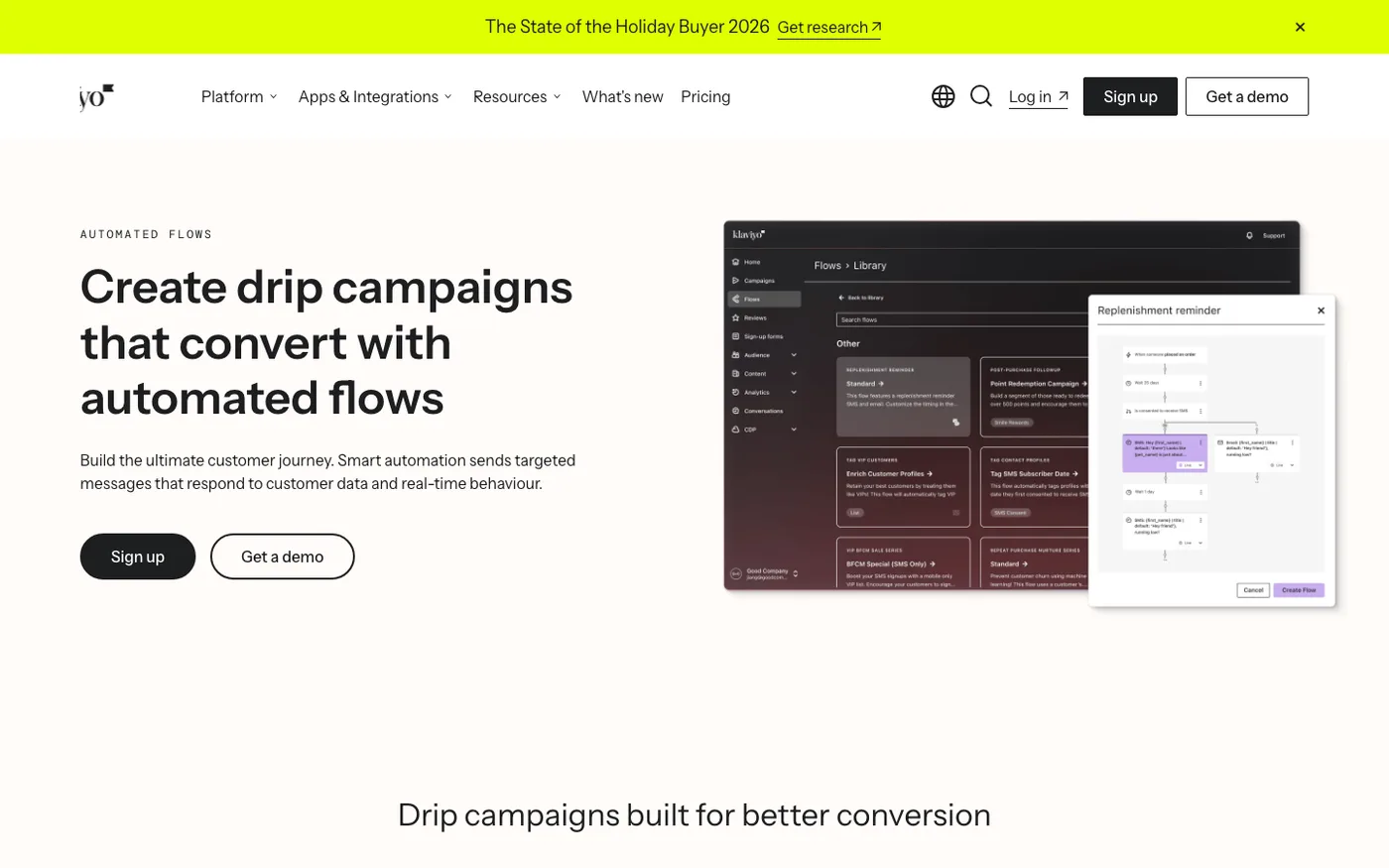
Once the stack is in place, build these flows in order of impact. In Klaviyo, these live under Flows, and each triggers off Shopify events.
Post-purchase thank you (triggered on fulfillment): The sequence described above, confirmation, shipping, delivery, check-in, review request. Split it into two branches: first-time buyers get education about the product; repeat buyers get cross-sells based on what they bought.
Replenishment or cross-sell (timed to consumption): If your product runs out, skincare, coffee, supplements, email the customer right before they'd need to reorder. Time it off your product's actual usage cycle, not a generic 30 days. This one flow routinely becomes the top revenue-generating email in a store.
Winback (90–180 days after last order): "We haven't seen you in a while" emails work better than most merchants expect, especially with a genuine reason to return: new products, improved formulations, a real incentive. Cap the discount, if 30% off is the only reason anyone returns, you have a product problem, not a marketing problem.
Browse abandonment and cart abandonment: Not strictly post-purchase, but they belong in the same system since they're built on the same events. Don't run these with huge discounts on day one; start with a reminder, save the incentive for the second or third touch.
For each flow, measure revenue per recipient, not just open rate. Opens are inflated by Apple Mail privacy changes; revenue is the number that pays the bills.
Measuring What Actually Matters
Stores drown in retention metrics. Four are enough to start:
- Repeat purchase rate: the percentage of customers who buy again. Shopify reports this under Analytics. Benchmarks vary wildly by category, but under 20% for a consumables-adjacent store means the post-purchase experience needs work.
- Time to second purchase: how long the average customer takes to come back. This tells you when to fire replenishment and winback flows.
- Customer lifetime value (LTV): average revenue per customer over time. Rising LTV is the whole point of retention work. If it isn't moving after six months, the system isn't working.
- Refund and chargeback rate: a post-purchase problem detector. Spikes here usually trace back to shipping communication failures, not product failures.
Review these monthly in Shopify Analytics, with Klaviyo flow revenue alongside. If you're investing in paid acquisition, and most of our clients are, tie this back to the economics. Higher LTV means you can pay more per acquisition. That's the compounding loop that makes retention the quiet growth lever: our performance marketing work always runs retention-aware for this reason.
Frequently Asked Questions
What is post-purchase experience in ecommerce?
It's everything a customer encounters after they complete checkout: order confirmation emails, shipping updates, delivery, packaging, review requests, support, and any loyalty or winback communication. It's often called the second funnel, because a first purchase is really just the start of the relationship, or the end of it, if the post-purchase experience is neglected.
How do I improve my Shopify store's post-purchase experience?
Start with communication, not apps. Fix your order confirmation, shipping updates, and a post-delivery check-in email first, those three changes alone cut support tickets noticeably. Then add automated email flows in Klaviyo, a tracking page, and a review app. Loyalty programs come last; they're seasoning, not the meal.
Which apps do I need for post-purchase retention?
The lean stack we deploy most often is Klaviyo for email and SMS, AfterShip or Malomo for order tracking, and Judge.me for reviews. Add a loyalty app like LoyaltyLion or Smile.io only if your products have natural repeat-purchase cycles. Resist installing everything at once; each app adds script weight and another email sender to coordinate.
How long should a winback email flow be?
Two to three emails over about two weeks. The first is a genuine "we miss you" note with no discount, the second introduces a reason to return, and the third can carry an incentive. Beyond three emails, you're training customers to wait for discounts, and unsubscribes climb fast.
Does post-purchase experience really affect SEO?
Indirectly, yes. Better post-purchase experience drives more reviews, and reviews improve product page conversion and add fresh user-generated content. Fewer refund requests and chargebacks protect your payment standing, and brands with strong retention get more branded searches and direct traffic. None of this replaces technical SEO, but it compounds with it.
Get Help With This
Building a retention system takes honest work: mapping flows, coordinating apps, and measuring what actually moves LTV. If you'd rather have it done right than assembled app-by-app, our team can audit your post-purchase flow and build the retention engine, from email automation to loyalty to the reporting that proves it's working.
