An ecommerce agency runs the six jobs that grow an online store: acquisition, conversion rate optimization, retention, creative, data, and development. That is the whole definition. Everything else, the pitch decks, the service pages, the retainer tiers, is packaging around those jobs. Here is what each job involves day to day, what changes when you hire one, what it costs, and the red flags that should send you walking.
I run one of these agencies, so read this as insider detail rather than a neutral overview. We have shipped all six jobs for stores on Shopify, and we have also watched merchants burn budget with agencies that did three of the six badly. Both experiences are in this post.
The Six Jobs an Ecommerce Agency Actually Does
Every agency service page lists more than six things. Strip the synonyms away and an ecommerce agency does six jobs. If a store is growing, all six are getting done, by an agency, by an in-house team, or by the owner at midnight.
1. Acquisition. Getting new people to the store. This is paid ads on Meta and Google, SEO, marketplaces, and the occasional affiliate program. The real job is buying attention at a cost that leaves margin. Our rule on the performance marketing side: nothing scales past $100 a day until it has held break-even CPA for 14 straight days. Agencies that skip that rule are renting you revenue spikes.
2. Conversion rate optimization. Turning more of the visitors you already have into buyers. A/B testing, checkout fixes, page speed, offer structure. This is the highest-return job on the list. A store doing $100,000 a month that converts 15% better adds $15,000 a month in revenue with zero extra ad spend. No ad campaign can say that.
3. Retention. Getting existing customers to buy again. Email flows, SMS, loyalty programs, subscriptions. Done properly, email alone drives 25 to 35% of a store's revenue. It is also the job owners neglect most, because the payoff arrives weeks later while the fire alarm of ad spend rings daily.
4. Creative. The ads, the video, the product photography, the landing page design. Creative is the biggest lever in paid social right now. The algorithms have flattened media buying, so the image and the hook decide who wins. We test 20 to 30 concepts to find one that scales. An agency without a creative function is selling you other people's templates.
5. Data. Analytics setup, dashboards, attribution. This job looks boring and is load-bearing. If your tracking is off by 20%, every decision downstream is off by 20%, including the ones the agency makes for you. Any agency that talks about spending before it talks about tracking has the order backwards.
6. Development. The store itself. Builds, migrations, speed work, app integrations, bug fixes. On the Shopify side of our work, this is the job that touches everything, because a slow or broken store makes the other five jobs more expensive.
| Job | What it covers | A number that shows it matters |
|---|---|---|
| Acquisition | Paid ads, SEO, marketplaces | Nothing scales past break-even CPA for 14 days |
| Conversion rate optimization | A/B tests, checkout, page speed | A 15% lift on $100,000 a month is $15,000 a month |
| Retention | Email, SMS, loyalty programs | Email drives 25 to 35% of store revenue |
| Creative | Ads, video, product pages | 20 to 30 concepts tested per winner |
| Data | Analytics, attribution, reporting | Tracking off by 20% poisons every decision |
| Development | Builds, speed, apps, fixes | Each extra second of load time costs about 7% |
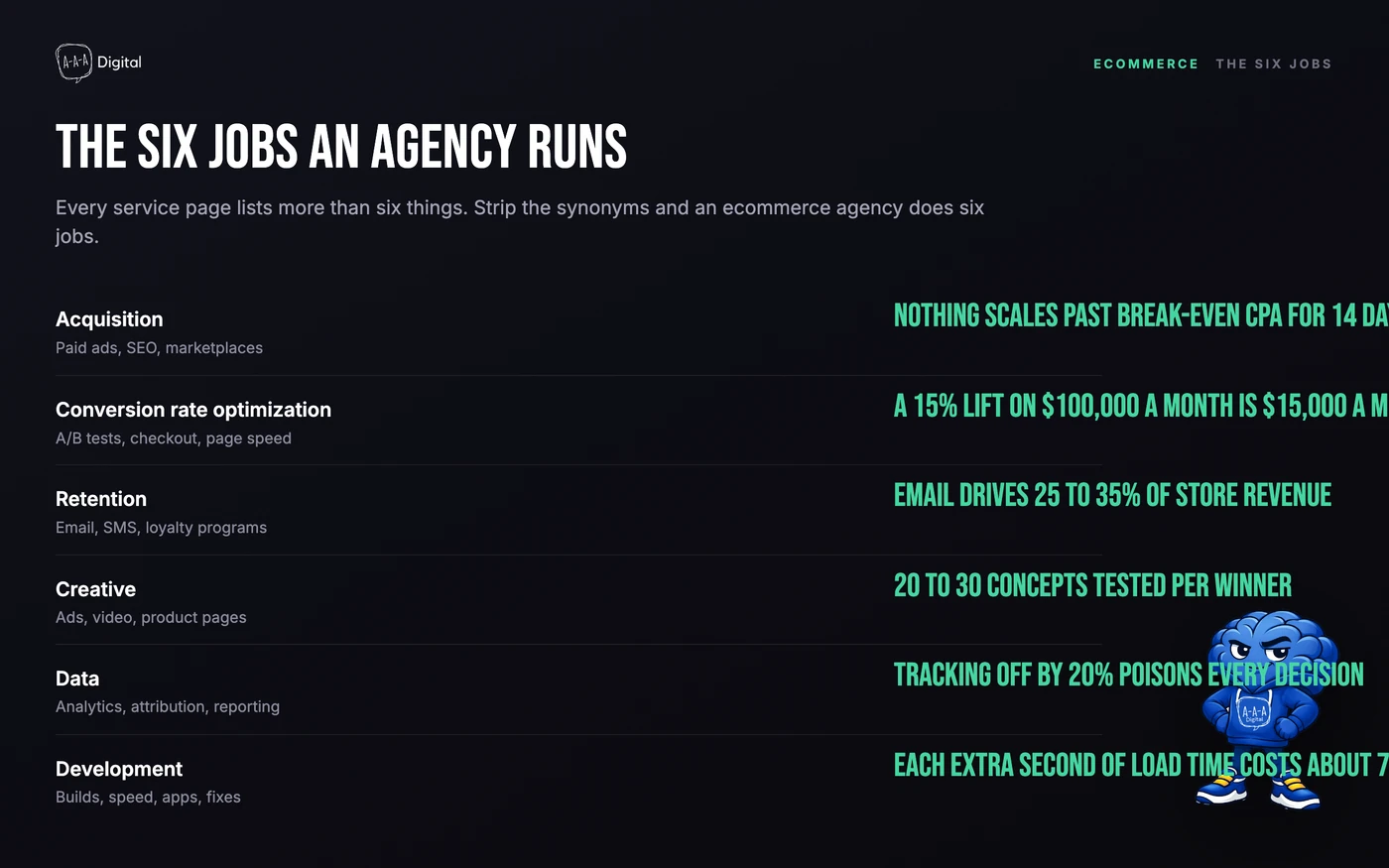
The row worth staring at is the second one. CRO and retention are the cheapest jobs on the list and the ones most often skipped, because agencies get paid more for acquisition and development. Ask any candidate agency which of the six they are weakest at. The honest answer tells you more than the case studies.
The Three Agency Shapes
"Ecommerce agency" covers three very different animals. Knowing which one you are talking to prevents most bad hires.
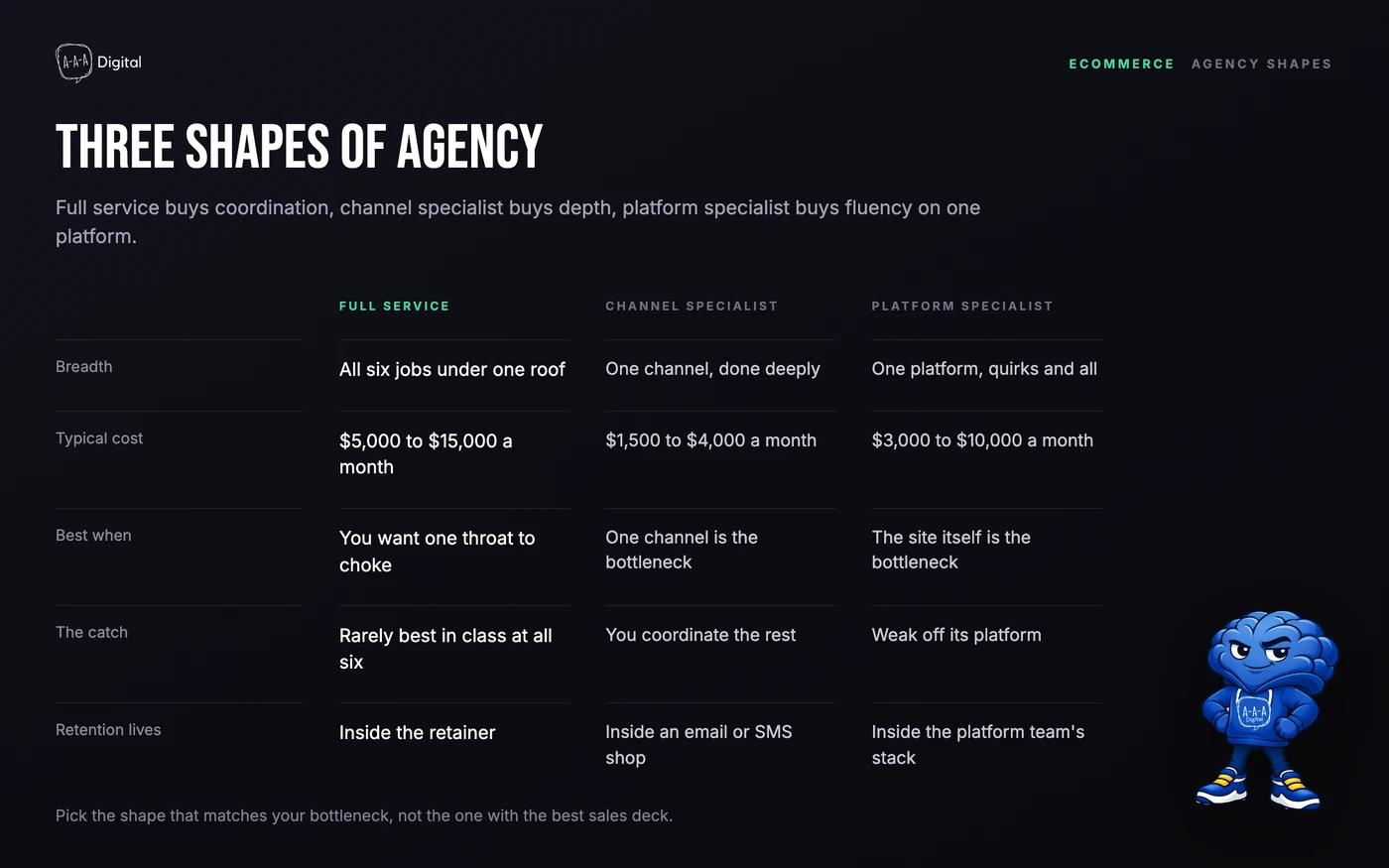
Full service. All six jobs under one roof. One contract, one weekly call, one throat to choke. The cost is real money, usually $5,000 to $15,000 a month, and the honest tradeoff is depth. A full-service shop is rarely the best in class at every channel it sells.
Channel specialist. One channel, done deeply. A paid social agency, an email agency, an SEO agency. The best results per dollar usually come from here, because the team does one thing all day. The catch is coordination. Someone on your side has to make four specialists point in the same direction, and that someone is usually you.
Platform specialist. Deep expertise on one platform: a Shopify agency, a Magento agency. They know the platform's quirks, app ecosystem, and limits cold. If your store is on Shopify and you need builds, migrations, or platform-specific SEO, this is usually the right shape. Our ecommerce SEO service sits in this category, and so does our Shopify development work.
Most growing stores end up with a mix: one platform specialist handling the site, one or two channel specialists handling traffic, and retention living inside one of them. There is no prize for hiring a single agency to do everything.
What Changes When You Hire One
Owners imagine the change is deliverables. It is not. The deliverables were always available. What changes is the operating rhythm.
Meetings. Expect a weekly or biweekly working call and a monthly review that looks at numbers, not activity. If an agency proposes daily standups, they are billing you for process theater. Propose quarterly check-ins and they are a vendor, not a partner.
Reporting. A real agency gives you two things: a dashboard you can open at any time, and a short written summary each month that says what happened, why, and what changes next. If the report leads with impressions and clicks instead of revenue and margin, ask for a rewrite. Twice.
Who owns what. This is the part that quietly kills engagements. The agency owns execution: campaigns, tests, flows, code. You own decisions: product, pricing, brand, offers. The moment an agency starts setting your pricing for you, or the moment you start rewriting their ad copy line by line, the arrangement is broken and both sides know it.
The word "no." A good agency says it. The best month we ever gave a client was the month we talked them out of a $25,000 replatform they did not need. An agency that agrees with everything you say is billing you for comfort, and comfort does not convert.
How to Choose an Ecommerce Agency
Three tests do most of the filtering. We published a version of this as a Shopify agency checklist, and the tests generalize to any ecommerce hire.
Read case studies backwards. Everyone reads the ending: "380% revenue growth." Start at the beginning. What was the store doing before? What was the budget? Over how many months? A 380% lift on $4,000 a month is $15,200 a month, which is a different story than the same percentage on $400,000. Case studies hide the denominator by design. Find it.
Ask who touches the account. The polished person on the sales call is rarely the person doing the work. Ask to meet the actual account manager and the people executing before you sign. Good agencies say yes in the first call. Ours does, because the people on the call are the people on the account.
Start with a trial project. Do not open with a six-month retainer. Open with a scoped two to four week project: an audit, a CRO sprint, one campaign build. You will learn more about how an agency communicates, estimates, and handles bad news from one small project than from ten sales calls. If the trial goes well, scale the engagement. If they refuse a trial, that is data too.
What an Ecommerce Agency Costs
Ranges, not a single number, because the shape of the engagement moves the price more than the agency's logo does.
| Engagement type | Typical range | What you actually get |
|---|---|---|
| One-off project | $3,000 to $25,000 once | An audit, build, or migration with a defined end |
| Single channel retainer | $1,500 to $4,000 a month | One of the six jobs, done consistently |
| Multi channel retainer | $3,000 to $10,000 a month | Several jobs plus someone coordinating them |
| Base plus commission | $1,000 to $3,000 base plus 5 to 15% of tracked revenue | Shared risk, and an attribution argument every month |
| In-house hire, per person | $8,000 to $15,000+ a month | One specialist, no redundancy, no QA layer |
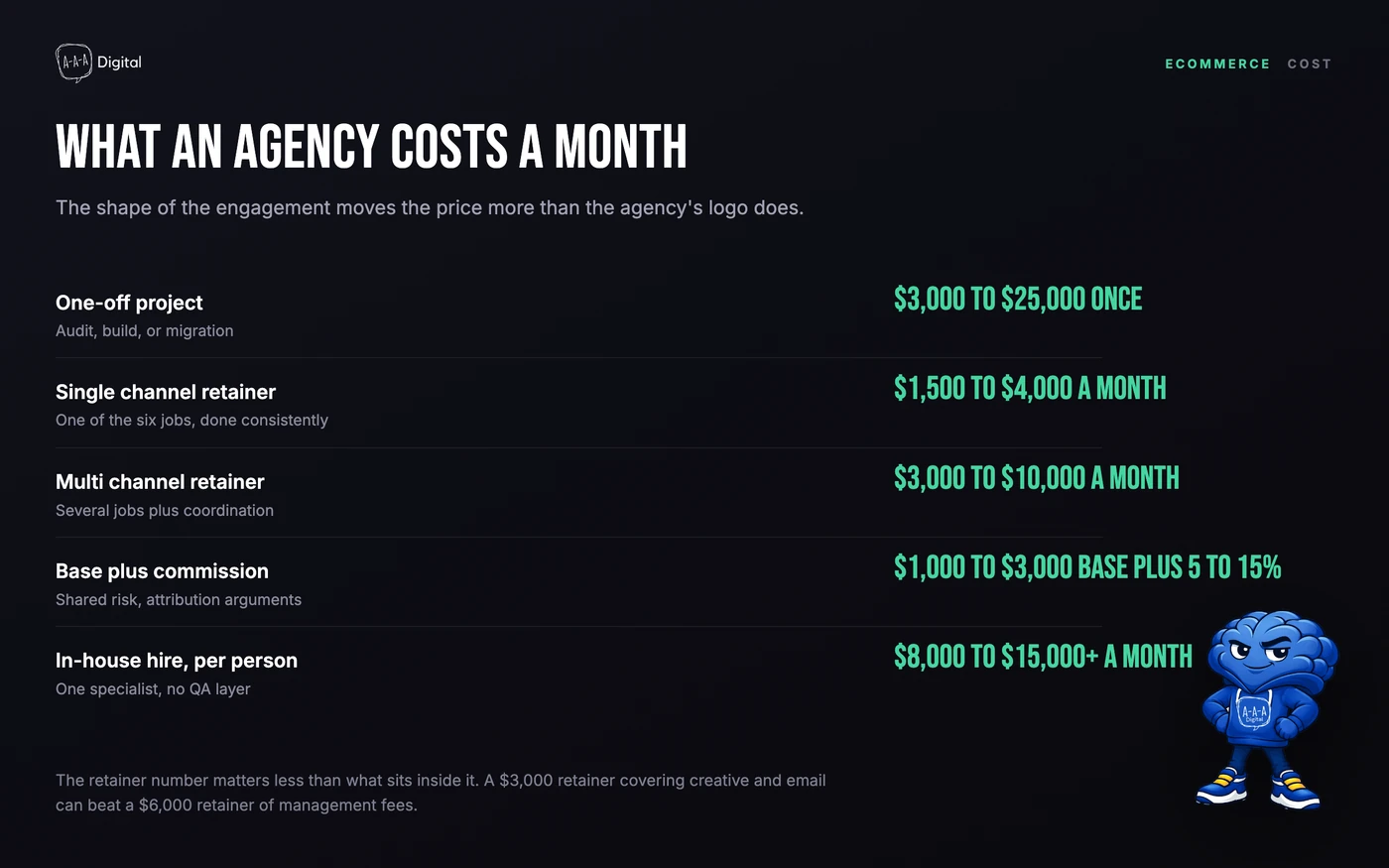
Two things to know about these ranges. First, pricing far below them usually means juniors doing senior work, or a loss leader that recovers its margin later through markups and scope creep. Second, pricing far above them needs to show up in the work as senior hands and real creative volume, not as account management overhead. We track what a fair engagement looks like in our breakdown of what a Shopify expert costs, and the pattern holds across agency types. We have been on both sides of every row in that table.
Red Flags
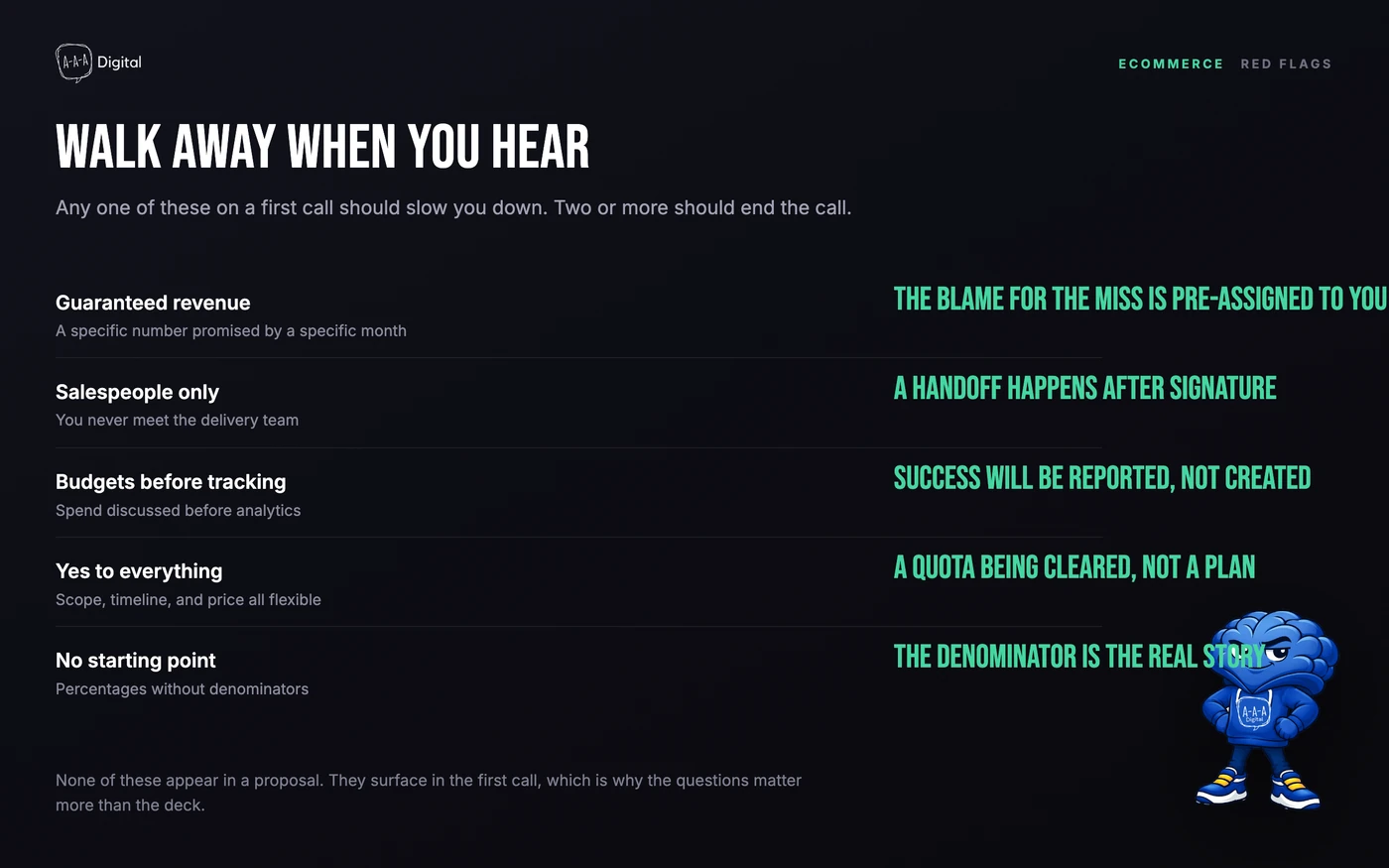
Short list. Any one of these on a first call should slow you down. Two or more should end the call. We hold ourselves to the same five.
- Guaranteed revenue numbers. No one can promise a specific revenue figure in a specific month. Anyone who does has either already decided to blame you for the miss, or has no plan for the miss at all.
- You only ever meet salespeople. If you cannot meet the delivery team before signing, you will meet them only when something goes wrong.
- Budgets before tracking. An agency that talks spend before analytics is planning to report success, not create it.
- Yes to everything. Scope changes, timeline cuts, price discounts, all accepted instantly. That is a quota being cleared, not a plan being made.
- Case studies with no starting point. Percentages without denominators. Growth without budgets. If they cannot show where the client started, ask why.
Frequently Asked Questions
What does an ecommerce agency do?
An ecommerce agency runs the six jobs that grow an online store: acquisition, conversion rate optimization, retention, creative, data, and development. Day to day that means buying traffic, improving the store's conversion rate, setting up email and SMS flows, producing ad creative, keeping analytics accurate, and maintaining or building the site. Full-service agencies do all six. Specialists do one or two of them deeply.
What is the difference between an ecommerce agency and a marketing agency?
A marketing agency usually means a brand, content, or ads shop that works across industries. An ecommerce agency specializes in online stores, which means it owns the parts a general agency hands back to you: the platform itself, checkout, product feeds, app stack, and store metrics like conversion rate and average order value. If your business is a store, the specialist almost always integrates faster.
How much does an ecommerce agency cost per month?
Single channel retainers typically run $1,500 to $4,000 a month. Multi channel retainers run $3,000 to $10,000. One-off projects like audits, builds, and migrations run $3,000 to $25,000. Anything priced far below these ranges is usually cutting the QA layer or staffing with juniors, and you pay the difference later in rework.
Is an ecommerce agency worth it for a small store?
Usually not below roughly $20,000 a month in revenue, unless you have a specific problem with a clear fix. Below that level, your money goes further with a freelancer for bounded tasks, and your own time is the growth lever. Above it, the compounding jobs, CRO, retention, and SEO, start paying back more than the fees. We covered the freelancer side of that math in our agency vs freelancer comparison.
How long does it take to see results from an ecommerce agency?
Paid ads can show signal in two to four weeks. CRO tests usually need four to eight weeks per learning cycle. And SEO and retention compound over three to six months. Any agency promising big numbers in the first month is selling you a spike, not a system. The honest pitch sounds slower and ends with owned growth instead of rented reach.
Should I hire one agency or several specialists?
Start with the shape that matches your bottleneck. If the store is technically weak, hire the platform specialist first. If traffic is the constraint, hire the channel specialist. Add the second specialist only when the first is stable and reporting cleanly. One full-service agency makes sense when you would rather pay a coordination premium than run the coordination yourself.
How do I know if an agency is doing a good job?
Judge output, not activity. Revenue and margin trend against a baseline you agreed on in month one. Your dashboard matches your actual bank deposits, not just platform-reported numbers. Reports tell you what failed and what was learned, not only what won. If those three hold for two consecutive quarters, the engagement is working.
The Bottom Line
Hire an ecommerce agency when the six jobs have outgrown your calendar and the cost of doing them halfway is higher than the retainer. Choose by shape first, full service, channel specialist, or platform specialist, then run the three tests: read case studies backwards, meet the delivery team, and start small. If you want to see how we run the platform and search jobs, look at our Shopify agency work and our ecommerce SEO service, then bring us a trial project and judge the process for yourself.
