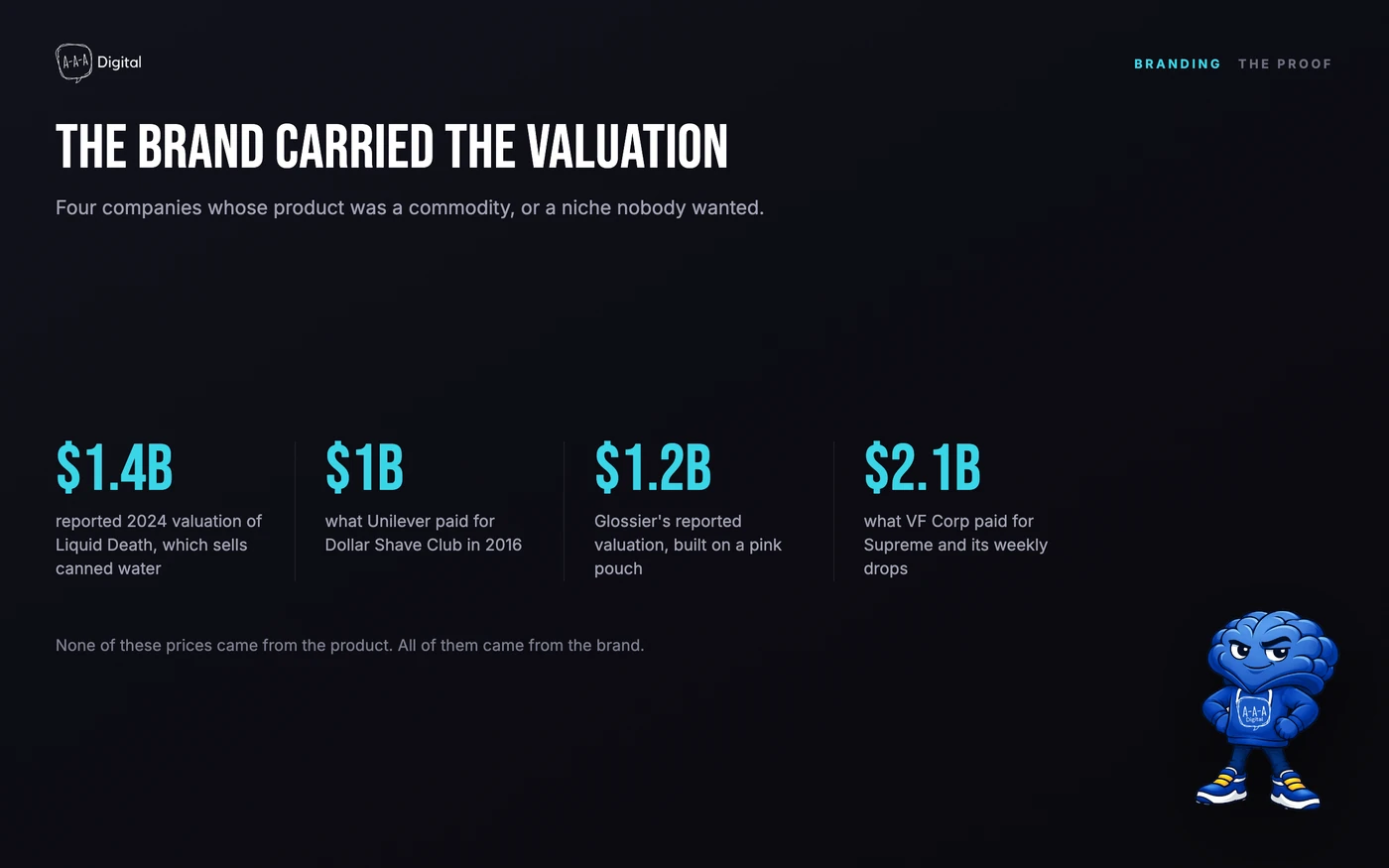
In 2019, a company started selling water in a tallboy can with a melting skull on it and the instruction to "murder your thirst." By 2024, that company, Liquid Death, was reportedly valued at $1.4 billion and into major grocery chains. The water was never the product. The brand was.
Most Shopify stores do the opposite. The product is excellent. The packaging is a plain poly mailer, the About page says "passionate about quality," and the store name sounds like a spreadsheet tab. Then the founder wonders why paid ads are the only channel that works.
I am the creative head at AAA Digital, and the rebrand briefs I accept all start with a positioning sentence. The ones I refer out usually start with a Pinterest link. Branding is not decoration. It is a system of choices that makes a stranger remember you, choose you, and pay more than the cheapest alternative. Here are the nine ecommerce branding strategies that hold up, each with an example that proves it and the cheapest honest way to copy it.
The 9 Ecommerce Branding Strategies at a Glance
| Strategy | Example that proves it | Cost to copy |
|---|---|---|
| Positioning before visuals | Liquid Death: water, valued at a reported $1.4B on punk positioning | One afternoon, free |
| Naming and verbal identity | Dollar Shave Club: the name is the pitch, sold for about $1B | Free before launch |
| Packaging as marketing | Glossier's pink pouch, recognized with no logo | From $0.50 an order |
| Founder-led branding | Gymshark: a garage, a sewing machine, £500M+ revenue | A phone camera, weekly |
| Community and UGC loops | Gymshark athletes; 79% of buyers say UGC sways them | Free product for 20 creators |
| Visual consistency systems | Tony's Chocolonely's unequal bar, built with no paid ads | One weekend |
| Price as a brand signal | Everlane's radical transparency cost breakdown | A paragraph per product page |
| Collaborations and drops | Supreme: weekly drops, sold for $2.1B | One limited run a quarter |
| Brand SEO | About 44% of US Google searches are brand terms | Search Console and Trends, free |
1. Nail Ecommerce Positioning Before You Touch a Single Visual
Positioning is the decision about what you stand for, made before any design work starts. It answers one question: why should a specific customer pick you over the default option? A logo cannot fix a vague promise, but a clear promise survives a plain logo. In our studio this is the one-sentence test: if a stranger cannot repeat what you sell after one sentence, the brand is decorated, not positioned.
Liquid Death is the clearest modern proof. Bottled water was a sea of blue labels, serene mountains, and the word purity. Founder Mike Cessario went the other way: heavy metal artwork, a can shaped like beer, the tagline "Murder Your Thirst," and a mission called "Death to Plastic." Water is the most commoditized product on earth; the brand reportedly hit a $1.4 billion valuation by 2024.
Last year a skincare founder showed me the logo she had paid $2,000 for. It was beautiful. Her sales pitch still took four sentences and a diagram.
How a small brand executes this cheaply: write one sentence: "For [specific customer] who [problem], [brand] is the [category] that [one promise], unlike [the default option]." Run the swap test: if a competitor's name fits in your sentence and it stays true, you wrote a category description, not a position. We covered the full philosophy, including the maths of charging more, in our piece on building a brand that sells.
2. Treat Naming and Verbal Identity as the First Ad
Your name is the first ad a customer ever sees, and your tone of voice is the ad they hear on every page, email, and packing slip after that. Verbal identity means the words you always use, the words you never use, and the rhythm of your sentences.
Dollar Shave Club is the textbook case. The name alone telegraphs the price, the product, and the subscription model. The 2012 launch video, reportedly made for about $4,500, put founder Michael Dubin in a warehouse delivering the pitch in deadpan. Unilever bought the company in 2016 for about $1 billion in cash. Buyers paid for the brand and the subscriber base, not for anything a designer made.
How a small brand executes this cheaply: before you launch, say the name out loud on a phone call and make the other person spell it back. If they cannot, pick another. Then write a one-page voice doc: three words you sound like, three you never sound like, and two example sentences for emails and product pages. That doc then governs your product page copywriting so the store sounds like one person.
3. Build Packaging That Markets: an Unboxing Worth Filming
For an ecommerce brand, the box is the first physical touchpoint, and the only part of your brand a customer touches before deciding whether to trust you again. Packaging as marketing means designing that moment on purpose, for the camera as much as for the hands.
Glossier proved a pouch can be a brand asset. Since 2014, every online order has shipped in a pink bubble-wrap zip pouch, no logo required to identify it. The pouch became so recognizable that when Glossier fought to register it as a trademark, its filing included a 252-page response arguing consumers already saw the color and shape as the brand, according to Fast Company's reporting. Packaging so distinctive it becomes legal property. Glossier started as a beauty blog and built a reported $1.2 billion valuation on that visual world.
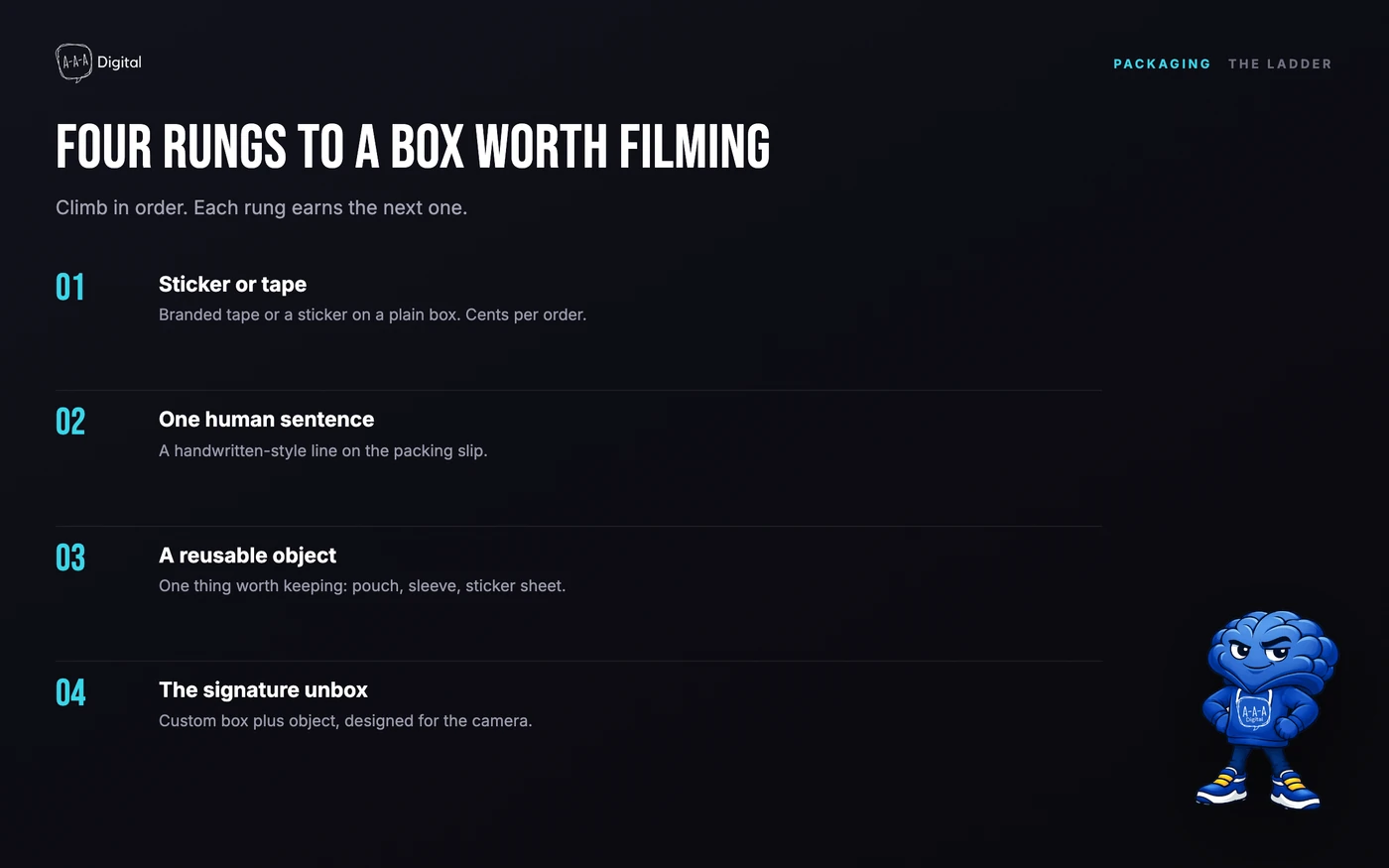
The camera test is the cheapest filter we know: hold the finished parcel up and ask whether anyone would film opening it. If not, you are shipping a cost, not an asset. I have watched a $40 custom stamp do more for a brand's unboxing photos than a $4,000 box redesign.
How a small brand executes this cheaply: climb the ladder in the graphic below in order. Branded tape or a sticker on a plain box first, one reusable object second, a fully custom box only when volume pays for it. The goal is one detail a customer would photograph without being asked.
4. Run Founder-Led Branding: Put a Face on the Store
People buy from people. A face on the store builds trust faster than any badge, and it is the one asset a competitor cannot copy, including the AI-generated stores flooding every niche. Founder-led branding means the person who started the company shows up, regularly, as the voice and face of the brand.
Gymshark is the standout in ecommerce. Ben Francis started the company in 2012 as a teenager, screen-printing shirts with a sewing machine in his parents' garage, and he never handed the mic to an agency. He fronts videos, posts training content, and talks about the business in public. When General Atlantic took a minority stake in 2020, the reported valuation passed a billion pounds, and the brand's best ad was still a founder talking to his own customers. That continuity carried Gymshark past £500 million in annual revenue and onto every list of the best Shopify stores, proof that a persistent founder face compounds.
How a small brand executes this cheaply: film 20 minutes a week on your phone. Explain one product decision, one customer question, one thing that went wrong. Reply to comments, and add a short "from the founder" email to your welcome flow. Consistency beats production value; the algorithm rewards the face that shows up weekly, and so do customers.
5. Engineer Community and UGC Loops That Acquire for You
A UGC loop is a system where customers create content that convinces the next customer. Community is the audience that keeps the loop fed. Trust has moved to peers: Nielsen's Global Trust in Advertising survey, spanning 56 countries and over 28,000 respondents, found 92% of consumers trust earned media and recommendations above every other form of advertising. Stackla found 79% say user-generated content highly impacts purchase decisions, up from 60% in 2017.
Gymshark, again, is the proof. Its athlete program signed fitness creators to long-term deals years before "creator economy" was a phrase; those creators produced the ads. The company grew for years with essentially no traditional advertising; the community was the media plan. When we audit stores, the ones with thriving UGC always share one habit: they reply to every tagged post within a day. The payoff lands on the product page, where shoppers who interact with UGC convert at far higher rates: the loop is a revenue system, not a vanity metric.
How a small brand executes this cheaply: pick one branded hashtag and ask for it in the order confirmation email. Seed product to 20 micro-creators in your niche; five thousand followers is plenty. Put the best customer photos on your product pages, with permission. You are building a flywheel, not buying posts.
6. Build a Visual Consistency System, Not Just a Logo
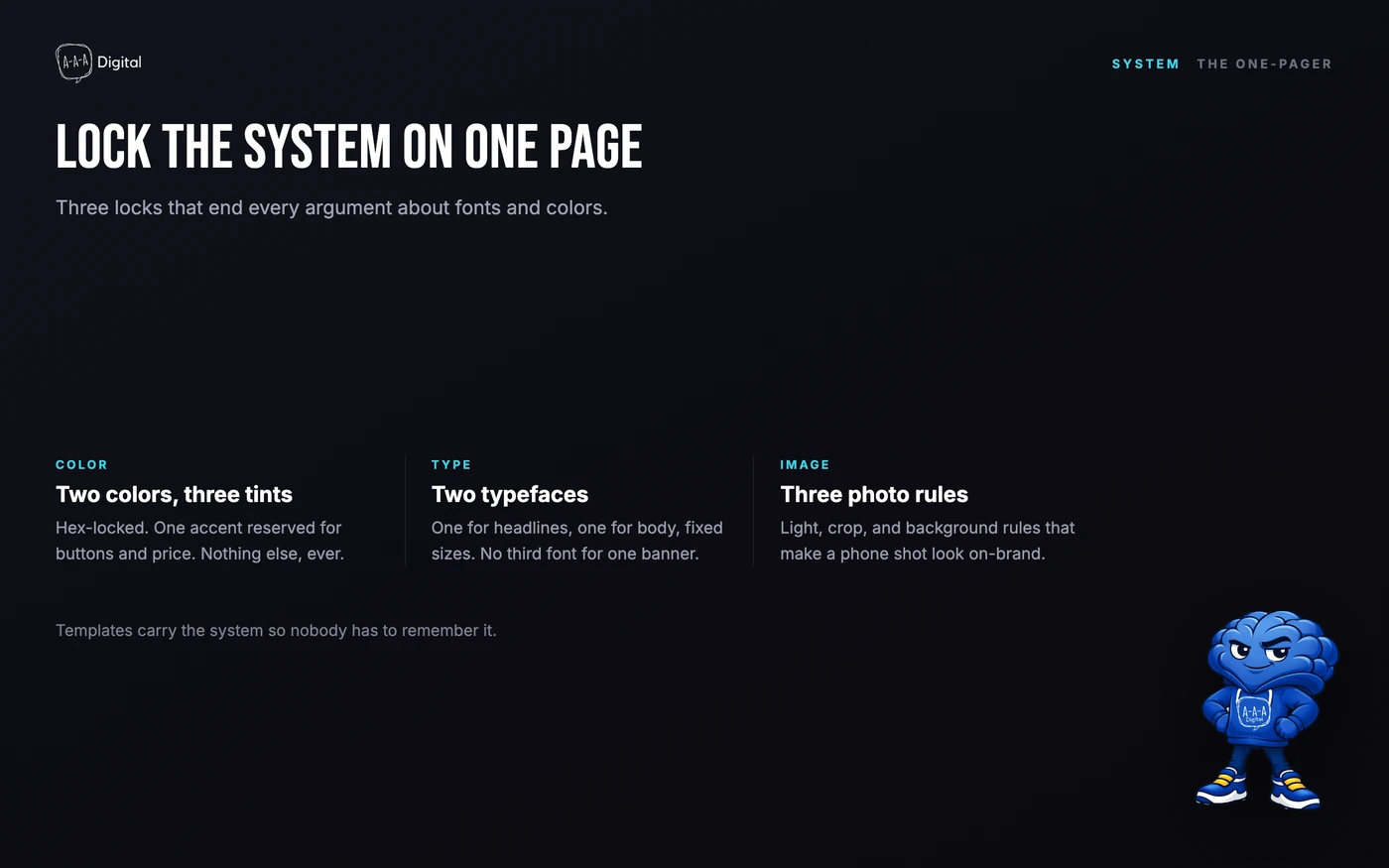
A logo is one mark. A visual system is the rules that make every touchpoint look like the same brand: colors, type, imagery, layout, and motion. Consistency compounds recognition, and recognition is what lets you charge more later.
Tony's Chocolonely shows how far a system can carry a product. The Dutch brand wraps its bars in loud, clashing colors with bold type, and the bar itself is divided into unequal chunks, a physical metaphor for how unfairly the cocoa trade pays farmers. The product is the advertisement. Marketing Week reported in 2022 that the brand had grown without spending a penny on marketing, and Lidl's 2024 lookalike bar, and the public fight it started, proved the system is recognizable.
When we hand clients a one-page brand sheet, the arguments about fonts end. That alone pays for the workshop.
How a small brand executes this cheaply: lock the system on one page, shown below, and turn every repeatable asset into a template so consistency never depends on memory. If you want this built and enforced across your store, that is exactly what our branding service delivers.
7. Use Price as a Brand Signal and Say Why It Costs What It Costs
Price is a message sent before the product is even described. Too cheap reads as risky. A premium with no explanation reads as arrogance. Two parts: hold a price line so customers never learn to wait for discounts, and publish the reason behind the number.
Everlane built a brand on the second part. Its "radical transparency" puts a cost breakdown on every product page, materials, labor, duties, and transport, next to the traditional retail equivalent. The price stops being a number and becomes a story about fairness, which is why a plain $80 shirt there feels considered, not overpriced.
How a small brand executes this cheaply: write a "why this costs what it costs" paragraph for your ten best sellers and put it on the product page. Remove the permanent sale section; constant discounting teaches customers to doubt your list price. If you raise prices, say why in public and honor the old price for existing subscribers. At a 30% margin, a 10% price rise can absorb a 25% drop in unit volume before profit falls.
8. Borrow Heat With Collaborations and Build Scarcity With Drops
Collaboration culture means releasing limited products with a partner or on a fixed schedule, so each release is an event with a news cycle attached. Scarcity is the engine: a small, honest limit on quantity makes the product a signal of being in the know.
Supreme wrote the playbook. A New York skate shop founded in 1994, it releases small drops every Thursday that sell out in minutes, and the box logo became a badge you pay to wear. The 2017 collaboration with Louis Vuitton took the brand into luxury department stores, and VF Corporation bought Supreme for $2.1 billion in cash in 2020. Resale markets priced the signal: a box logo crewneck that retailed for $158 resold around $700 on StockX, per Business Insider at the time.
How a small brand executes this cheaply: one limited run per quarter is enough. Recolor an existing bestseller, or pair with an adjacent creator or local brand whose audience overlaps yours. Drop at a fixed time, tell your email list first, and retire the product when it sells out. Do not fake it: permanent countdown timers on permanent stock train customers to distrust you.
9. Make Branded Search Volume Your Brand Health Metric
Brand SEO is the work of making sure that when someone hears about you and types your name into Google, what they find closes the sale. The demand side is the health metric: how many people search your name is the best public proxy for whether everything above is working.
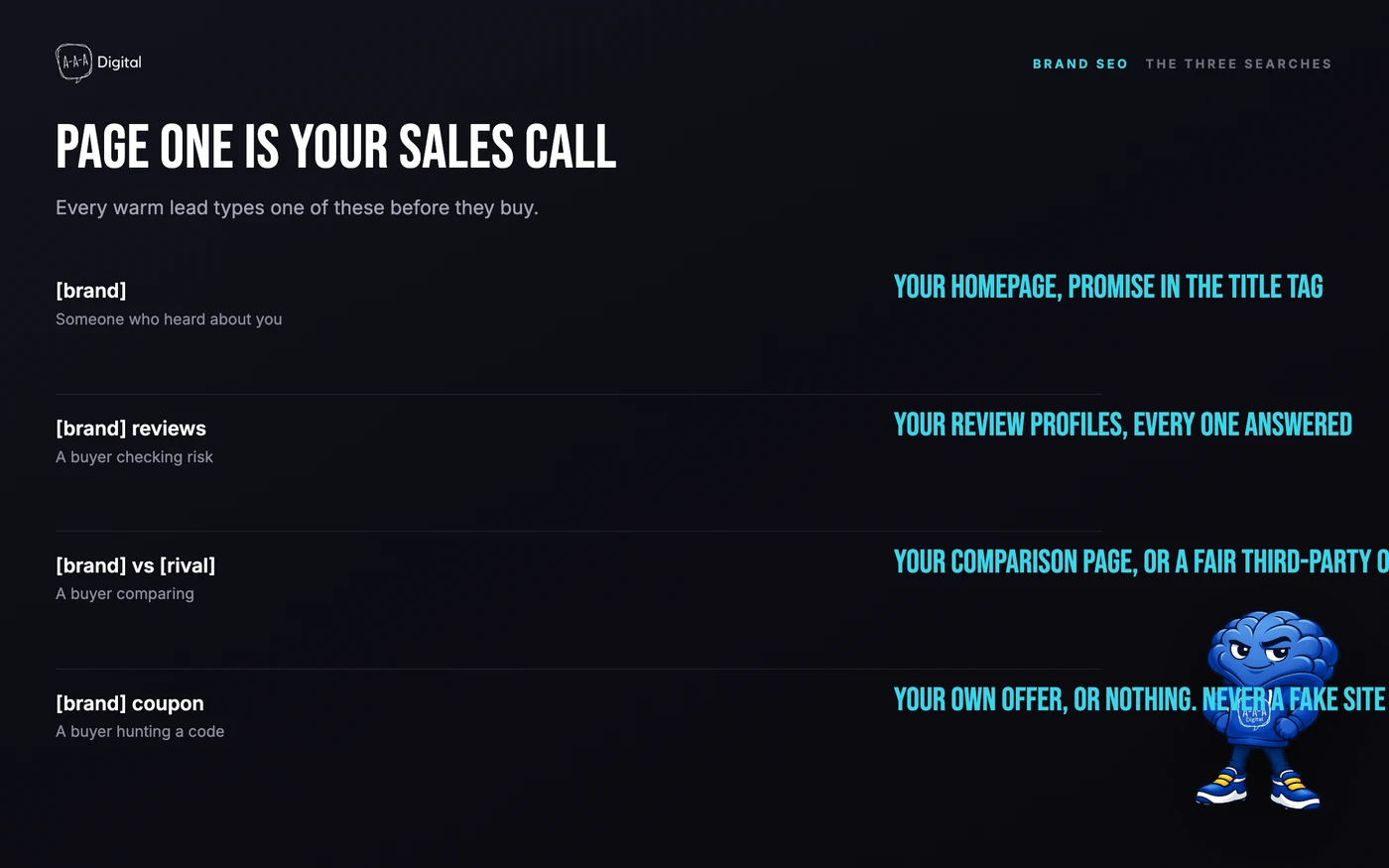
The numbers justify the obsession. SparkToro's analysis of Datos clickstream data found that just over 44% of US Google searches are for branded terms. Semrush research found branded queries convert at two to five times the rate of non-brand traffic. And as AI Overviews swallow informational searches, branded demand holds: an Ahrefs study of over a million SERPs found AI Overviews appear roughly half as often on branded queries. Meanwhile 82% of consumers read online reviews for businesses, per BrightLocal. When someone searches "[your brand] reviews," page one decides whether the sale happens.
A brand is the only distribution channel you fully own; our channel marketing playbook makes the same argument about outlasting the ad budget.
How a small brand executes this cheaply: track three numbers monthly in free tools: brand-query clicks in Google Search Console, your Google Trends curve, and what page one shows for "[brand] reviews." Reply to every review; those replies are brand copy read at the decision moment.
FAQ
Which ecommerce branding strategy should a new Shopify store start with?
Start with positioning and naming, because both are free and everything else compounds from them. A clear position and a memorable name make every later dollar work harder. Skipping them means paying to decorate a forgettable promise.
How much should a small ecommerce brand spend on branding?
Spend on strategy before visuals. A positioning and naming sprint costs about a sixth of a full visual rebrand and tells you whether the promise is distinctive before you pay to pretty it up. If the strategy is weak, a bigger design budget only makes a forgettable brand prettier.
How do I know if my branding is working?
Watch branded search volume, direct traffic, repeat purchase rate, and whether customers pay full price without asking for a discount code. Rising ad costs with flat branded search means you are renting attention, not building a brand. All four live in your analytics and Search Console and move months before revenue does.
Can I build an ecommerce brand without paid ads?
Yes. Gymshark reached hundreds of millions in revenue on community and creator partnerships before spending on traditional advertising. Paid ads can accelerate a brand that already means something, but they cannot substitute for one. Community, UGC, and a visible founder are the unpaid engines.
Get Your Brand System Built
If you finished this list realizing your store has a logo but not a system, the gap is fixable. Our branding team builds the positioning, verbal identity, visual system, and packaging direction as one project, then applies it across your Shopify store. Book a free brand review and we will tell you honestly whether the problem is the promise or the design.
