Search for "best Shopify stores" and you will find the same gallery of screenshots ten times over. Pretty homepages, vague praise about "clean design," and not a single revenue number. Without numbers you cannot tell the difference between a store that looks good and a store that sells.
This list is the one we wanted to read and could not find. Twelve stores, all confirmed on Shopify, across fashion, beauty, food and beverage, accessories, home, fitness, and footwear. For each: what it sells, one tactic it executes unusually well, and a publicly reported revenue or order figure with outlet and year attached, hedged properly, because private companies do not publish audited accounts. If you want the platform angle, our breakdown of companies using Shopify covers why these brands chose it, and our Shopify website examples post tears down the design side. Here, we follow the money.
When we tear these stores down for clients, a reported figure tells us what scale a single tactic can support before we copy it.
The Comparison Table
| Store | Category | Reported revenue (source, year) | One-line lesson |
|---|---|---|---|
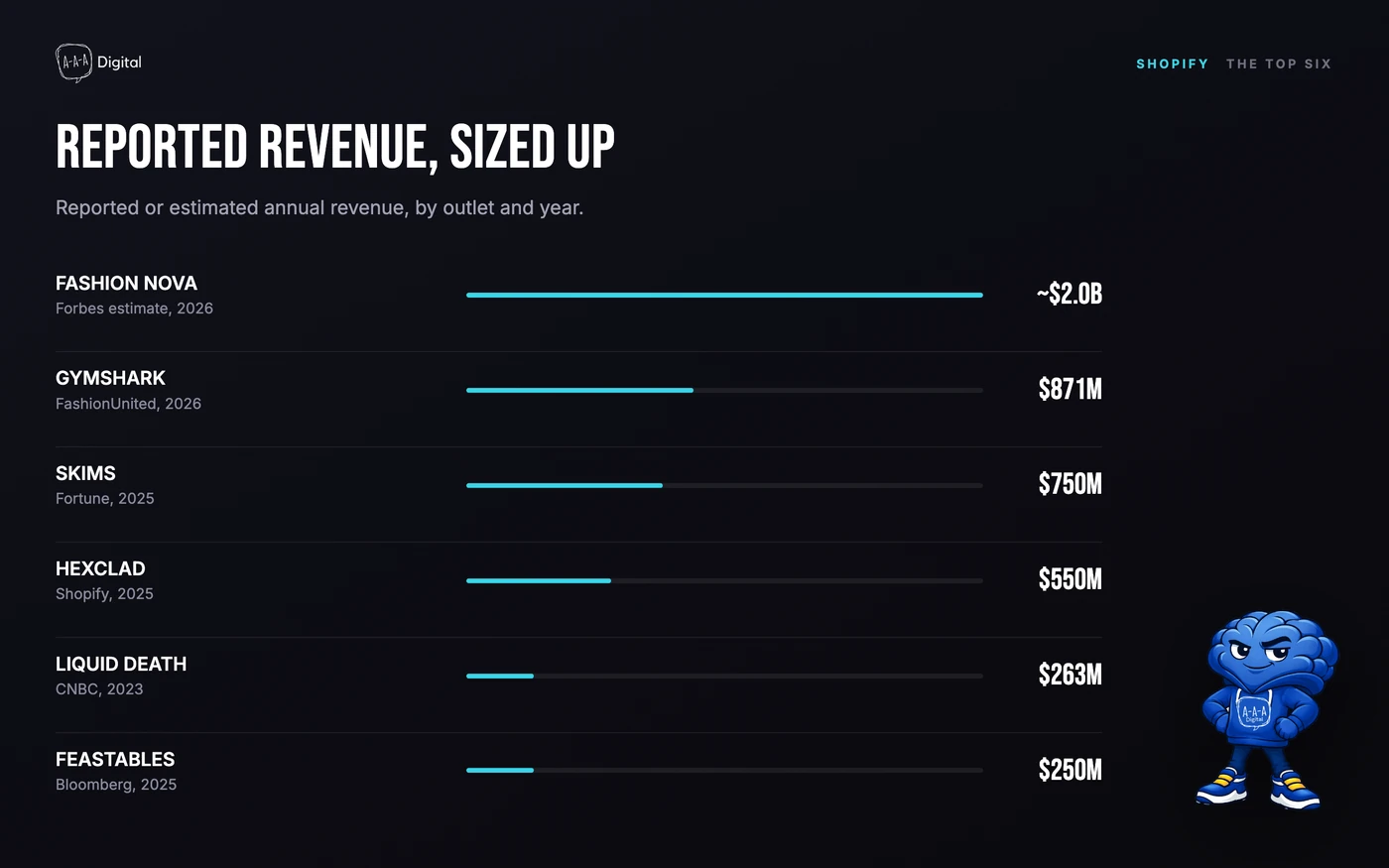
| Fashion Nova | Fast fashion | ~$2B annual sales, estimated (Forbes, 2026) | Product velocity beats ad spend |
| Gymshark | Fitness apparel | £646M / ~$871M, FY25 (FashionUnited, 2026) | Gamified loyalty keeps a community buying |
| Skims | Shapewear | ~$750M sales, 2023 (Fortune, 2025) | Engineered scarcity fills carts |
| HexClad | Cookware | $550M+ annually (Shopify, 2025) | Expert endorsement compounds |
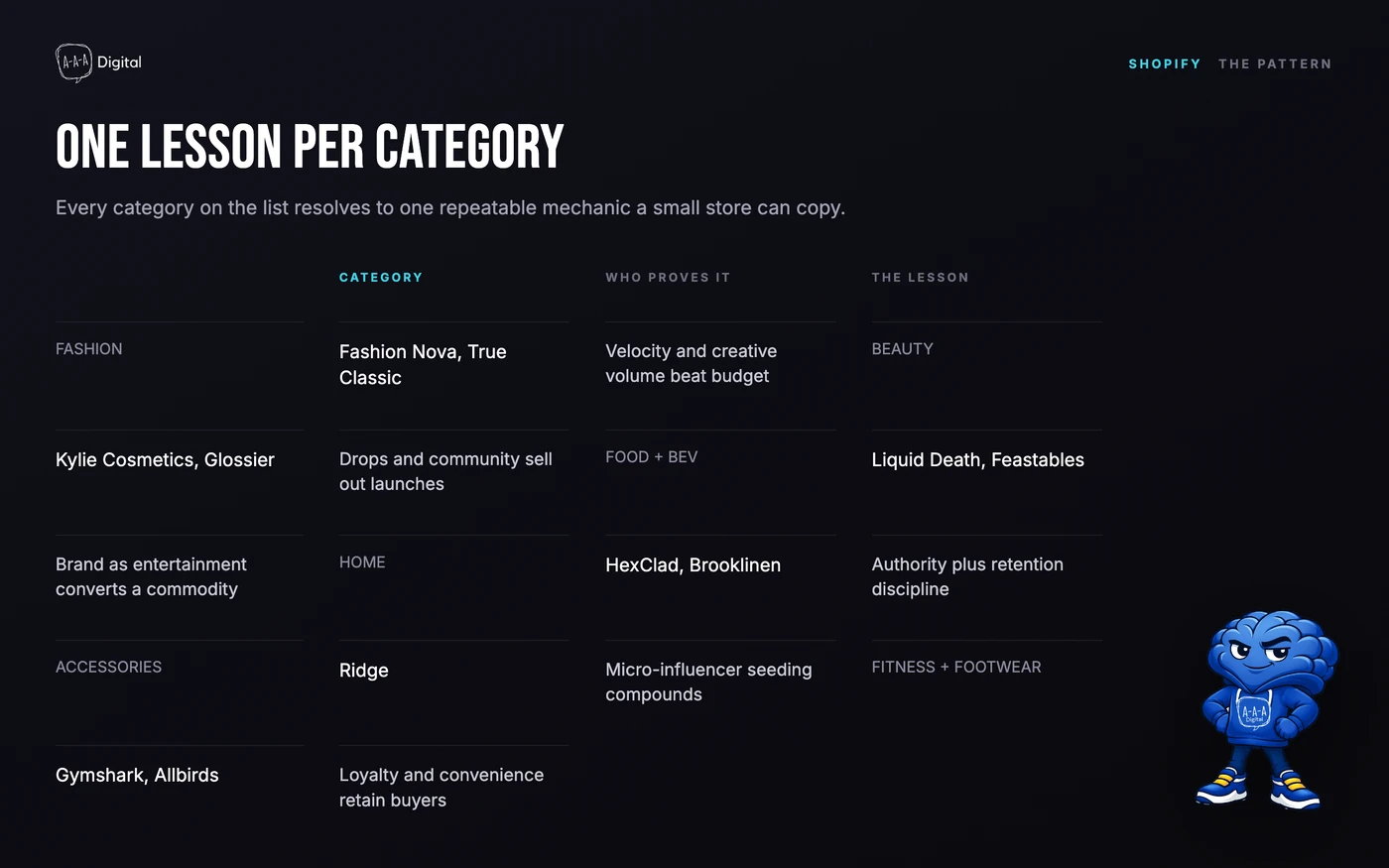
| Glossier | Beauty | $200M to $250M, 2024 est. (BeautyMatter, 2024) | Community feedback builds sellout products |
| Liquid Death | Beverages | $263M retail sales, 2023 (CNBC) | Brand voice converts a commodity |
| Feastables | Snacks | ~$250M sales, 2024 (Bloomberg, 2025) | Sweepstakes mechanics drive repeat buys |
| Allbirds | Footwear | $189.8M net revenue, FY24 (SEC filing, 2025) | Convenience features earn loyalty |
| True Classic | Menswear | $200M+ run rate, 2024 (Modern Retail, 2024) | Creative volume is a moat |
| Kylie Cosmetics | Beauty | ~$177M verified revenue, 2018 (Forbes, 2020) | Owned-audience drops sell out |
| Brooklinen | Bedding | $100M+ (company-reported via Carryup, 2026) | Email restraint lifts repeat rate |
| Ridge | EDC accessories | $100M+ annually (Shopify, 2024) | Seed product with micro-influencers |
Two honest caveats. First, private company figures are reported or estimated, not audited. Second, revenue is an outcome, not a tactic; the point here is the tactic underneath each number, and what a smaller merchant can steal this quarter.
1. Fashion Nova (fast fashion)
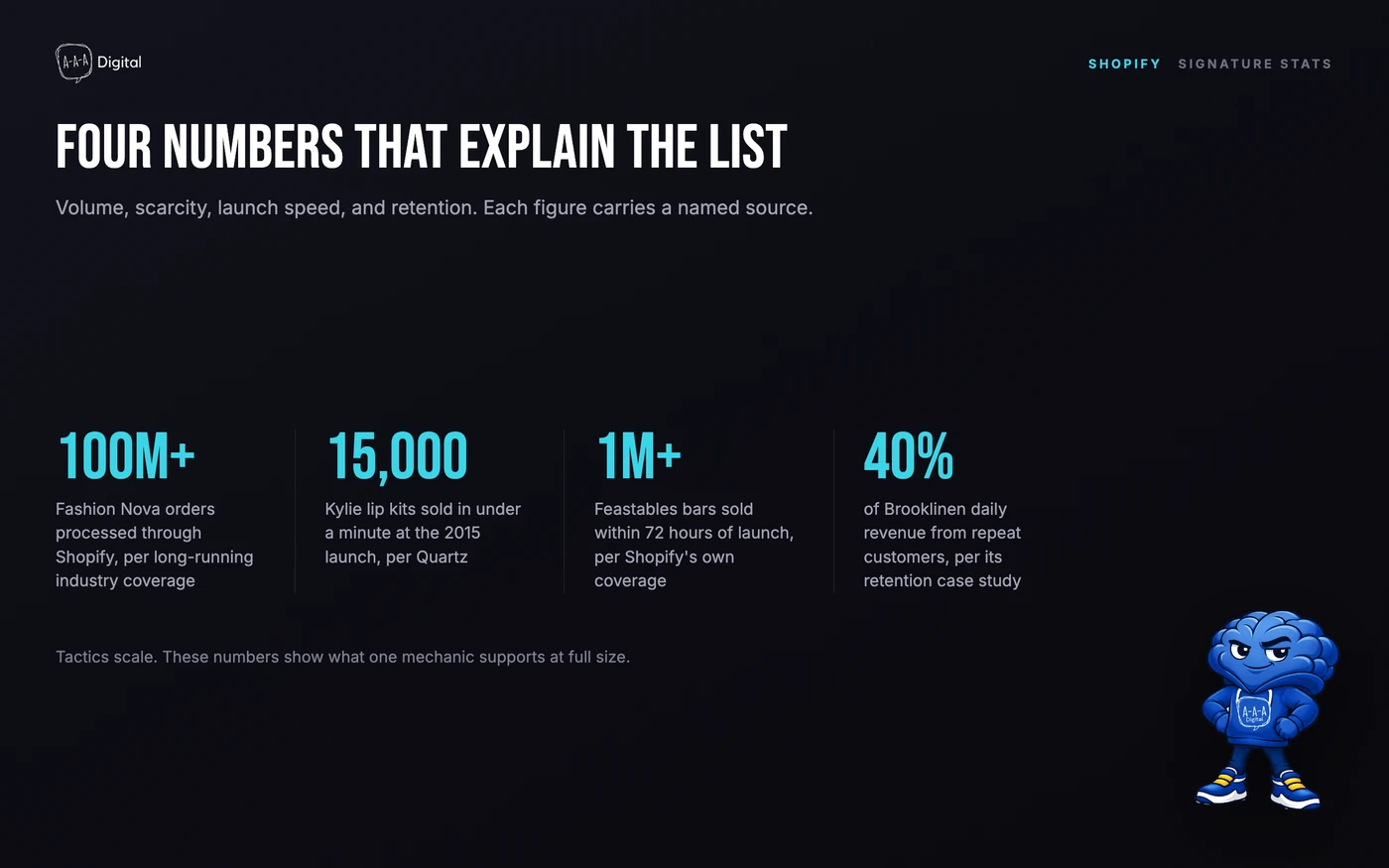
Fashion Nova sells trend-driven clothing at prices that make impulse buys painless. Its Forbes founder profile estimates some $2 billion in annual sales.
The tactic worth copying is product velocity with an influencer pipeline. Fashion Nova reportedly adds hundreds of new styles to its catalog every week, and it seeded early growth by sending free clothes to thousands of micro-influencers before "creator seeding" was an industry term. In 2018, Google reported it was the most searched fashion brand, per Forbes.
The steal: you do not need Cardi B. Ten micro-influencers with 20,000 engaged followers, given product and a discount code, will outproduce one polished brand campaign.
2. Gymshark (fitness apparel)
Gymshark is the strongest data point on this list because its numbers are filed, not estimated. The company reported revenue of £646 million, roughly $871 million, for the financial year ending 31 July 2025, its thirteenth consecutive year of growth, according to FashionUnited's coverage of the filings. Pre-tax profit was a modest £7 million; the company is reinvesting everything into retail expansion and brand.
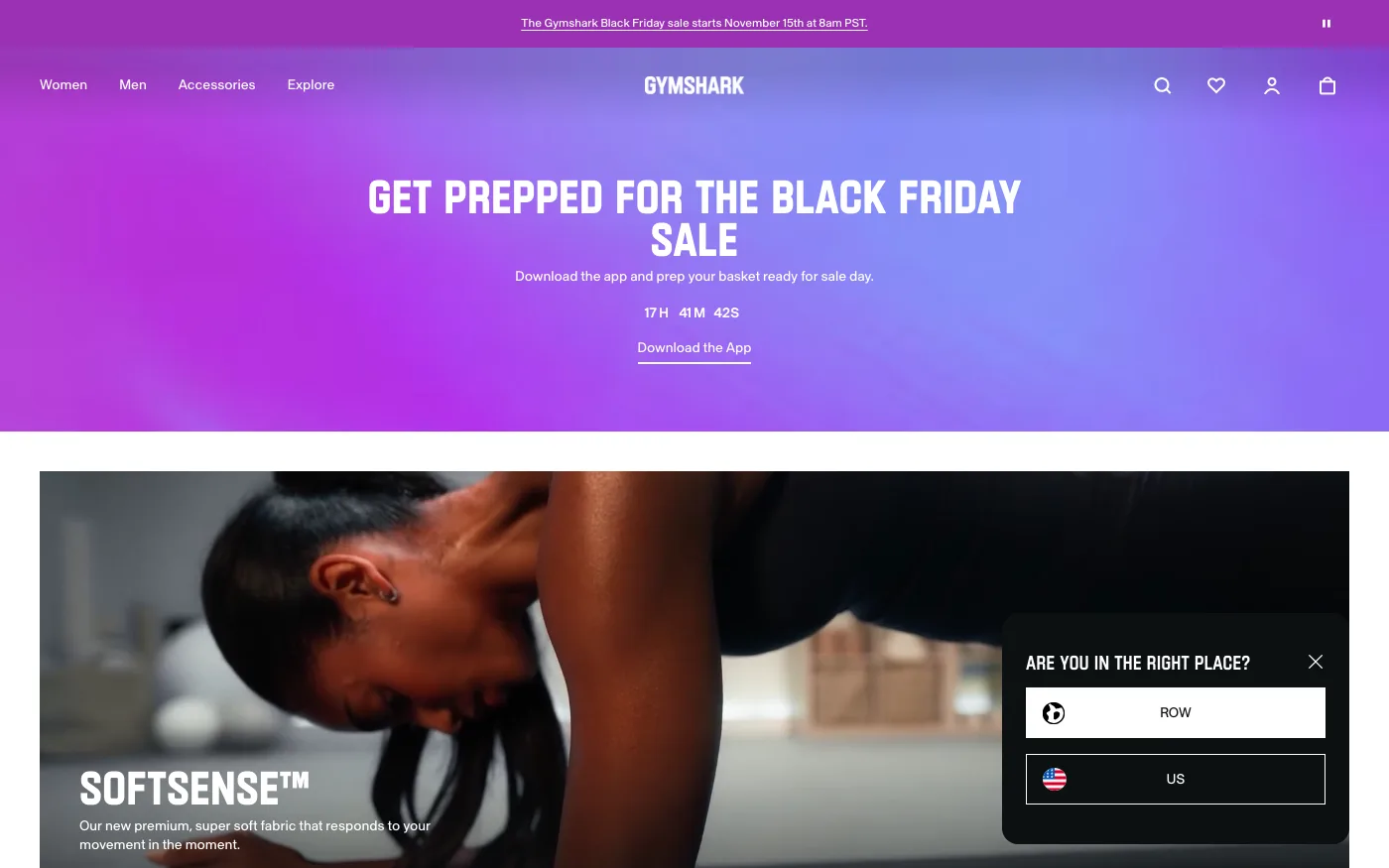
The store runs on Shopify Plus behind a headless build, adopted after a costly Black Friday outage on its old platform. The tactic we watch is the loyalty program, which gamifies purchases and workouts with points and tiers, layered on a creator flywheel of athletes wearing the product years before they were paid spokespeople.
The steal: reward engagement, not just spend. Points for a workout check-in or a review give customers a reason to return even when they are not ready to buy.
3. Skims (shapewear and intimates)
Skims sells shapewear and intimates built around inclusive sizing, moved in drops that behave like sneaker releases. Per Fortune's reporting on its November 2025 funding round, Skims generated about $750 million in 2023 sales, up from roughly $500 million in 2022, and turned profitable that year; the same round valued it at $5 billion.
The store runs on Shopify Plus with a custom theme built by Shopify Plus partner agency King & Partners. The tactic is engineered scarcity: limited colorways, celebrity collaborations, and restock alerts that turn a product page into a queue.
The steal: a monthly limited run with a real cutoff, announced to your email list first, manufactures urgency a permanent sale never will.
4. True Classic (menswear basics)
True Classic sells fitted tees and basics, around $25 to $30 a shirt, to men who hate shopping for clothes. Modern Retail reported in December 2024 that the brand passed $500 million in lifetime sales on a run rate above $200 million, and a 2025 Shopify feature called it one of the platform's fastest-growing merchants.
The tactic is creative volume. True Classic's team produces new ad creative constantly, testing hooks and user-generated-style video at a pace that keeps every ad cheap to replace and hard for competitors to copy. Underneath the ads, the product page does quiet work: fit guidance, fabric specs, and social proof where skeptical first-time buyers look for it. Our guide to product page conversions maps that structure in detail.
The steal: ship a set number of new ad creatives every week, each with a clear hypothesis. Volume with discipline beats one expensive brand film.
5. Feastables (snacks)
Feastables is MrBeast's chocolate brand, launched in January 2022 directly on Shopify. Per Bloomberg's March 2025 reporting on investor documents, it generated about $250 million in sales in 2024 with more than $20 million in profit. Shopify's own coverage notes over a million bars sold within 72 hours of launch.
The tactic is the sweepstakes mechanic. Every bar carries a code, and codes feed prize drawings ranging from cash to a Willy Wonka-style chocolate factory contest. The product is the lottery ticket, and the purchase-to-play loop converts one-time buyers into repeat scans without a single traditional ad.
The steal: add a post-purchase game. A scratch card in the box, an entry with every order, a monthly draw announced by email. The marginal cost is trivial; the repeat visit it buys is not.
6. Liquid Death (beverages)
Liquid Death sells canned water and iced tea. That sentence should not work, and according to CNBC's reporting it produced $263 million in retail sales in 2023, while Sacra estimates 2024 revenue around $333 million.
The store runs on a custom Shopify Plus build, described publicly by its developer ArcTouch. The tactic is treating the store as a media property. "Murder Your Thirst" is a brand voice that polarizes on purpose, the merch line is a margin engine disguised as marketing, and the Country Club loyalty program turns entertainment into recurring revenue. It proves the argument in our brand-building post: personality is a conversion asset, not decoration.
The steal: pick a voice with an opinion. Bland stores compete on price; stores with a point of view compete on memory.
7. Kylie Cosmetics (beauty)
Kylie Cosmetics launched in 2015 with a single product, the lip kit, and reportedly sold 15,000 kits in under a minute, according to Quartz. The hard numbers arrived when Coty paid $600 million for a 51 percent stake in 2019, a deal Forbes and MarketWatch reported valued the company at about $1.2 billion. It is also the list's best cautionary tale: Forbes reported in 2020 that the family's public revenue claims were inflated, with verified 2018 revenue closer to $177 million.
Its Shopify store became a Plus showcase. The tactic is the owned-audience flash drop: launches announced to tens of millions of Instagram followers, sent straight to a store built to absorb a traffic spike, with scarcity that holds because stock genuinely sells out.
The steal: drops only work when the audience is yours. Build the email and SMS list now, because a launch is only as fast as the channel you own.
8. Glossier (beauty)
Glossier sells skincare and makeup that its community effectively co-develops. Industry research citing The Information and Business Insider put 2023 revenue expectations near $275 million; BeautyMatter's 2024 FUTURE50 profile placed 2024 in the $200 million to $250 million range.
The store is a Shopify build by agency SDG, which has publicly described its work on Glossier.com. The tactic is the feedback loop: Glossier started as the Into The Gloss beauty blog, and that readership still steers product development. New launches arrive pre-sold because the community asked for them, and custom sets and bundles let customers build their own kits at higher order values.
The steal: ask customers what to make next, publish the answer, then sell it back to them as a set. Community is the cheapest product research channel that exists.
9. HexClad (cookware)
HexClad sells hybrid stainless-and-nonstick cookware at premium prices, fronted by Gordon Ramsay. Shopify's own brand profile states the company surpassed $550 million in annual revenue, and Inc. reported in August 2024 that the brand was tracking toward $600 million after roughly doubling through 2023.
The store runs on Shopify Plus in the US and UK, which its agency partner has documented. The tactic is the authority loop: a Michelin-starred co-sign, chef-led product development, and demo content that shows the product doing something a normal pan cannot.
The steal: borrow authority. A local chef, respected trainer, or known maker using your product on camera borrows the same trust at a scale you can afford.
10. Brooklinen (bedding)
Brooklinen sells bedding and bath goods and started with a 2014 Kickstarter that raised over $230,000. A decade on, a 2026 case study of its retention program describes it as a $100 million-plus business running its direct-to-consumer channel on Shopify Plus.
The tactic is restraint. The oft-cited internal discipline: Brooklinen gets roughly 40 percent of its daily revenue from repeat customers while keeping promotional email to about 7 percent of what it sends. Most stores blast discount codes weekly and train customers to wait for them; Brooklinen invested in post-purchase flows, referral, and product quality until repeat revenue carried the day.
The steal: count your promo email share this month. If it is above a fifth of what you send, you are renting revenue you already own and teaching customers never to pay full price.
11. Ridge (wallets and everyday carry)
Ridge sells minimalist metal wallets and everyday carry gear. Shopify's brand coverage states the wallet line alone passed $100 million in annual revenue, following Practical Ecommerce's 2021 report that the company crossed $50 million on the back of influencer marketing.
The store has run on Shopify for years. The tactic is disciplined testing: Ridge runs an A/B testing program that treats the product page as a permanent experiment, showing first-time visitors tailored feature and benefit information instead of one generic page.
The steal: run one structured test a month on your best-selling product page. Headline, image order, guarantee placement. Small stores lose to big ones on traffic, not on testing.
12. Allbirds (footwear)
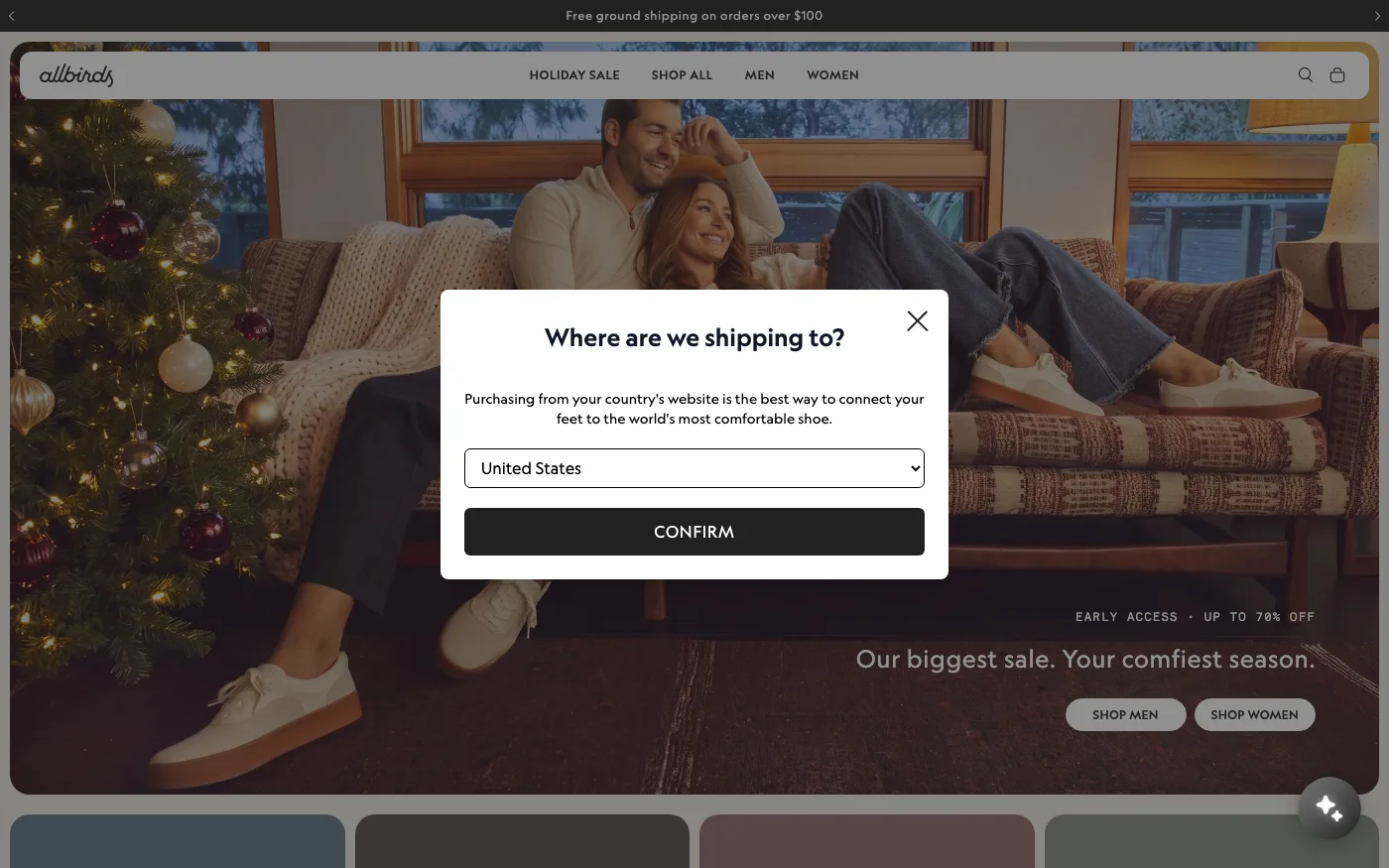
Allbirds closes the list as the honesty case. The public company reported full-year 2024 net revenue of $189.8 million, down 25.3 percent from $254.1 million in 2023, in SEC-filed results published in March 2025. Revenue can go down, and on this list it has.
The store has run on Shopify since 2016, and Shopify has documented its ship-from-store rollout, where retail locations fulfill online orders through Shopify POS. The tactic is convenience as a feature: inventory that doubles as fulfillment nodes, carbon-footprint labels on product pages, a returns process designed to be boring. None of it is glamorous; all of it compounds.
The steal: if you have any physical presence, turn it into a fulfillment option before you rent a warehouse. Speed is a conversion feature, and your stores are already paid for.
What Small Merchants Can Steal
The pattern I keep seeing across these teardowns is that every store on this list wins one mechanic at a time, and almost none of them leads with the mechanic it is now famous for. Fashion Nova was a mall store first. Glossier was a blog. Brooklinen was a Kickstarter. The tactic that prints their revenue today was usually their second or third experiment, not their first.
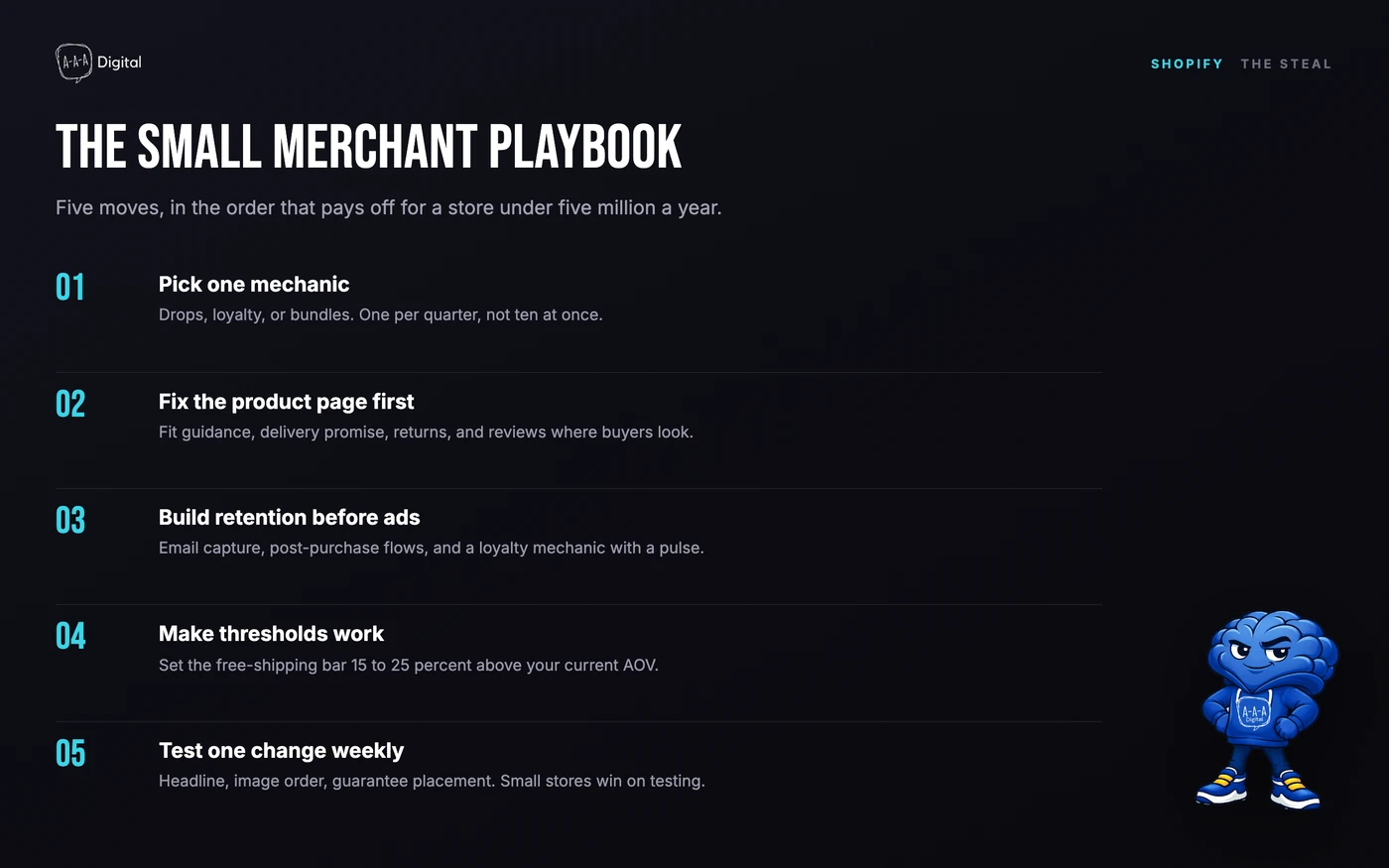
For a store doing under $5 million a year, the honest sequence looks like this. Fix the product page before chasing traffic, because every store above converts the visitors it already has. Build the retention asset next: email capture, post-purchase flows, a loyalty mechanic with a pulse. Then add one scarcity or gamification mechanic, and only then scale paid acquisition into a funnel that already holds. A tactic borrowed from a $2 billion store works at $50,000 a month if you borrow one and commit for a quarter, instead of ten for a week each.
Notice what is missing from the list: none of these stores wins on theme design. All of them win on a conversion decision a competitor was too timid to make. That is good news for smaller merchants, because decisions are free.
FAQ
How do you know these stores actually run on Shopify?
Every store here has a public Shopify signal: Shopify's own brand coverage (Gymshark, Ridge, Feastables, HexClad, True Classic, Liquid Death), Shopify Plus agency case studies (Skims, Brooklinen, Glossier, Allbirds), or detection profiles like BuiltWith and StoreInspect flagging Shopify on the live domain (Fashion Nova, Kylie Cosmetics).
Why do the revenue figures vary so much between sources?
Most of these companies are private, so figures come from press reporting, investor documents, or founder profiles. Forbes estimates Fashion Nova at around $2 billion in annual sales, while Bloomberg cited investor documents for Feastables. Where filings exist we used them: Gymshark files with UK Companies House and Allbirds reports to the SEC. Treat every private figure as a reported estimate.
Can a small store really copy tactics from a $750 million brand?
Yes, with one rule: copy the mechanic, not the budget. Skims' scarcity drops cost almost nothing to imitate. Brooklinen's email restraint is free. What does not transfer is paid spend, so ignore how these brands buy traffic and study how they convert and keep it.
Which store on the list is the best model for a brand-new Shopify store?
Feastables and Glossier, for different reasons. Feastables shows how a launch mechanic can carry a brand with no ad budget, and Glossier shows how an audience built on content turns product launches into pre-sold events. Both started small. Neither won on theme design.
One Last Thing
None of the stores above got on this list by luck or theme design. Every one of them made a specific, testable conversion decision, backed it with a funnel that holds, and repeated it until the revenue figures started showing up in other people's articles. If you want your store's numbers to look more like the left column of that table, our Shopify CRO service exists for exactly that. We will tell you which of these twelve tactics fits your store and which to ignore.
