Most "is Shopify worth it" reviews answer a different question. They compare features, award Shopify the checkout and the app store, and stop. They do not tell you whether it is worth it for your store.
The useful question is narrower. For your order volume, your margin, and your team, does the total bill come back as more revenue than the same money spent elsewhere? That is a cost question, not a feature question, and it has a different answer at $500 a month than at $50,000.
Here is the short version. For a store selling physical products, paying for traffic, and doing more than $10,000 a month, Shopify wins on total cost. For a content site with a small shop, a wholesale-first business below $1M, or a developer who needs control of the checkout, it often does not.
The model matters. Our guide to making money on Shopify starts with what one order leaves after costs.
What you actually pay
Shopify publishes four US plans. These are the list prices as of October 2026:
| Plan | Monthly | Annual (per month) | Card rate | Third-party gateway fee |
|---|---|---|---|---|
| Basic | $39 | $29 | 2.9% + 30¢ | 2% |
| Grow | $105 | $89 | 2.7% + 30¢ | 1% |
| Advanced | $399 | $359 | 2.5% + 30¢ | 0.6% |
| Plus | $2,300 | Custom | Custom | 0.2% |
Three things sit outside that table, and they decide the real bill.
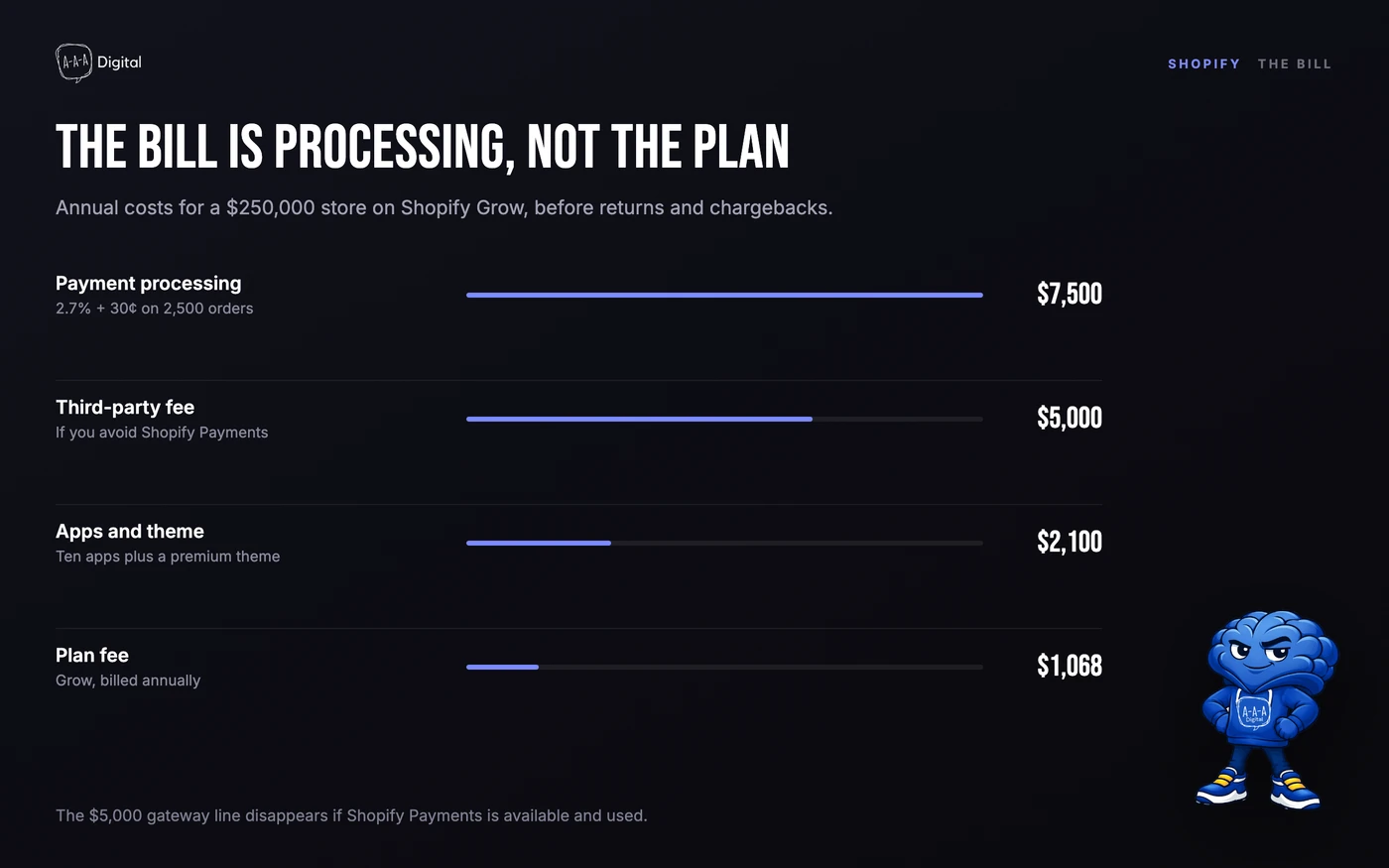
Payment processing. The card rate applies to every order. On $250,000 of sales, the difference between 2.9% and 2.7% is $500 a year, before the 30 cents per order. This is the largest line on the bill, and it grows with revenue.
The third-party gateway fee. Use Stripe, PayPal, or a local gateway instead of Shopify Payments, and Shopify adds 2% on Basic, 1% on Grow, 0.6% on Advanced, or 0.2% on Plus. That sits on top of your gateway's own fee. Where Shopify Payments is unavailable, it is unavoidable. Where it is available, avoiding it is the largest cost decision on the platform.
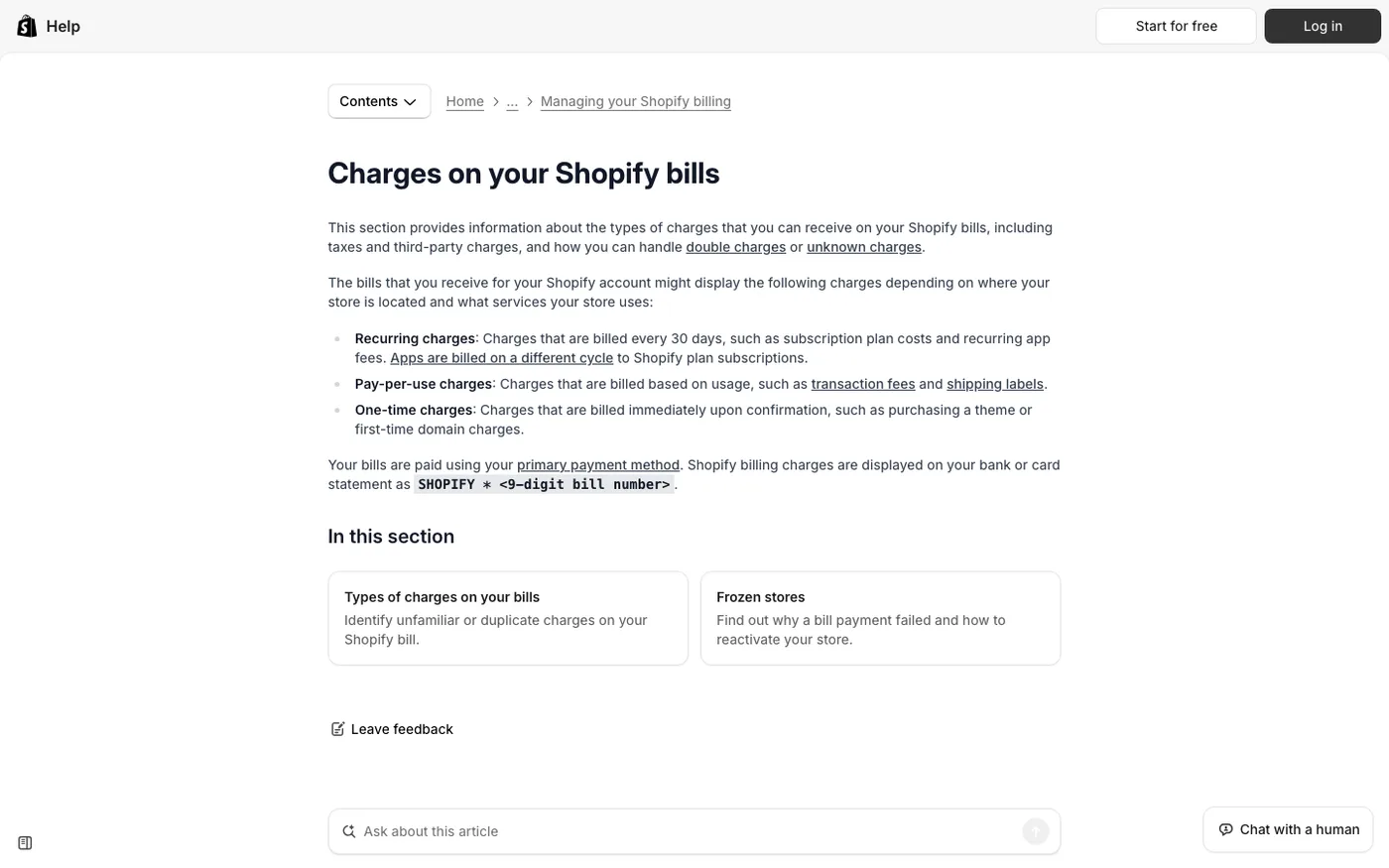
Apps, themes, and development. A plan gets you a store, not subscriptions, reviews, advanced email, loyalty, or a custom product configurator. A typical established store runs 8 to 15 apps and spends $80 to $200 a month. Heavy stacks reach $300 to $600. Add $180 to $400 for a premium theme, or more for custom work.
The comparison that matters
Sticker price comparisons are close to useless. A $29 plan with a 2.9% card rate and a thin app stack can cost more than a $105 plan with a 2.7% rate and five apps included. The only fair comparison is total cost at the same revenue, with the same order count, under each platform's real constraints.
Here is one store: $250,000 a year, 2,500 orders, $100 average order value, US cards, annual billing.
| Platform | Plan and hosting | Processing | Apps, theme, development | Year one |
|---|---|---|---|---|
| Shopify Grow | $1,068 | $7,500 | $2,100 | $10,668 |
| WooCommerce | $600 hosting | $8,000 | $3,800 | $12,400 |
| Wix Business | $468 | $8,000 | $300 | $8,768 |
| Squarespace Plus | $588 | $7,500 | $300 | $8,388 |
| BigCommerce Scale | $3,588 | $7,950 | $2,100 | $13,638 |
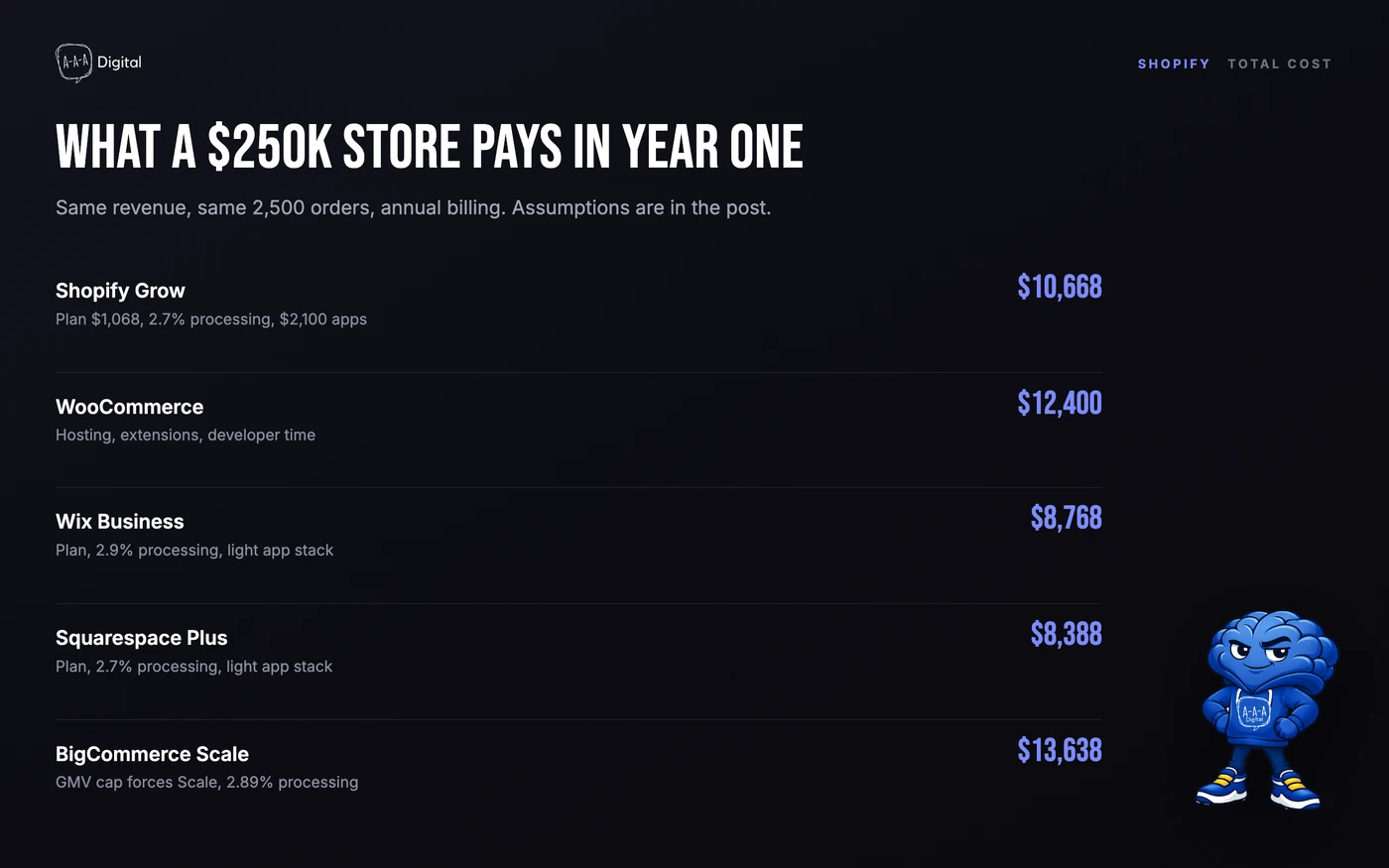
The assumptions are deliberate and you should change them. Processing uses each platform's published standard rate: 2.7% plus 30 cents on Shopify Grow and Squarespace Plus, 2.9% plus 30 cents on Wix and WooPayments, 2.89% plus 29 cents through Stripe on BigCommerce. Apps and development assume $150 a month on Shopify and BigCommerce, $25 a month on Wix and Squarespace, and $3,000 a year for WooCommerce extensions and developer time.
Two results surprise most merchants.
First, the spread is smaller than the marketing suggests. The cheapest option is $8,388 and the most expensive is $13,638. That is $5,250 a year, or 2.1% of revenue. It is money, but not the difference between a profitable store and a failing one. Traffic and conversion decide that.
Second, BigCommerce stops being cheap at this volume. Its Growth plan caps at $100,000 in trailing twelve-month sales. A $250,000 store is pushed to Scale at $299 a month annual, which is why its total lands above Shopify's. Shopify has the same trap in reverse: Basic looks cheapest until you need a second staff seat or a lower card rate.
The honest conclusion is not "Shopify is cheapest". It is that all five platforms cost 3.4% to 5.5% of revenue at this size. Decide on checkout conversion, operational fit, and the team time each one consumes. The subscription is a tiebreaker, not the main event.
The returns side of the ledger
A cost table only tells half the story. The reason merchants pay Shopify's fee is that the store sells more than the alternatives for the same traffic.
Checkout conversion. Shopify's checkout is the most tested part of the platform, and Shop Pay prefills addresses and cards for shoppers who have used it anywhere. Shopify claims checkout with Shop Pay converts up to 50% higher than guest checkout. Treat that as a best case, not a forecast. On a $250,000 store, a 7% relative lift in conversion adds $17,500 in revenue, which at a 30% contribution margin covers the entire $5,250 gap between the cheapest and most expensive platform above.
App depth. More than 20,000 apps means the feature you need probably exists. That cuts both ways: the feature exists, and so does the monthly bill. Our guide to what Shopify really costs covers app creep in detail.
Multi-channel inventory. One stock count across the online store, POS, Instagram, TikTok Shop, Amazon, and Google Shopping is hard to replicate on Wix or Squarespace. If you sell in more than two places, this alone can justify the fee.
Operational drag. WooCommerce is free and flexible. It also needs updates, security patches, hosting, and someone to own them. If that person charges $75 to $150 an hour, the free platform is not free.
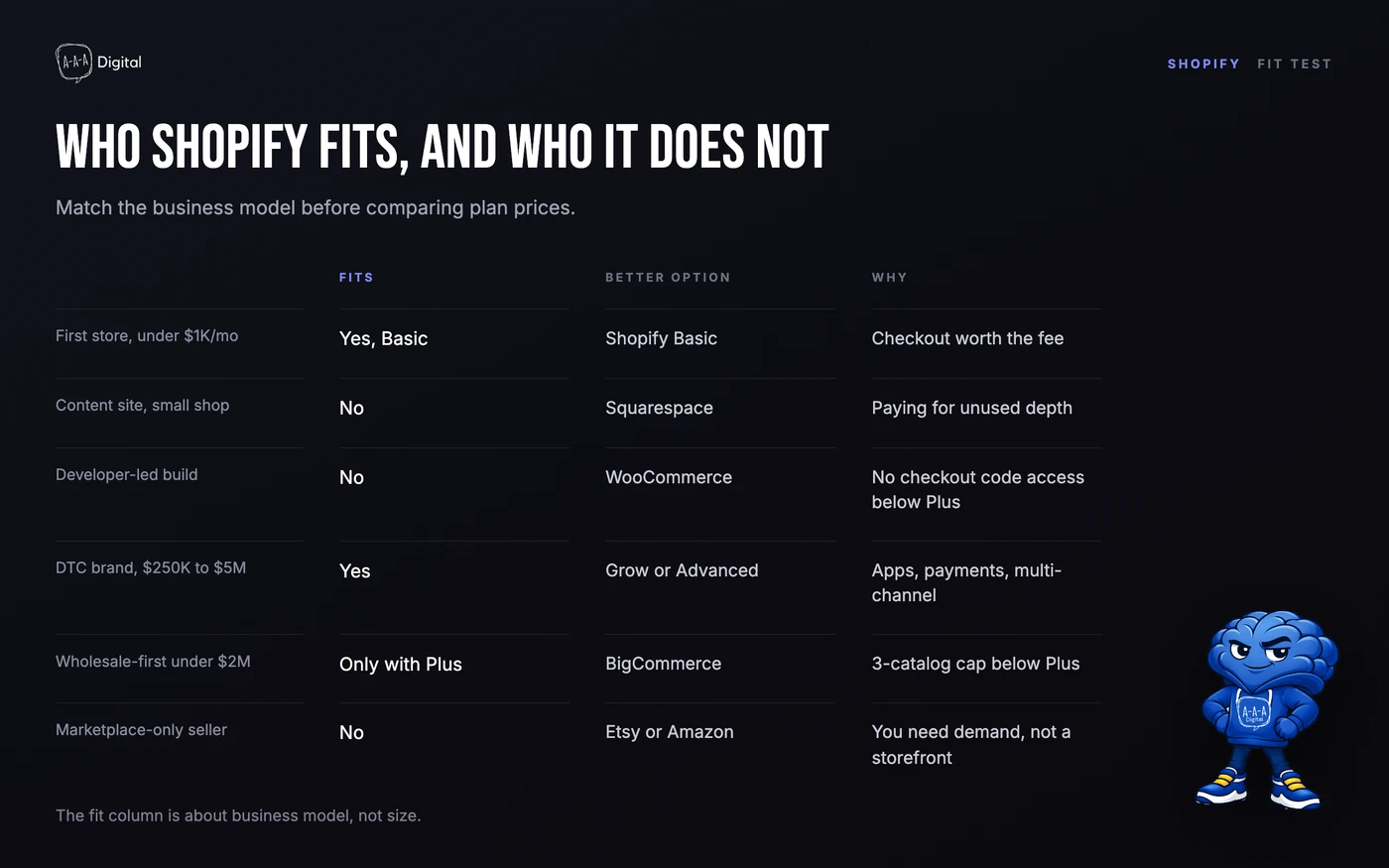
Who Shopify fits, and who it does not
| Your situation | Shopify? | Better option | Why |
|---|---|---|---|
| First store, under $1,000 a month | Yes, Basic | Shopify Basic | The checkout and templates are worth more than the fee |
| Content site with a small shop | No | Squarespace or Wix | You would pay for commerce depth you do not use |
| Developer-led custom build | No | WooCommerce | No database or checkout code access below Plus |
| DTC brand, $250,000 to $5M | Yes | Grow or Advanced | Apps, payments, and multi-channel carry the fee |
| Wholesale-first under $2M | Only with Plus | BigCommerce for B2B depth | 3-catalog cap below Shopify Plus |
| Marketplace-only seller | No | Etsy or Amazon | You need demand, not another storefront |
| Retailer with a store and a website | Yes | Shopify with POS | One inventory across both channels |
The pattern is not about size alone. It is about whether commerce is the main job of the website. If the site exists to sell, Shopify's fee buys a better selling machine. If the site exists to publish, book, or explain, the fee buys features you will not use.
When Shopify is the wrong answer
This is the section most reviews skip, so here it is plainly.
You need control of the checkout and will not pay for Plus. Below Plus, checkout customization is limited to branding and available extensions. If your business model depends on an unusual checkout flow, a custom payment step, or server-side logic at checkout, Shopify will frustrate you. WooCommerce or a headless build is the honest choice.
You are wholesale-first and under $2M. Shopify's B2B tools exist below Plus, but the plan caps at three catalogs. If you need price lists or net terms, the option is Plus at $2,300 a month. BigCommerce includes B2B tooling earlier, and WooCommerce has wholesale plugins. Our Shopify B2B setup guide explains what changes at Plus.
Your category is restricted. Shopify's Acceptable Use Policy and its payment partners restrict categories including many CBD and vape products, firearms, some supplements, and adult content. You may find a high-risk gateway, but you will pay 4% to 6% and face chargebacks. If payments are the constraint, the platform is not the decision.
Your country lacks Shopify Payments. Without it, you pay the third-party gateway fee on every order. On Basic that is 2%, which can wipe out the plan's price advantage in a low-margin category.
You sell five products and traffic is the problem. Shopify does not bring customers. Without an acquisition plan, a $39 subscription plus $200 in apps is a cost with no offsetting return. A marketplace or a payment link is a better first step.
You want a website that happens to sell. Squarespace and Wix are cheaper and faster for brochure sites with a small shop. If most of your value is content, booking, or portfolio, pay for that instead.
How to decide in an afternoon
- Write down three numbers. Monthly revenue, gross margin, and current conversion rate. Without them, every comparison is a vibe.
- Calculate annual cost on each shortlist option, including processing at your real order count and the hours of maintenance. Four hours a month at $75 an hour is $3,600 a year.
- Value one conversion point. Revenue divided by conversion rate gives sessions. At a 2.5% baseline, one tenth of a point is roughly 4% more revenue. Compare that to the cost gap.
- Run a real trial. Build ten products, install the apps you expect to need, and test checkout on a phone. A week of building beats a month of reviews.
If you want the arithmetic done for your store, our Shopify ROI calculator models plan, processing, apps, and conversion lift in one place. For a build or migration, our Shopify development team can scope it.
Frequently Asked Questions
Is Shopify worth it for a small business?
For a small business selling physical products online, usually yes. Basic costs $29 a month billed annually plus card fees, and the checkout converts better than most cheap alternatives. It stops being worth it below $500 a month, or when the site is mostly content.
Is Shopify cheaper than WooCommerce?
Not on the subscription, and often not on total cost. WooCommerce's software is free, but hosting, extensions, and developer time usually put a $250,000 store at $12,400 a year against $10,668 on Shopify Grow. It wins with in-house development and deep customization.
Why is Shopify so expensive?
The plan fee is not where the money goes. On a $250,000 store, processing costs about $7,500 a year and apps about $2,100, against a $1,068 plan. Transaction costs dominate on every hosted storefront.
Is Shopify better than BigCommerce?
They are close at the low end and diverge by fit. BigCommerce includes some B2B features earlier, but its GMV caps push growing stores onto higher plans. Shopify has the larger app ecosystem and stronger checkout.
How much do I need to sell for Shopify to be worth it?
There is no universal threshold, but the math gets comfortable at $10,000 a month. Below that, fixed fees and apps take a large share of contribution margin. Above $30,000, plan upgrades and processing rates matter more than the subscription.
If you are weighing a move, the expensive mistake is choosing on sticker price and discovering the real bill in month six. Our Shopify migration guide covers what switching actually involves, and our ecommerce SEO team handles the traffic side that makes the platform fee pay for itself. Book a free strategy call and we will run the numbers for your catalog.
