Search "how to make money on Shopify" and you get a list. Dropshipping, print on demand, digital products, apps, themes, affiliates. Each idea gets a paragraph and a screenshot of someone else's revenue.
What the list never shows is the number that matters: what one order leaves after the product, the shipping, the card fee, the app, and the ad that brought the customer in. If that number is negative, the idea is not a business yet. It is a hobby with a checkout.
This post works through six models with realistic margins, the cash each one needs, and the customer acquisition ceiling that decides whether paid traffic can work at all. If you are already leaning toward the cheapest of those models, we costed Shopify dropshipping line by line and it does not look like the YouTube version. If you are still choosing the platform itself, our Shopify cost analysis covers the total bill.
The three numbers that decide everything
Every Shopify business comes down to three figures:
- Average order value. What a customer spends per order, not per product.
- Contribution margin. Revenue minus product cost, shipping, payment fees, and the apps directly used to fulfil the order. It is what is left to pay for ads, staff, and overhead.
- Customer acquisition cost. Total marketing spend divided by new customers. Not by orders. Our CAC benchmark guide covers what is normal by category.
The relationship is simple. Your contribution margin per order is your CAC ceiling. Spend more than that to acquire a first-time customer and every sale loses money, no matter how good the revenue chart looks.
CAC itself is cost per click divided by conversion rate. At $1.00 per click and 2% conversion, CAC is $50. At $0.60 per click and 3% conversion, it is $20. The same product can be a disaster on one traffic source and a business on another.
What six models actually keep
Take a $60 order and run the same deductions through each model. These are planning figures, not guarantees, but the shape is right.
| Model | Product and shipping | Fees and tools | Ad spend | Left per order | Margin |
|---|---|---|---|---|---|
| Private label | $25.00 | $3.54 | $18.00 | $13.46 | 22% |
| Print on demand | $33.00 | $2.54 | $15.00 | $9.46 | 16% |
| Digital product | $0 | $2.54 | $18.00 | $39.46 | 66% |
| Dropshipping | $26.00 | $3.04 | $20.00 | $10.96 | 18% |
| Wholesale | $47.00 | $3.80 | $0 | $9.20 | 15% |
| Subscription, repeat order | $18.00 | $5.04 | $0 | $36.96 | 62% |
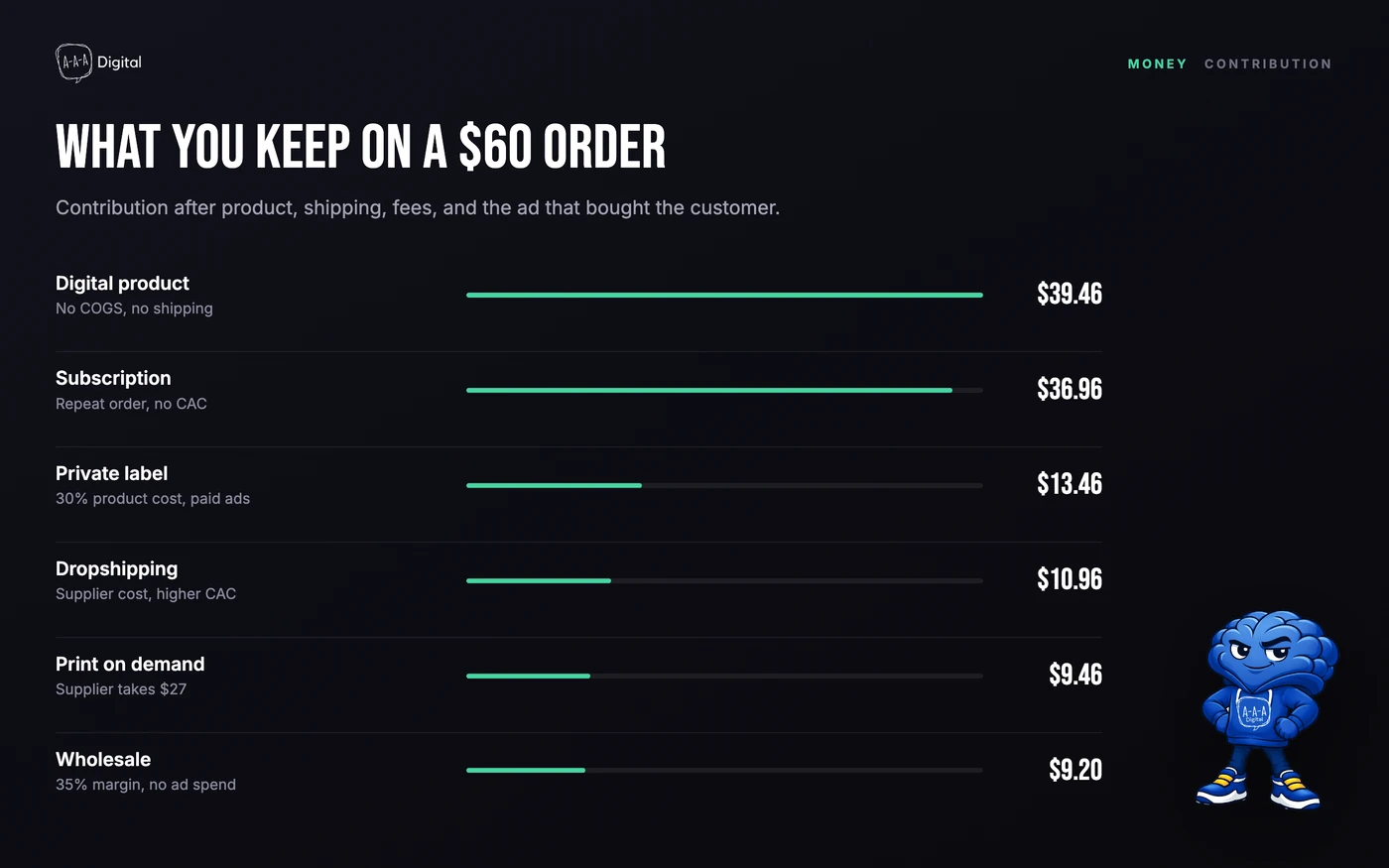
Read the table as a set of trade-offs, not a ranking.
Private label keeps $13.46 on a $60 order at a 30% product cost. That is a healthy physical-product margin, and it is also the model that needs the most cash before the first sale: inventory, photography, packaging, and a first ad budget. The margin is earned by owning the product, not by the platform.
Print on demand keeps $9.46. The supplier takes $27 of the $60, and the shipping is slow enough that some customers cancel before it arrives. It is the cheapest way to test a design and the hardest way to build a brand with repeat customers.
Digital products keep $39.46 because there is no product cost and no shipping. The catch is on the other side of the ledger: creation time, refunds, piracy, and a higher bar for perceived value. Our guide to selling digital products on Shopify covers delivery and tax.
Dropshipping keeps $10.96 at these assumptions, and that is before supplier errors, returns, and chargebacks. The model works when you can buy traffic below the contribution and when the supplier ships reliably. Both are harder than the videos suggest.
Wholesale keeps $9.20 on a $60 order, but there is no ad spend and the order size is usually much larger. A $6,000 wholesale order at the same percentage leaves $920. The constraint is cash flow: stock is bought upfront and paid for 30 to 60 days later. Our guide to what you can sell on Shopify covers the categories where that trade works.
Subscription keeps $36.96 on a repeat order because there is no acquisition cost in that order. The first order carries the CAC. A $40 first-order CAC is paid back by the second order, which is why consumables are the most forgiving model for paid traffic.
What each model demands
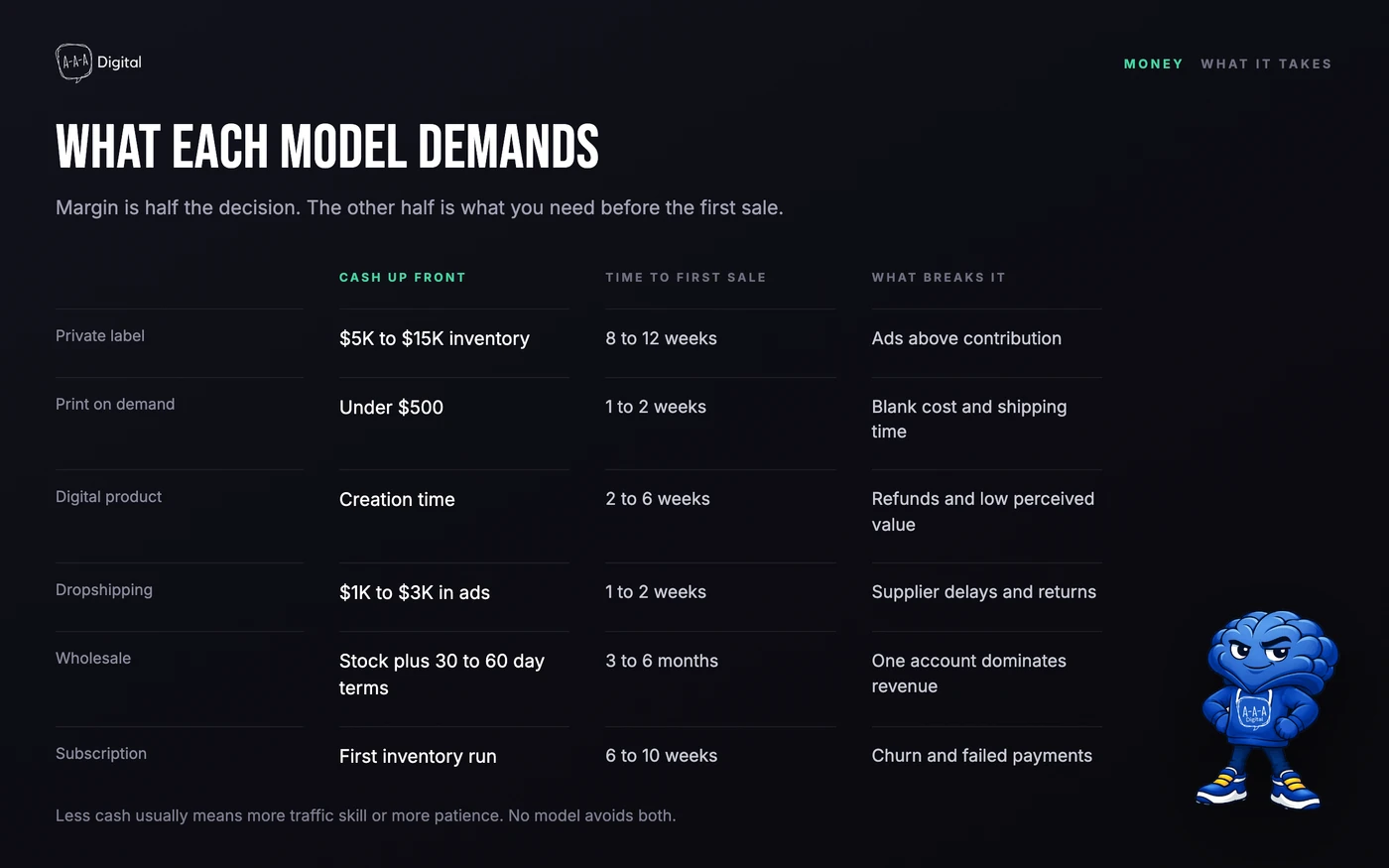
Margin is only half the decision. The other half is what you need before the first sale.
| Model | Cash before launch | Time to first sale | What breaks it |
|---|---|---|---|
| Private label | $5,000 to $15,000 | 8 to 12 weeks | Ad costs above contribution |
| Print on demand | Under $500 | 1 to 2 weeks | Blank cost and shipping time |
| Digital product | Creation time | 2 to 6 weeks | Refunds and low perceived value |
| Dropshipping | $1,000 to $3,000 in ads | 1 to 2 weeks | Supplier delays and returns |
| Wholesale | Stock plus 30 to 60 day terms | 3 to 6 months | One account becomes most of revenue |
| Subscription | First inventory run | 6 to 10 weeks | Churn and failed payments |
The pattern: models that need less cash need more traffic skill or more patience. There is no version where you need neither.
The CAC ceiling in practice
Here is why so many stores grow revenue and shrink profit. They compare CAC to revenue instead of contribution.
At a $60 AOV and 22% contribution, the ceiling is $13.46 per new customer. On Meta at $1.20 per click and 2% conversion, CAC is $60. That is four times the ceiling. The store is paying $60 to earn $13.46, and the loss repeats on every new customer until the ad account is turned off.
The fix is not always a lower CAC. Sometimes it is a higher contribution:
- Raise AOV with a bundle or a free-shipping threshold. Our margin improvement guide covers the levers in order.
- Cut the product cost by ordering a larger batch, once the design is validated.
- Improve conversion so the same clicks produce more orders. Moving 2% to 3% cuts CAC by a third.
- Shift spend to email and repeat orders, where there is no acquisition cost.
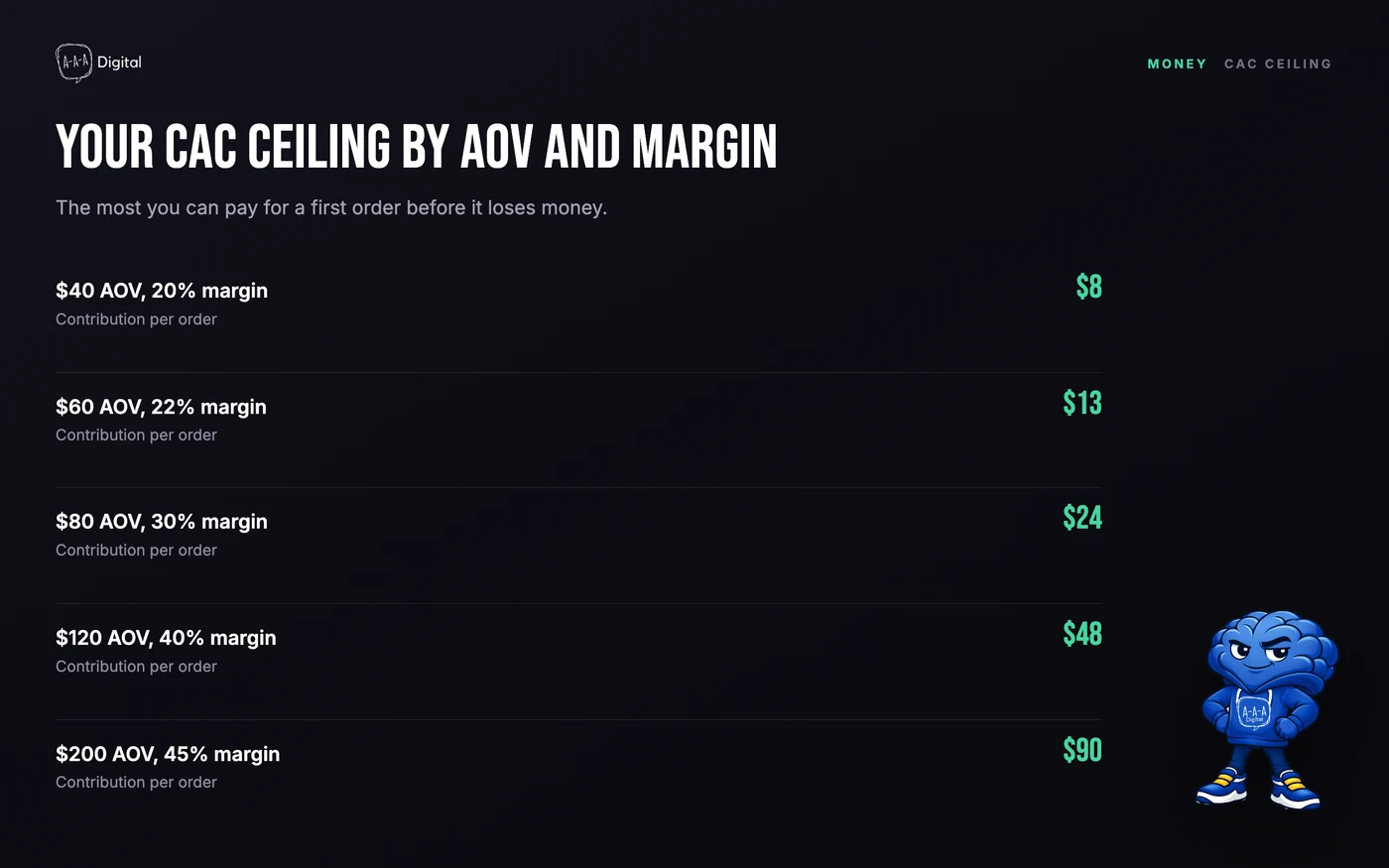
A $40 order at a 20% contribution leaves $8. A $200 order at 45% leaves $90. The ceiling moves with both numbers, which is why discounting without cutting product cost is so dangerous.
The most useful exercise is to work backwards. Pick the CAC your ad account can realistically hit, then ask what AOV and margin you need to support it. A $30 CAC needs about $135 in revenue at a 22% contribution. That is a bundle, not a single product.
A realistic first 90 days
This is the sequence we see work, across categories.
Days 1 to 14: choose one model and one product. Build the contribution table before you buy anything. If the numbers do not work at a plausible CAC, change the product, not the ad targeting.
Days 15 to 30: sell 20 orders. A small batch, a pre-order, or a landing page with a deposit. The goal is not profit. It is proof that strangers will pay, and a first read on conversion.
Days 31 to 60: measure CAC and repeat rate. One product, one traffic source, one offer. If contribution is positive after ads, add budget slowly. If it is negative, fix the offer or stop.
Days 61 to 90: add the retention layer. A welcome flow, an abandoned cart flow, and a post-purchase flow. Email revenue is the cheapest revenue a store has, and our email flows guide covers the build order.
Where the profit actually comes from
After the first 90 days, three levers matter more than the model you picked.
Repeat rate. A customer who buys three times is worth three contribution margins for one acquisition cost. Subscription and consumable models win here, but any product with a refill, a size, or a season can build a replenishment flow.
AOV. Moving a $60 order to $75 with a bundle adds $15 of revenue and, at a 50% incremental product cost, $7.50 of contribution. That is more than most stores gain from a 10% ad optimization.
Conversion rate. The same traffic at 2.5% instead of 2% is 25% more orders and 25% lower CAC. This is where performance marketing earns its fee, and where most stores underestimate the return.
Revenue is a vanity number. Contribution per order, multiplied by new customers and repeat orders, is the business.
Frequently Asked Questions
How much money can you make on Shopify?
There is no fixed answer, because the platform does not generate demand. A store with a 22% contribution margin doing 500 orders a month at $60 AOV leaves about $6,730 before overhead and salaries. A digital product store with the same orders leaves about $19,730. The model and the traffic decide the income.
Is dropshipping still profitable in 2026?
It can be, at a 10% to 20% contribution margin and a CAC below that number. Most beginners fail because they buy traffic at $30 to $50 per customer on a product that leaves $10. It is a media-buying business, not a product business.
How much does it cost to start a Shopify store?
The store itself costs $29 to $39 a month on Basic, plus a domain and a theme. The business costs more: $500 for a print-on-demand test, $1,000 to $3,000 for a dropshipping test, or $5,000 to $15,000 for a private-label run. Budget for ads separately.
What is a good profit margin on Shopify?
For physical products, 20% to 30% contribution after ads is healthy. Digital products can run 60% to 80%. Wholesale sits lower per order but has no ad cost. Anything below 10% leaves no room for returns, refunds, or a bad month.
Do I need a lot of followers to make money on Shopify?
No, but you need a way to reach buyers. A following is one acquisition channel. Search, marketplaces, email, and paid ads are others. A store with 2,000 engaged subscribers can outperform one with 200,000 passive followers.
If the model is clear and the numbers are not, start with our Shopify ROI calculator. It models contribution, CAC, and break-even before you spend on stock. For a second opinion on the traffic plan, book a free strategy call and we will pressure-test the math with you.
