Starting dropshipping on Shopify costs about $200 a month in software before you run a single ad, and $1,200 to $3,000 in ad spend before the numbers tell you anything true. On a $34.99 product with a $9.80 landed cost, your break-even cost per acquisition is $22.13.
That last number is the whole business. Most stores never calculate it, run ads at $30 a sale, and conclude that dropshipping stopped working. It did not stop working. The math never worked at that price.
What dropshipping is, without the sales pitch
You list a product you do not own. When someone buys, the order goes to a supplier who ships it directly to your customer. You keep the difference between the retail price and the supplier cost, minus fees, refunds, and advertising.
Three things follow from that structure, and they are the source of every strength and weakness in this model.
- No inventory risk. You can list 40 products for the price of 40 clicks. Nothing is bought until something sells.
- No control over the last mile. The supplier ships when they ship, in packaging with their return address, at their speed.
- No exclusivity. The same product, sometimes with the same photos, sits on a few hundred other stores.
Suppliers come in three flavours: an AliExpress listing, an agent like CJ or Zendrop that consolidates orders, and a private agent who quotes per SKU. The first is free and slow, the second adds 10% to 20% to the unit cost for faster dispatch, and the third only makes sense above 20 orders a day.
The model is a testing machine. It is a poor way to run a business that already has demand.
The fixed costs, month one
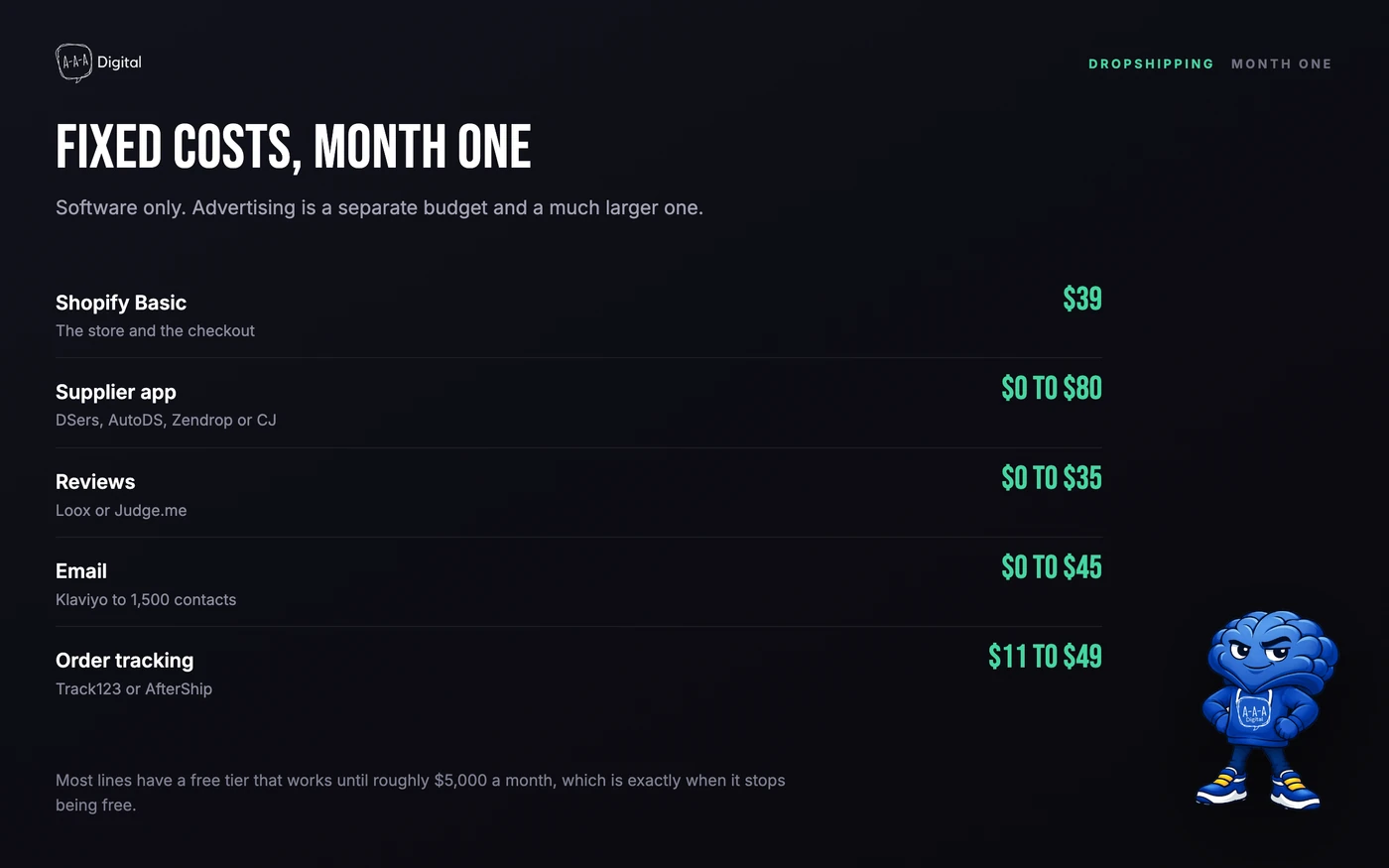
| Line | What you need it for | Monthly |
|---|---|---|
| Shopify Basic | The store and checkout | $39 ($29 annual) |
| Supplier app | DSers, AutoDS, Zendrop, or CJ | $0 to $80 |
| Reviews | Loox or Judge.me | $0 to $35 |
| Klaviyo up to 1,500 contacts | $0 to $45 | |
| Order tracking | Track123 or AfterShip | $11 to $49 |
| Domain | $15 a year, amortized | $1.25 |
Add a theme, if you buy one, at $180 to $400 once. Skip it for the first month: Dawn is free and fast, and a theme does not fix a product nobody wants.
The honest range is $180 to $250 a month, and most stores hit the top of it by month three, when the free tiers of the Shopify dropshipping apps they installed start expiring. Our guide to setting up a Shopify store covers the build itself, which takes two focused days, not two weeks.
What is missing from that table is the number that decides whether you have a business: what you can pay to acquire a customer.
The unit economics of one order
Work backwards from the price. Take a $34.99 product, free shipping, paid card, US customer.
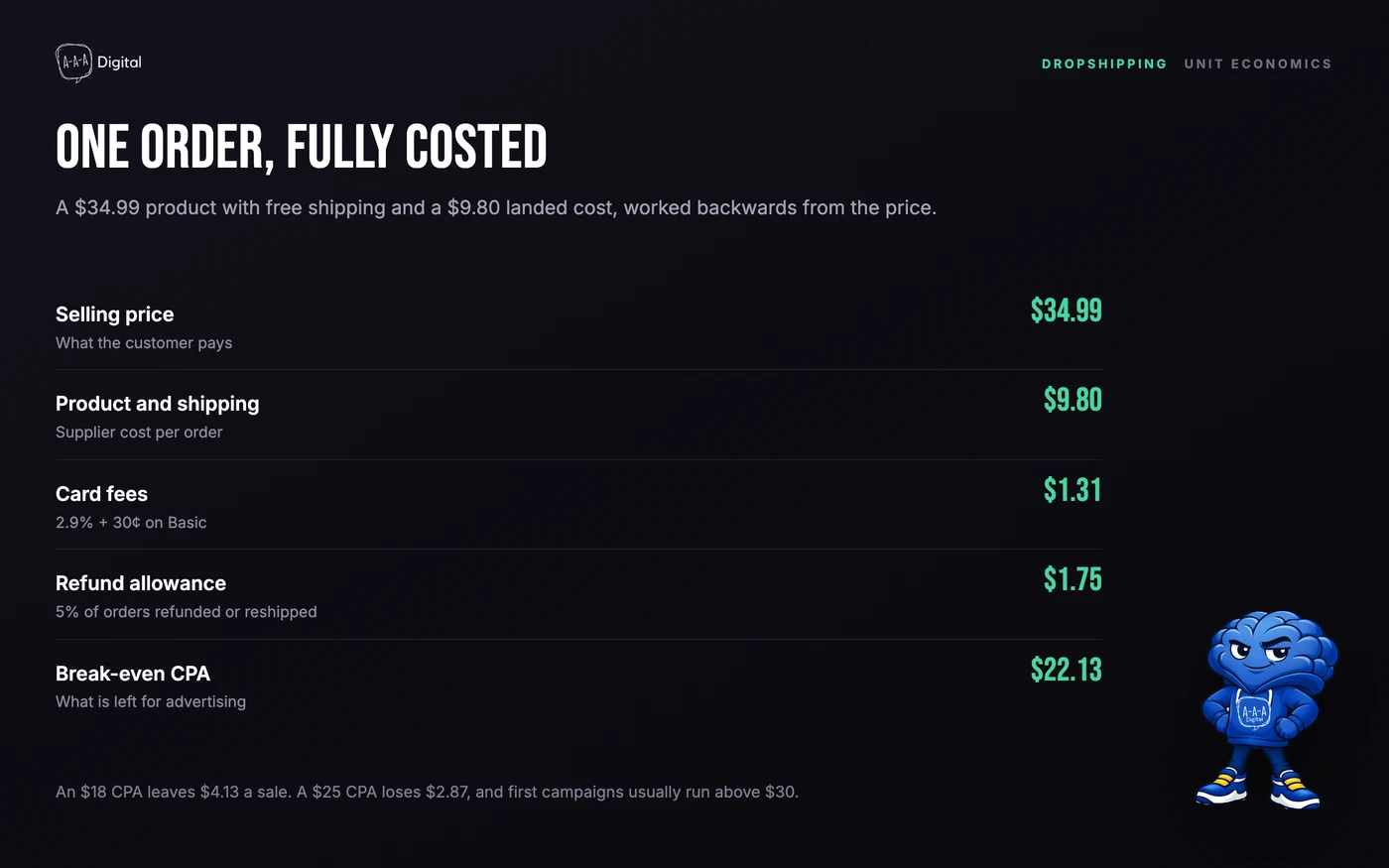
| Line | Basis | Amount |
|---|---|---|
| Selling price | What the customer pays | $34.99 |
| Product and shipping | Supplier cost per order | $9.80 |
| Card fees | 2.9% + 30¢ on Basic | $1.31 |
| Refund allowance | 5% of orders refunded or reshipped | $1.75 |
| Break-even CPA | What is left for advertising | $22.13 |
At a $22.13 break-even cost per acquisition, an $18 CPA leaves $4.13 a sale. That is a real business, at 12% contribution margin. A $25 CPA loses $2.87 a sale, and first campaigns usually run at $30 to $50 before creative and audience are dialled in.
The 5% refund allowance is not pessimistic. Dropshipped orders refund more than stocked orders because the delivery estimate is long and the product is often not what the photo promised. Add chargebacks at $15 each on a bad batch, and the allowance should be 6% to 8% for a store selling novelty products.
Two levers move the ceiling. A higher price, if the product supports it, adds straight to break-even. A cheaper landed cost does the same. Our guide to improving ecommerce margins covers the cost side in more detail than this post can.
What the first sale actually costs
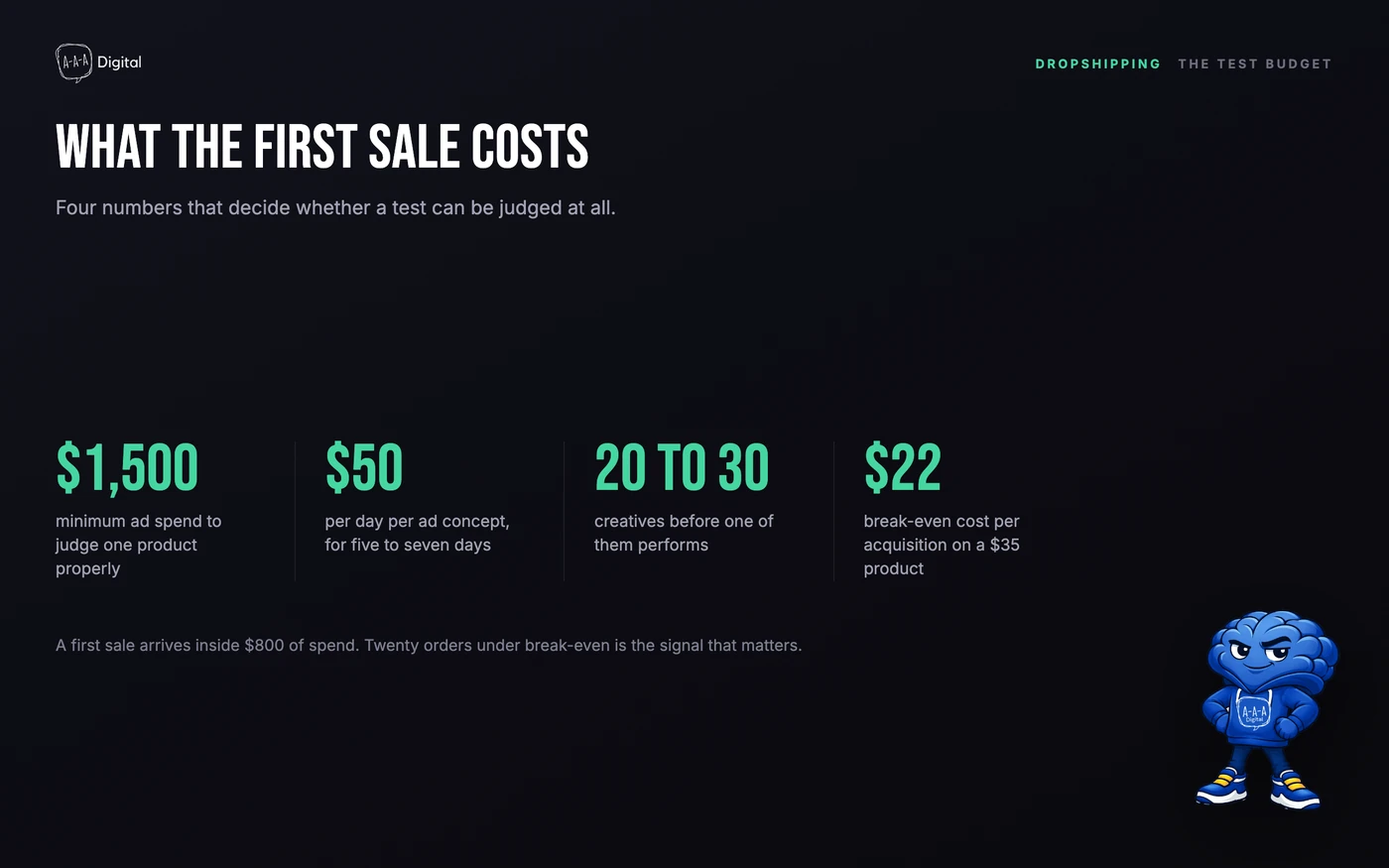
Most first sales arrive within $300 to $800 of ad spend. That is not the useful milestone. The useful one is a week of spend where cost per acquisition sits under break-even across at least 20 orders, because 20 orders is roughly the point where a 12% margin stops looking like luck.
Plan for $50 to $100 a day per ad set, five to seven days, and expect to run 20 to 30 creatives before one performs. That is $1,200 to $3,000 for a real read, and it is why the "start with $100" advice fails: $100 buys a day of data, not a decision.
Three rules we use, which are boring and effective:
- Kill at 2x break-even after $150 spent. On the $34.99 product, that is a $44 CPA with no sale in the last 24 hours.
- Scale at or under break-even, in 20% steps every two days. Doubling a budget resets the learning phase and usually raises CPA.
- Judge by contribution, not ROAS. A 2.5 ROAS on a 30% margin product is a loss. Our customer acquisition cost guide explains why blended CAC is the number to hold yourself to.
Shipping times decide the conversion rate
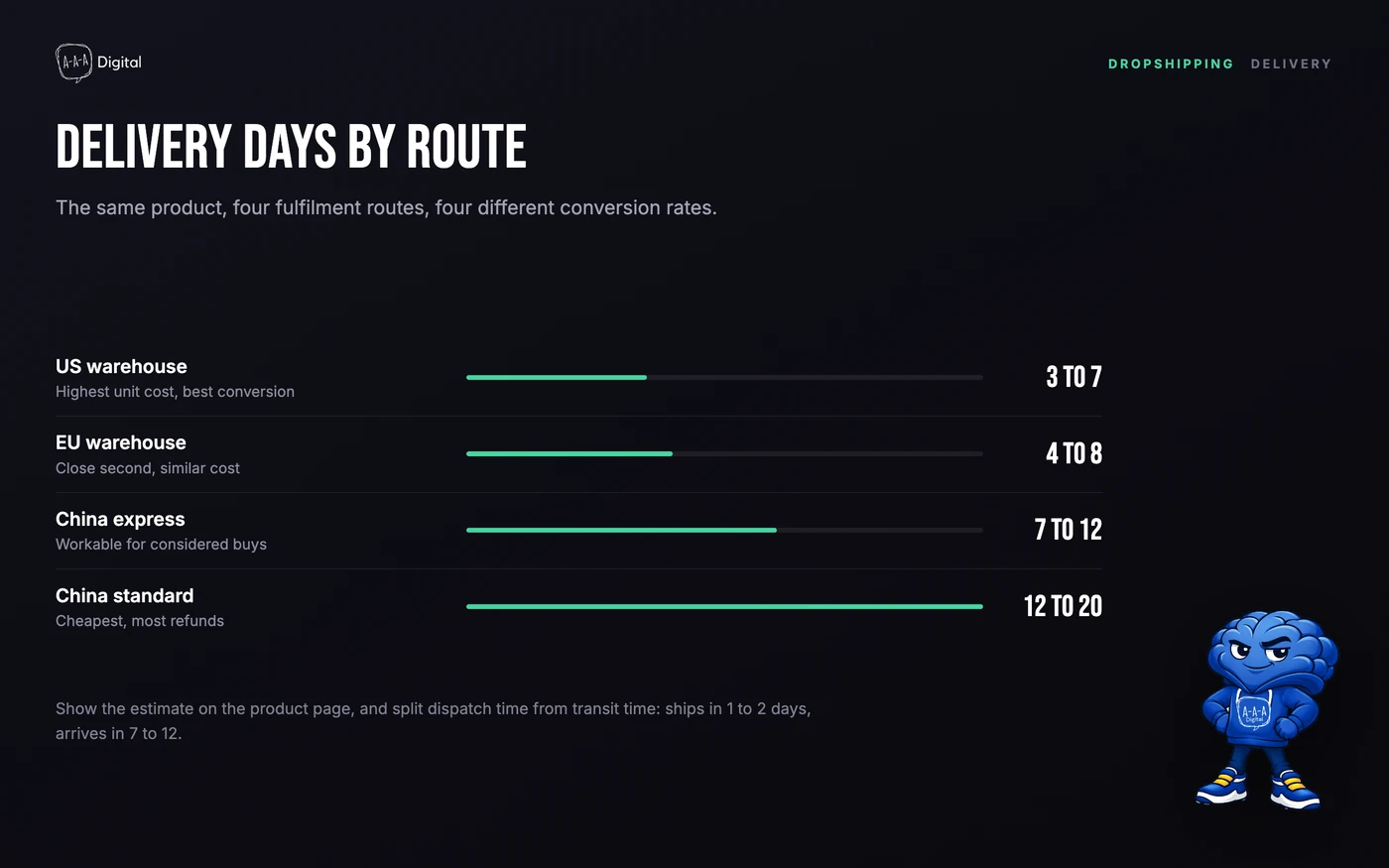
| Route | Delivered in | Effect on conversion |
|---|---|---|
| US warehouse (3PL) | 3 to 7 days | Best. Comparable to a normal store. |
| EU warehouse | 4 to 8 days | Close second, higher unit cost. |
| China express | 7 to 12 days | Acceptable for considered purchases. |
| China standard | 12 to 20 days | Noticeable drop, more refunds. |
Two operational rules prevent most of the damage. Show the estimate on the product page, not just at checkout, and set the dispatch time separately from the transit time: "ships in 1 to 2 business days, arrives in 7 to 12". Then hold the supplier to the dispatch time, because a product that ships on day four has a real delivery window of 11 to 16 days.
Peak season breaks all of this. Orders placed in late November routinely take 25 to 35 days from China, and the customer blames you, not the calendar. If Q4 is a meaningful share of your revenue, move the top SKU to a local warehouse before October. Our comparison of shipping apps for Shopify covers the tracking side, which cuts support tickets by roughly half when delivery slips.
Where dropshipping loses to holding inventory
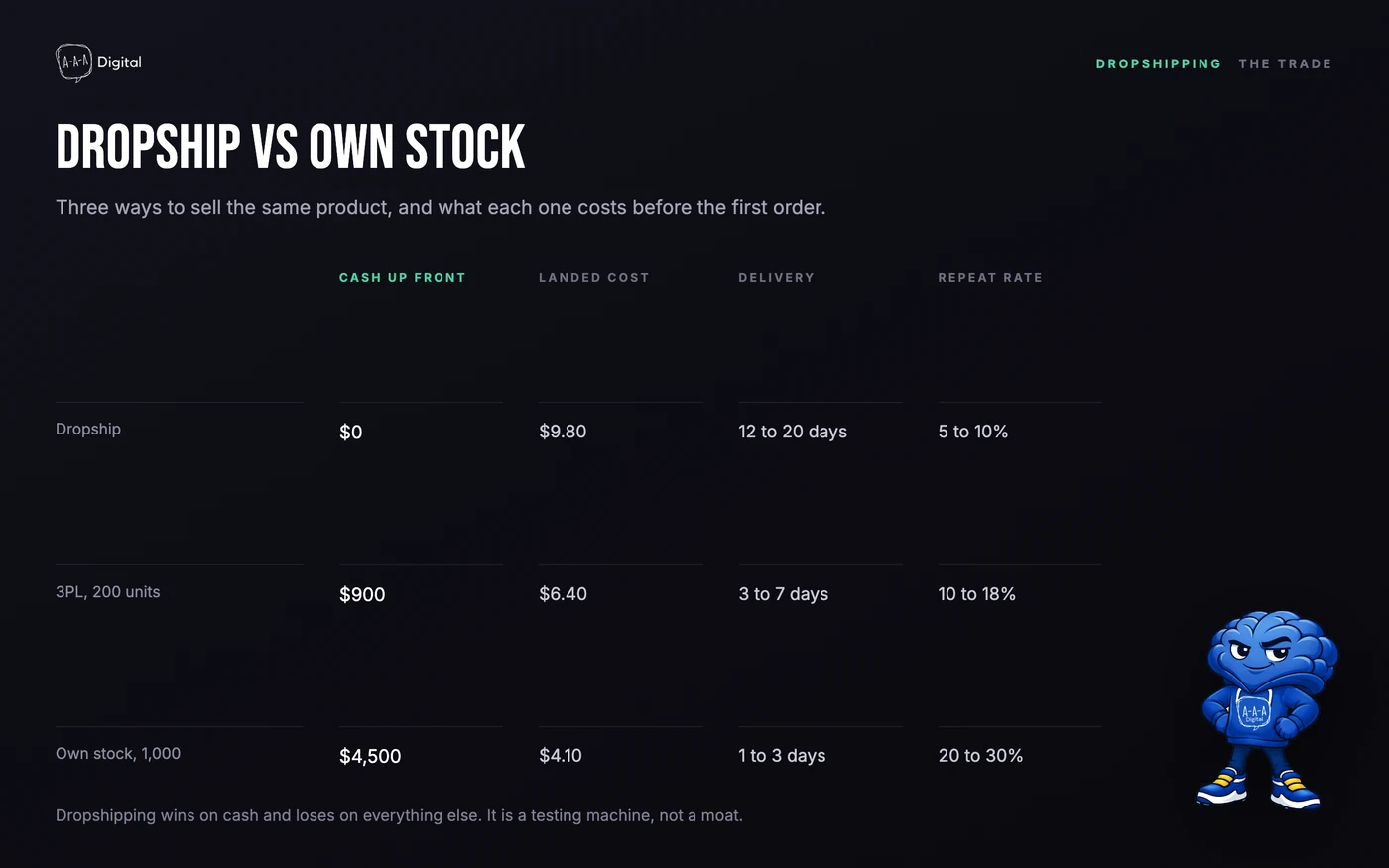
| Model | Cash up front | Landed cost | Delivery | Repeat rate |
|---|---|---|---|---|
| Dropship | $0 | $9.80 | 12 to 20 days | 5% to 10% |
| 3PL, 200 units | About $900 | $6.40 | 3 to 7 days | 10% to 18% |
| Own stock, 1,000 units | About $4,500 | $4.10 | 1 to 3 days | 20% to 30% |
Say it plainly: dropshipping loses on everything except cash. A stocked store pays $4.10 landed instead of $9.80, which lifts break-even CPA from $22 to $28 on the same price. It ships in under a week, so it converts better on cold traffic. It can put a card in the box, so it gets repeat orders. And it owns the product page, so it is not one of forty stores selling the identical item with the identical video.
Dropshipping wins in one place: it lets you find out whether a product has demand for $1,500 instead of $4,500. That is a real advantage, and it is the only one worth building a strategy on.
The transition point is when a single SKU sells 15 to 20 units a day for three consecutive weeks at positive contribution. At that volume, buying 200 units and moving to a 3PL cuts landed cost by roughly a third, and 200 units sell through in under two weeks. Below that volume, holding inventory is a bet on demand you have not proven.
How to start dropshipping on Shopify in 90 days
A plan with numbers, because "consistency" is not a plan.
Weeks 1 and 2: build and pick. One niche, ten products from one supplier. One supplier matters, because two suppliers means two shipping profiles, two return addresses, and twice the support load. Build the store in two days, and check that the category clears payments and shipping rules before you fall in love with a product. The product filter guide covers the categories that lose Shopify Payments.
Weeks 3 and 4: test. Three ad concepts, three creatives each, $50 a day each for ten days. Budget $1,500 for the block. Kill anything above 2x break-even CPA after $150. Keep the one concept that produces orders under break-even, even at low volume.
Weeks 5 to 12: fix the order, not the ads. Add the email flows, the review request, and a tracking page. Raise the average order value with a bundle rather than a discount. If contribution is positive at $100 a day by week 12, start sourcing the top SKU in bulk. If it is not, kill the store and keep the $1,200 you did not spend on inventory.
Most people who fail at this fail in week 3, when the first $300 produces two sales and they respond by changing the product, the price, and the ads at once. Change one variable at a time, or you learn nothing from the money you spent.
Frequently Asked Questions
How much does Shopify dropshipping cost to start?
About $180 to $250 a month in software, plus $1,200 to $3,000 in ad testing before the results mean anything. The domain and theme add $15 to $400 up front, and the domain renews yearly.
Is dropshipping still profitable?
On a $34.99 product with a $9.80 landed cost, break-even cost per acquisition is $22.13. That leaves room for a $15 to $18 CPA, which is achievable but not easy. Products under $25 rarely work, because fees and shipping eat the margin before ads do.
How long until the first sale?
With $50 a day and decent creative, usually within one to three weeks. A first sale is a weak signal. Twenty orders under break-even in one week is the signal worth acting on.
Do I need to hold inventory to scale?
Not at first, and yes eventually. Past roughly 15 to 20 units a day on one SKU, buying 200 units and using a 3PL cuts landed cost by about a third and shortens delivery to under a week, which improves conversion and repeat rate at the same time.
What is a good margin for dropshipping?
Aim for a landed cost at or below 30% of the selling price. At 28%, break-even CPA is about $22 on a $35 product. Below 20% margin, the ad platform takes the rest, and no amount of optimisation fixes it.
Dropshipping is a cheap way to buy information and an expensive way to buy a brand. If you want help reading the numbers before the ad budget decides for you, our performance marketing team builds the test plan and the kill rules with you. To see what a product needs to earn before it is worth stocking, the Shopify ROI calculator runs the same math on your prices.
