The honest answer to "what can you sell on Shopify" is almost anything legal. Shopify's Acceptable Use Policy restricts a short list of categories, and payment providers restrict another. Everything else is allowed.
Allowed is not the same as sellable. A product that weighs 40 kg, needs a licence, or carries a 4% high-risk payment rate can be listed in ten minutes and lose money for a year. The categories that work are the ones where shipping, regulation, and margin line up. If you plan to test without holding stock, read the dropshipping cost breakdown before you buy a theme.
This post covers what ships cleanly, what does not, and the four filters to run before you buy stock. If the platform itself is still the question, our Shopify cost analysis runs the total bill first.
The four filters
Every product passes through four questions before it deserves a store.
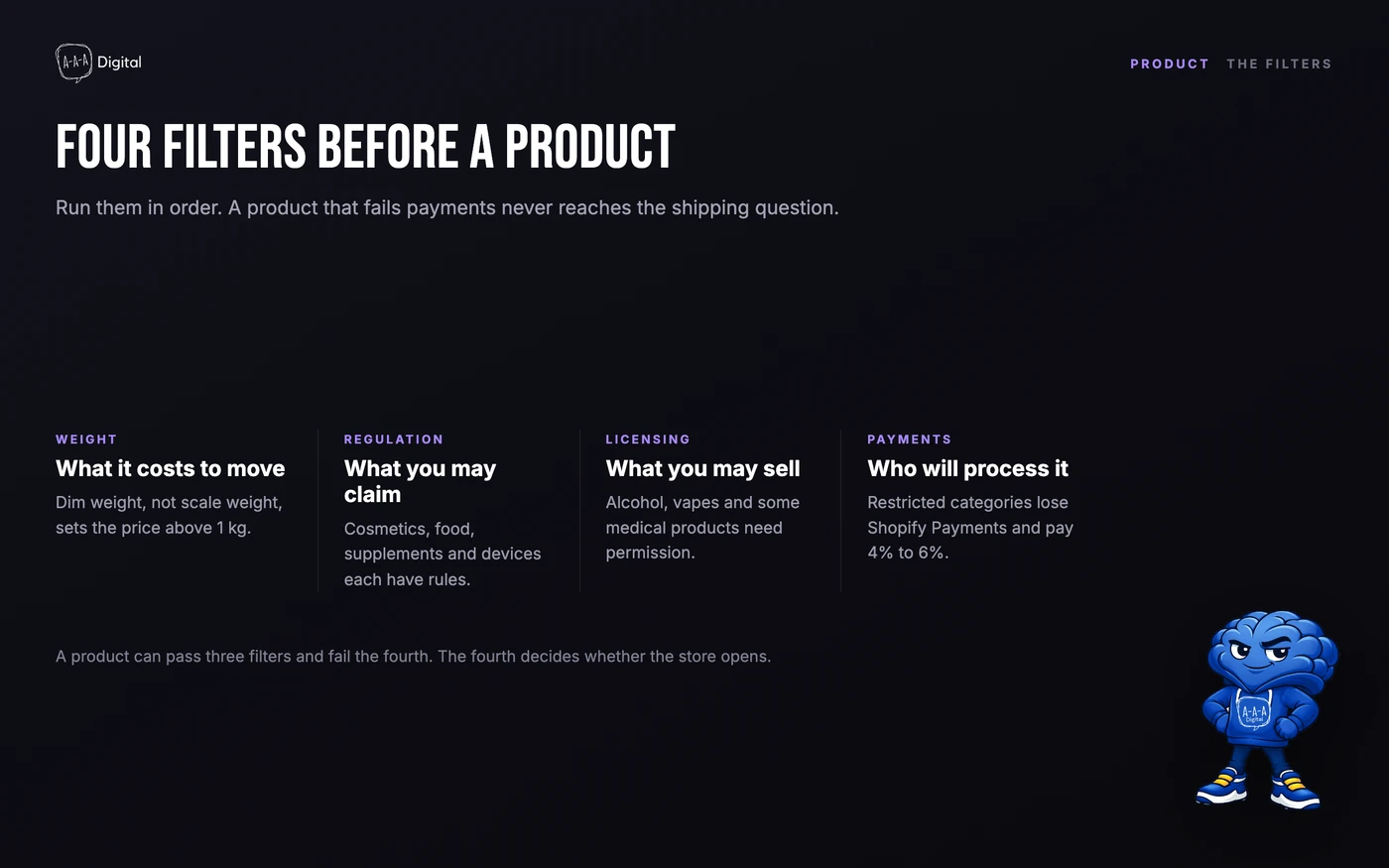
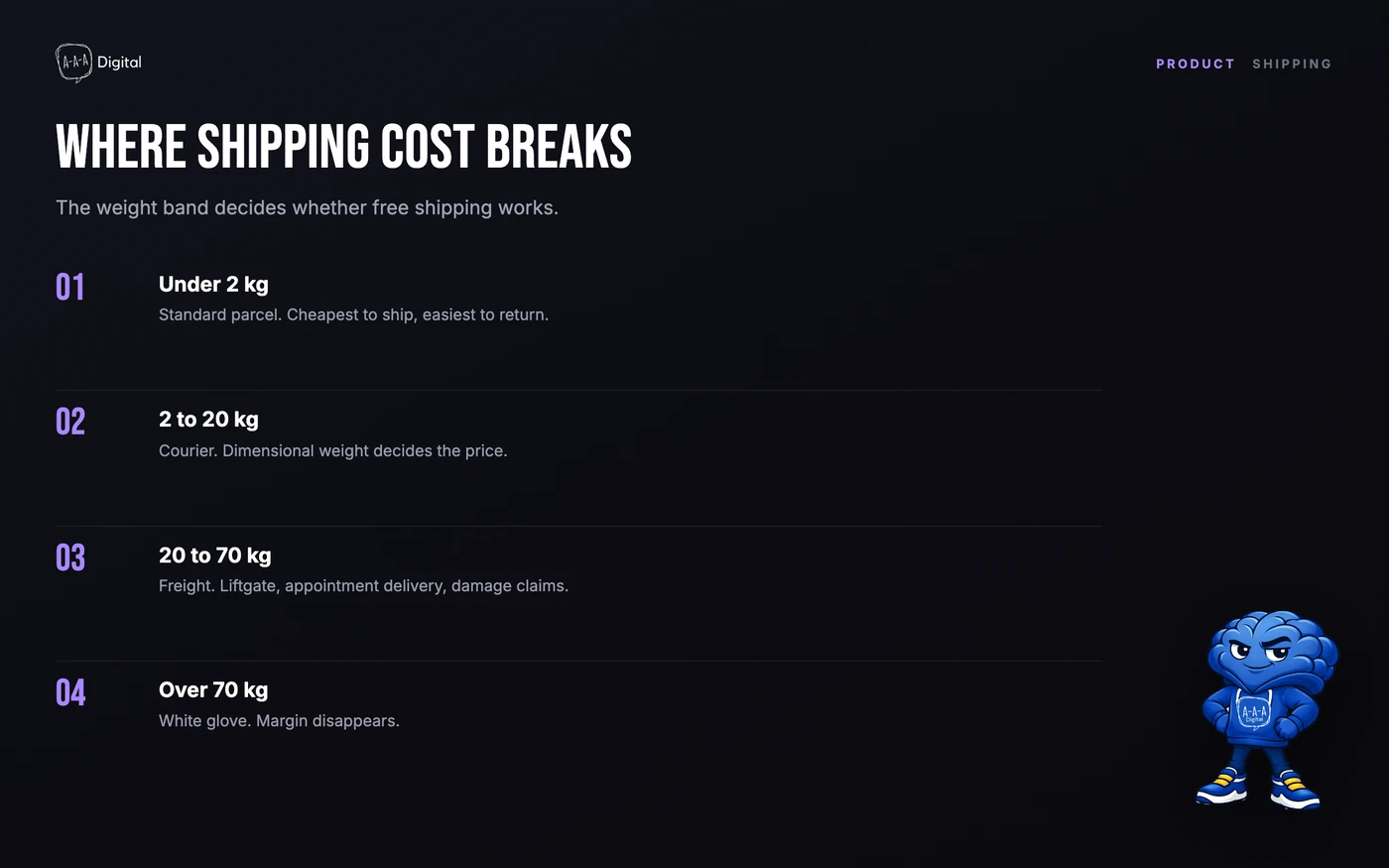
Weight and size. Below 2 kg, a product moves as a standard parcel and returns are cheap. Above 20 kg, you are pricing freight, liftgate delivery, and damage claims. Dimensional weight matters more than actual weight: carriers charge for the space the box takes, so a light but bulky item can cost more to ship than a dense one twice its weight.
Regulation. Cosmetics, food, supplements, medical devices, and children's products each have their own labeling and testing rules. The rules differ by market, and the platform does not enforce them for you. A product can be legal to sell and still be illegal to claim.
Licensing. Alcohol, tobacco, vapes, cannabis, firearms, and some medical products require licences that vary by state or country. Some carriers refuse them outright. A licence is not a marketing asset; it is a gate.
Payments. Restricted categories often lose Shopify Payments and move to a high-risk gateway at 4% to 6% plus chargebacks. That single change can erase the margin on a product that looked profitable at 2.9%.
What ships cleanly
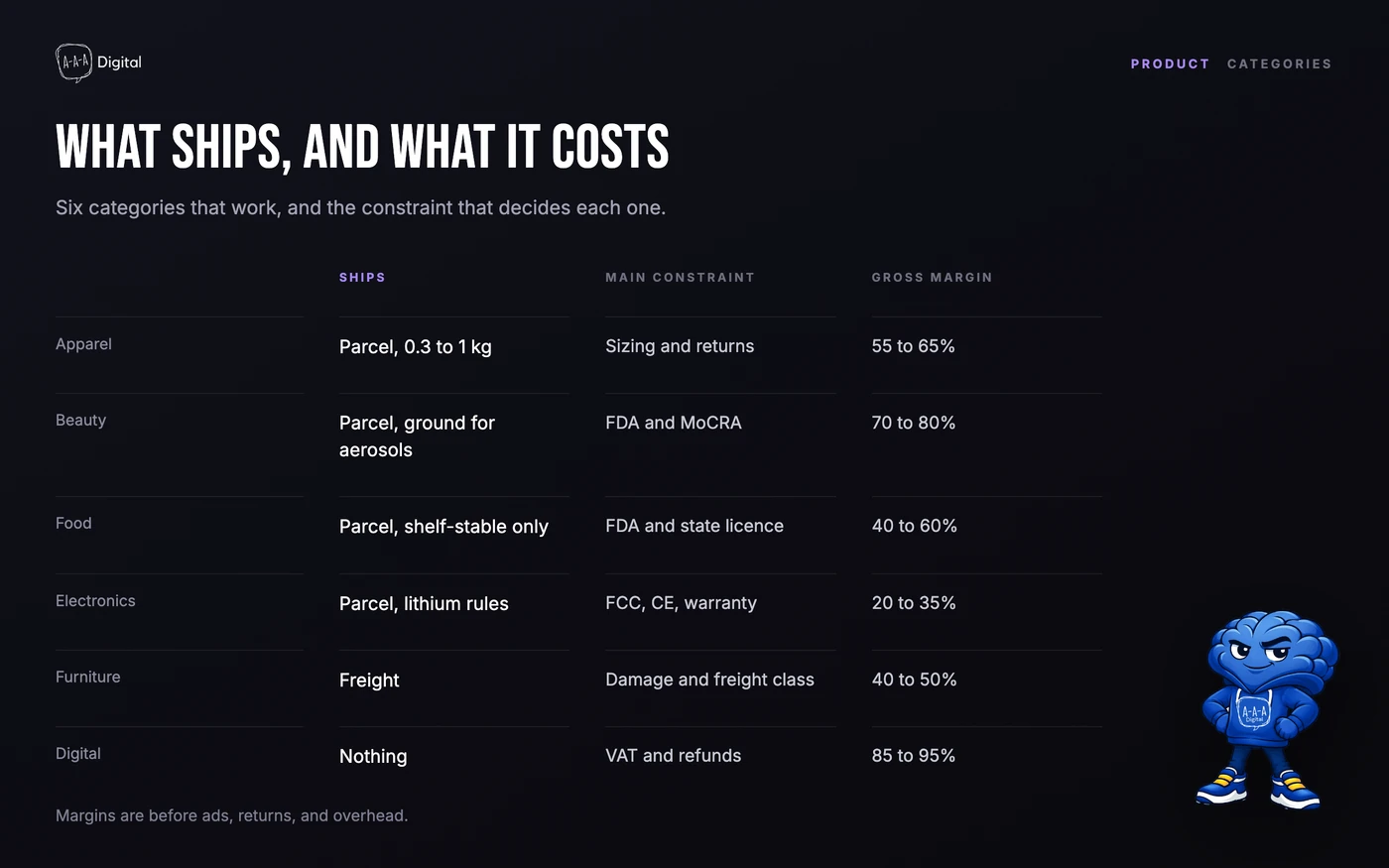
These categories share three traits: low weight, no licence, and a margin that can absorb returns.
| Category | Typical shipping | Main constraint | Realistic gross margin |
|---|---|---|---|
| Apparel | Parcel, 0.3 to 1 kg | Sizing and returns | 55% to 65% |
| Accessories | Letter or small parcel | Low average order value | 50% to 65% |
| Home textiles | Parcel, 1 to 3 kg | Dimensional weight | 45% to 55% |
| Pet supplies | Parcel, 1 to 5 kg | Repeat purchase | 40% to 55% |
| Stationery and craft | Letter or small parcel | Low price point | 50% to 70% |
| Beauty and skincare | Parcel, ground for aerosols | FDA and MoCRA | 70% to 80% |
| Digital products | Nothing | VAT and refunds | 85% to 95% |
Apparel is the default for a reason. It is light, it photographs well, and customers expect to buy it online. The cost is returns. Size guides, model shots, and a clear exchange policy are not optional extras; they are the margin.
Accessories avoid sizing risk and ship in a padded envelope. The trade-off is a low average order value, which makes paid acquisition harder. They work best as a second product, not a first.
Home textiles such as towels, throws, and bedding sit in the middle: heavier than apparel, but not freight. Watch the box size. A duvet that ships in an oversized box gets charged dimensional weight and can lose $8 a parcel.
Pet supplies have strong repeat behaviour, which makes them forgiving on acquisition cost. Food and treats add regulatory weight, so start with accessories, toys, and grooming tools if you want the simpler path.
Beauty and skincare carry the best margins in physical goods and the most regulatory work. In the US, cosmetics fall under FDA rules and MoCRA facility registration and product listing. In the EU, you need a responsible person and CPNP notification. Aerosols and fragrances also trigger ground-only shipping.
Digital products ship nothing and keep the most. The constraints move to tax and refunds: digital sales tax rules vary by country, and a $49 template is easy to copy. Our guide to selling digital products on Shopify covers delivery, tax, and refund policy.
What ships badly
These can sell, but the physical cost eats the margin.
Furniture and large home goods. Freight class, liftgate, appointment delivery, and damage claims. A $600 sofa might cost $180 to ship and another $40 in damage allowances. It can work at high AOV with a narrow catalog, not as a side product.
Perishables. Chocolate, fresh food, and anything temperature-sensitive need insulated packaging and expedited shipping. A single melted order can cost more than the margin on five.
Glass and ceramics. Plan for 2% to 5% breakage without custom packaging. Double-boxing and foam add cost and weight.
Electronics with lithium batteries. Standalone lithium batteries (UN3480) and batteries contained in equipment (UN3481) have carrier rules, labeling, and air restrictions. A product that cannot fly limits your international sales.
Oversized lightweight items. A lamp that weighs 1 kg but ships in a 60 cm box is priced on volume. Check the dimensional weight before you set the shipping rate.
The regulated categories
Regulation is where most "you can sell anything" advice falls apart.
Food and beverage. Shelf-stable products need FDA food facility registration in the US, correct nutrition and allergen labels, and compliance with state rules. Perishables add cold chain. Cottage food laws allow some home-produced items, but usually only in-state and only for certain products.
Supplements. Structure and function claims must be truthful and substantiated. The FDA does not approve supplements before sale, which is not the same as having no rules. Chargebacks run high, and payment providers watch the category.
Alcohol. The US three-tier system means you generally need a licence in each state where you ship, age verification at checkout, and a carrier that accepts alcohol. Some states prohibit direct-to-consumer shipping entirely.
Vapes, CBD, and adult products. Shopify Payments prohibits many of these categories. Merchants move to high-risk gateways at 4% to 6%, with rolling reserves and higher dispute rates. If payments are the constraint, the platform is not the decision.
Medical devices and children's products. Medical devices need FDA clearance or registration depending on class. Children's products need CPSIA testing and tracking labels. Both are legitimate categories with a real barrier to entry, which is also why the margins can be better.
Plants and live animals. Carrier restrictions, state agricultural rules, and mortality risk. Some categories are better sold locally or through a specialist marketplace.
Digital products and services
The lightest catalog on Shopify is not a physical product at all.
Digital downloads. Presets, templates, fonts, planners, audio packs, and ebooks. No shipping, no inventory, 85% to 95% gross margin. The work is in creation and in stopping refund abuse.
Courses and memberships. Higher price points, more support, and a refund window that can stretch to 30 days. A $299 course with a 10% refund rate still nets more per sale than most physical products.
Services and bookings. Consultations, installations, repairs, and lessons. Shopify handles the booking and payment; the delivery is your time. Capacity is the constraint, not shipping.
Wholesale and B2B. Selling to retailers changes the unit economics: lower margin per unit, larger orders, net terms. Our Shopify B2B setup guide explains when the built-in tools are enough and when you need Plus.
How to validate before buying stock
- Check the landed cost, not the unit cost. Product, freight to your warehouse, duties, packaging, and a 3% damage allowance.
- Price at three times landed cost. Below that, paid acquisition is difficult unless the product is a consumable with strong repeat rates.
- Weigh and measure a sample. Calculate dimensional weight and get a real shipping quote to the furthest zone you plan to serve.
- Read the payment rules for the category. Check Shopify Payments eligibility and your backup gateway before launch.
- Sell 20 units before ordering 200. A small batch or pre-order tells you more than a supplier's minimum order discount.
If the landed cost, shipping quote, and payment rate leave less than 30% contribution, the product is not ready. Our margin improvement guide covers the fixes, the shipping apps guide covers rates and labels, and the Shopify ROI calculator models them together. For the full model economics, read how to make money on Shopify.
Frequently Asked Questions
Can you sell anything on Shopify?
Almost anything legal, but not anything profitably. Shopify's Acceptable Use Policy blocks illegal and harmful products, and payment providers block additional categories such as many vapes, CBD products, and firearms. Restricted categories can sometimes use a high-risk gateway, at a much higher cost.
What is the most profitable thing to sell on Shopify?
Digital products have the highest gross margin, often 85% to 95%, because there is no product cost or shipping. Among physical products, beauty and skincare run 70% to 80%, while apparel runs 55% to 65% before returns. Profit also depends on acquisition cost, not margin alone.
What can you sell on Shopify without inventory?
Digital downloads, courses, services, print-on-demand products, and pre-orders. Dropshipping also avoids inventory, but you are relying on a supplier's stock and shipping times, which is a different risk.
Can you sell food on Shopify?
Yes, if you meet the labeling, licensing, and facility requirements for each market. Shelf-stable products are simpler than perishables. In the US, most food facilities must register with the FDA, and state rules vary.
Do you need a licence to sell on Shopify?
Not to open a store. You need one for regulated categories such as alcohol, tobacco, vapes, cannabis, medical devices, and some food products. The licence is separate from Shopify and is issued by your state or country.
The category decision is the expensive one. Changing a theme costs a week; changing a catalog costs inventory, photography, and a season. If you want the shortlist tested against real shipping and payment costs, our Shopify SEO team can map the demand side while you validate supply. Book a free strategy call and bring your landed costs.
