Search "how much does Shopify cost" and you get the plan table. Four numbers, a comparison grid, a free trial button. What you do not get is the bill a real store pays in month eighteen, after eleven apps, a premium theme, two failed experiments, and a payment processor taking a cut of every order.
That gap is why stores underestimate Shopify by 3 to 5x in their first year of planning. This guide covers both numbers: the published price, and the realistic total for stores at different stages.
What the plans actually cost
Shopify publishes four tiers in the US. Prices move, so treat these as the shape rather than the law, and check the pricing page before you budget.
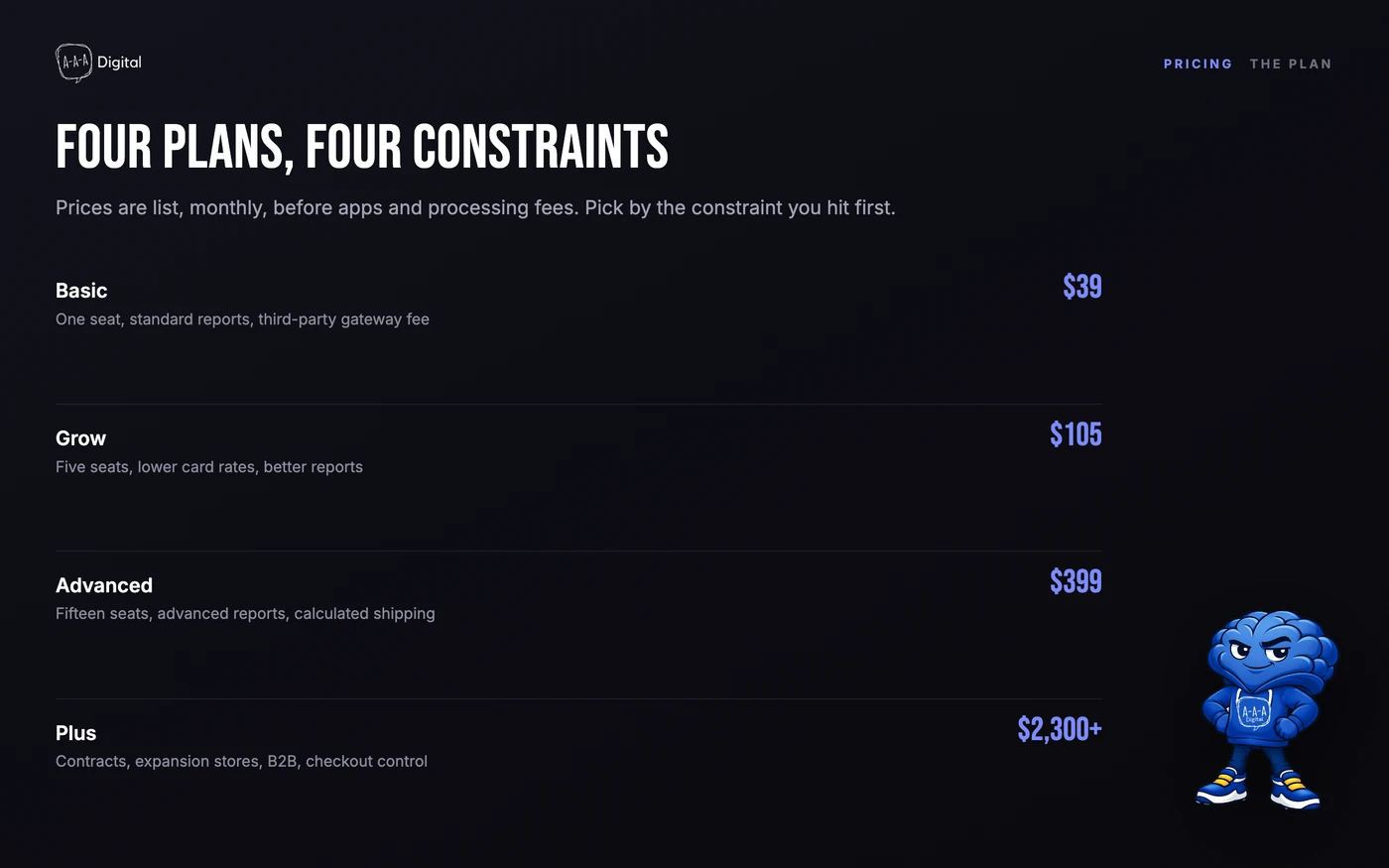
The jump that matters for most stores is Basic to Grow, not Grow to Advanced. Grow's lower card rates start paying for themselves somewhere around $1,500 to $2,000 in monthly sales, depending on your gateway mix. Below that, Basic is fine and the extra fee is wasted.
Two details the pricing page buries:
- Annual billing saves about 25% but commits you for a year. If you are still testing the business, monthly is the honest choice.
- The staff seat count is a real constraint. Basic includes one, Grow five, Advanced fifteen. A small team outgrows Basic's seat before it outgrows its order volume.
The plan fee is not the bill
Here is a $1M-per-year store on Grow, costed honestly:
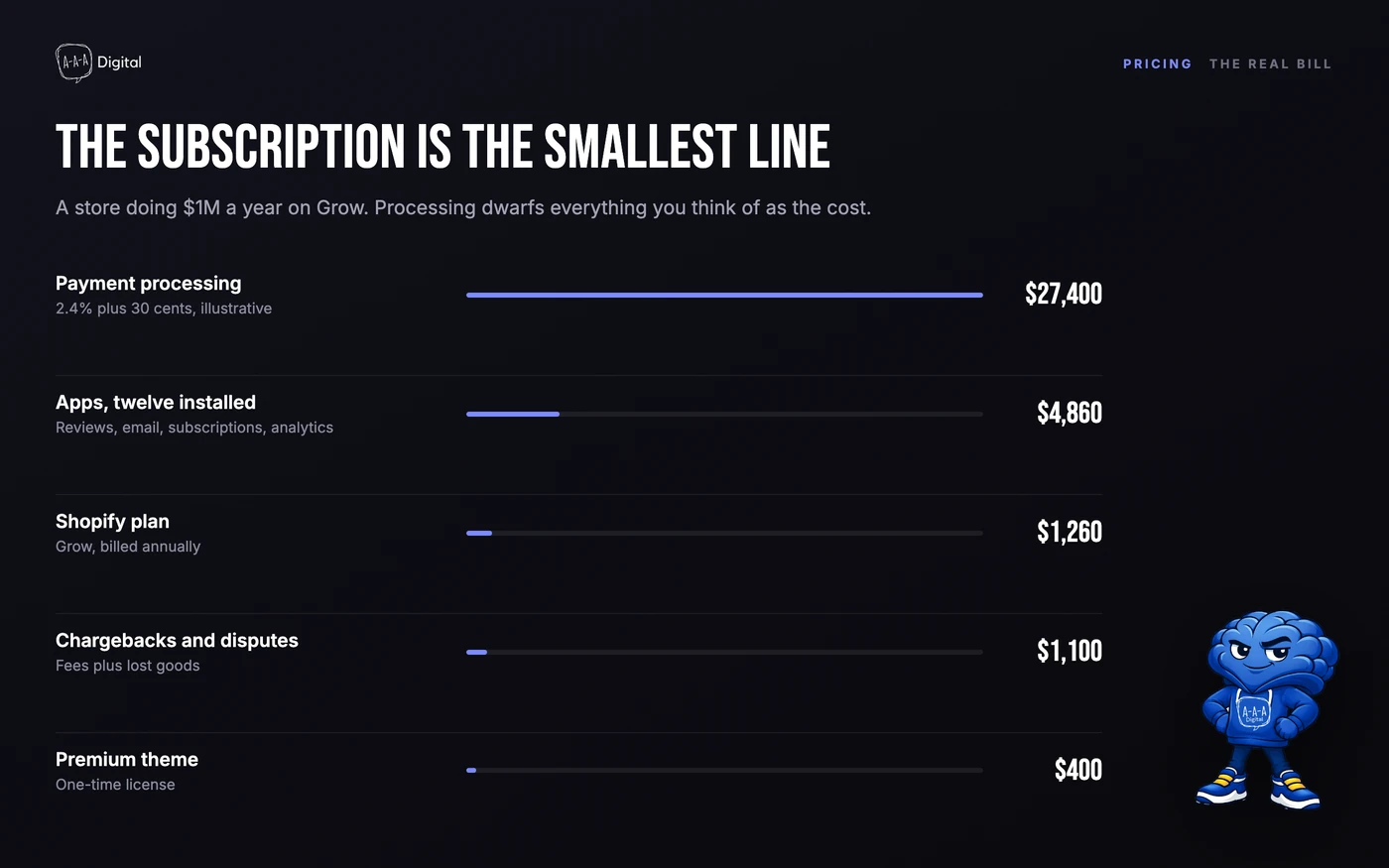
Five lines, and only one of them is Shopify's subscription:
- Plan fee. $1,260 a year on Grow at list price.
- Apps. This is where bills go wrong. A store with reviews, email, subscriptions, upsells, analytics, and two forgotten trials easily spends $300 to $600 a month.
- Theme. A one-time license of $180 to $400 for a premium theme, unless you built custom, which costs more.
- Payment processing. 2.4% to 2.9% plus 30 cents per transaction, depending on plan, region, and whether the buyer uses Shop Pay. On $1M in sales that is $24,000 to $29,000, and it dwarfs everything else.
- Chargebacks and disputes. Fees per dispute, plus the revenue lost. Small stores ignore this line until the first fraud wave.
If you are forecasting costs for a business plan, model processing separately. It scales with revenue and it is the number that decides your margin.
Where the bill grows quietly
Nobody installs twelve apps on day one. They install one a month, each solving an urgent problem, and nobody removes the one that stopped being used.
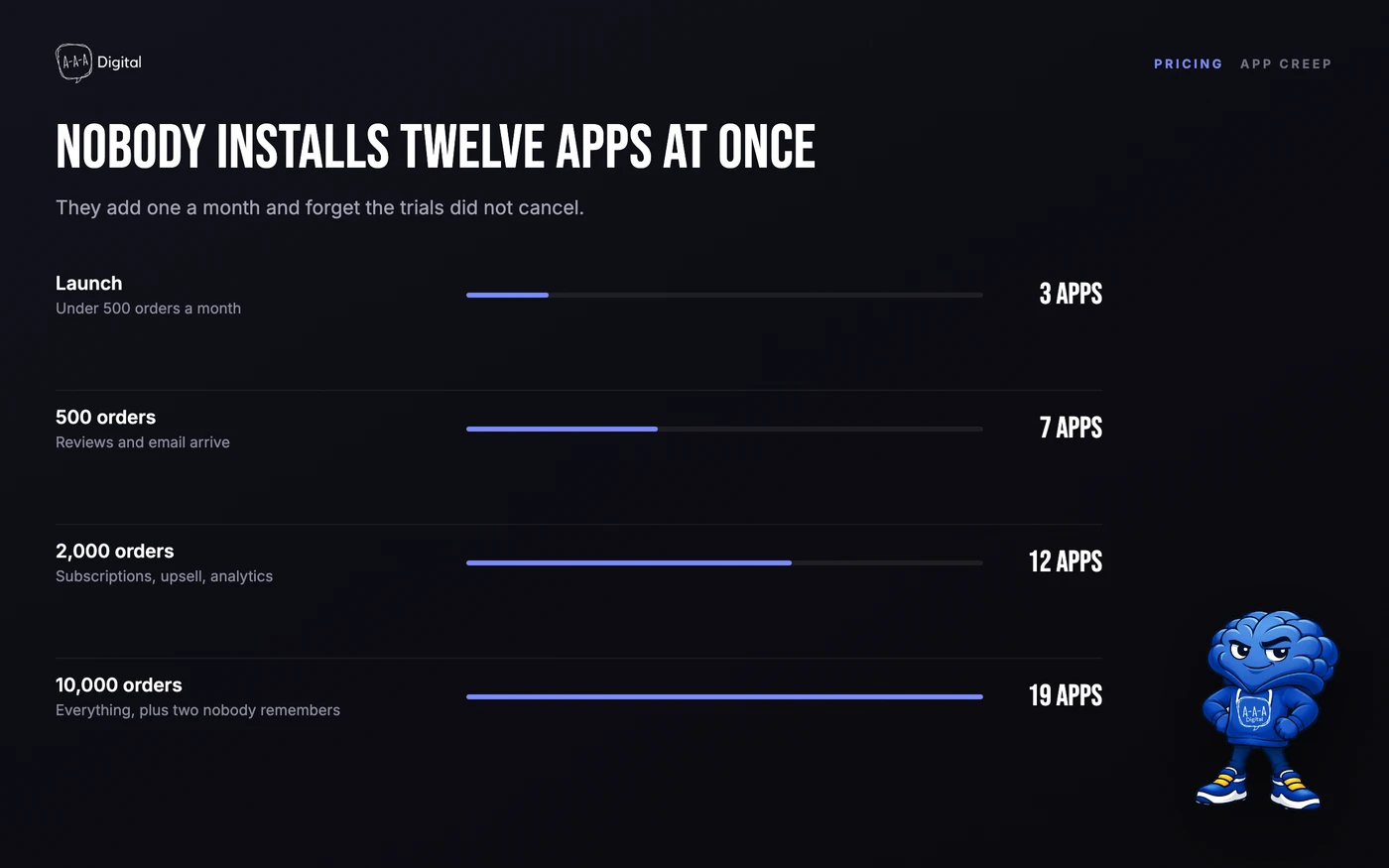
Three patterns show up in almost every app audit we run:
- Duplicate function. Two review apps, two email tools, an upsell app that overlaps with a subscription app's built-in upsells. Each was installed by a different person at a different time.
- Zombie subscriptions. Trials that converted and never got used, or apps removed from the theme but still billing.
- Tier drift. The app you installed on a $29 plan is now on a $99 plan because your order volume grew. Nobody renegotiated or checked whether a competitor charges by feature instead.
A quarterly app audit is a 30-minute job that routinely finds $100 to $300 a month. That is more than most stores spend on SEO.
Which plan, by constraint
Plan choice is decided by the first constraint you hit, not by list price.
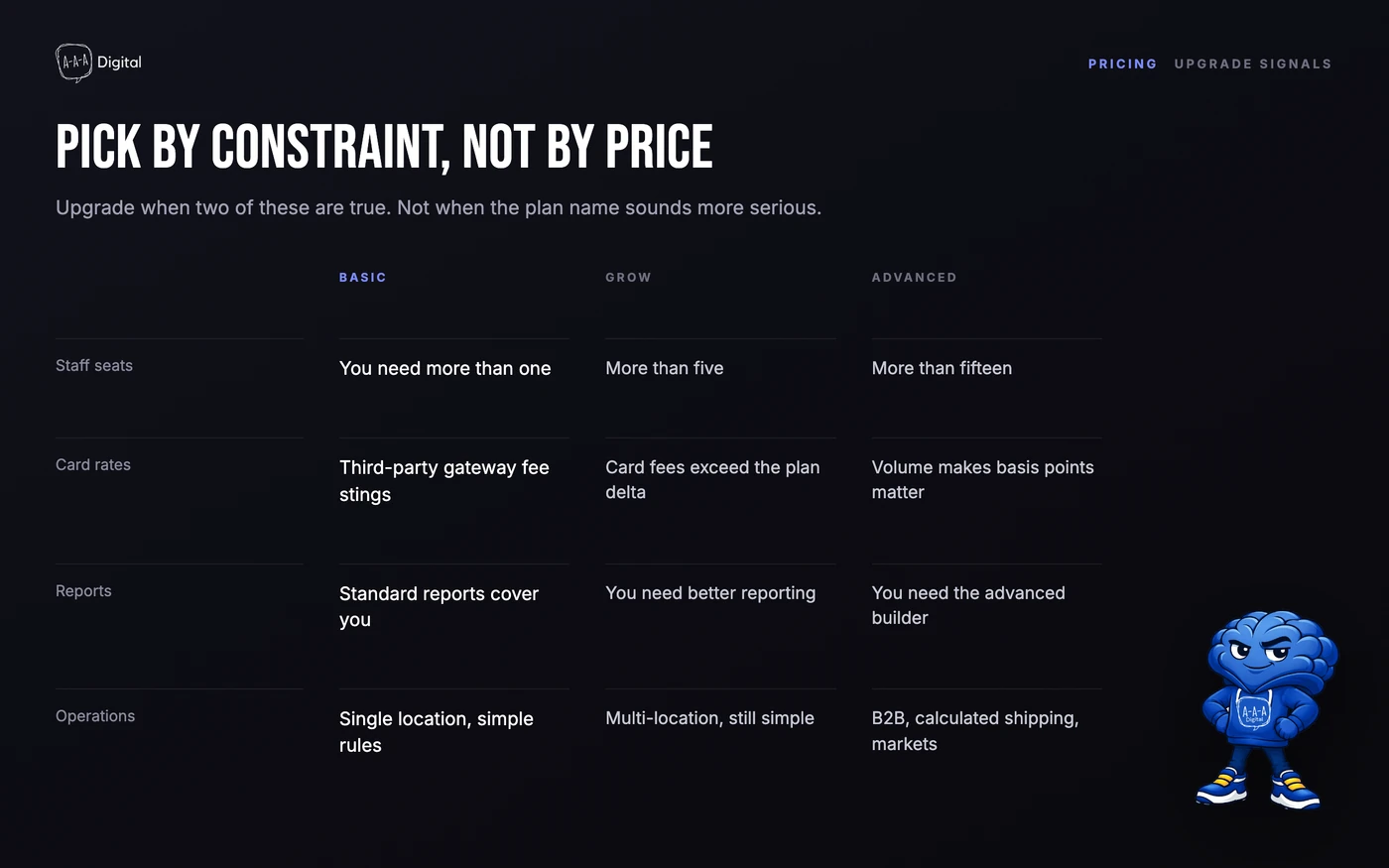
The signals, in the order they usually arrive:
Upgrade from Basic when you need a second staff seat, your third-party gateway fee exceeds the plan price difference, or you want reports that do not need a spreadsheet to interpret.
Upgrade from Grow to Advanced when you run multiple locations, need third-party calculated shipping rates, or your card rate difference starts to matter at volume. Advanced also unlocks the report builder that replaces an analytics app for some stores.
Consider Plus when you sell wholesale with net terms, run multiple storefronts or markets, need checkout customization Liquid cannot give you, or your launch calendar includes high-traffic drops. Plus starts around $2,300 a month and is a commercial conversation, not a checkout cart. Our guide to whether Shopify Plus is worth it breaks down the break-even math.
Hidden costs nobody puts on the pricing page
- Migration. Moving from Magento, WooCommerce, or BigCommerce costs money once and saves money monthly. Typical ranges are in our Shopify migration cost breakdown.
- Theme customization. A developer at $60 to $120 an hour, for the things a theme demo cannot do.
- Email and SMS platform costs that scale with list size, not with Shopify plan.
- App development, if you need something the App Store does not sell.
- Ongoing SEO and CRO, which is the line most stores cut first and regret. The platform cost is fixed; the traffic cost is the one that compounds.
How to cut the bill without cutting the store
- Audit apps quarterly. Export the billing list from Shopify admin, mark each app as keep, consolidate, or remove.
- Check the annual plan once you are past the survival stage. The 25% saving is real if you are staying.
- Consolidate overlapping apps into one that does the job at your tier.
- Review your gateway mix. For some markets, a local gateway at lower rates beats the default, and Shop Pay eligibility changes the calculation.
- Stop buying themes. One good theme customized properly beats three premium themes installed and abandoned.
FAQ
How much does Shopify cost per month? Basic starts around $39, Grow around $105, Advanced around $399, and Plus from roughly $2,300 in the US. Annual billing reduces those by about 25%. Apps and payment processing sit on top.
Is Shopify free? No, but there is a free trial, and development stores are free until you launch. After that every plan has a monthly fee plus payment processing on sales.
What is the cheapest Shopify plan? Basic. For most new stores it is the right starting point until seats, card rates, or reports force an upgrade.
Does Shopify take a percentage of sales? Shopify Payments charges processing rates (roughly 2.4% to 2.9% plus 30 cents per transaction, varying by plan and region). Using a third-party gateway instead adds a small transaction fee on Basic and Grow.
Are Shopify apps free? Some are. Many have free tiers that expire, and most serious apps charge $10 to $100 a month, with pricing that scales by order volume or SKU count.
How much should a store budget for apps? Under $100 a month for a new store, $300 to $600 for a store doing real volume. If you are above that, run an audit before adding anything else.
If the plan decision is clear but the traffic and conversion side is not, that is the part we usually fix first. Book a free strategy call or see how our ecommerce SEO team approaches catalog work, including the app-bloat cleanup that pays for itself.
