Shopify Payments is Shopify's own payment processor, not a wallet or a financing product. On Basic it takes 2.9% + 30¢ per online card order, and using it removes the extra 2% Shopify charges when a third-party gateway processes the payment.
The second half of that sentence is the part merchants miss. Shopify Payments is usually not chosen for its rate. It is chosen because the alternative costs a percentage point more than the rate difference suggests.
What Shopify Payments actually is
A merchant account and a gateway, bundled into the admin. When a customer pays by card, Shopify authorises the charge, captures the funds, and settles them into a Shopify Payments balance that pays out to your bank on a schedule. You never open another dashboard or paste API keys anywhere.
Four things sit inside it:
- Card processing. Visa, Mastercard, Amex, Discover, and in most markets the local debit networks.
- Shop Pay. The accelerated checkout, which only works when Shopify Payments is the primary provider. Our explainer on Shop Pay covers what it does for conversion.
- Fraud tools. Basic fraud analysis on every order, plus the option to block high-risk ones automatically.
- Disputes. Chargebacks arrive in the admin with a response deadline attached.
It is not a bank. The balance is not insured like a deposit account, and it is not a place to park working capital. For interest, that is Shopify Balance, a separate product in the US.
In the US it runs on Stripe's infrastructure, which is why the two headline rates match to the cent. What differs is the wrapper: Shopify's fee sits on top when you bypass it.
The fee stack, by plan
Rates come off the plan you pay for, which is why upgrading sometimes pays and sometimes does not. US online card rates, before any surcharge:
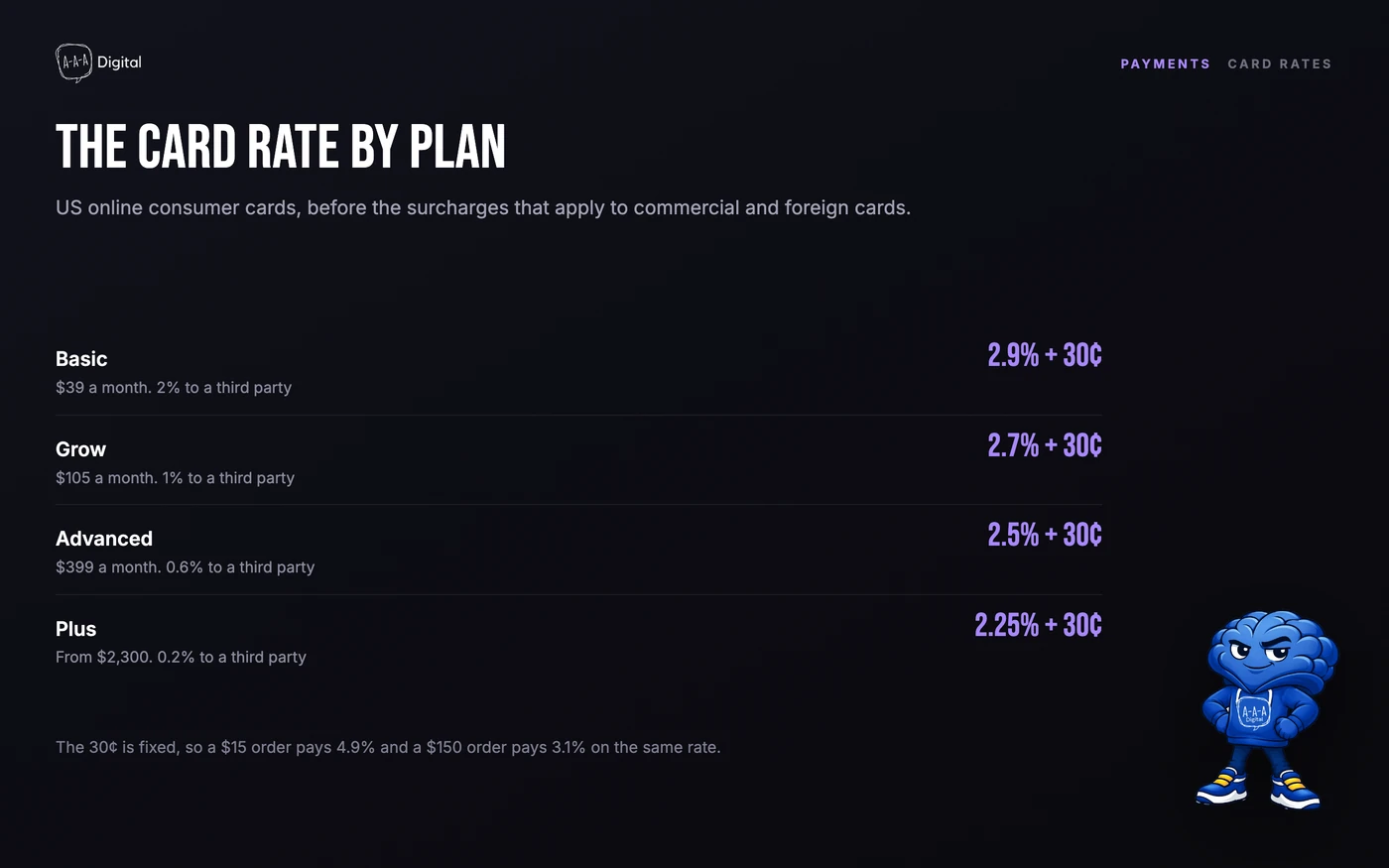
| Plan | Monthly | Shopify Payments, online | Third-party fee | In person |
|---|---|---|---|---|
| Basic | $39 | 2.9% + 30¢ | 2% | 2.6% + 10¢ |
| Grow | $105 | 2.7% + 30¢ | 1% | 2.5% + 10¢ |
| Advanced | $399 | 2.5% + 30¢ | 0.6% | 2.4% + 10¢ |
| Plus | from $2,300 | 2.25% + 30¢ | 0.2% | 2.3% + 10¢ |
Three surcharges sit outside that table. Commercial and corporate cards add about 0.6 points, so 3.5% + 30¢ on Basic. Cards issued outside your market add 1 point. Currency conversion, when a buyer pays in a currency you do not settle in, adds roughly 1.5%.
The 30¢ is fixed, which means it matters more on cheap products. A $15 order on Basic pays 2.9% ($0.44) plus 30¢, an effective 4.9%. The same rate on a $150 order is 3.1%. If your average order value is under $40, the fixed fee is the number to watch when you price.
Which countries it works in
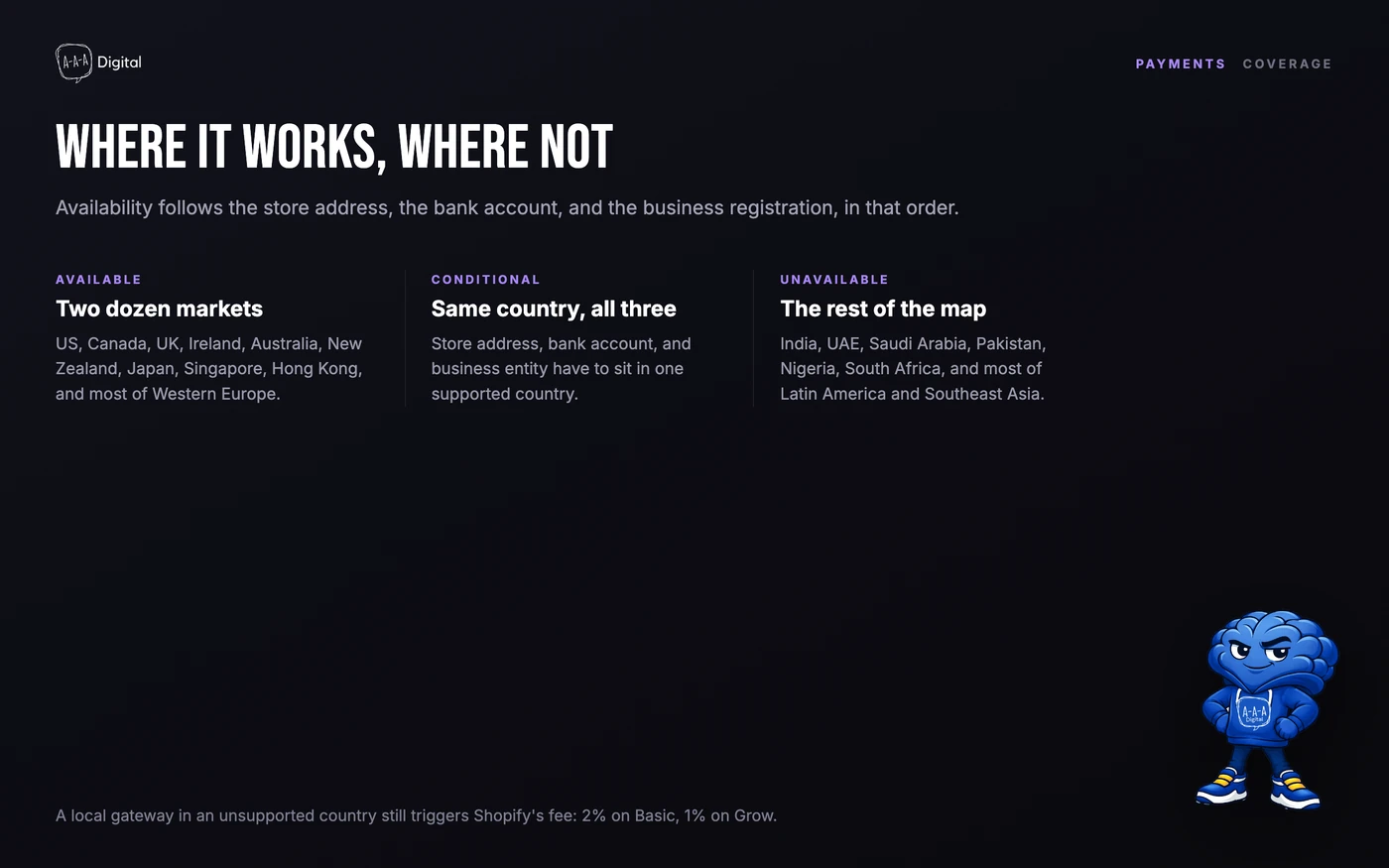
Shopify Payments runs in roughly two dozen countries. The core list: United States, Canada, United Kingdom, Ireland, Australia, New Zealand, Japan, Singapore, Hong Kong, and most of Western Europe, including Germany, France, the Netherlands, Spain, Italy, Austria, Belgium, Denmark, Sweden, Finland, Switzerland, Portugal, and the Czech Republic.
It does not run in India, the UAE, Saudi Arabia, Pakistan, Nigeria, South Africa, or most of Latin America and Southeast Asia. In those markets the option is greyed out with no explanation, which is where most "why is Shopify Payments not available" searches come from.
Even inside a supported country, activation fails for four common reasons:
- The bank account is in a different country. Shopify requires a bank account in the same country as the store address. A US LLC with a UK bank account does not qualify.
- The address does not match the documents. A virtual office address that does not appear on the business registration gets flagged.
- The business category is restricted. Supplements with medical claims, weapons, gambling, adult content, and some subscription models are refused or reviewed manually.
- A previous account was terminated. Shopify links accounts by identity, bank details, and device, so a closed store with unpaid chargebacks can block a new one.
The workaround people try, registering a supported-country address while operating elsewhere, is misrepresentation. Shopify closes accounts for it, usually after a payout has been held, and the money comes back months later or not at all. Do not do it.
Shopify Payments vs Stripe
Stripe is the comparison people actually make, and the honest answer depends on whether Stripe is available where you are. In the US, both charge 2.9% + 30¢. The difference is Shopify's 2% third-party fee on Basic, which Stripe does not absorb.
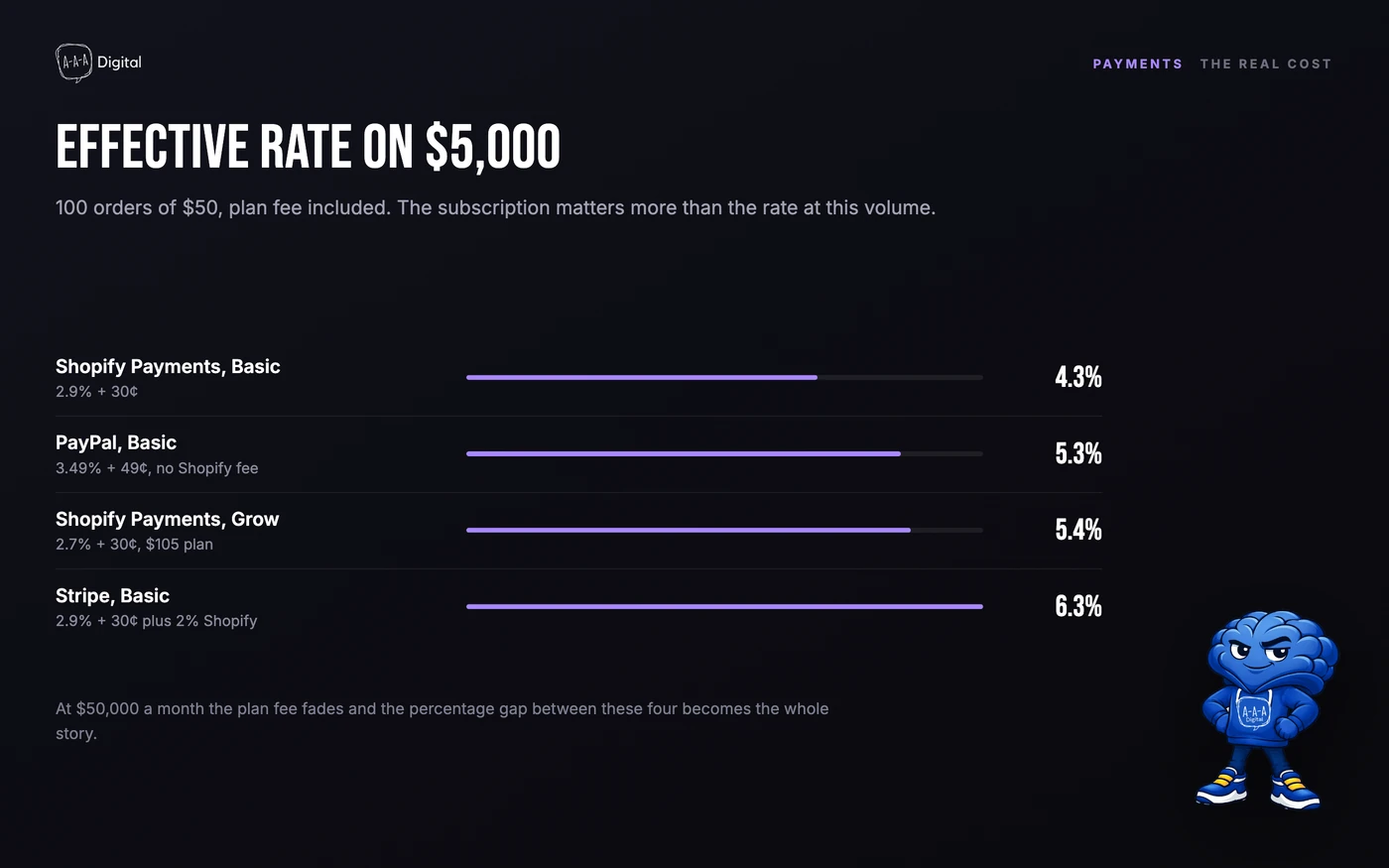
On $5,000 a month in 100 orders of $50:
| Setup | Per order | Monthly fees | Effective rate |
|---|---|---|---|
| Shopify Payments, Basic | $1.75 | $214 | 4.3% |
| PayPal, Basic | $2.24 | $263 | 5.3% |
| Shopify Payments, Grow | $1.65 | $270 | 5.4% |
| Stripe, Basic | $2.75 | $314 | 6.3% |
Grow costs $66 more in subscription and saves $10 in processing at this volume. It only pays for itself above about $33,000 a month in card sales.
Stripe wins in exactly two situations. You are outside Shopify Payments coverage and Stripe is available there, or you are on Advanced or Plus with a negotiated Stripe rate low enough to beat the 0.6% or 0.2% Shopify fee. For a Basic store in the US, Stripe costs about $100 a month more at this volume for no functional gain.
PayPal is a different trade. It is exempt from the Shopify third-party fee when Shopify Payments is primary, which makes it a reasonable secondary button, and it charges 3.49% + 49¢ in the US. Keep it for buyers who distrust cards on unfamiliar stores, not as the primary.
Payout timing, from sale to spendable cash
Shopify Payments does not pay out the moment a card clears. There are two waits, and they stack.
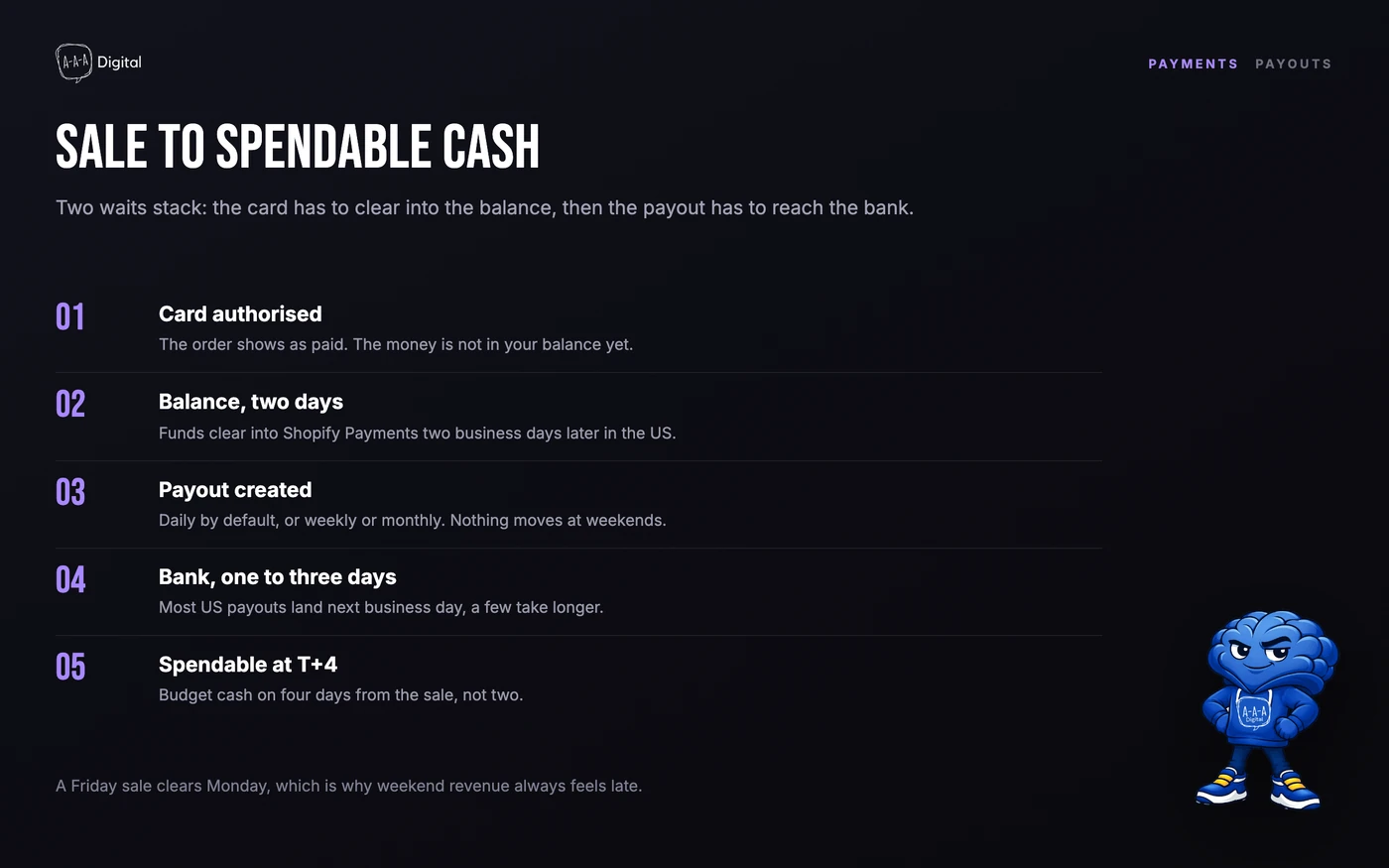
- The card authorises and the order is paid. The money exists, but not in your balance.
- Funds clear into the Shopify Payments balance. Two business days in the US for standard cards. Some accounts are set to three.
- A payout is created on your schedule. Daily by default, or weekly, or monthly. Payouts are not sent on weekends or bank holidays.
- The payout reaches your bank. One to three business days, with the average closer to one.
Four days from sale to spendable cash is the number to plan with. Stores that run ads on the same card they pay suppliers with get caught here in the first month, because the ad bill arrives before the payout does.
Accelerated payouts exist in the US for a fee, and they shorten the second wait, not the first. Shopify Capital repayments also come out of payouts automatically if you have taken an advance, which reduces what lands without reducing what you sold.
Holds, reserves, and chargebacks
A hold is not a penalty. It is the risk team waiting for evidence that the orders are real.
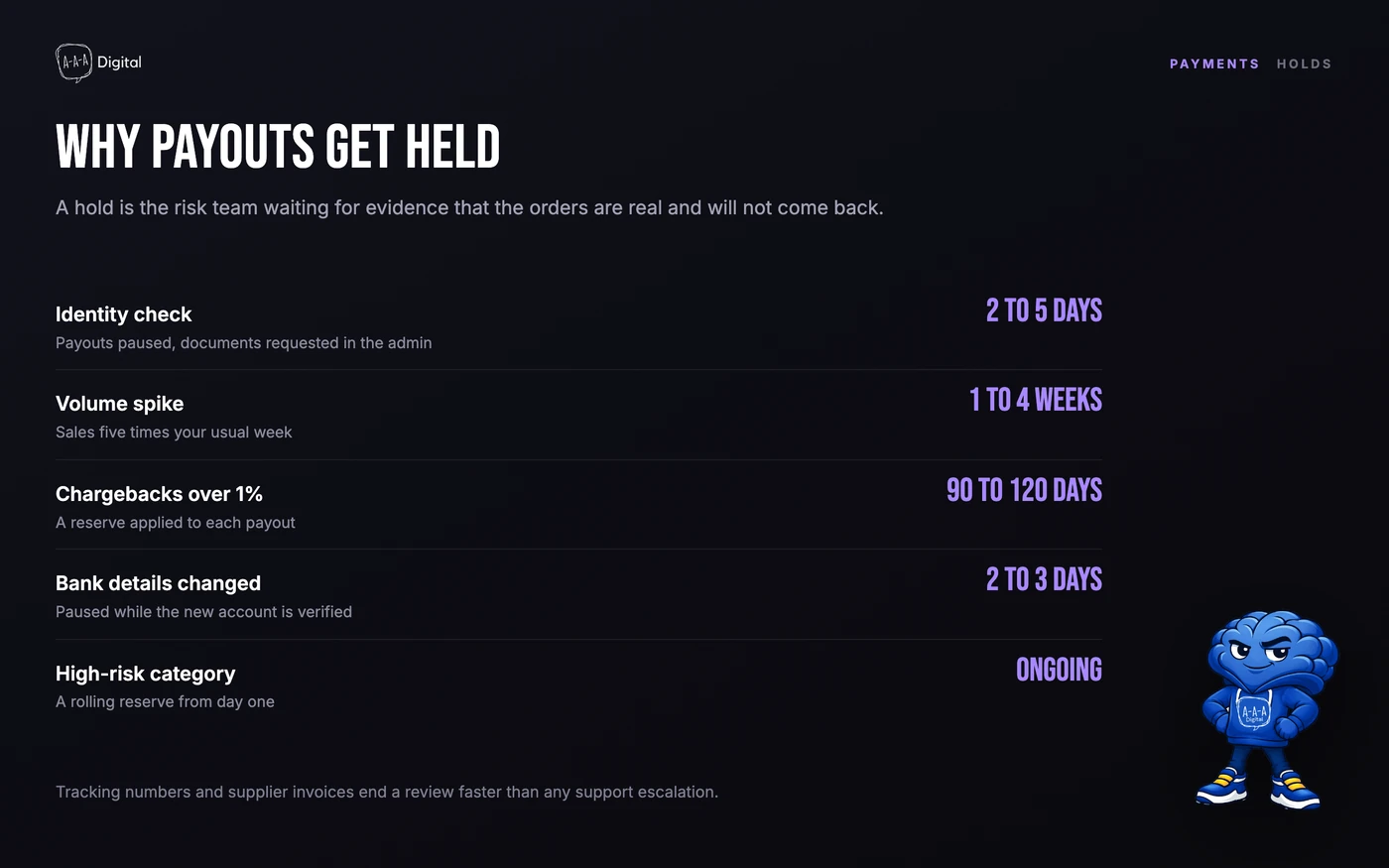
| Trigger | What it looks like | Typical length |
|---|---|---|
| Identity or business check | Payouts paused, document request in the admin | 2 to 5 days |
| Volume spike | Sales 5x higher than your usual week | 1 to 4 weeks |
| Chargeback rate over 1% | A reserve applied to each payout | 90 to 120 days |
| Bank details changed | Payout paused while the new account is verified | 2 to 3 days |
| High-risk category | A rolling reserve on every payout | Ongoing |
Two habits prevent most of this. Upload ID, business registration, and a bank statement before they are asked for, and warn support before a launch that will multiply volume.
If funds are held, reply with tracking numbers and supplier invoices. Vague answers extend the review, and a real store is usually released in two weeks.
Chargebacks. Every chargeback costs a $15 fee in the US, and you lose the sale amount if you do not respond. Shopify emails you when one arrives, and the window is about seven days.
Winning is mostly documentation: a delivery scan at the customer's address, a signature above $200, the AVS result at checkout, and the policy shown on the product page. Send all of it in one reply.
The number that matters is your chargeback rate. Card networks start monitoring around 0.65% to 1% of transactions, and Shopify Payments adds its own review above 1%. A store doing 1,000 orders with 11 disputes is already in trouble. Our guide to refunding and cancelling orders covers the order side; chargebacks are a separate process and a separate fee.
When Shopify Payments is not available
You have three real options, in order of preference.
A local processor that Shopify supports. In India that is Razorpay or PayU, in Nigeria Paystack, in the UAE Network International, in Saudi Arabia Moyasar, and in Latin America, Mercado Pago. They integrate through Shopify's payment provider list, and each one triggers the third-party fee: 2% on Basic, 1% on Grow, 0.6% on Advanced. On a 3% local rate plus 2%, you are at 5% before currency conversion.
PayPal plus manual methods. Bank transfer, cash on delivery, and draft orders marked paid cover a surprising share of markets where cards are unreliable. Manual methods carry no Shopify fee and no processing cost, but they also carry no fraud protection.
A supported entity, set up properly. If you genuinely have a company and a bank account in a supported country, with staff and operations there, that is not a workaround, it is a legitimate setup. If you do not, it is a termination waiting to happen.
Whichever route you choose, the money has to reconcile in your books. Our Shopify development team configures the gateway, the payout account, and the tax mapping together, because those three break when set up separately.
Frequently Asked Questions
Is Shopify Payments the same as Shopify?
No. Shopify Payments is a payment processing service that Shopify operates with partner banks. Shopify is the platform subscription. You can run a Shopify store without Shopify Payments, but you pay a 2% third-party fee on Basic for the privilege.
How much does Shopify Payments take per sale?
2.9% + 30¢ on Basic, 2.7% + 30¢ on Grow, 2.5% + 30¢ on Advanced, and 2.25% + 30¢ on Plus for standard US consumer cards. Commercial cards, international cards, and currency conversion each add to that.
How long do Shopify Payments payouts take?
About four days from sale to spendable cash in the US: two business days to clear into your Shopify Payments balance, then one to three for the bank transfer. Weekend and holiday sales shift the clock.
Why is Shopify Payments not available for my store?
Either the store is in an unsupported country, or the bank account does not match the store's country, or the business category is restricted. Identity verification failures and a previously terminated account also block activation.
Can I use Stripe instead of Shopify Payments?
Yes, in countries where Stripe operates. On Basic you pay Stripe's rate plus Shopify's 2% third-party fee, which lands near 4.9% + 30¢ per order. Stripe makes sense when Shopify Payments is unavailable, not as a cost saving.
The rate on the pricing page is the easy part. The decisions that cost money are the country match, the payout schedule, and the reserve that appears on month two if your chargeback rate drifts. Get those right and the 30¢ stops being the thing you think about. For the full fee picture across plans and gateways, see what Shopify actually charges.
