Last month a merchant showed us her discount dashboard. Eleven codes were live. SLEEP15 sat in the announcement bar for a campaign that ended in June. WELCOME10 was in the welcome email, SAVE20 in an SMS flow, and a coupon-extension browser plugin was cheerfully applying all of them to orders she thought were full price. Over the trailing 90 days, 58% of her orders shipped with a code applied. Her blended margin had quietly fallen nine points, and she couldn't say which code had earned a single new customer.
We've built discount programs for 40+ Shopify stores, and this is the normal state of things, not the exception. The problem is rarely the discount itself. It's that most lists of discount code ideas hand you twenty tactics with no math and no job description. A code is a loan against your margin. Before you pick one, you need to know what it's for, what it costs, and whether it teaches your customers to wait for the next one.
The Margin Math Nobody Does First
A discount has one cost that never appears in the Shopify admin: profit dollars. Percentages feel small. Profit cuts don't.
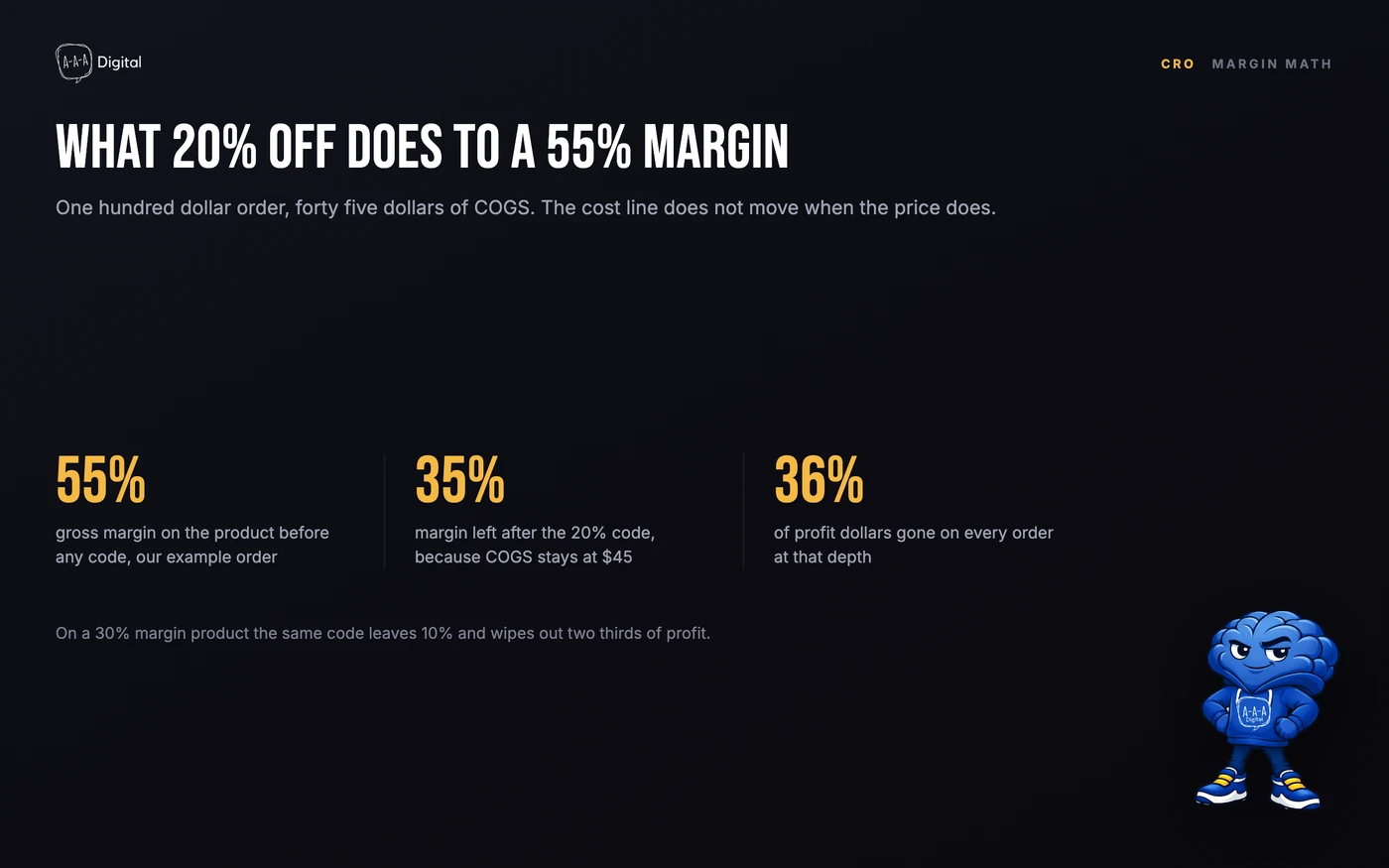
Take a $100 order on a product with a 55% gross margin. COGS is $45, gross profit is $55. Apply a 20% off code and the order drops to $80, but the product still cost $45 to make and ship. Gross profit is now $35. Your margin fell from 55% to 35%, and you gave up 36% of your profit dollars to get there.
Now run the same 20% code on a 30% margin product, common in supplements, groceries, and anything COGS-heavy. Revenue drops to $80 against $70 of cost. Ten dollars of profit survive. Two thirds of your profit is gone.
| Discount depth | 30% margin product | 45% margin product | 55% margin product | 65% margin product |
|---|---|---|---|---|
| 10% off | 20% margin left | 35% margin left | 45% margin left | 55% margin left |
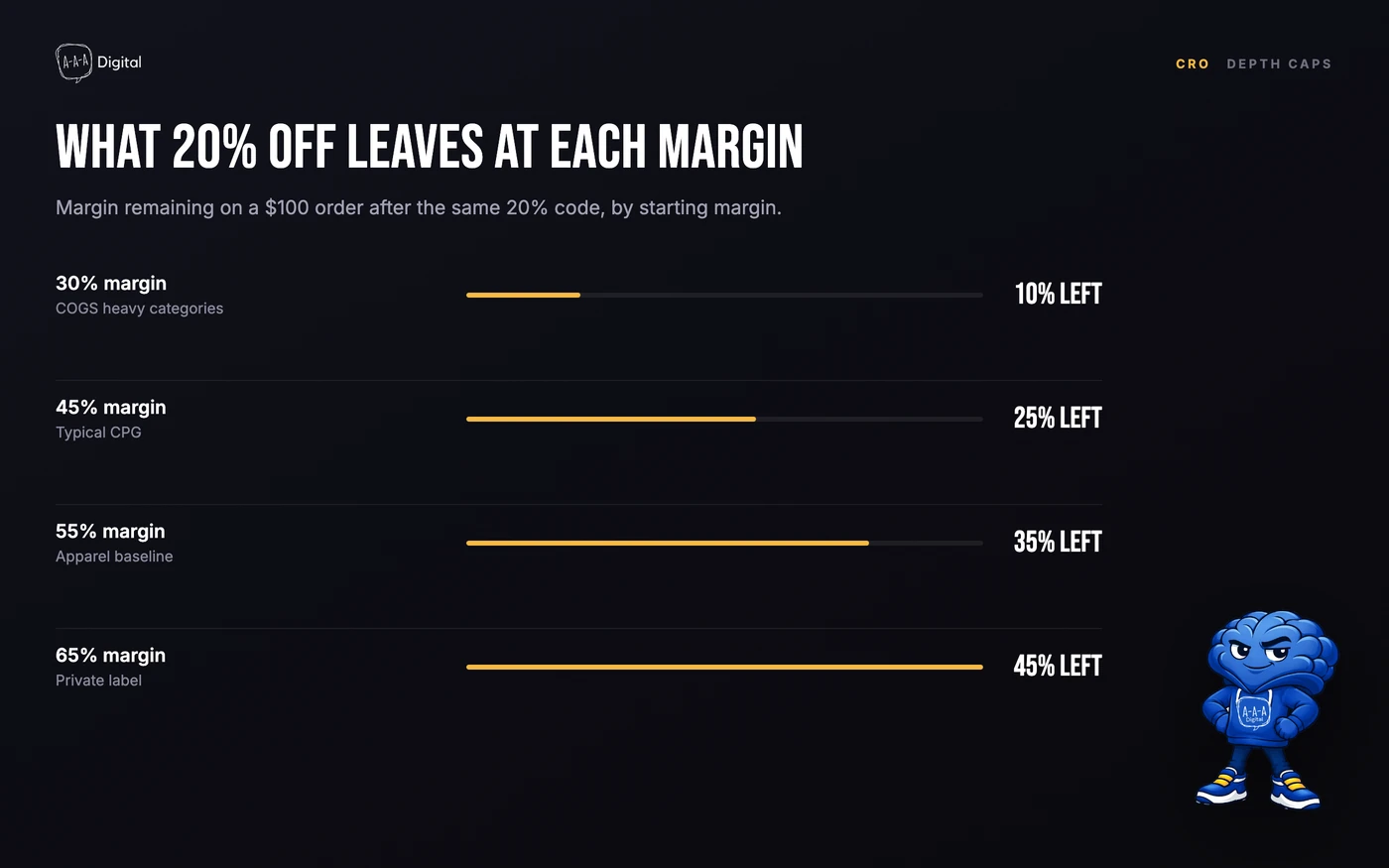
| 20% off | 10% margin left | 25% margin left | 35% margin left | 45% margin left |
| 30% off | 0% margin left | 15% margin left | 25% margin left | 35% margin left |
Read the last row carefully. A 30% code on a 30% margin product is not a promotion, it's a donation with extra steps. Every code in this list needs a depth ceiling set from this table, not from what a competitor's email looked like. If you don't know your real margins per collection yet, stop and run the numbers first. Our ecommerce margin improvement guide walks the full audit; the short version is that most stores are wrong about at least one collection.
The Five Jobs a Discount Code Can Do
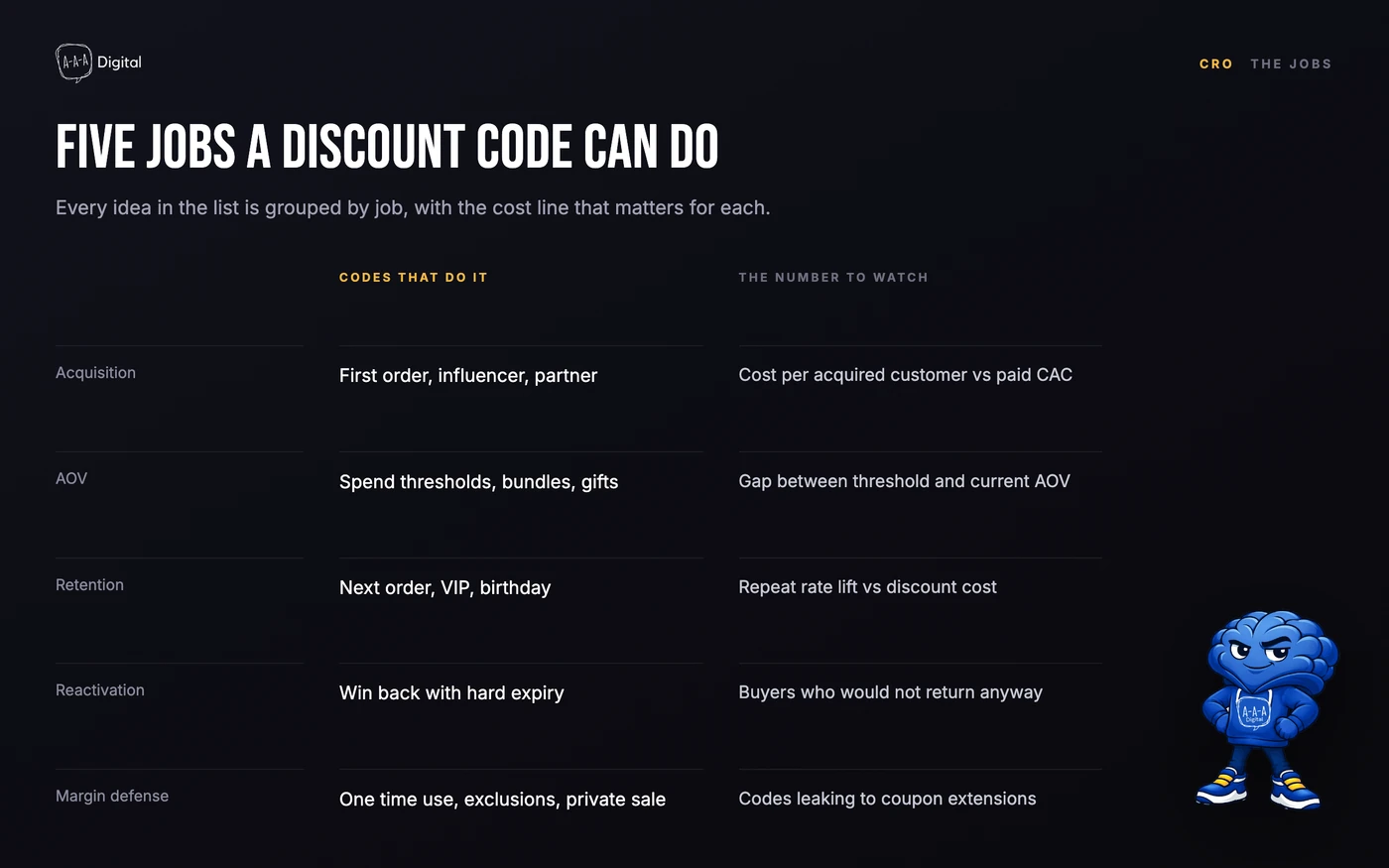
Every code on this list does one of five jobs: acquiring a first customer, raising average order value, keeping an existing customer, reviving a lapsed one, or defending margin by replacing a worse alternative. When a code tries to do two jobs, it usually fails at both, so we've grouped the twenty ideas by job and flagged the math that matters for each.
Discount Code Ideas That Acquire New Customers
Acquisition codes are the most expensive on this list because they ride on cold traffic. Treat each one as a customer acquisition cost line, with a per-code redemption count, and review them monthly.
1. First-order welcome code. The standard 10% for an email signup still works when the signup intent is real. Klaviyo's published benchmarks put the average welcome flow around $2.65 per recipient, which is strong, but the number that matters is yours: divide the discount cost by first-time buyers who never return. If that group is large, you bought a lot of one-and-done orders. Cap the depth at 10 to 15% and gate it to new customers only.
2. Influencer and affiliate codes. Give every partner a unique code, not a shared one, so you can see who actually sells. We've watched merchants pay 15% commissions to influencers with beautiful feeds and zero redemptions. Set a 90-day review and kill codes that don't clear a CAC you'd happily pay Meta.
3. Lead magnet code. A checklist, quiz, or sizing guide that ends in a one-time code converts content traffic into first orders. It trains waiting less than a header code because the only way to get it is to hand over an email.
4. Partner and community cross-promo codes. Swap newsletter placements with a complementary brand and give each audience a partner-exclusive code. Audiences arrive warmer, so the discount can be shallower.
One flag on all four: coupon-extension browser plugins scrape and reshare codes, so an acquisition code can quietly become a sitewide discount. Check your redemption reports for codes that "leak" far beyond their intended audience before trusting any of these numbers.
Discount Code Ideas That Raise Average Order Value
AOV codes are the only discounts that can pay for themselves, because the condition forces a bigger basket.
5. Spend-and-save threshold code. "15% off orders over $100" only works if your current AOV sits meaningfully below $100. Set the threshold 20 to 30% above your AOV, then merchandise products that push carts over the line. The honest comparison here is against a free-shipping threshold. In our cart work, a shipping threshold usually beats a percentage code because the customer gets a concrete benefit and you keep the product margin. Our cart abandonment fixes cover how to choose between them with real numbers.
6. Tiered threshold code. 10% over $75, 15% over $125. The second tier pulls your best customers up without discounting the entry order at all.
7. Bundle code. A code that only works on a curated bundle, or that activates at two or more units, moves stock you'd discount deeper later. Pair it with quantity-break apps if bundles are permanent.
8. Gift-with-purchase code. A free mini or accessory often converts better than the same cost in percentage off, because the gift feels like value while your margin only pays COGS.
9. Buy X get Y code. Shopify's native Buy X get Y handles this cleanly, and it reads as a deal rather than a markdown.
Framing matters on all of these. Jonah Berger's Rule of 100, from his book Contagious, says under $100 products should be framed as percentages, over $100 as dollars. "20% off a $40 candle" and "Save $80 on a $400 mattress" feel larger than their twins, and the cost to you is identical.
Discount Code Ideas That Retain Customers
Retention codes are cheap to fund because the audience already bought. The risk is low, the payoff is real, and the main mistake is forgetting them entirely.
10. Post-purchase next-order code. Put a one-time code with a 30 to 60 day expiry in the order confirmation email or packing insert. This is the single best use of a discount in most stores: it converts a happy first order into a second one while the product is still in use.
11. VIP codes. Reserve a standing code for your top decile. Ten percent off everything, forever, costs less than a loyalty app and makes your best customers feel seen.
12. Birthday codes. A birthday month code with a personal subject line earns outsized goodwill for a modest, once-a-year cost.
13. Early-access codes. Give loyal customers first access to a launch at full price, or with a small code, instead of a public sale later. Early access creates urgency without resetting your public price. It trains customers to buy fast, not to wait.
Discount Code Ideas That Win Back Lapsed Buyers
Reactivation codes target customers who are at roughly zero percent odds of ordering on their own, so any redemption is incremental. The cost discipline is in the audience selection.
14. Win-back code with a hard expiry. Pull customers lapsed 60 to 120 days, send a 15% code that dies in 14 days. No expiry, no urgency, and you've trained a former customer to wait for the next one.
15. "We miss you" personalized code. Same mechanic, softer tone, and reference their last purchase in the email. We've seen win-back emails with a product photo of what they bought outperform generic pleas by a wide margin.
16. Second-chance cart code. For carts abandoned more than a week that got no earlier discount, a one-time code in a final email is fair game. Just don't use it in the first abandonment email, or you'll teach people to abandon on purpose.
Discount Code Ideas That Defend Margin
This group replaces discounts that hurt more than they help. If you're going to spend margin anyway, spend it here.
17. One-time-use codes. Bulk-generate unique codes for direct-mail inserts, packing slips, CS goodwill, and post-purchase thank-yous. Unique codes can't leak to coupon extensions and can't be shared. Our free discount code generator creates them in bulk with your prefix, format, and quantity, and exports a CSV you can paste into a Shopify discount import, which is exactly how we set these up for clients.
18. Exclusion-gated codes. Every code can exclude sale collections and gift cards. If you skip this step, your 20% code stacks onto clearance and you pay customers to empty your worst stock at the worst margin.
19. Stacked-condition codes. Shopify lets you set minimum purchase amounts, specific collections, first-order-only limits, and per-customer usage counts on the same code. A "20% off your first order over $80, one use per customer" code is a different animal from a bare 20% code.
20. Private list-sale codes. Run the sale for your email and SMS list with a code, and leave the storefront at full price. You get urgency and revenue without telling every future visitor that your prices are negotiable. This is the format we push hardest for BFCM. Adobe Analytics put US Cyber Monday 2024 online spend at a record $13.3 billion, and Shopify reported its merchants sold $11.5 billion that weekend, up 24% year over year. The demand is there. You do not need a public markdown to catch it.
Two structural guardrails belong here. First, Shopify now lets customers combine up to five product or order discount codes plus one shipping code on a single order, depending on your combination settings. If you haven't reviewed those settings, assume your codes can stack in ways you never intended. Second, set every code's depth ceiling from the margin table above, using your weakest-margin collection, because that is where a "standard 20%" quietly turns into a loss.
Which Discount Code Ideas Train Customers to Wait
The ideas themselves aren't the problem. The schedule and the visibility are.
High training risk: evergreen sitewide codes in the header, a predictable calendar of public sales, a discount in the first email of every flow, and any code a coupon extension can scrape. A skincare brand we work with cut its public sitewide sales from twelve a year to four, kept discounts private to its list, and watched full-price revenue climb while total revenue held. Nothing else changed.
Low training risk: thresholds, bundles, gifts with purchase, one-time-use codes, early access, and private list sales. The common thread is that the customer has to do something to earn the discount, so the full price never becomes the sucker price.
If you want the campaign-level version of this thinking, with the promo mechanics that sit above individual codes, see our roundup of Shopify sales promotion examples that protect full-price sales. And if your codes are live but nobody has ever measured what they actually do, that measurement gap is a core part of the CRO audits we run for Shopify stores.
Five Rules Before Any Discount Code Goes Live
Run this checklist before a code ships, not after the margin report stings.
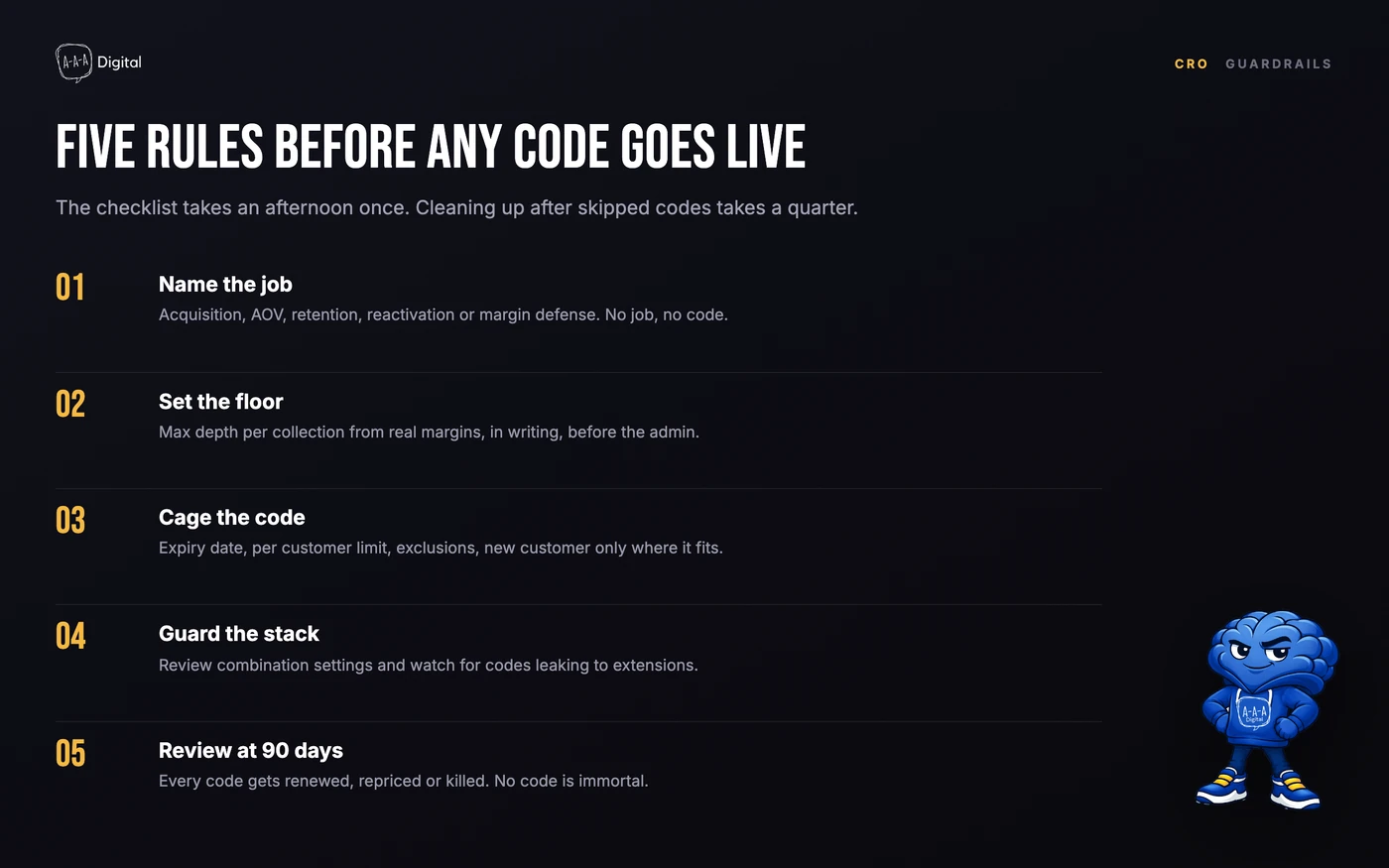
- Name the job. Acquisition, AOV, retention, reactivation, or margin defense. A code with no job is a donation.
- Set the floor. Maximum depth per collection, from the margin table, in writing, before anyone opens the Shopify admin.
- Cage the code. Expiry date, per-customer limit, collection exclusions, and new-customer-only where it applies.
- Guard the stack. Review combination settings, and check redemption reports monthly for codes leaking to coupon extensions.
- Review at 90 days. Every code gets renewed, repriced, or killed on a schedule. No code is immortal.
FAQ
How much should a first-order discount code be?
Ten to fifteen percent is the working range for most Shopify stores, with 10% the safer default on low-margin products. The right number comes from the margin table: a 15% code on a 30% margin product leaves almost nothing. If you need a bigger hook than your margins allow, use a gift with purchase or free shipping threshold instead of a deeper percentage.
Do discount codes train customers to wait for sales?
They can, and the mechanism is predictable. Public, predictable, always-available discounts teach customers that your full price is a ceiling, not a floor. The fix is not to stop discounting. It is to make discounts earned, targeted, and irregular: thresholds, one-time-use codes, private list sales, and early access. Customers wait for sales they can predict. They don't wait for codes they can't.
Should I use automatic discounts or discount codes on Shopify?
Automatic discounts apply at checkout with no code typed, which cuts friction and defeats most coupon-extension scraping. Codes win when the code itself is the mechanism: partner tracking, one-time-use mailers, win-back segments, and any campaign where you need to measure a specific audience. A sensible default is automatic discounts for broad offers and codes for targeted ones.
How many discount codes can a customer use on one Shopify order?
Under Shopify's current combination rules, a customer can apply up to five product or order discount codes plus one shipping discount code to a single order, and an automatic discount can apply alongside depending on your settings. If you haven't set combination rules deliberately, audit them now, because stacked codes can take a healthy order to zero profit faster than any single deep discount.
Get Help With This
Discount codes are small levers with outsized margin consequences, and most stores are running more of them than they know. Before your next promotion, run the numbers through our free discount margin calculator to see what the discount does to your margin and how many extra units you'd need to sell to break even. If you want your discount program audited against your actual margins, with the fixes in order of profit impact, start with our Shopify CRO service. And when you're ready to roll out unique codes properly, our free discount code generator will have you exported and imported in minutes.
