In 2023, a skincare brand came to us with a problem that did not look like a promotion problem. Revenue was flat, ad costs were climbing, and her reflex was the one every merchant reaches for: run a bigger sale. She already was. A 20% off code had been live for fourteen months. Customers had stopped seeing it, coupon extensions had scraped it, and all it did reliably was remove four points of margin from every order.
Search "types of sales promotions" and you get listicles describing fifteen formats while skipping which fits your margin, AOV and traffic source. Here are all fourteen with the math, when each works and backfires, and one real example to steal.
The Two Discounts You Already Run: Percentage vs Dollar
Sales promotion example 1: percentage-off discounts
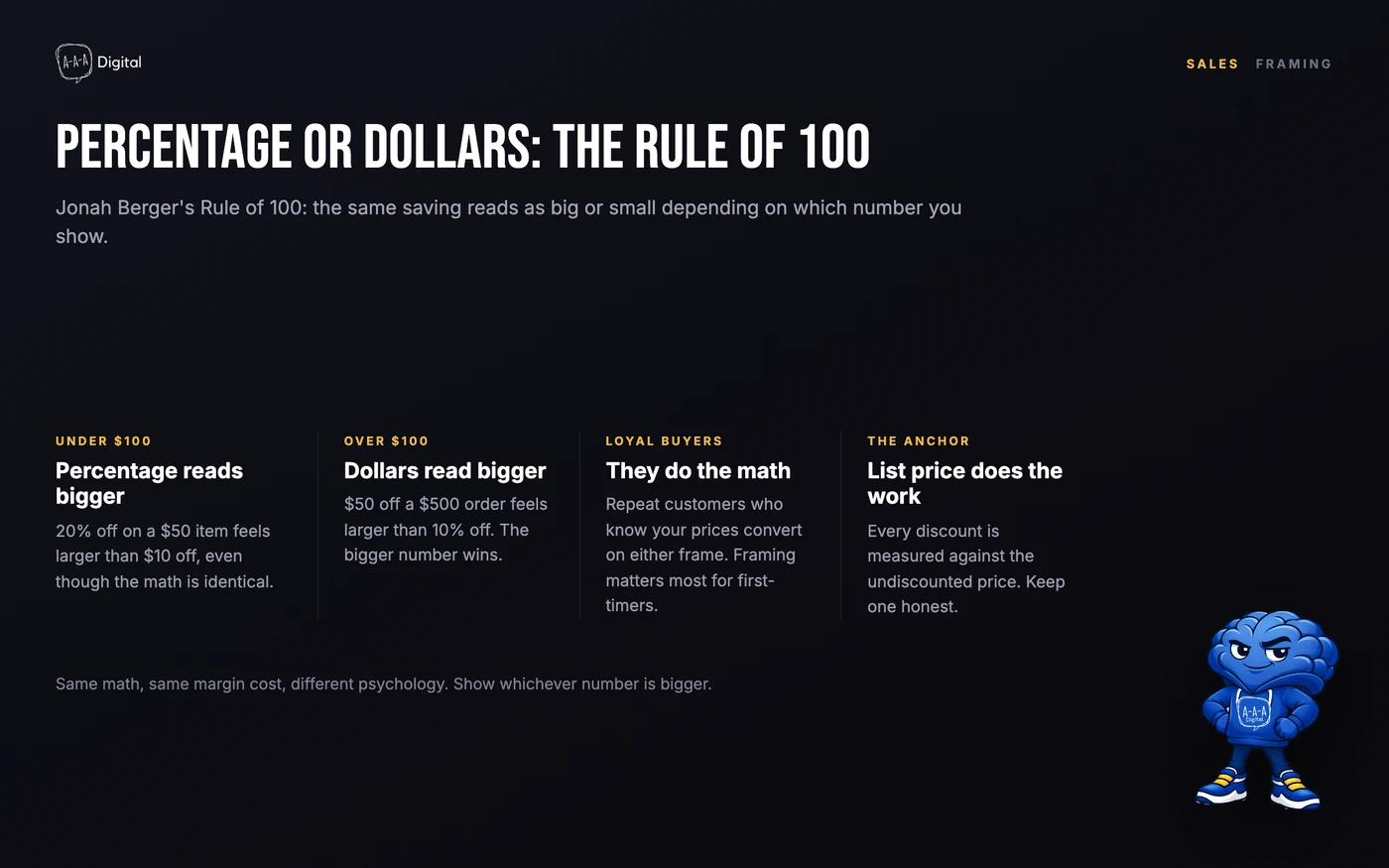
A $50 item marked down to $40 can be framed as "20% off" or "$10 off." Same math, same margin cost, different psychology. Jonah Berger called the principle the Rule of 100 in Contagious: under $100, the percentage number is bigger, so "20% off" feels like the larger saving.
When it works: products under roughly $100, impulse categories, first-time buyers with no reference price. It is also the safest format for tiered sales: Sephora runs its Savings Events as percentages (20% Rouge, 15% VIB, 10% Insider), which keeps the full-price anchor intact.
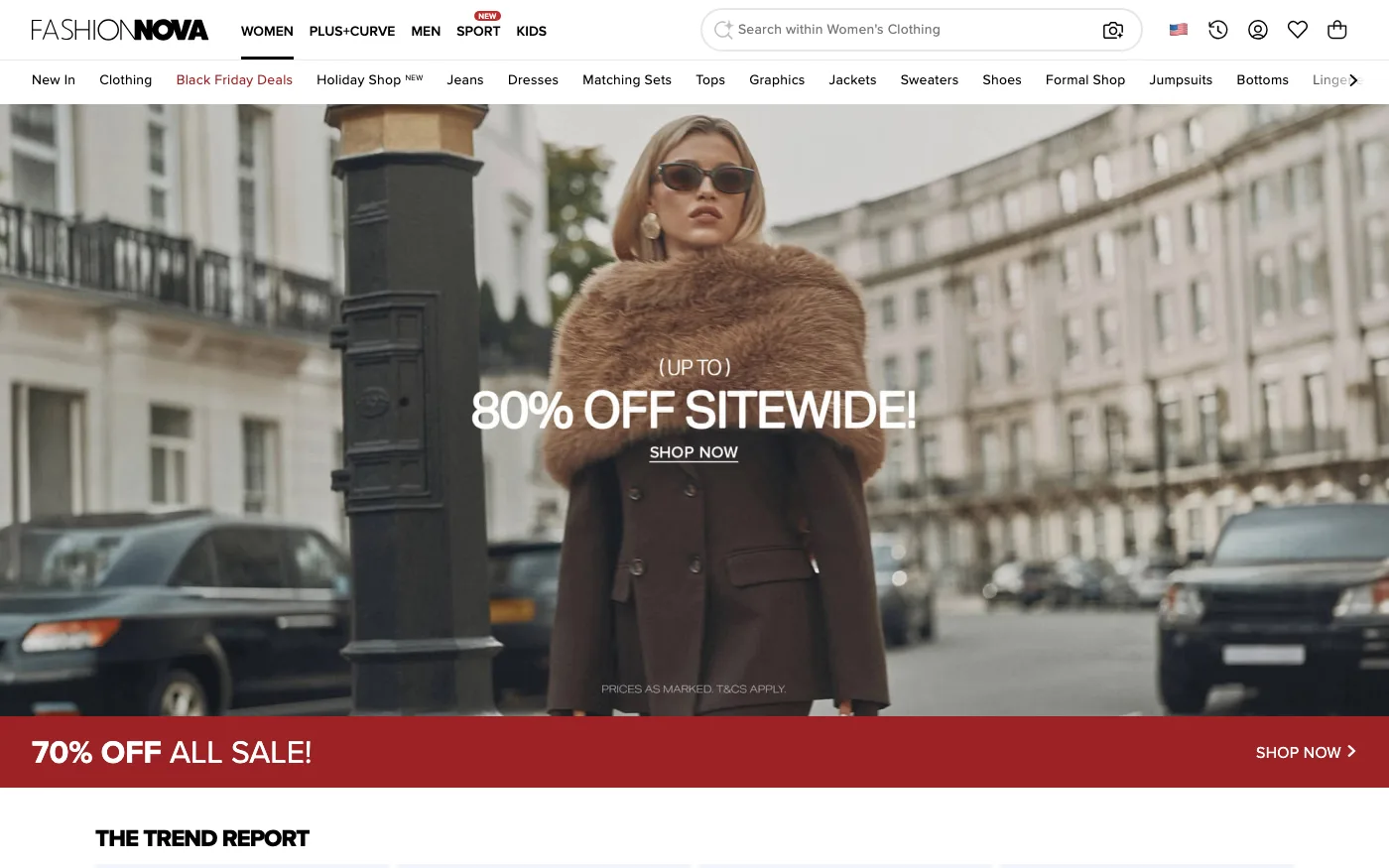
When it backfires: anything over $100. "15% off" a $400 order makes the customer do math; "$60 off" hands them the answer. When it never ends, it stops being a promotion and becomes your real price, with a fictional one above it.
Sales promotion example 2: dollar-off discounts
Dollar framing is the inverse. "$50 off your $500 order" feels concrete; "10% off" feels like homework. Ulta lets members redeem points in $3 increments (100 points equals $3 off) rather than abstract percentages, which makes the reward feel like money.
When it works: high-AOV stores, anything over $100, and threshold offers where the dollar amount is the hook.
When it backfires: small amounts on small carts. "$3 off" a $35 order reads as trivial and costs the same margin as a percentage that sounded bigger. Skip dollar framing under about $25 in savings.
For code naming and stacking rules, see our discount code ideas post.
Multibuy Promotions: BOGO, Half-Off Deals and Bundles
Sales promotion example 3: BOGO free
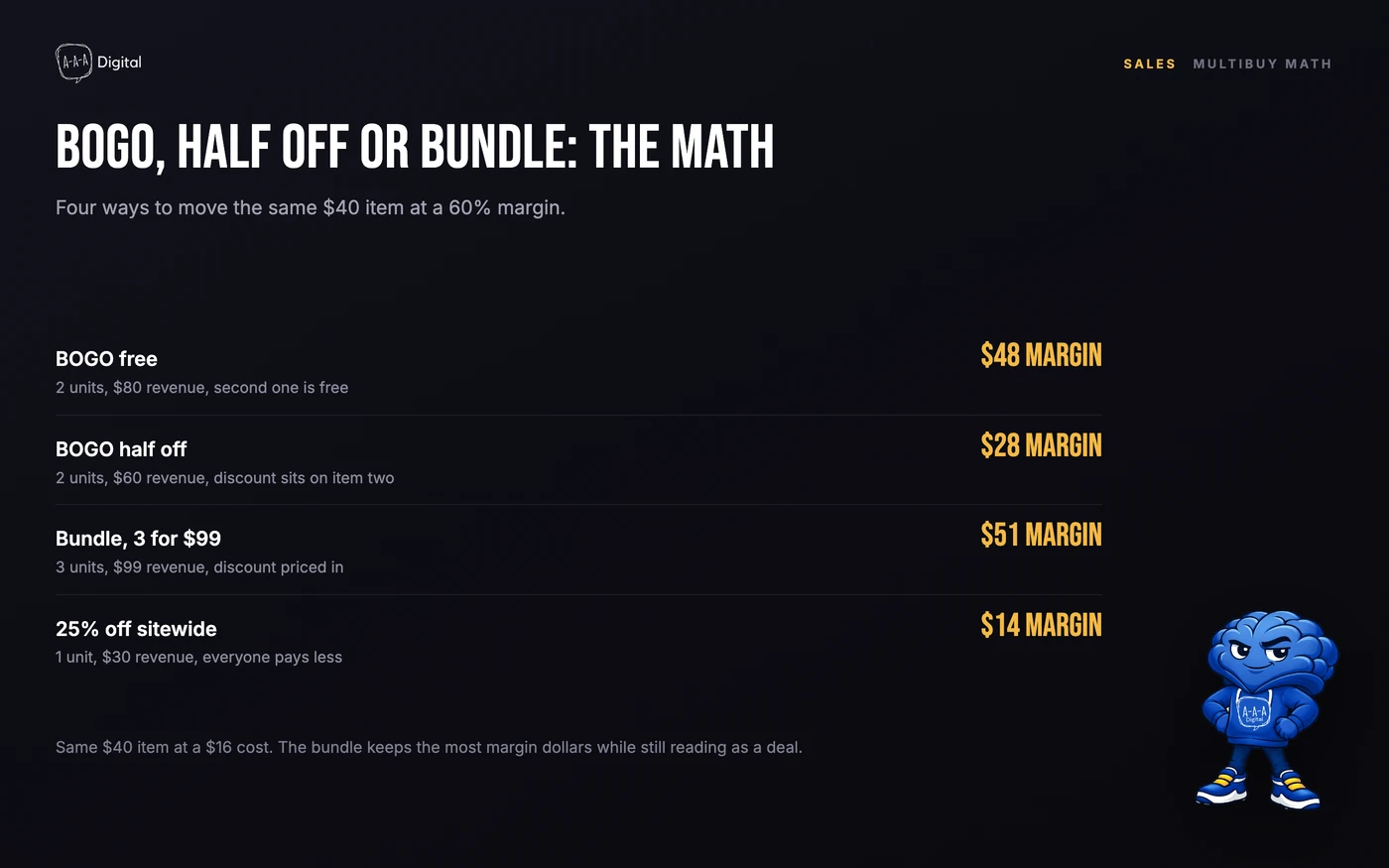
A 2020 study in the International Journal of Research in Marketing found shoppers preferred buy-one-get-one-free over an economically identical multi-buy percentage deal, because "free" short-circuits the calculation. Take a $40 item at 60% margin: $16 cost. BOGO free moves two units at $80 revenue and $48 margin. You gave up half the margin on the pair, but doubled units, and the customer heard the word "free."
When it works: consumables, products people genuinely use two of, and inventory that needs to move.
When it backfires: when the customer only wanted one. A shopper ready to pay $40 for a single item bounces off a frame that forces a double commitment. BOGO also trains stockpiling, which pushes the next purchase further out. Jewelry and gift-driven categories should stay away.
Real example: Pura Vida built early growth on multibuys across its bracelet lines, where low unit prices and a collect-them-all design made two units feel like a bargain instead of an upsell.
Sales promotion example 4: BOGO half-off multibuys
"Buy one, get one 50% off" is a 25% discount across the pair, but the discount sits on the second item, so the first keeps its full-price anchor. Use it when BOGO free bleeds too much margin but "25% off" would break price integrity.
When it works: apparel, accessories and gifting seasons, where a second item is plausible but not guaranteed.
When it backfires: the stockpile problem again, milder, plus a framing trap: on a single $40 item, "50% off" would have converted the customer you just lost. If most of your orders contain one unit, test a straight percentage first.
Real example: Walgreens runs recurring buy-one-get-one-half-off events across vitamins and personal care, categories with the right profile: low unit prices, genuine repeat use.
Sales promotion example 5: product bundles
A bundle prices complementary items below their combined list price. Same $40 item, $16 cost: a "3 for $99" bundle produces $99 revenue against $48 cost, or $51 margin. That beats the BOGO's $48 while looking like a smaller discount. All four on one item:
| Mechanic | Basket | Revenue | Margin after | Effective discount |
|---|---|---|---|---|
| BOGO free | 2 units | $80 | $48 | 50% per unit |
| BOGO 50% off second | 2 units | $60 | $28 | 25% per unit |
| Bundle, 3 for $99 | 3 units | $99 | $51 | 17.5% |
| 25% off sitewide | 1 unit | $30 | $14 | 25%, given to everyone |
When it works: products used together (skincare routines, coffee and a grinder), hero SKUs that pull attachments, and any brand that wants AOV up without a public discount anchor.
When it backfires: bundles of unrelated items read as inventory dumps, and bundles shown before the customer decides anything raise the first decision's price. Keep them on the product page and in the cart. We moved one supplement client's bundles from a sitewide banner into the product page and cart drawer; attach rate went 4% to 11% in a quarter once the bundle met buyers at the moment of intent. The pre-purchase bundle and the post-purchase upsell are the same play at different moments.
Wiring these into product and cart pages without wrecking page speed is our Shopify CRO service.
Threshold Promotions: Free Shipping vs Spend-and-Save
Sales promotion example 6: free shipping threshold
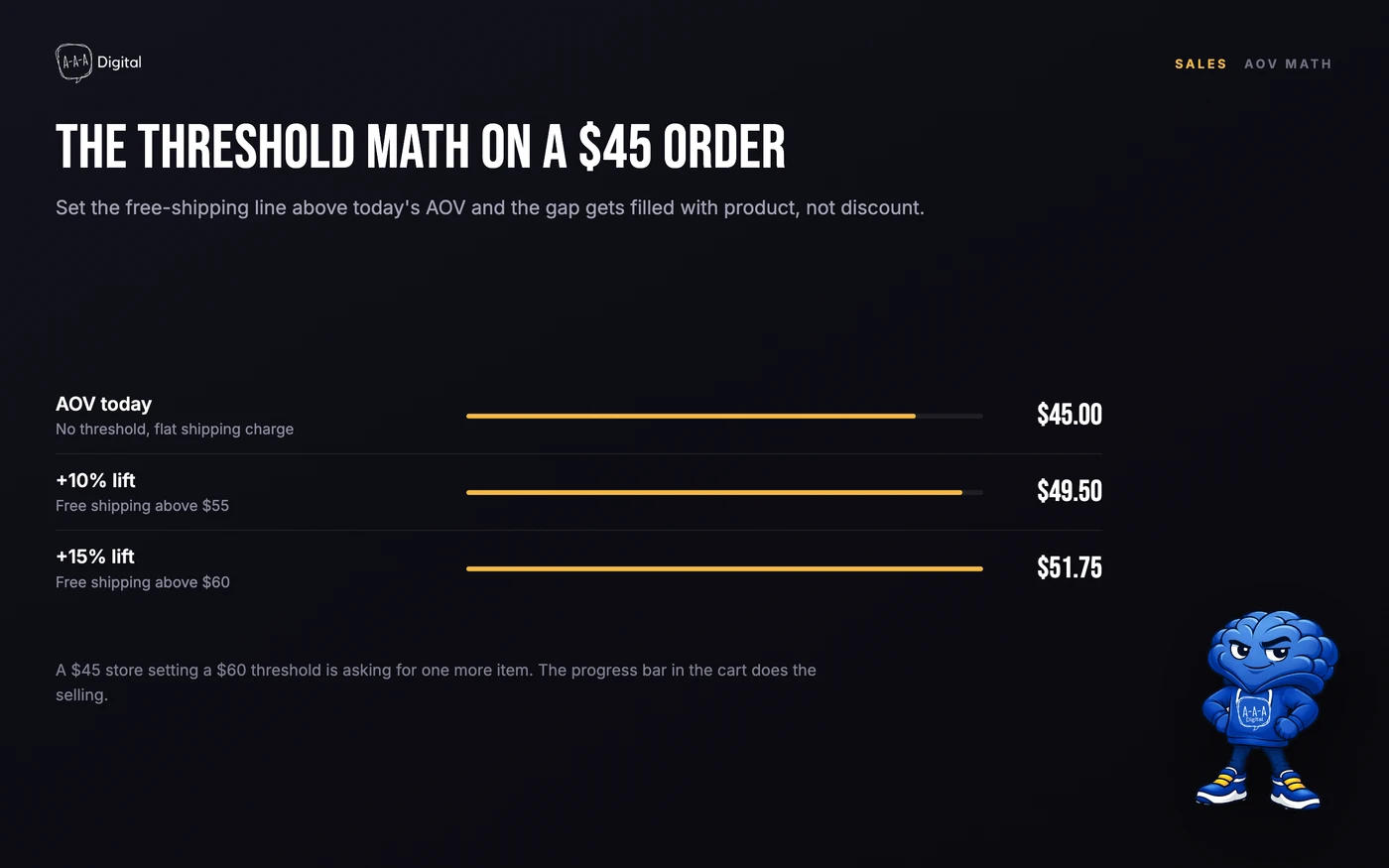
Capital One Shopping's research reports free shipping lifts AOV by 15-20% and puts the average US threshold at $64 as of 2023. The mechanics: set the line 15-30% above current AOV, and the gap gets filled with product instead of discount. A $45-AOV store setting the threshold at $55-60 is asking for one more item.
When it works: almost always, if the threshold is honest. The cost is your actual shipping spend, usually $5-9, not a percentage of product value, so the damage is bounded and invisible.
When it backfires: when the line sits below your AOV and everyone qualifies, so you eat shipping on orders you already had, or so high the cart becomes a math exam. A jewelry client had set hers at $200 against an $85 AOV; nothing moved. We restructured to a $99 threshold with a progress bar in the cart, and AOV rose roughly 12% the following quarter.
Real example: Zappos built a decade of loyalty on the opposite bet, free shipping with no threshold and painless returns; without its economics, the threshold version is the sustainable one.
Sales promotion example 7: threshold discount (spend $X, save $Y)
"Spend $75, get $15 off" frames a bigger saving than any shipping subsidy, but the math is stricter. A $75 basket at 60% margin holds $45; the code takes it to $30. Against a $45-AOV baseline holding $27, you made $3 more per qualifying order before fulfillment costs. The whole promotion lives or dies on whether it pulls baskets from $45 to $75.
When it works: catalogs where one more item is an easy yes, and when the cart shows the gap ("you are $9 away from $15 off").
When it backfires: the double margin hit. You discount product that was already going to sell, and the add-ons too. If under a third of orders can realistically reach the line, you built a promotion for your biggest customers and a frustration for everyone else. Read our margin improvement guide before scaling one past a test.
Time-Boxed Promotions
Sales promotion example 8: flash sales
A flash sale compresses a discount into an announced window, usually 24 to 72 hours, and the deadline is the product. Start Tuesday or Wednesday so the email and SMS land when people plan purchases, and end at midnight in the customer's timezone.
When it works: collection launches, slow inventory, list reactivation before a bigger event, and any store with enough email and SMS audience to make the window feel crowded.
When it backfires: on a schedule. A store running a "flash sale" monthly has built a permanent discount with extra steps. We audited a fashion client running monthly 48-hour events; her full-price weeks were decaying because the list had learned to wait. Cutting to four events a year, tied to real inventory moments, stabilized full-price revenue within two months.
Real example: Amazon turned Prime Day, launched in 2015, into a two-day July event that created its own shopping season. The lesson: rare, named and annual, not weekly.
Sales promotion example 9: tiered VIP early-access sale
Sephora's Savings Events are the template: the discount is real but the gate is membership. Rouge gets 20% and shops first, VIB 15%, Insider 10%. The promotion rewards the best customers, grows the program (you must join to get the code), and never marks a public price down.
When it works: stores with a real loyalty base and full-price integrity to protect. The early-access window is the actual reward; the percentage is the excuse.
When it backfires: when your base is small. A tiered sale with fifty members per tier reads as an empty room.
Margin-Friendly Promotions
Sales promotion example 10: gift with purchase
Gift with purchase swaps a discount for a free item above a threshold. Ulta runs it constantly: spend $50 on a qualifying brand, receive a free gift. The math is why beauty retail loves it. On a $60 order at 60% margin you hold $36; a $4.50 sample set leaves $31.50. A 10% off code would leave $30 while teaching the customer your price is negotiable. Same cost, very different precedent.
When it works: beauty and sampling categories where the gift converts future buyers, gift cost under about 10% of order value, and perceived value inflated by packaging minis as a "set."
When it backfires: when the gift reads as clearance junk, when a GWP goes evergreen and customers hold orders until it returns, and when fulfillment misses it. A forgotten gift generates support tickets and one-star reviews that cost more than the margin you saved.
Real example: Estée Lauder's department-store GWP events have run for decades and are tracked by dedicated deal sites, proof a well-staged gift can drive full-price volume for a month at a time.
Sales promotion example 11: loyalty points multiplier events
Instead of discounting the cart, multiply the earnings: double or triple points weekends. Ulta runs multiplier events regularly, and members treat them as stock-up moments. The economics are sneaky-good: the reward is future store credit, some of which is never redeemed.
When it works: stores with an active program and replenishable products, where customers already know what a point is worth.
When it backfires: when nobody does. Multiplier events amplify an existing program rather than create one, and they accrue points liability, so keep them rare and loud.
Relationship Promotions
Sales promotion example 12: referral rewards
A referral program turns customers into the channel. The canonical example is Harry's, which collected an estimated 100,000 email signups in one prelaunch week using tiered product rewards: 5 referrals for shave cream, 10 for a razor, 25 for a shave set, 50 for a year of free blades. The currency is product, not cash: high perceived value, near-zero marginal cost.
When it works: products people naturally talk about, double-sided rewards, and the first tier placed low enough that everyone can reach it.
When it backfires: cash rewards, which attract deal-hunters who churn the moment the reward clears, and referral pushes into closed communities where the offer reads as spam.
Sales promotion example 13: first-order incentive
The welcome discount is the default email-capture bribe: a September 2026 tracker covering 235 DTC sites found 152 running a welcome popup, percentage-off the most common format, median discount 15%. Popup data suggests bigger discounts do not convert meaningfully better; having an offer matters more than its size. Our sizing rule: 10% if margin is under 60%, 15% as the norm, and a gift or free-shipping framing instead of anything at 20% and above, because at that depth you are buying a customer your funnel should have won. When you show the offer matters as much as its size, which is why we test popup strategy separately.
When it works: cold ad traffic with no brand trust, high-consideration products where the first purchase is the barrier, and stores whose email flows can monetize the address after.
When it backfires: trained coupon-hunters who abandon carts to trigger the popup, and code leakage to coupon extensions. If your first-order code is public, it is quietly subsidizing returning customers.
Sales promotion example 14: winback offers
A winback offer targets customers past their normal repurchase window. Klaviyo's benchmark reporting puts top-decile winback emails at $1.60 in revenue per recipient. Run a ladder, not a single blast: a reminder at the edge of the window, a modest incentive (free shipping first) for non-responders, and a deeper one reserved for high-LTV customers.
When it works: replenishable products with predictable cycles, where "it is time to reorder" is a true statement and not a hope.
When it backfires: when you pay for the inevitable. Discounting customers who were about to reorder anyway is donated margin, and blasting lapsed buyers forever torches deliverability. Sunset contacts who ignore three winbacks.
FAQ
What is the most effective type of sales promotion for a Shopify store?
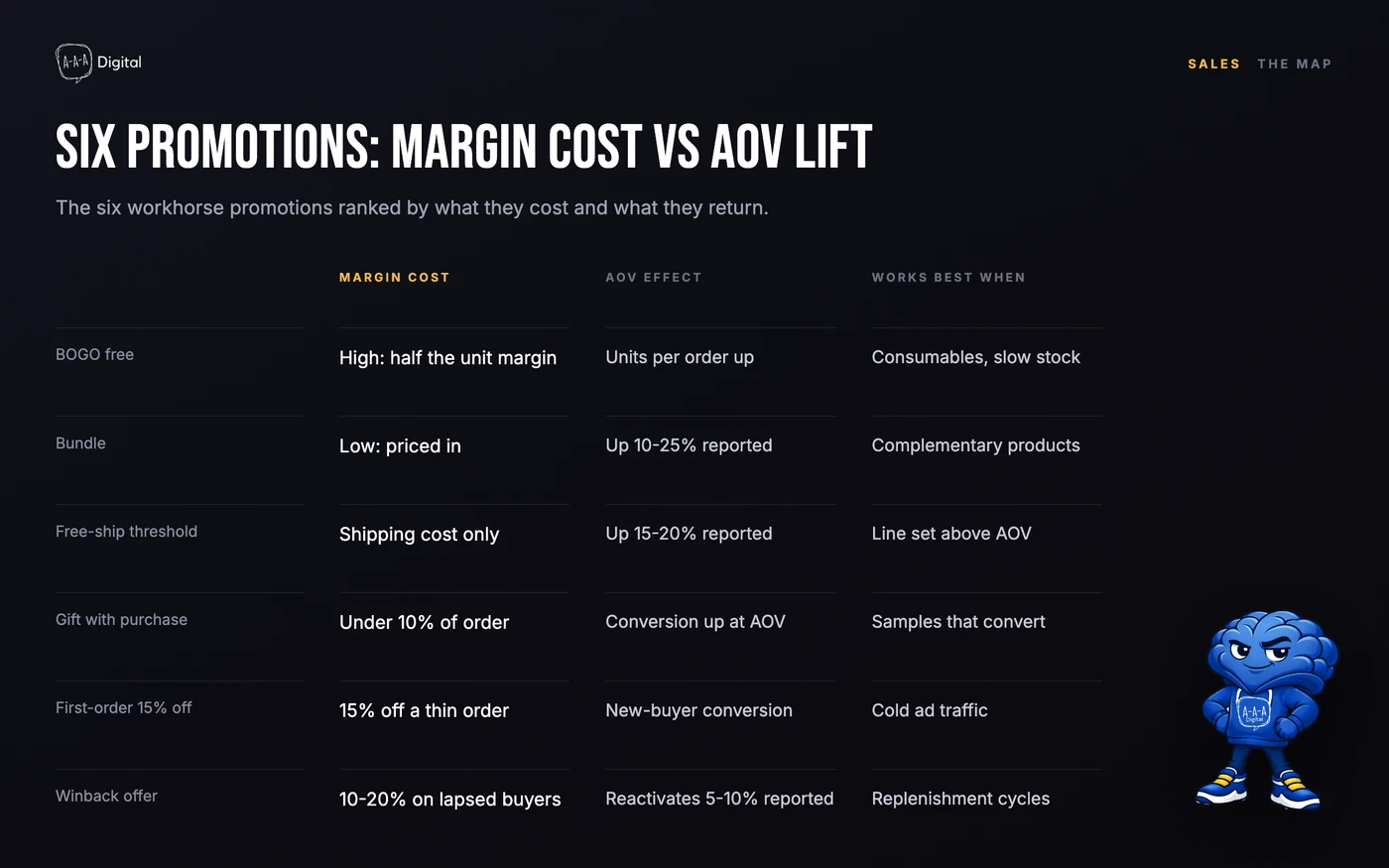
For most stores under $100 AOV, a free-shipping threshold set 15-30% above current AOV: reported research links it to 10-20% order-value lifts. Above $100 AOV, bundles and threshold discounts usually win on price-anchor grounds.
How often should I run sales promotions?
Fewer than you think. Most healthy stores we work with run two to four major events a year tied to real moments (inventory, seasons, launches). A promotion on permanent display stops being a promotion and becomes your price.
Do discounts hurt my brand?
They hurt when they are permanent, public and deep. Framed well (member-only, time-boxed, gift-based, threshold-based), promotions coexist with a premium position. Sephora and Ulta discount constantly without reading as cheap, because the gate is always membership and the list price never moves.
Get Help With This
Promotions are arithmetic wearing a creative costume: the stores that win know their margin, AOV and repurchase cycle before picking a format. If you would rather have someone run that math on your actual numbers and wire the winners into your product pages, cart and email flows, our Shopify CRO team does exactly that. Bring your last three months of orders; we will bring the spreadsheet.
