The Shopify Partner Program is a free program Shopify runs for the freelancers, developers, and agencies who build its stores. Signing up takes an afternoon, and a referred merchant pays the partner 20% of their monthly subscription, recurring for as long as that merchant stays on Shopify.
The first fact is the one merchants miss. Because joining is free and open, the partner badge on its own proves almost nothing. Anyone with an email address can hold one, which is why the verification steps in the second half of this post matter more than the badge itself.
What the Shopify Partner Program actually is
A free membership for the ecosystem around Shopify: store builders, app developers, theme designers, affiliates, and agencies. Members get a Partner dashboard with four working tools inside it.
- Development stores. Unlimited test stores with most plan features switched on. An agency builds your store on one, then transfers it to you when you pick a plan. You pay the plan, not the build environment.
- Collaborator access. The clean way for a partner to work inside your live admin without a staff account, a password, or a seat on your plan. Covered properly below.
- Client referrals. A tracked link that ties a merchant's subscription to the partner. This is what switches on the revenue share.
- Earnings and payouts. Referral income, affiliate bounties, and any app or theme revenue land in one balance with one payout method.
It is not a certification, and it is not employment. Shopify runs the program because it wants stores built and merchants referred by third parties, and it pays a cut to the ones who do it. Both motives are commercial. That is fine. It just means you should read the badge as a business arrangement, not a stamp of quality.
The program dates to 2012, and Shopify's own line is that the majority of new stores come to the platform through partners. Whatever the exact share this quarter, the practical read is the same: most merchants will end up hiring from inside this ecosystem, so the screening is on you.
Revenue share, in plain numbers
Three earning routes exist, and merchants usually only hear about one of them.
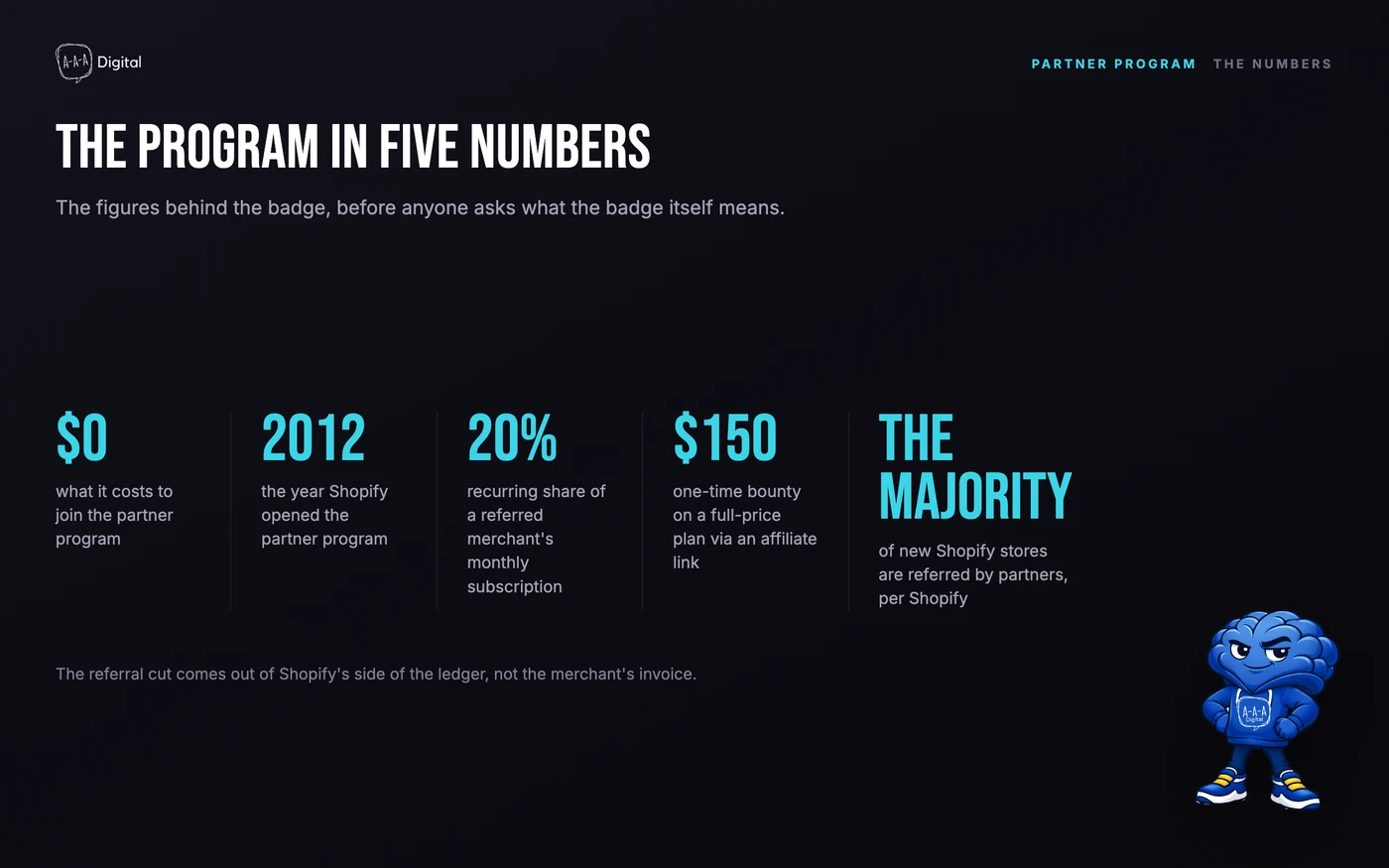
Client referral. A partner refers a merchant, usually by building or migrating the store, and Shopify pays the partner 20% of that merchant's monthly subscription every month the merchant stays. On a $105 a month Grow plan that is $21 a month to the partner, $252 a year, for as long as the store runs. Plus referrals run on a separate one-time payment instead, publicly pegged around $2,000.
Affiliate referral. A tracked link in a blog post or video. This pays a one-time bounty rather than a recurring share, roughly $150 when someone signs up on a full-price plan through the link. The affiliate route is built for content sites, not agencies.
Apps and themes. Sales revenue from apps and themes listed on Shopify's marketplaces. This is where most large partner incomes actually come from, and it has nothing to do with hiring an agency, so it ends here.
Two things follow for a merchant. First, the referral money comes out of Shopify's side, not yours. Your subscription and your agency invoice are the same whether or not a referral link sits behind the account. Second, the referral creates a quiet conflict of interest: a partner earns while your subscription stays active, not while your store performs. Most agencies absorb that tension honestly. Some build their entire pitch around it. Our breakdown of what a Shopify expert costs shows how referral income shapes the way some agencies quote.
Shopify Partner vs Shopify Plus Partner
Two badges, and the difference between them is the single most useful fact in this post.
The first badge is the free tier. Anyone joins, no clients required, no review. The second is Shopify Plus Partner status: the agency applies or is invited, and Shopify reviews the business, its Plus track record, and its technical depth before granting it.
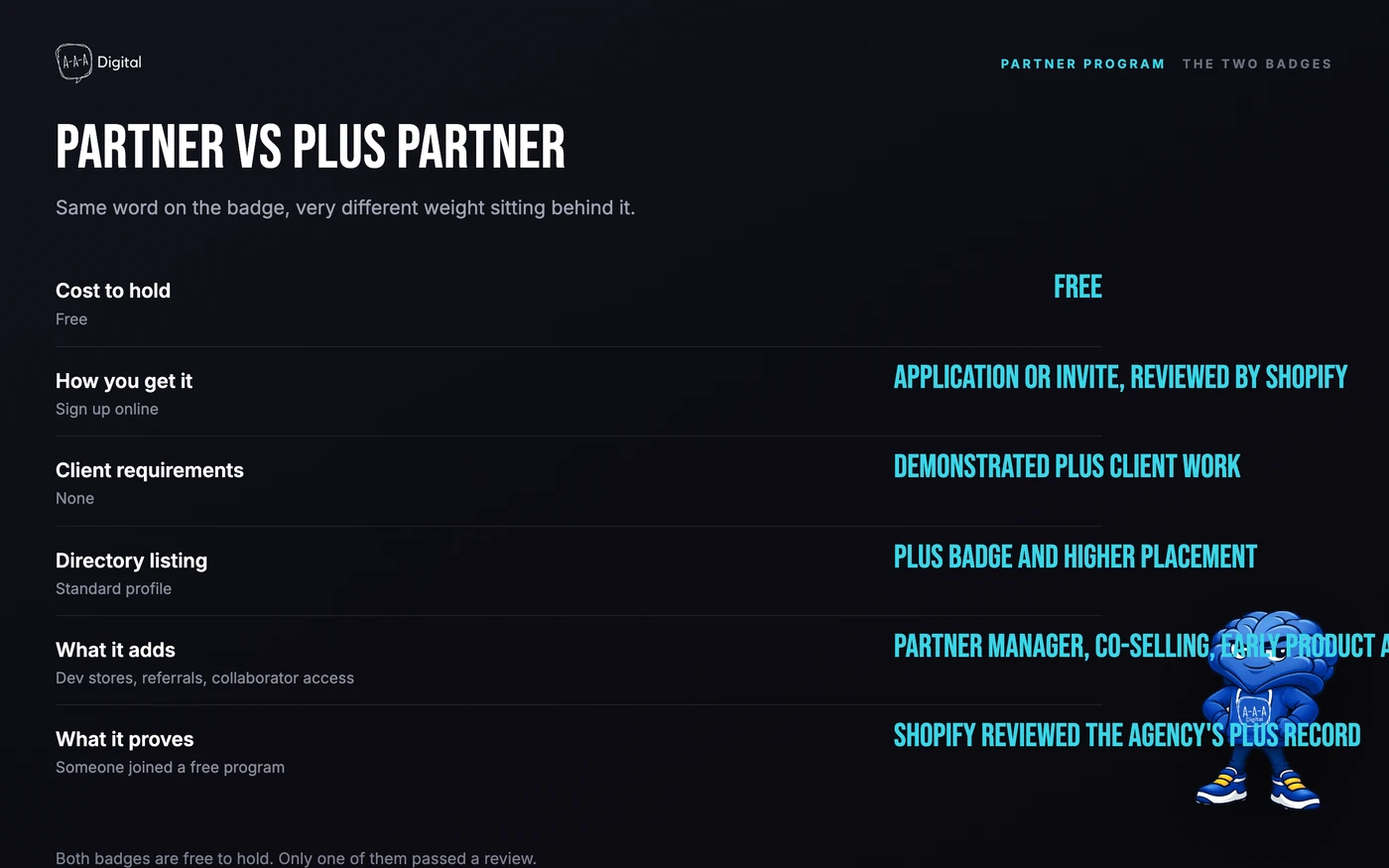
| | Shopify Partner | Shopify Plus Partner | |---|---|---|---| | Cost to hold | Free | Free | | How you get it | Sign up online | Application or invite, reviewed by Shopify | | Client requirements | None | Demonstrated Plus client work | | Directory listing | Standard profile | Plus badge, higher placement | | What it adds | Dev stores, referrals, collaborator access | Partner manager, co-selling, early product access | | What it proves | Someone joined a free program | Shopify reviewed the agency's Plus record |
The row that matters is the last one. Plus Partner filters out a real layer of pretenders. It still does not tell you who specifically will work on your store, or whether this quarter's team matches the one that earned the badge. Hold both thoughts at once.
How to become a Shopify Partner
A fair share of the people searching this term want in rather than want to vet. Here is the actual path, which is shorter than the courses selling it.
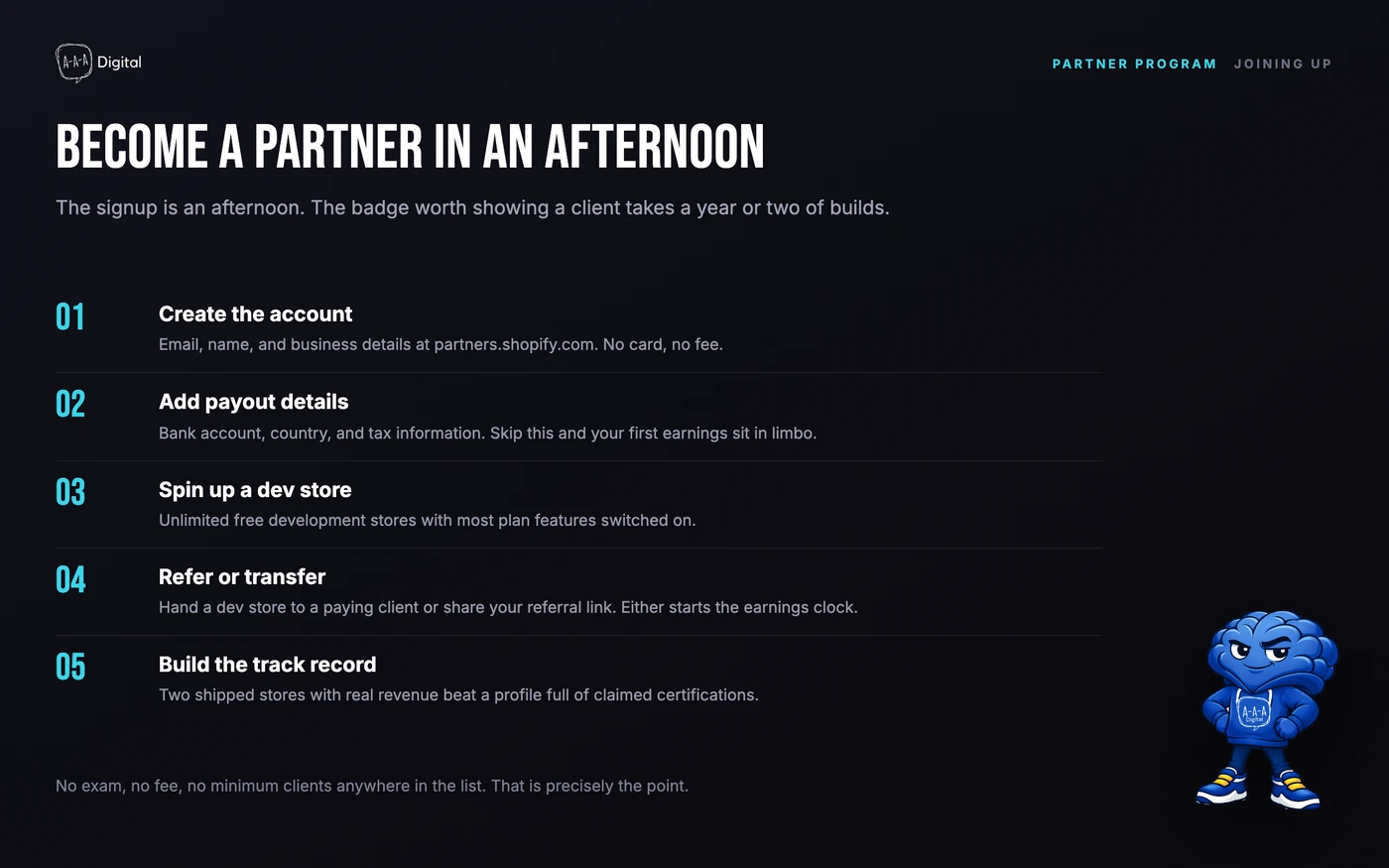
- Create the account. Email, name, and business details at partners.shopify.com. No card, no fee.
- Add payout details. Bank account, country, and tax information. Skip this and your first earnings sit in limbo.
- Spin up a dev store. Unlimited and free, with most plan features on. This is where a first client build happens.
- Refer or transfer. Hand the dev store to a paying client or share your referral link. Either action starts the earnings clock.
- Build the track record. Two shipped stores with real revenue beat a profile full of claimed certifications.
No exam sits anywhere in that list. There is no Shopify certification for individuals in the partner program at all, which becomes important when an agency implies its people are "Shopify certified". The signup took us an afternoon. The track record took years. That gap is the whole point.
How agencies actually use collaborator access
Collaborator access is the daily tool for a working agency, and watching how an agency handles it tells you most of what you need to know about the engagement.
A partner requests access from their dashboard using your store's myshopify.com address. You receive an email, approve the specific permissions the work needs, and the partner's team appears in your admin under Collaborators. Three properties matter:
- No password and no staff seat. Collaborators never see your login and do not count against your plan's staff limit.
- Scoped permissions. A theme fix needs theme access, not order data. A careful agency asks for the minimum and explains why each permission is needed.
- Visible and revocable. Every collaborator is listed in your admin, and any of them can be removed in two clicks, with the access trail left behind.
The failure mode to watch for is an agency that asks for your password or full admin access "to save time". That is not a shortcut. It is a preview of how the rest of the engagement will run.
We still get this request from new clients a few times a quarter, always framed as a favour. It never is. The two minutes a collaborator request takes are the cheapest insurance in the whole engagement. Our Shopify development service works through collaborator requests with a written scope, which is the pattern I would expect from any serious partner.
How to verify a partner before you sign
This is the section that pays for the rest of the post. Five checks, in order, none of which cost anything.
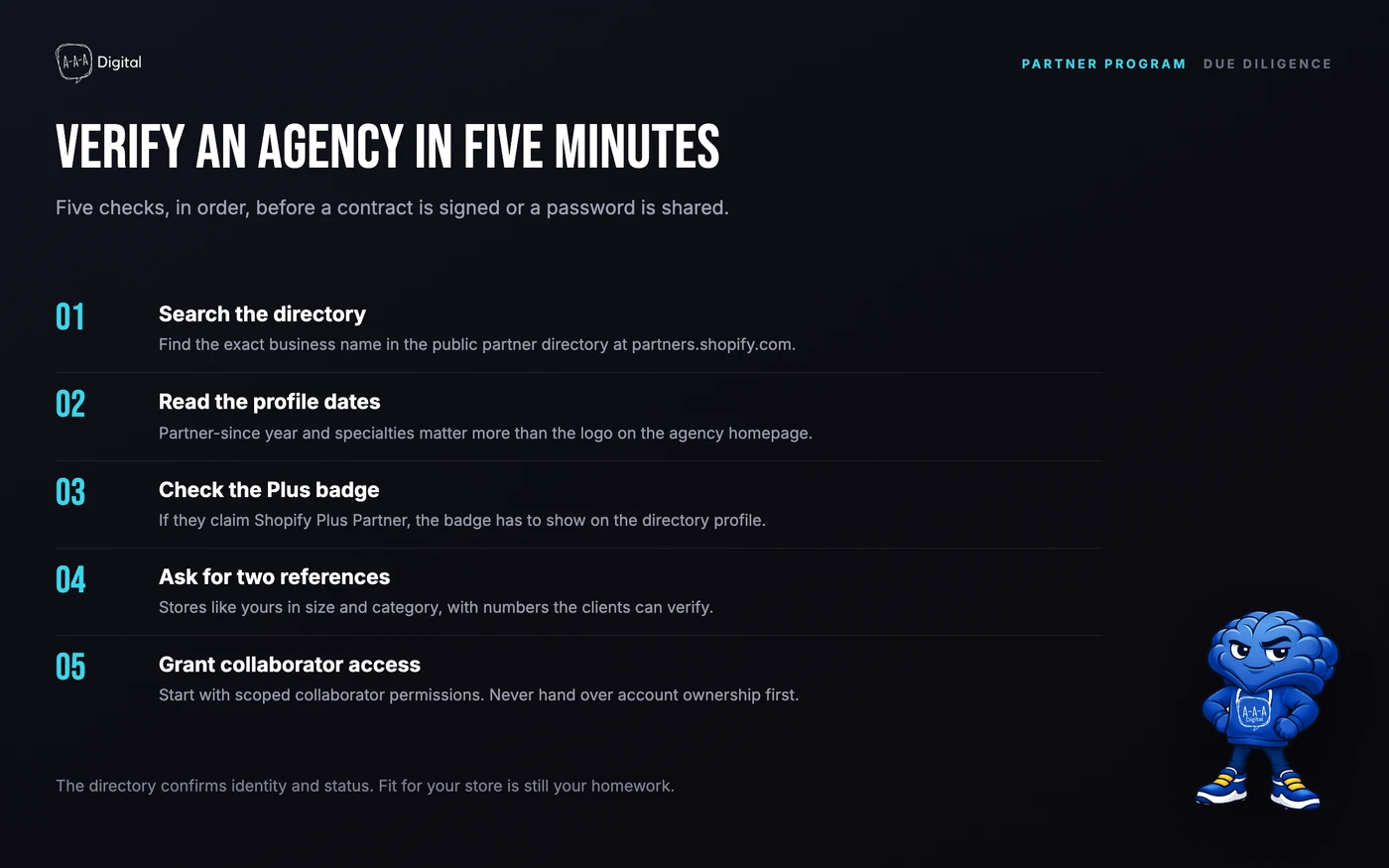
- Find them in the partner directory. The public directory at partners.shopify.com lists active partners by name, specialty, and location. No listing, or a listing under a different business name, is a flag.
- Read the profile instead of the badge. The directory shows how long they have been a partner and what they specialise in. A partner since 2013 with ten builds in your niche beats a partner since last month with a slick homepage.
- Check the Plus claim on the directory itself. If the pitch says Shopify Plus Partner, the Plus badge has to show on the profile. A missing badge usually means the status belonged to a different company, or to a former employer.
- Ask for two references on stores like yours. Size and category both count. A partner who is excellent on 10 SKU fashion brands can be lost on a 4,000 SKU parts catalogue.
- Start with collaborator access, never the account. Handing over store ownership before the work has proven itself removes your only remaining lever.
One free extra: search the agency's name plus the word Shopify and read the third page of results as carefully as the first. What surfaces past page one tends to be more honest than the homepage.
What Plus Partner proves, and what it does not
Merchants over-read this badge in both directions, so it is worth being precise.
It proves that Shopify reviewed the agency at some point: revenue, Plus client count, technical capability, business health. It proves they have shipped Plus stores and that Shopify expects them to keep shipping them. That filters out a genuine layer of pretenders.
It does not mean Shopify endorses them for your project, because Shopify does not endorse individual engagements. It does not certify the individual developers who will touch your store, because the program certifies businesses, not people. It does not put Shopify in your contract: if the engagement goes wrong, the dispute is between you and the agency, and Shopify's involvement ends at the badge. And it does not guarantee current staffing, because certifications lag hiring and attrition by a year or more.
The right read is narrow: "Shopify checked that this agency operates at a professional level." Never the wider read: "Shopify vouches for this agency on your build." Our guide to choosing a Shopify agency goes deeper on the questions that actually predict a good engagement.
Partner program myths vs reality
Five claims we hear regularly from merchants, next to what is actually true.
| Myth | Reality |
|---|---|
| The partner badge means Shopify endorses the agency | Membership proves signup, not endorsement. Only Plus Partner involves any review. |
| Shopify certifies the people who will work on your store | The program certifies businesses, not individuals. The freelancer on your project may hold no credential at all. |
| A Plus Partner engagement is supervised by Shopify | Shopify is not a party to your contract. Disputes sit between you and the agency. |
| Partner agencies charge more because of the badge | Status does not set pricing. The referral cut comes from Shopify's side, not added to your invoice. |
| The directory listing means Shopify vetted them for your project | The directory confirms identity and status. Fit for your store is still your homework. |
The pattern in the left column is the same five times: the badge is real, but the claim made from it is bigger than the badge. Verification closes that gap.
Frequently Asked Questions
What is the Shopify Partner Program?
A free program for the freelancers, developers, and agencies who build on Shopify. Members get a dashboard with development stores, collaborator access, referral tracking, and earnings, and they earn a share of the revenue they bring the platform. It opened in 2012.
Is the Shopify Partner Program free?
Yes. Joining costs nothing and takes about an afternoon. The cost is not money, it is the time needed to build a track record that makes the badge worth anything.
How much do Shopify Partners make per referral?
20% of the referred merchant's monthly subscription, recurring for as long as the merchant stays on Shopify. Affiliate link referrals pay a one-time bounty instead, around $150 on a full-price plan signup, and Plus referrals carry a separate one-time payment.
What is the difference between a Partner and a Shopify Plus Partner?
Partner is the free tier anyone can join. Plus Partner is reviewed by Shopify and requires demonstrated Plus client work, in exchange for a Plus badge, higher directory placement, a partner manager, and early access to new product.
Does the partner badge mean Shopify recommends the agency?
No. The badge shows program membership. Even Plus Partner status is a review of the business, not a recommendation for your specific project.
How do I check if an agency is a real Shopify Partner?
Search the public partner directory for their exact business name, check the partner-since date and listed specialties, and confirm the Plus badge if they claim Plus Partner status. Then ask for two client references on stores like yours.
The badge is the start of the conversation, never the end of it. A real partner shows a directory profile with history, asks for collaborator access instead of your password, and offers references before you think to ask. If you want that standard applied to your own build, our Shopify experts work exactly that way, and the questions worth asking any expert before you sign are the ones we would want asked of us.
