In October 2026, Shopify and BigCommerce charge exactly the same list prices for their three self-serve plans: $39, $105 and $399 a month. Sit with that for a second, because most of the content ranking for this comparison was written before June 1, 2026, when BigCommerce renamed its plans, cut its sales thresholds and started charging a transaction fee of its own. Those articles are not slightly out of date. They describe a different product.
We run migrations in both directions, BigCommerce to Shopify far more often than the reverse, and this post is the conversation we have on the first call. Not which platform is "better", but which one you regret in eighteen months. Here is where BigCommerce genuinely wins, where Shopify genuinely wins, and the pricing math almost nobody publishes.
Shopify vs BigCommerce pricing in 2026
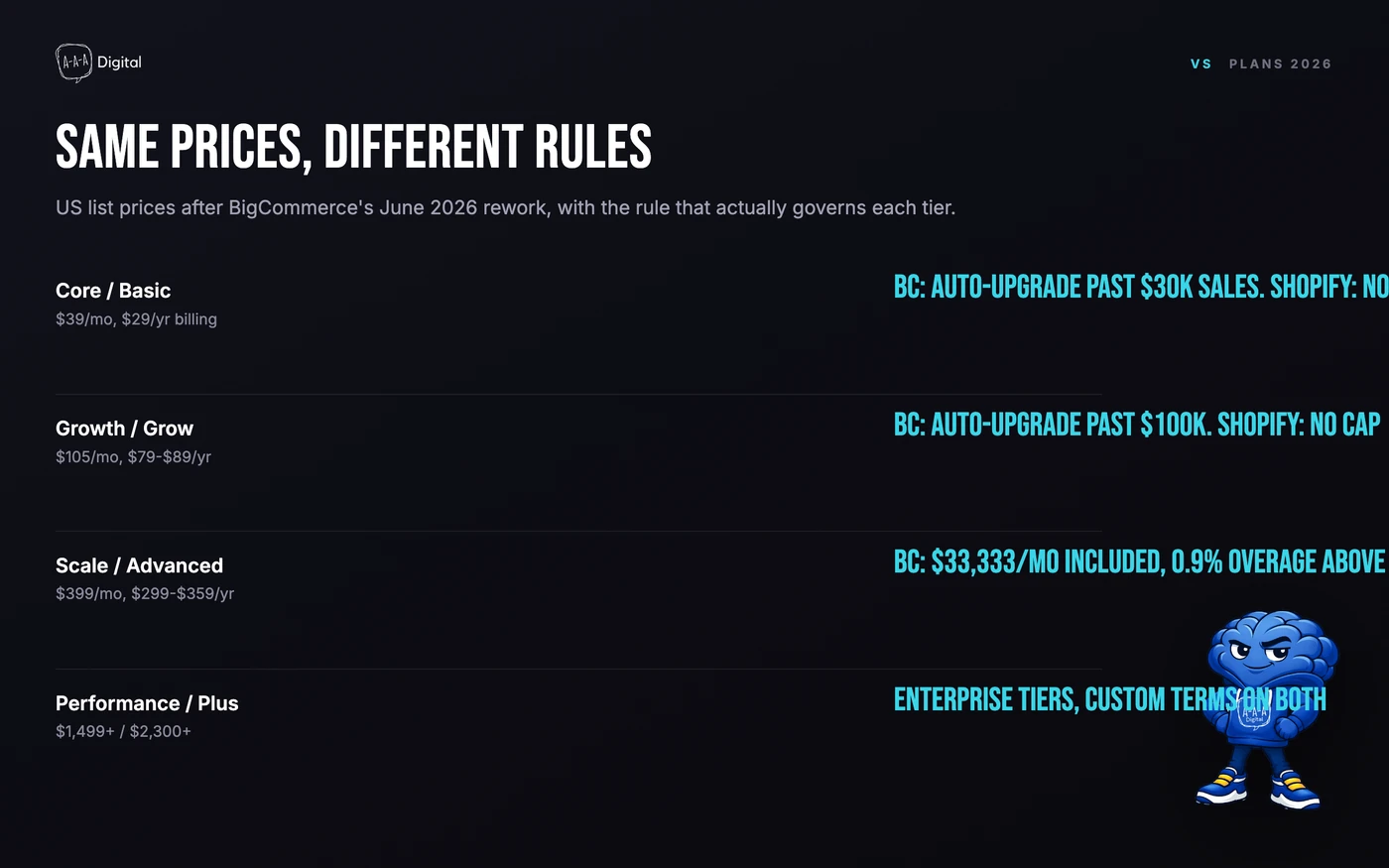
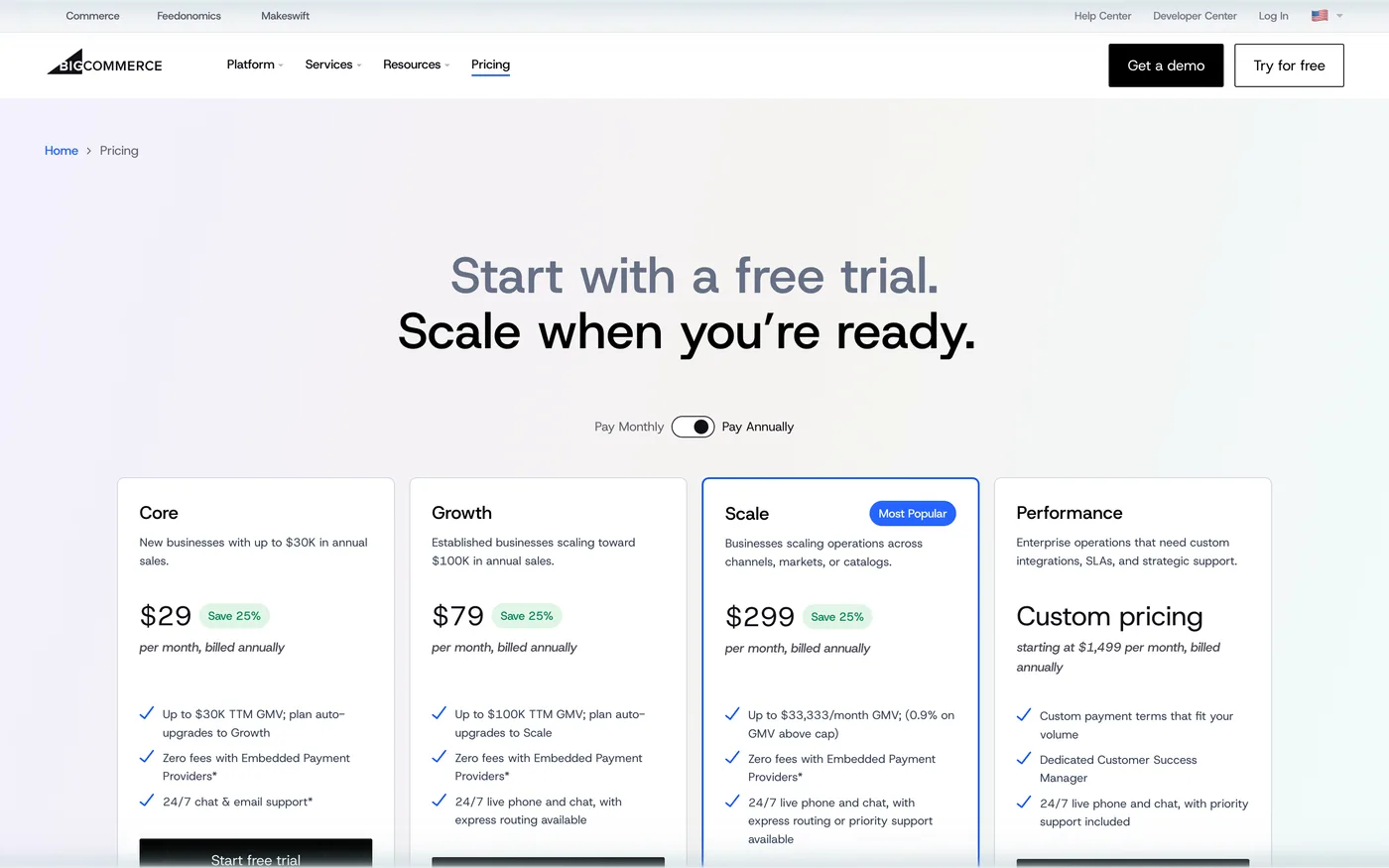
BigCommerce overhauled its pricing on June 1, 2026. Standard, Plus, Pro and Enterprise became Core, Growth, Scale and Performance. The monthly sticker prices ended up identical to Shopify's. The rules behind them did not.
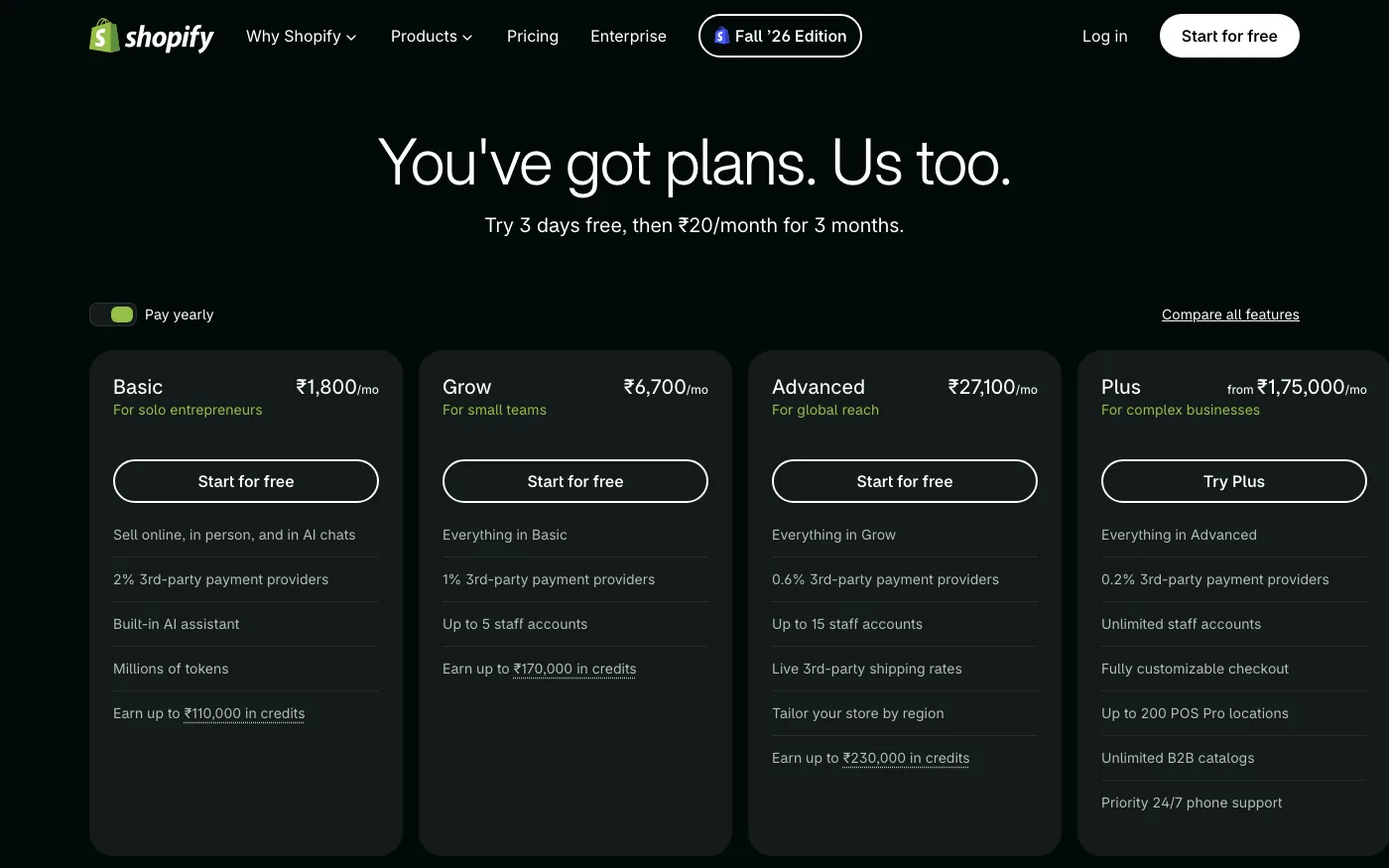
| Shopify | BigCommerce | |
|---|---|---|
| Entry plan | Basic: $39/mo, or $29/mo billed yearly | Core: $39/mo, or $29/mo billed annually |
| Mid plan | Grow: $105/mo, or $89/mo billed yearly | Growth: $105/mo, or $79/mo billed annually |
| Top self-serve plan | Advanced: $399/mo, or $359/mo billed yearly | Scale: $399/mo, or $299/mo billed annually |
| Enterprise tier | Plus: from $2,300/mo on a three-year term | Performance: custom, from $1,499/mo billed annually |
| Sales cap | None on any plan | Core up to $30K trailing 12-month sales, Growth up to $100K, Scale includes $33,333/mo then 0.9% on sales above, auto-upgrade to Performance at $2M |
| Extra fee on outside payment providers | 2%, 1%, 0.6% by plan, 0.2% on Plus | Open Payment Provider fee: 2%, 1%, 0.6%, 0% on Performance |
| Providers that avoid the extra fee | Shopify Payments only | Around 20 embedded providers, including Stripe, Adyen and PayPal Braintree |
| Published US card rate, online | 2.9% + $0.30 down to 2.5% + $0.30 by plan | PayPal Braintree from 2.89% + $0.29 |
One caveat on the yearly columns: both vendors adjusted published rates during 2026, and the annual figures third-party sources report do not all agree. Treat them as directional and model from the live pricing pages before you budget.
Three details do the real work. First, BigCommerce ties each plan to a sales threshold and upgrades you automatically when trailing twelve-month sales cross it. Its GMV figure counts taxes, shipping and marketplace orders, minus a 10% adjustment, so it rarely matches your own bookkeeping. Shopify caps nothing; you pick plans by features and card rate.
Second, the old "BigCommerce has no transaction fees" pitch is dead. Both platforms now charge 2%, 1% and 0.6% for orders processed outside their preferred providers. The difference is the waiver list: Shopify forgives only Shopify Payments, while BigCommerce forgives any of its roughly 20 embedded providers. If you have a negotiated rate with Stripe or Adyen, BigCommerce lets you keep it penalty-free.
Third, Shopify Payments is Stripe under the hood and is available in around 40 countries. If it does not operate where you sell, Shopify's third-party fee applies to every order. That single row has ended more than one platform debate in our calls. For the full Shopify side, our Shopify pricing breakdown keeps current numbers in one place, and whether Plus earns its fee is a separate question we answer on its own.
Where BigCommerce genuinely wins
Let us be fair first, because most agency-written comparisons treat BigCommerce as a punchline. It is not. Four areas are real wins.
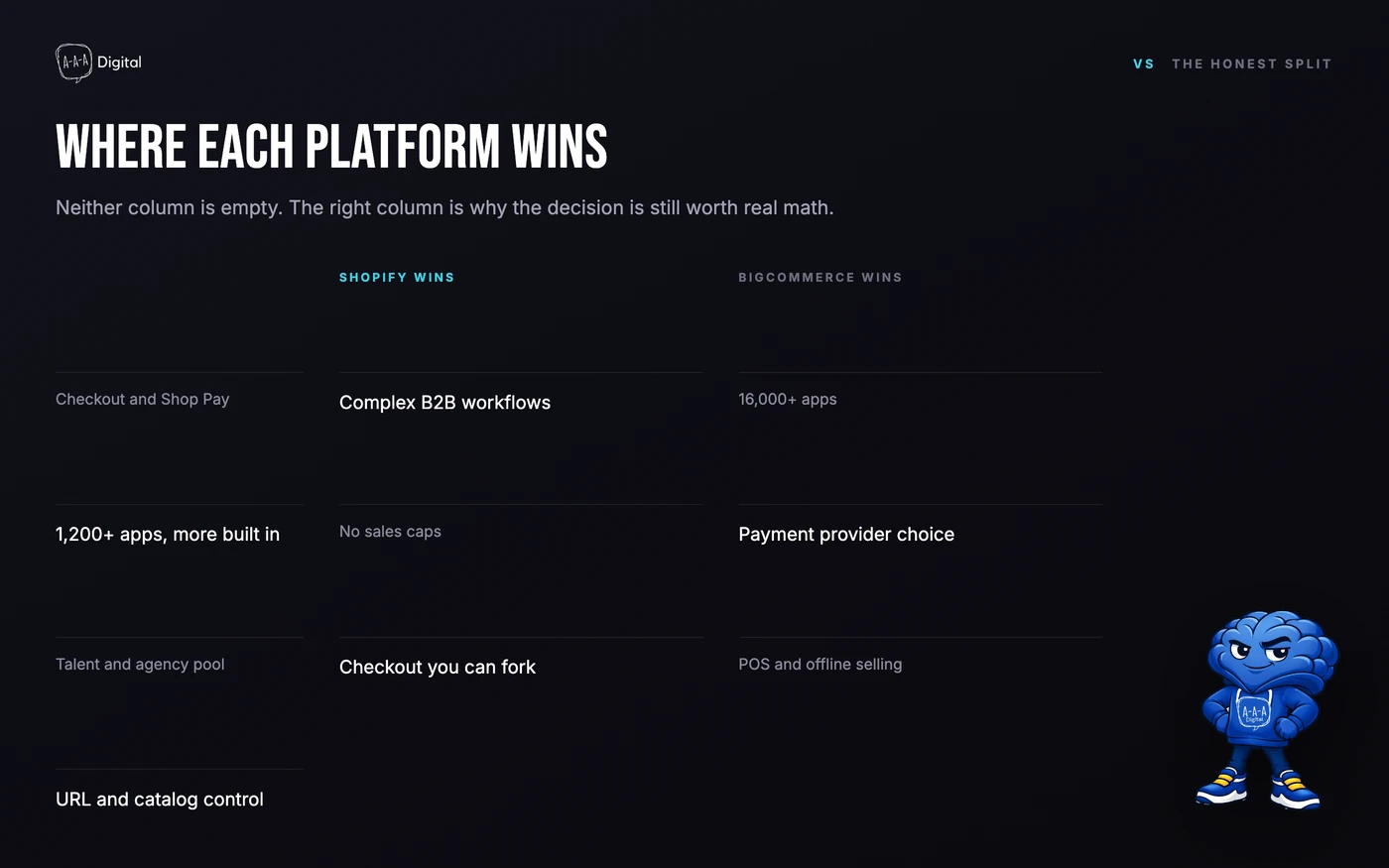
Complex B2B. BigCommerce has sold wholesale tooling for years. Customer groups start on Growth, price lists sit on Performance, and B2B Edition adds quote-to-cart, purchase orders, net terms, company hierarchies and approval workflows. Shopify has closed the gap fast; since April 2026, standard plans include basic native B2B with up to three catalogs, which covers simple wholesale. But quote-driven B2B with approval chains is still BigCommerce territory. When a merchant needs that on Shopify, it means Plus plus an app layer, and we plan it with them through our Shopify B2B setup guide.
Payment provider freedom. As above, the embedded provider list means you are not locked into one processor to avoid a penalty. Merchants with negotiated gateway rates, high-risk categories, or a processor relationship their CFO refuses to unwind keep it on BigCommerce.
Checkout control. BigCommerce's checkout is open source; developers fork it, customize it deeply, and plug it back in, on any plan. No-code controls handle branding and guest checkout behavior. Shopify treats checkout as crown property: meaningful customization (checkout UI extensions) is Plus-only, checkout.liquid is gone, and Shopify Scripts stopped working on June 30, 2026. For the record, BigCommerce has shipped a native single-page checkout since 2016; Shopify only moved to one-page in 2023. Both are fast now. The difference is who is allowed to change the machine.
Catalog and URL flexibility. Price-adjusting modifiers (engraving, add-ons, custom inputs) work natively without a product-options app. Product and category URL patterns are configurable, where Shopify fixes you to /products/ and /collections/ paths. BigCommerce also builds more in: 70+ discount rules, native reviews, real-time carrier quotes, and multi-storefront add-ons from $30/mo for running extra brands on one account.
Last year we talked a $2M apparel brand out of migrating. Their wholesale buyers submitted purchase orders through a BigCommerce workflow that would have cost them a Plus plan and a stack of apps to rebuild on Shopify. Staying was the right call, and we told them so.
Where Shopify genuinely wins
Now the other side, and it is the longer list for a reason.
Checkout conversion. Shop Pay has more than 250 million buyers on file, checks out roughly 2.5 times faster than guest checkout, and Shopify's own 2026 data shows order values about 16% higher when it is used. Shopify's long-published claim of up to 50% higher conversion versus guest checkout is their own number, so treat it as directional; even a fraction of it dwarfs any subscription difference. BigCommerce has a solid one-page checkout with wallets, but nothing with that network effect behind it.
The app ecosystem. The Shopify App Store lists over 16,000 apps. BigCommerce lists around 1,200. When you need an ERP connection, a 3PL, subscription billing with dunning, or a feed manager, Shopify usually has three options and an agency that has integrated each. The honest cost of that depth is maintenance: every app is a script on your pages, so installs need discipline.
Market gravity. StoreLeads counts roughly 3 million live Shopify stores against about 36,000 to 40,000 on BigCommerce, and BigCommerce's count sits below its late-2019 peak. Shopify processed about $378 billion in GMV in 2025. Gravity matters practically: Shopify developers, agencies and ops hires are everywhere, so talent is cheaper and easier to find; apps you depend on are less likely to vanish; and new commerce capabilities ship to Shopify first more often than not.
No sales caps. On Shopify you can grow from $30K to $3M in sales without the platform moving your plan underneath you. Some merchants like that BigCommerce forces the upgrade; most prefer choosing for themselves.
Selling beyond the website. Native POS on every plan, the Shop app, marketplace channels and AI-agent storefronts are built in. BigCommerce covers the same ground through integrations.
The objection I hear most from merchants considering BigCommerce is the subscription price. The reason I hear most from merchants leaving it is talent: they cannot hire developers, agencies or internal ops staff who know the platform.
Total cost of ownership at $1M and $10M in sales
Sticker price comparisons are entertainment. Here is the model we run with clients, stated assumptions and all.
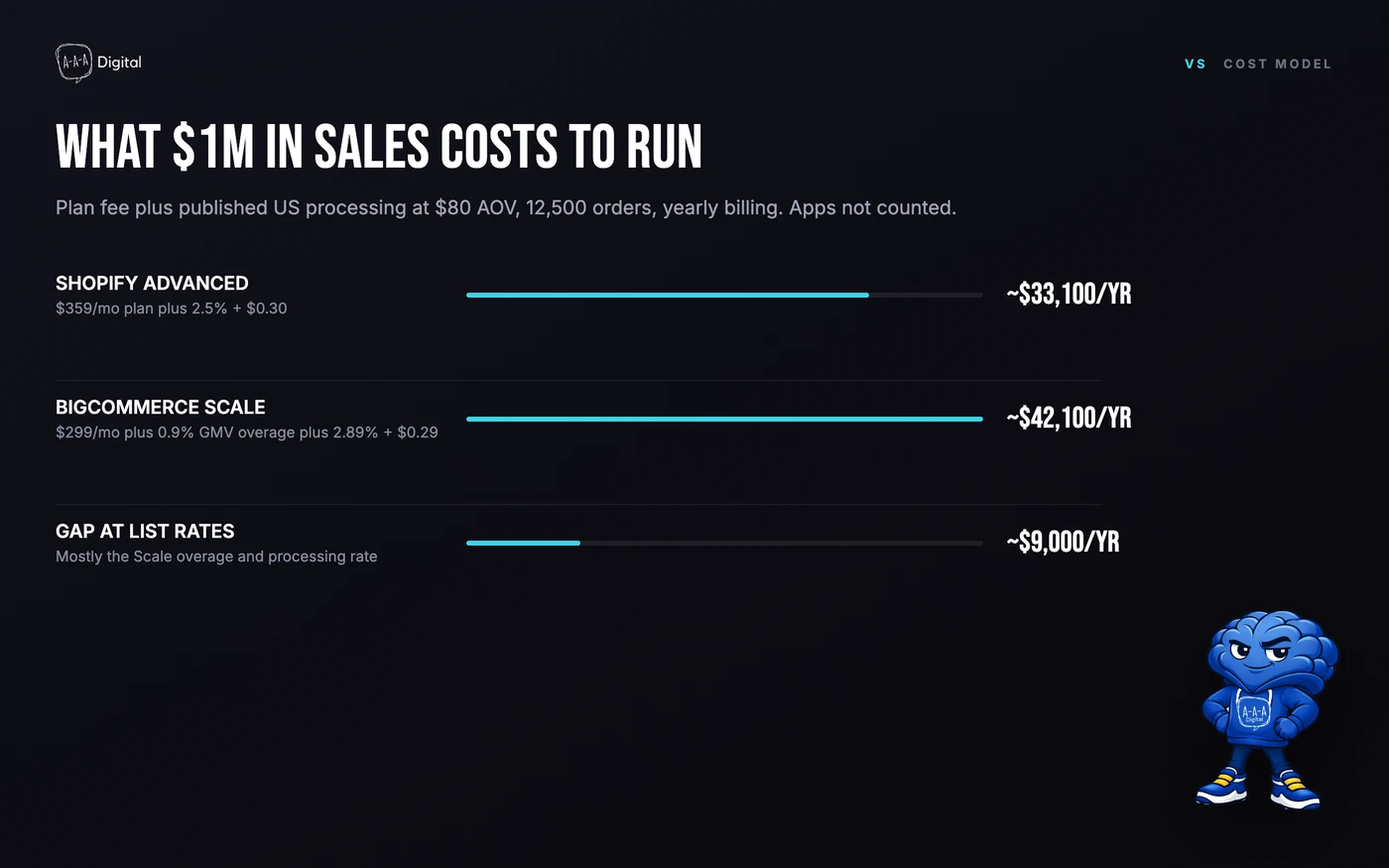
At $1M in annual sales. Assume a $80 average order, about 12,500 orders a year, US rates, yearly billing, no apps counted.
- Shopify Advanced: $359/mo plan fee ($4,308/yr) plus Shopify Payments at 2.5% + $0.30, which is $28,750 on $1M. Total: about $33,100 a year, or 3.3% of sales.
- BigCommerce Scale: $299/mo ($3,588/yr) plus Braintree at its published 2.89% + $0.29, about $32,525, plus the 0.9% overage on measured sales above Scale's included $400K, roughly $6,000 at this volume. Total: about $42,100 a year, or 4.2% of sales.
At list rates, Shopify comes out roughly $9,000 a year cheaper at $1M, driven mostly by the Scale overage and the processing-rate gap. A negotiated Braintree rate below about 2.6% closes most of that. And remember what is not counted: apps, theme work and development, which on either platform usually exceed the platform-fee difference.
At $10M in annual sales. Subscriptions become noise. Plus runs $2,300 to $2,500 a month; Performance starts near $1,499. Together with processing, negotiated on both sides at this level, platform fees land under 0.5% of sales. What actually differs at $10M is everything around the platform: integration availability, developer rates, checkout conversion and B2B depth. One point of checkout conversion at $10M is $100,000 a year, which is why enterprise brands should choose on capability and ecosystem, not on which invoice is smaller.
A merchant doing about $340K a year came to us last fall after BigCommerce auto-upgraded them from Growth to Scale in the middle of Q4. The platform did nothing wrong; the threshold is the product working as designed. But the new invoice landed the same week as their holiday ad bill. That is the experience a cap model creates: your plan changes on the platform's calendar, not yours.
Who should choose which
The decision gets clearer once you accept that both platforms are good at different businesses.
Choose BigCommerce if:
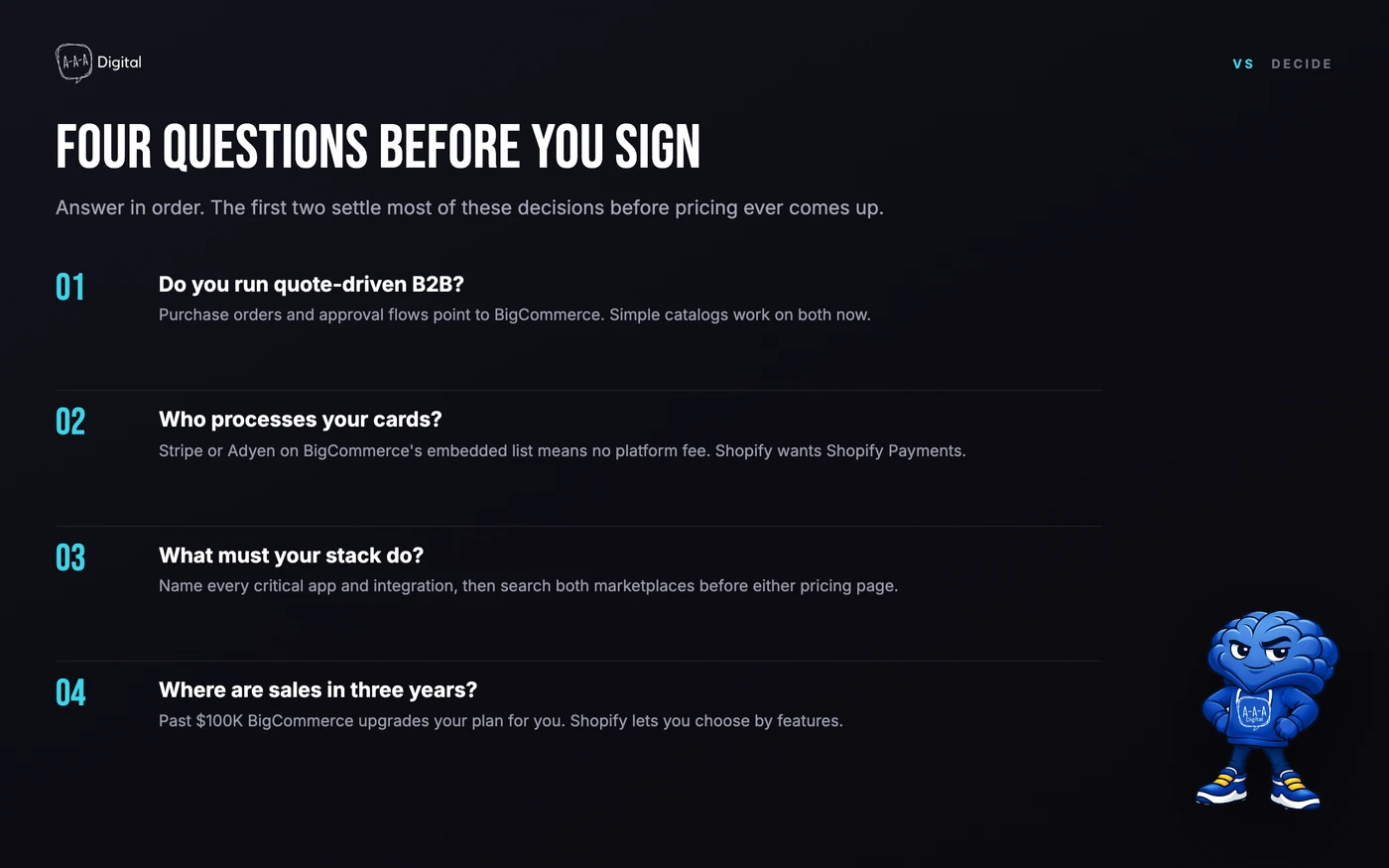
- You run quote-driven B2B with purchase orders, net terms or approval workflows, or B2B Edition's feature list matches how your sales team actually sells.
- You have a negotiated processor deal with a provider on the embedded list, or Shopify Payments is not available in your country.
- You need deep checkout or catalog customization without paying for an enterprise plan.
- You sell configurable products with price-adjusting options and refuse to bolt on an app for it.
- You run several brands or storefronts from one account and want it as an add-on, not a contract.
- You employ technical staff who would rather use built-in features than assemble an app stack.
Choose Shopify if:
- You are a direct-to-consumer brand buying traffic, where checkout conversion pays for the entire subscription difference by itself.
- You want the deepest app, theme and agency market, and the easiest hiring pool, in ecommerce.
- You sell online and in person and want one system for both.
- You expect fast growth and do not want automatic plan upgrades keyed to trailing sales.
- Your wholesale needs are simple: a few catalogs, company accounts, net terms.
- You want a platform whose direction you rarely have to think about.
If you are a smaller business still weighing platforms beyond this pair, we compared ecommerce platforms for small business on three-year cost of ownership, and Shopify often wins there for reasons that have nothing to do with brand name.
One honest note about both lists: they are starting points, not verdicts. Roughly half the brands we audit run on more platform than they need, paying enterprise prices for a catalog a $39 plan would carry comfortably. The other half are duct-taping a platform that stopped fitting two years ago because a rebuild feels risky. Both problems are cheaper to fix the earlier you name them.
Moving from BigCommerce to Shopify
This is the part most comparison posts skip, and the part we know best: moving from BigCommerce to Shopify is one of our most common migration projects. Last quarter we moved a $4M BigCommerce store to Shopify. Not because BigCommerce failed them; their checkout was fine. Every new capability they wanted, subscriptions, a 3PL integration, a loyalty program, existed on Shopify on day one and showed up on BigCommerce as a custom-project quote.
The mechanics deserve their own post, and we wrote one: how to migrate from BigCommerce to Shopify covers the export, the redirect map, the option-to-variant conversion and the first 90 days. The short version: products, customers and orders move cleanly; URLs do not (plan a one-to-one redirect map); customer passwords never migrate; and any BigCommerce app data you care about needs a named Shopify counterpart before launch, not after.
Timing matters more than people expect. Migrating before a sales threshold pushes you up a plan can be a reason to move now rather than after the auto-upgrade. If you are weighing that switch, our Shopify migration service runs the full process, audit, redirect map, build and 90-day watch, and we will tell you honestly if your case is a bad candidate. The reverse move happens too, a few times a year, almost always for B2B complexity.
FAQ
Is BigCommerce cheaper than Shopify? At list price, no: the three self-serve tiers cost the same $39, $105 and $399 a month on both. Total cost depends on your sales volume, because BigCommerce upgrades your plan automatically past its thresholds, and on your payment provider, because both platforms charge 2% to 0.6% extra for providers outside their preferred lists.
Which is better for B2B, Shopify or BigCommerce? For simple wholesale, a few catalogs and company accounts, both now handle it natively. For quote-driven B2B with purchase orders, approval workflows and buyer hierarchies, BigCommerce's B2B Edition is still ahead; Shopify typically solves it with Plus plus apps.
Will migrating from BigCommerce to Shopify hurt my SEO? Not if the redirect map is built before launch from Search Console and crawl data, every indexed URL gets a one-to-one redirect, and content ships with the same titles and structure. Expect a two-to-four-week dip while Google processes the changes; an unrecovered ranking after about six weeks points to a redirect problem.
Is Shopify or BigCommerce better for SEO? Both cover the fundamentals. BigCommerce gives more control over URL structure; Shopify's fixed /products/ and /collections/ paths are a minor constraint. Rankings will be decided by content, speed and links long before the URL prefix matters.
If you are on BigCommerce and the math above points at Shopify, the useful conversation is what the switch costs and when to time it. Read how our Shopify migration service runs end to end, or book a strategy call and we will map your specific catalog, stack and redirects before you commit to a date.
