A small store doing $250,000 a year will spend somewhere between $27,000 and $76,000 over three years on its platform, and the subscription fee is almost never the reason for the gap. Payment processing, apps, hosting, and the hours you spend maintaining the thing make up most of it.
So this is not a feature grid. Every platform below can take a payment and show a product. What separates them is how much of the work you want to own, how you expect customers to find you, and what happens at $1M in revenue. We have built or migrated stores on all of them except Etsy, where the move is a channel decision rather than a build, and the honest answer depends on your business type far more than on which demo looked better.
The short answer
For most small product businesses that intend to grow past $300,000 a year, Shopify is the safest default. It costs more per month than the website builders, and it removes an entire category of work: servers, security patches, plugin conflicts, and checkout maintenance.
WooCommerce is the better answer if you have a developer, a content-heavy catalogue, or a business that already lives inside WordPress. Squarespace and Wix make sense when commerce is a secondary part of the site, such as a studio selling prints alongside its portfolio. BigCommerce earns its place in B2B and very large catalogues. Etsy is not really a platform decision at all, it is a demand decision, and the fees reflect that.
And if your current store is working, staying is usually the highest-return option on this list. More on that below.
What actually decides the platform
Five things decide it, and price is fourth or fifth.
Payment processing. This is the largest line for any store doing real volume. Shopify Payments runs roughly 2.4 to 2.9 percent plus 30 cents in the US, depending on plan, and third-party gateways add a small transaction fee on the lower plans. Stripe and PayPal run about 2.9 percent plus 30 cents. On $250,000 of revenue, the difference between a good and a bad rate is thousands a year, which is why our breakdown of what Shopify actually takes starts there.
Catalogue complexity. Fifty products with two options each is a different problem from 5,000 SKUs with size, colour, and wholesale pricing. Platform limits show up at the edges: variant caps, order limits, and how much of the product page you can change without code.
Who maintains it. A managed platform is a subscription. A self-hosted store is a subscription plus a person. If nobody on your team can debug a plugin conflict at 9pm on a Friday, that is a platform constraint, not an IT detail.
How customers find you. Marketplace traffic, organic search, and paid social reward different things. Etsy brings demand. Shopify and Woo reward SEO and paid media. Squarespace rewards a strong visual brand.
Exit cost. Every platform can be migrated from. The question is what it costs in money, redirects, and lost rankings. That cost belongs in the decision, because the cheapest platform this year can be the most expensive one in three.
Shopify, the managed default
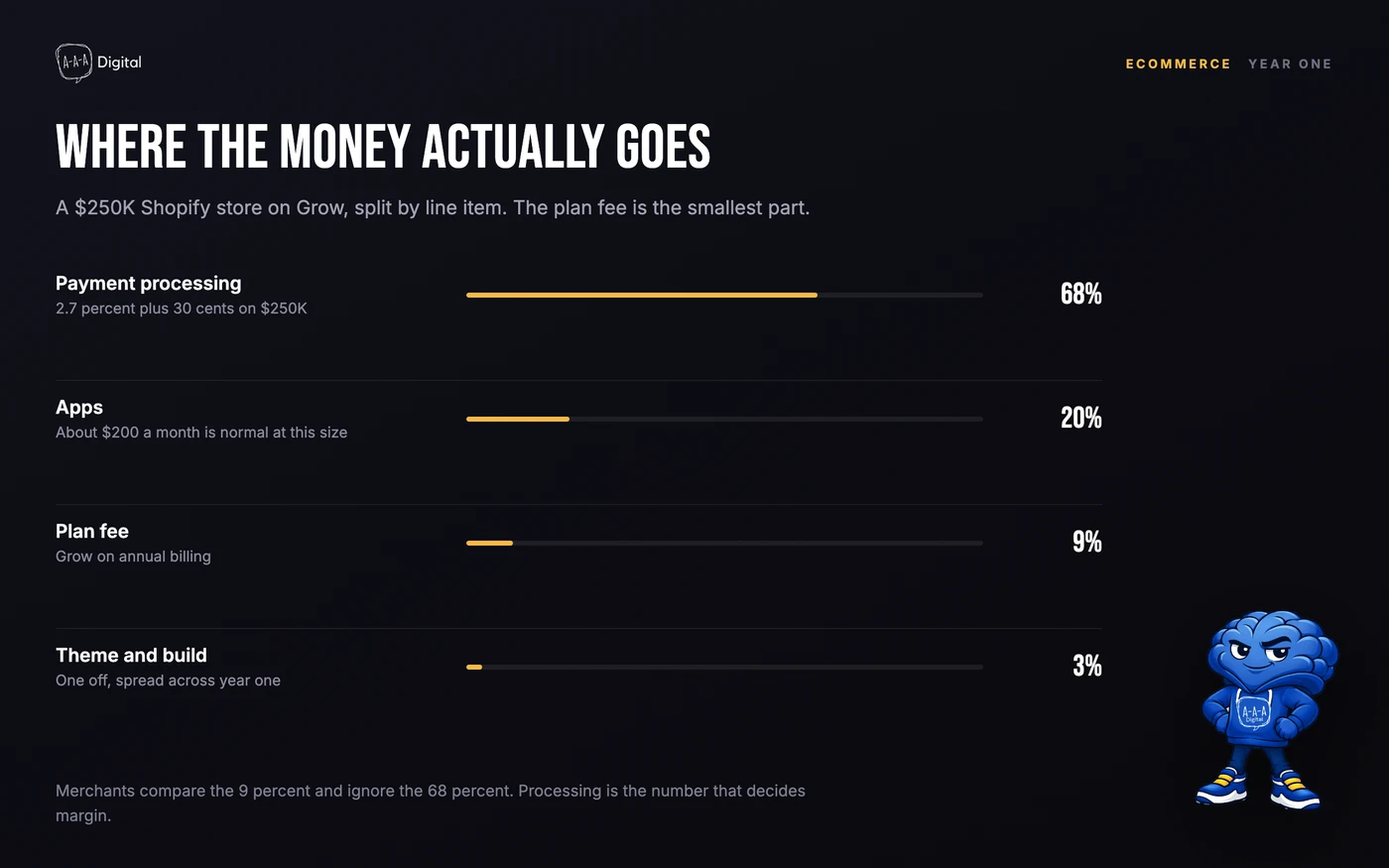
Most small businesses end up choosing between Shopify and WooCommerce, so both get the detail here. Shopify starts at around $39 a month on Basic, $105 on Grow, and $399 on Advanced, with annual billing cutting roughly 25 percent. Plus starts around $2,300 a month and is a commercial conversation. The plan fee is the smallest part of the bill: apps typically add $50 to $300 a month, and payment processing scales with revenue.
What you get for that is a managed stack. Hosting, CDN, PCI compliance, checkout, and upgrades are handled. The theme layer is Liquid, which is approachable for a developer and limiting for anyone who wants deeply custom checkout logic on a standard plan. The app store covers almost every gap, which is both the strength and the trap: stores accumulate $200 to $400 a month of overlapping apps and wonder where the margin went.
Shopify's SEO is solid out of the box, strong enough that the real ranking work is content and links rather than technical fixes. It is also the platform most agencies, apps, and payment providers integrate with first, which shortens every future project. If you want the full argument, our Shopify vs Wix comparison covers where the managed model wins and where it does not.
WooCommerce, the open-source alternative
WooCommerce is a free WordPress plugin. The software costs nothing, and the store costs whatever your hosting, extensions, and developer time cost. Managed Woo hosting runs $30 to $300 a month depending on traffic, extensions for subscriptions, bookings, or complex shipping run $50 to $300 a year each, and a developer to keep it patched and fast is the line most budgets miss.
In exchange you own everything. The content layer is WordPress, which is still the strongest publishing tool on the web, and the plugin ecosystem covers cases Shopify handles with apps or not at all. For a content-led brand with a real editorial operation, that control is worth the maintenance.
The failure mode is familiar: eleven plugins, no staging site, a PHP upgrade that breaks checkout, and a page speed score in the forties. WooCommerce does not fail because it is bad software. It fails because it hands you responsibility and nobody on the team owns it. Our WordPress vs Shopify SEO comparison goes deeper on the technical side of that trade.
The specialists
Squarespace is a design tool with commerce attached. Plans run from around $16 to $52 a month on annual billing, and the templates are consistently better than what most small brands build themselves. Commerce is competent for a small catalogue: variants, discounts, and basic email. It is not where you want to run a 2,000 SKU store with complex shipping rules, and the app ecosystem is thin.
Wix is the cheapest credible option for a service business that also sells a few products. Plans run from around $17 to $159 a month, commerce works, and the editor is genuinely easy. The trade is flexibility and performance: heavy pages, limited technical SEO control, and a migration path that is more painful than Shopify's when you outgrow it.
BigCommerce starts around $39 a month and scales through tiers tied to annual sales volume. It has native B2B features (company accounts, price lists, net terms), no additional transaction fees, and no order limits, which makes it a real alternative for wholesale and large catalogues. It also has a smaller app ecosystem and a steeper learning curve than Shopify.
Etsy charges $0.20 per listing, a 6.5 percent transaction fee, and payment processing of about 3 percent plus 25 cents. That adds up to roughly 10 percent of revenue before ads, which is a lot, and in exchange you get an audience that already searches for handmade and vintage goods. Etsy is a channel, not a store. Many of the businesses we work with run Etsy alongside Shopify and treat the marketplace as customer acquisition rather than a home.
The cost of ownership, modelled honestly
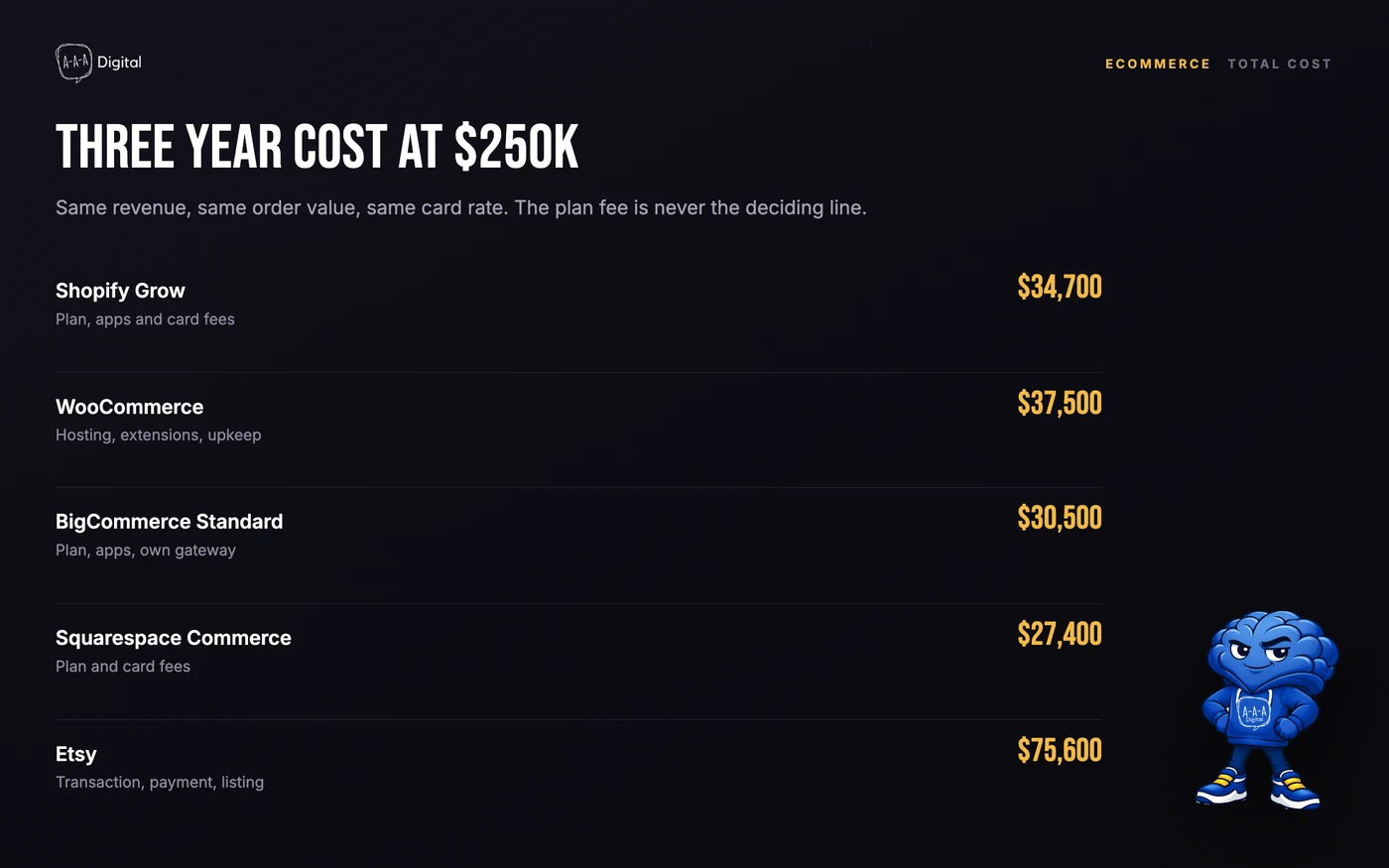
The model below uses $250,000 of annual revenue, a $60 average order value (about 4,167 orders), a 2.9 percent plus 30 cent card rate, and a modest app stack. It is a model, not a quote. Treat the assumptions as the argument.
| Platform | Platform, apps and theme, year one | Processing, per year | Year one | Three years |
|---|---|---|---|---|
| Shopify Grow | $3,768 | $8,000 | $11,768 | $34,700 |
| WooCommerce | $4,000 | $8,500 | $12,500 | $37,500 |
| BigCommerce Standard | $1,668 | $8,500 | $10,168 | $30,500 |
| Squarespace Commerce | $624 | $8,500 | $9,124 | $27,400 |
| Etsy | $16,650 | $8,500 | $25,150 | $75,600 |
Three things stand out. Processing is 68 to 93 percent of the total on the four store platforms, and about a third on Etsy, where the transaction fee does the same job under a different name. The subscription fee is a rounding error at this revenue level. And Etsy is in a different category entirely, because you are renting demand rather than building an asset, and the rent scales with every sale.
The Shopify row includes a $300 theme and $2,400 of apps. That app number is not padding: reviews, email, subscriptions, and analytics at this size routinely total $200 a month, and the figure assumes you audit and cut the rest. Wix, not shown above, models to roughly $27,000 over three years at $36 a month plus processing, which puts it just below Squarespace on cost and behind both Squarespace and Shopify on commerce depth.
Which platform by business type
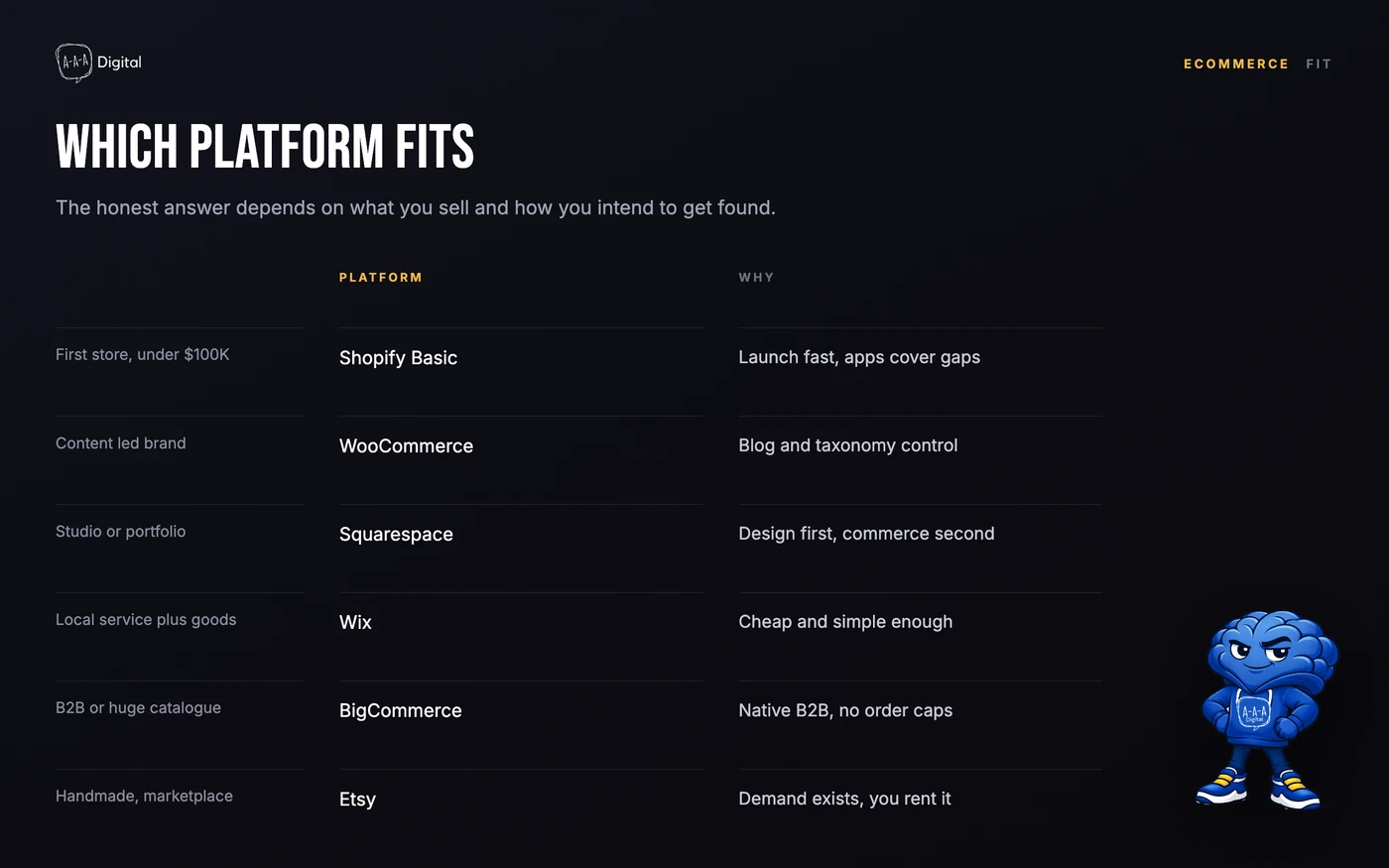
The pattern is consistent once you look at it this way.
A first store with fewer than 200 products and a plan to run paid ads belongs on Shopify Basic. The time you save on operations is worth more than the $15 a month you might save on a cheaper plan.
A content-led brand with a blog that actually ranks, a developer on retainer, and a product range under 500 SKUs is the one profile where WooCommerce genuinely wins. The publishing workflow and taxonomy control are better, and the maintenance cost is real but manageable.
A studio, photographer, or designer selling fewer than 50 items should look at Squarespace first. The templates will do more for conversion than any app you could install.
A local service business selling add-on products, such as a salon with a retail shelf, should use Wix or Squarespace and stop overthinking it. A $39 Shopify plan plus apps is more platform than the business needs.
Wholesale, B2B, or a catalogue above 10,000 SKUs points to BigCommerce or Shopify Plus, and the decision comes down to how much customization the sales process needs.
Handmade, vintage, or personalised goods with a story should test Etsy before building anything. If Etsy produces sales, run it as a channel and build the owned store once the demand is proven.
The case for staying where you are
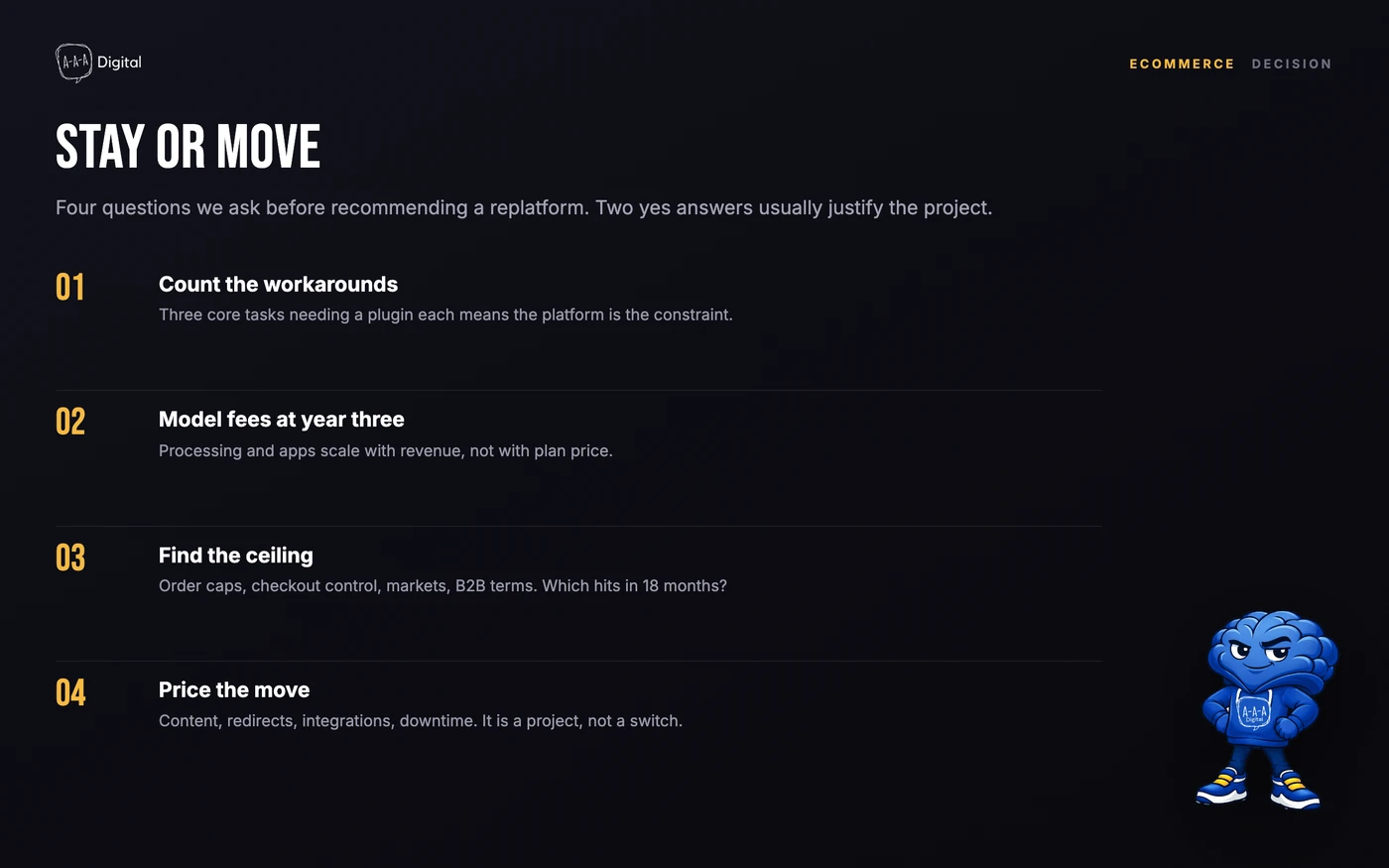
Most owners who ask about migrating do not need to migrate. They need their current store to be faster, better merchandised, and easier to check out. Those three fixes are cheaper than a replatform and they show up in revenue within a quarter.
A migration touches everything: URLs, redirects, tracking, email flows, integrations, product data, and the institutional knowledge of how the store is wired. A store doing $250,000 a year should budget $5,000 to $25,000 for the move and two to three months of disrupted attention, and expect organic traffic to dip for four to eight weeks even when it is done well.
Stay if the platform is not the constraint. If your conversion rate is below 2 percent, your product pages are thin, and your site takes four seconds to load, moving to Shopify will not fix any of that. You will arrive on a faster platform with the same offer and the same traffic, and the numbers will barely move.
Move when you can name the constraint precisely. A hard variant limit you hit every season. A checkout you cannot customize for wholesale. A multi-currency requirement the platform cannot meet. A plugin stack that costs more to maintain than a Shopify subscription. Those are platform problems, and no amount of conversion work solves them.
If you do move
Migration is a project with a sequence: audit the catalogue, map URLs, rebuild templates, port content, set up redirects, verify tracking, then cut over and watch. The redirect map is where most migrations lose traffic, and it is the part most often rushed. Our guide to preserving SEO during a replatform covers the mapping in detail, and the WooCommerce to Shopify migration walkthrough covers the specific data model differences you will hit.
If you want the move handled end to end, our Shopify migration service covers the audit, the build, the redirects, and the first 30 days of monitoring. Bring your analytics access and your product export, and we can usually tell you within a week whether the move is worth doing at all.
The rest of this decision is not technical. Pick the platform that matches how you sell, budget for the fees that scale with revenue, and spend the saved energy on the offer and the traffic. That is where the growth is, on any platform.
