Search for B2B ecommerce examples and you get two kinds of list: galleries of big-brand screenshots captioned "clean design," or logo dumps that hope you never ask for a number. Neither says what the store does differently, or whether the claim is verifiable.
B2B buying is not B2C with a login page. Buyers purchase on net terms, reorder the same SKUs on a schedule, route orders through procurement systems, and expect contract pricing. When a merchant briefs us on a B2B build, the ask is never "make it look like a DTC store"; it is "let a purchasing manager reorder last month's order at their price, without calling a rep."
These twelve pass three tests: the B2B operation is real, the platform is confirmed where confirmation exists, and each carries a public number with a named source and year, hedged. For platform context, see our breakdown of companies using Shopify and our Shopify B2B setup guide. Here, we follow the operations.
The Comparison Table
| Company | Niche | Platform | One tactic | Public number (source, year) |
|---|---|---|---|---|
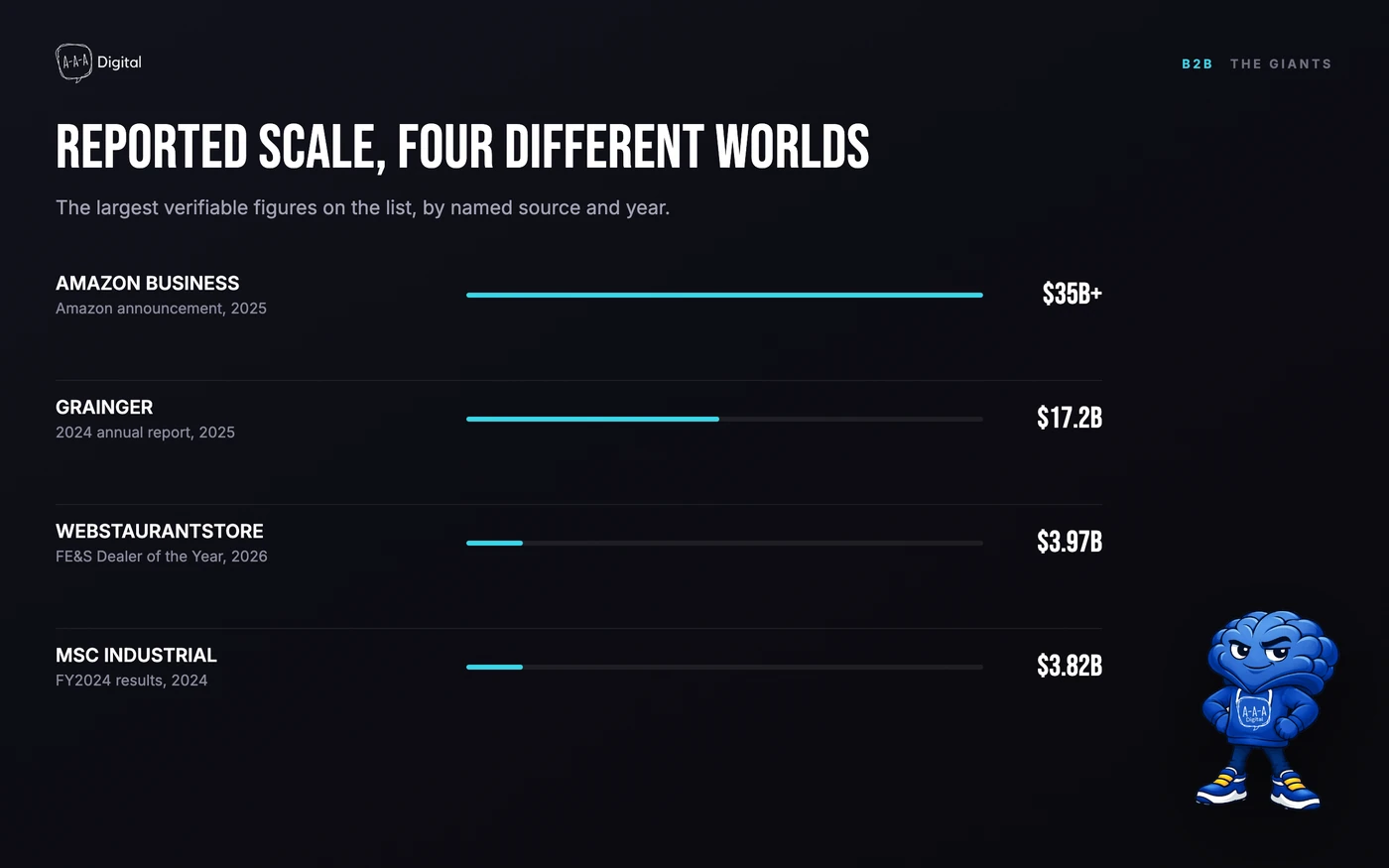
| Grainger | Industrial and MRO supplies | Custom (public company) | Punchout catalogs and EDI tied to managed inventory | $17.2B revenue (company annual report via MDM, 2025) |
| Amazon Business | B2B marketplace | Amazon | Pay by Invoice plus approval workflows | $35B+ annualized gross sales, 8M+ organizations (Amazon announcement, 2025) |
| MSC Industrial | Metalworking and MRO | Custom (public company) | E-procurement punchout plus vending machines | $3.82B FY2024 net sales (company results, 2024) |
| WebstaurantStore | Restaurant supply | Custom (private) | Buying-guide SEO plus house brands | $3.97B 2025 revenue (FE&S, 2026) |
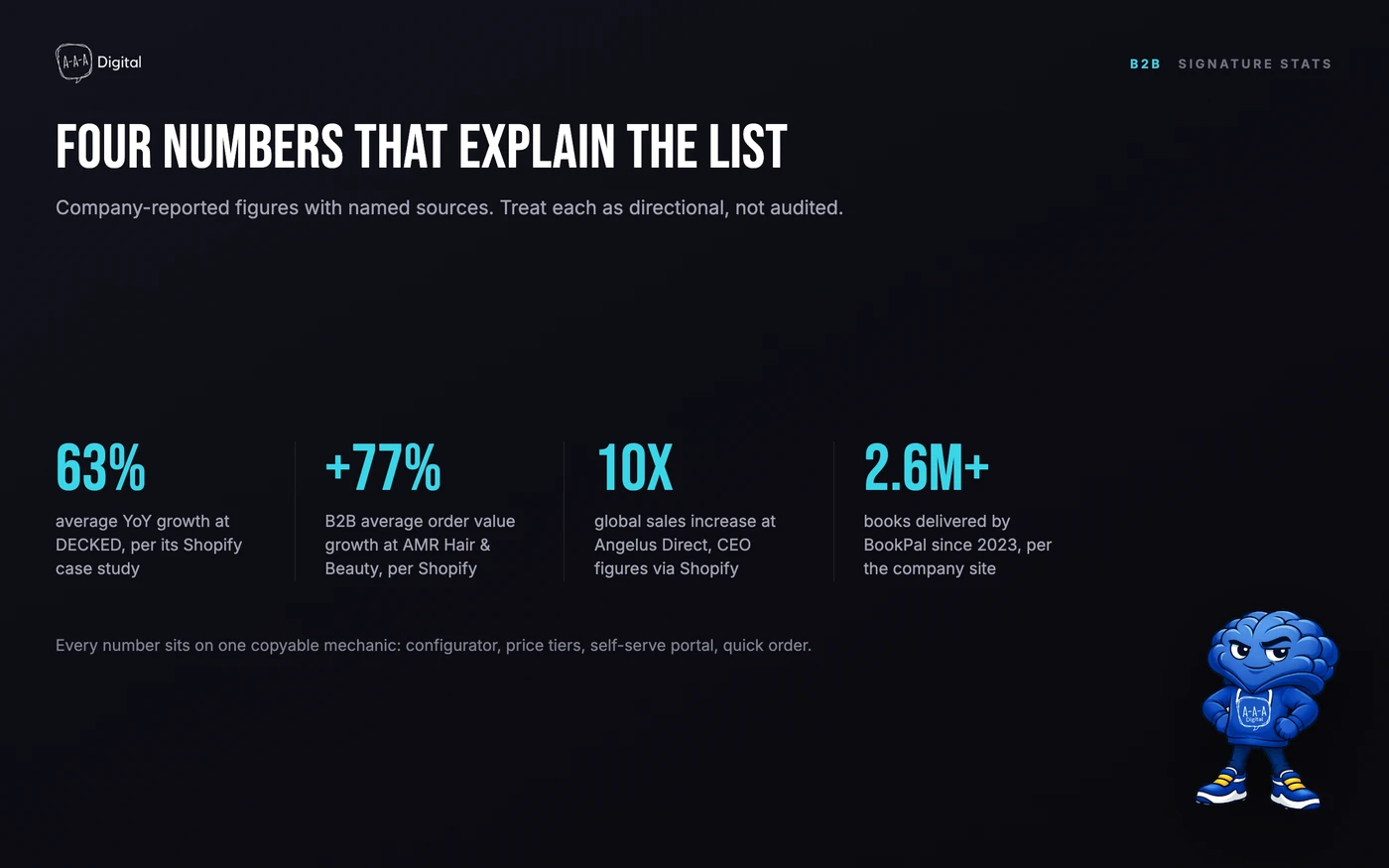
| BookPal | Bulk books for organizations | BigCommerce | ISBN paste-in quick order with quantity bands | 2.6M+ books delivered since 2023 (company site, 2026) |
| Tony's Chocolonely | Chocolate, retail and wholesale | Shopify | Tiered B2B pricing in a shared backend | €204.2M FY2024/25 revenue, +20% (annual report, 2026) |
| DECKED | Truck and van storage | Shopify | Dealer locator plus in-cart customization | 63% average YoY growth (Shopify case study, 2026) |
| AMR Hair & Beauty | Wholesale beauty | Shopify | Ten automated B2B price tiers | +77% B2B AOV, 2x sales (Shopify, 2026) |
| Dermalogica Pro | Professional skincare | Shopify | Gated trade portal plus education hub | 100,000+ trained skin therapists (Unilever, 2024) |
| Mokobara | Luggage and travel | Shopify | Localized B2B portals per market | Revenue doubled, +30% retention (Shopify, 2026) |
| The Conran Shop | Designer furniture | Shopify | Trade program with dedicated account managers | TCO halved, +54% conversion (Shopify case study, 2026) |
| Angelus Direct | Leather and sneaker care | Shopify | Self-serve portal replacing fax and email | 10x global sales (Shopify, 2026) |
One caveat: figures from Shopify's coverage are company-reported through its case study program, and other private-company numbers are reported or self-declared, not audited. Revenue is an outcome; each entry is about the tactic underneath.
1. Grainger (industrial and MRO supplies)
Grainger is the oldest playbook in the list: millions of products for maintenance and repair teams, sold to hospitals, factories, and contractors. It reported $17.2 billion in 2024 revenue, up 4.2 percent, per its annual report coverage in the trade press.
The tactic worth copying is how deeply Grainger wires itself into the buyer's purchasing system: punchout catalogs that drop a Grainger cart straight into a company's e-procurement software, EDI for customers who never touch the website, and its KeepStock managed inventory service, which puts stock inside the customer's facility and bills on consumption.
The steal: ask your best wholesale customer how they actually buy, then meet that channel. A punchout integration retains longer than any redesign.
2. Amazon Business (the marketplace benchmark)
Amazon Business is the competitor every B2B distributor names in earnings calls. Amazon announced in 2025 that it passed $35 billion in annualized gross sales serving 8 million-plus organizations, including most of the Fortune 100.
The tactic worth copying is purchase control as a feature: Pay by Invoice lines of credit, approval workflows where a manager signs off before an order ships, and business-only pricing with spend analytics. It answers the question a finance director actually asks: how do I stop rogue spending?
The steal: build the approval workflow your customer's CFO wishes they had. Volume discounts attract buyers; spend controls keep them.
3. MSC Industrial (metalworking and MRO)
MSC Industrial sells cutting tools, abrasives, and metalworking supplies to machine shops. Its fiscal 2024 results reported $3.82 billion in net sales, of which $2.43 billion, roughly 64 percent, flowed through e-commerce channels, per its earnings coverage.
The tactic worth copying is meeting the plant floor where it is. MSC runs punchout catalogs for large accounts and places industrial vending machines inside customer facilities, so a machinist taps a badge and pulls an end mill, with usage data feeding automatic replenishment. The order happens at the point of use, not at a desk.
The steal: reorder UX is a supply problem before it is a design problem. A badge-triggered reorder beats a prettier account page.
4. WebstaurantStore (restaurant supply)
WebstaurantStore, the flagship brand of Clark Associates, sells commercial kitchen equipment to restaurants and foodservice operators. Foodservice Equipment & Supplies named it 2026 Dealer of the Year, reporting revenue grew from $906 million in 2016 to $3.97 billion in 2025, entirely organically. The catalog runs past 340,000 products.
The tactic worth copying is content that answers a buyer's operational question at 11 pm. Buying guides, sizing charts, and regulatory explainers sit next to its categories, so an owner researching "what size ice machine do I need" lands inside the store. House brands like Choice match national-brand specs at a friendlier margin point.
The steal: write the buying guide your category is missing. One "how to choose" page that converts operators outranks a homepage redesign.
5. BookPal (bulk books for organizations)
BookPal sells books in bulk to schools, corporations, and event organizers: 25-plus copies per title, priced by quantity band. It runs on BigCommerce, proof a niche distributor does not need Shopify to execute; our Shopify vs BigCommerce comparison covers that tradeoff.
The tactic worth copying is the fastest order form in the category. BookPal's site lets a buyer paste a list of ISBNs with quantities, one per line, and returns matched editions with tiered pricing per band. The company states it has delivered more than 2.6 million books since 2023.
The steal: if customers reorder from spreadsheets, let them paste the spreadsheet. Every rep-assisted order your form absorbs is margin you stop paying for twice.
6. Tony's Chocolonely (chocolate, retail and wholesale)
Tony's Chocolonely sells chocolate with an anti-slavery mission, and a large share of it to retailers through ChocoPortal, its B2B ordering portal on Shopify. Shopify has documented the build: tiered B2B pricing, volume discounts, and flexible payment terms pulling from the same inventory and customer data as the consumer store.
Per its annual report, covered by trade press in early 2026, revenue hit €204.2 million for financial year 2024/25, up 20 percent, with US revenue up 50 percent.
The tactic worth copying is one backend for both channels. Trade buyers see net terms and case pricing; consumers see bars. Nobody maintains two stores, and wholesale stockouts die because the channels fight.
The steal: if you run Shopify DTC, turning on B2B beats a second platform. Our Shopify B2B setup guide maps the feature list.
7. DECKED (truck and van storage)
DECKED sells truck bed drawer systems and van storage to contractors and fleet buyers, with dealers handling installation. Its Shopify case study reports 63 percent average year-over-year growth and credits two conversion decisions: in-cart product customization, used by roughly half of buyers, and a dealer locator matching shoppers to nearby installers by what each dealer stocks.
The tactic worth copying is routing the sale to where it can be completed. DECKED treats dealers as fulfillment for the install, not competition, and the configurator answers "will this fit my truck" in the cart, the checkout class our Shopify checkout customization post covers.
The steal: if your product needs installation or a fit check, configurator before the cart, installer locator after it.
8. AMR Hair & Beauty (wholesale beauty)
AMR Hair & Beauty is an Australian wholesaler supplying salons and retailers from a catalog of more than 6,000 products, and it earns its slot with the clearest pricing-tier story here.
Per Shopify's coverage, AMR runs 10 different B2B pricing tiers, shown to each logged-in buyer automatically. Since moving to Shopify, the company reports a 77 percent rise in B2B average order value, 200 percent sales growth, and 93 percent conversion growth year over year, after seven years on a platform its founder called torture.
The tactic worth copying is automated tiering without negotiation theater. Salons reorder the same consumables monthly; their tier should set the price they see, no email thread required.
The steal: publish your quantity tiers and automate them. Hidden tier logic forces every order through a rep; visible tiers let buyers size their own cart up.
9. Dermalogica Pro (professional skincare)
Dermalogica sells to consumers, but the professional channel is the brand's spine: skin therapists buy through Dermalogica Pro, a gated B2B portal pairing purchasing with on-demand learning, bookable workshops, product fact sheets, and a client-consultation tool, per Shopify's B2B coverage.
The public anchor is the network itself: Unilever, which acquired the brand in 2015, states Dermalogica trains more than 100,000 professional skin therapists globally.
The tactic worth copying is selling the workflow, not the product. A therapist needs the consultation flow and education credits that make the purchase pay; gating the portal makes content feel like membership, and membership keeps the reorder loop closed.
The steal: put your training inside the gated portal and the reorder button next to the certificate.
10. Mokobara (luggage and travel)
Mokobara started as a direct-to-consumer luggage brand in India and expanded into B2B corporate gifting. Its move, documented by Shopify, was a password-protected B2B portal with dynamic bulk pricing, self-serve ordering and reordering, and corporate engraving options, localized for India and the UAE with currency, language, and payment methods switching automatically.
The reported outcome: doubled revenue, 30 percent year-over-year growth, 30 percent higher retention, per company figures cited in Shopify's coverage.
The tactic worth copying is localization as a wholesale feature, not an afterthought. A gifting buyer in Dubai sees AED pricing and local payment methods; a buyer in Mumbai sees theirs. Same backend, different storefront.
The steal: if wholesale buyers span even two currencies, localized catalogs beat a "contact us for international pricing" page, which is where those deals go to die.
11. The Conran Shop (designer furniture)
The Conran Shop sells designer furniture to consumers and runs a trade program for interior designers and architects: dedicated account manager, trade pricing and bundles, flexible payment and delivery, and private events. The operation sits on Shopify, unified with its retail stores.
Shopify's case study reports the migration results: total cost of ownership halved, conversion up 54 percent, email marketing revenue up 23 percent. In a category where a sofa is a three-week decision, the trade relationship is the moat.
The tactic worth copying is treating trade buyers as a segment worth real perks, not a discount code. The account manager is why a designer routes a client project through the program instead of a marketplace.
The steal: give trade buyers a named human and a terms sheet. Wholesale loyalty is contracted, not collected.
12. Angelus Direct (leather and sneaker care)
Angelus Direct sells leather paints and sneaker-customization supplies to hobbyists and wholesale partners. Before its B2B portal, wholesale ran on scratchpads, faxes, and emailed order forms; channeling partners into a self-serve portal on Shopify put order history, inventory, and production data in one place.
The reported result is a 10x increase in global sales, per the CEO's figures as cited in Shopify's B2B coverage, alongside a shift from pure wholesale to a mixed model.
The tactic worth copying is the unglamorous one: kill manual order entry. Every faxed order costs a rep's time, an error rate, and a planning blind spot. A portal turns the order into structured data the moment the buyer submits it.
The steal: if any wholesale volume still arrives by email or phone, a portal pays for itself in error reduction alone, before it adds a single new customer.
What a Smaller B2B Merchant Can Steal
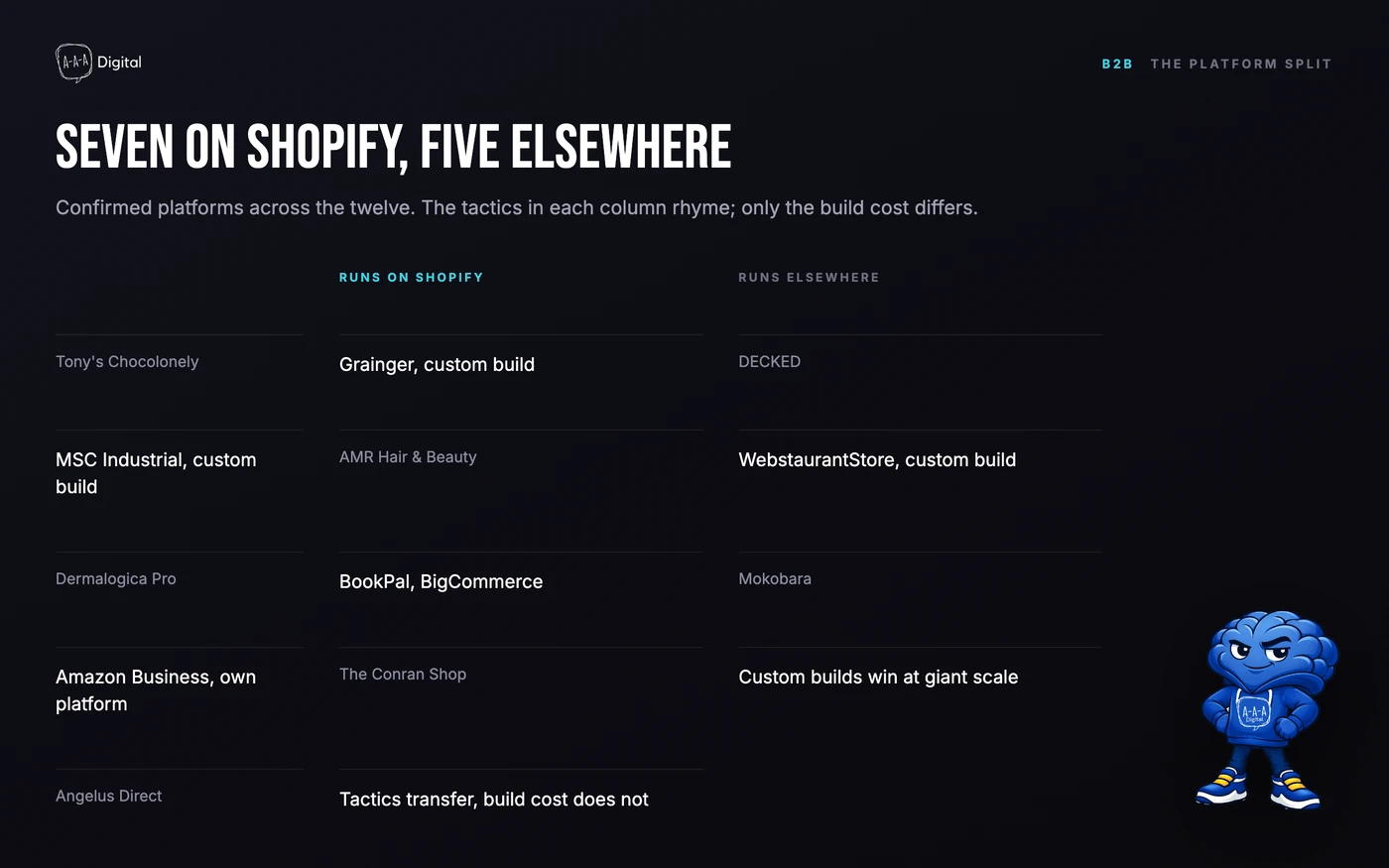
The pattern across these twelve is boring in the best way: nobody wins on theme design, and everybody wins on one operational decision repeated for years. Grainger and MSC buried themselves in procurement plumbing. WebstaurantStore answered buyer questions with content. BookPal made ordering as fast as a spreadsheet. The Shopify brands gated, tiered, localized, or portal-ized one part of the buying process and let it compound.
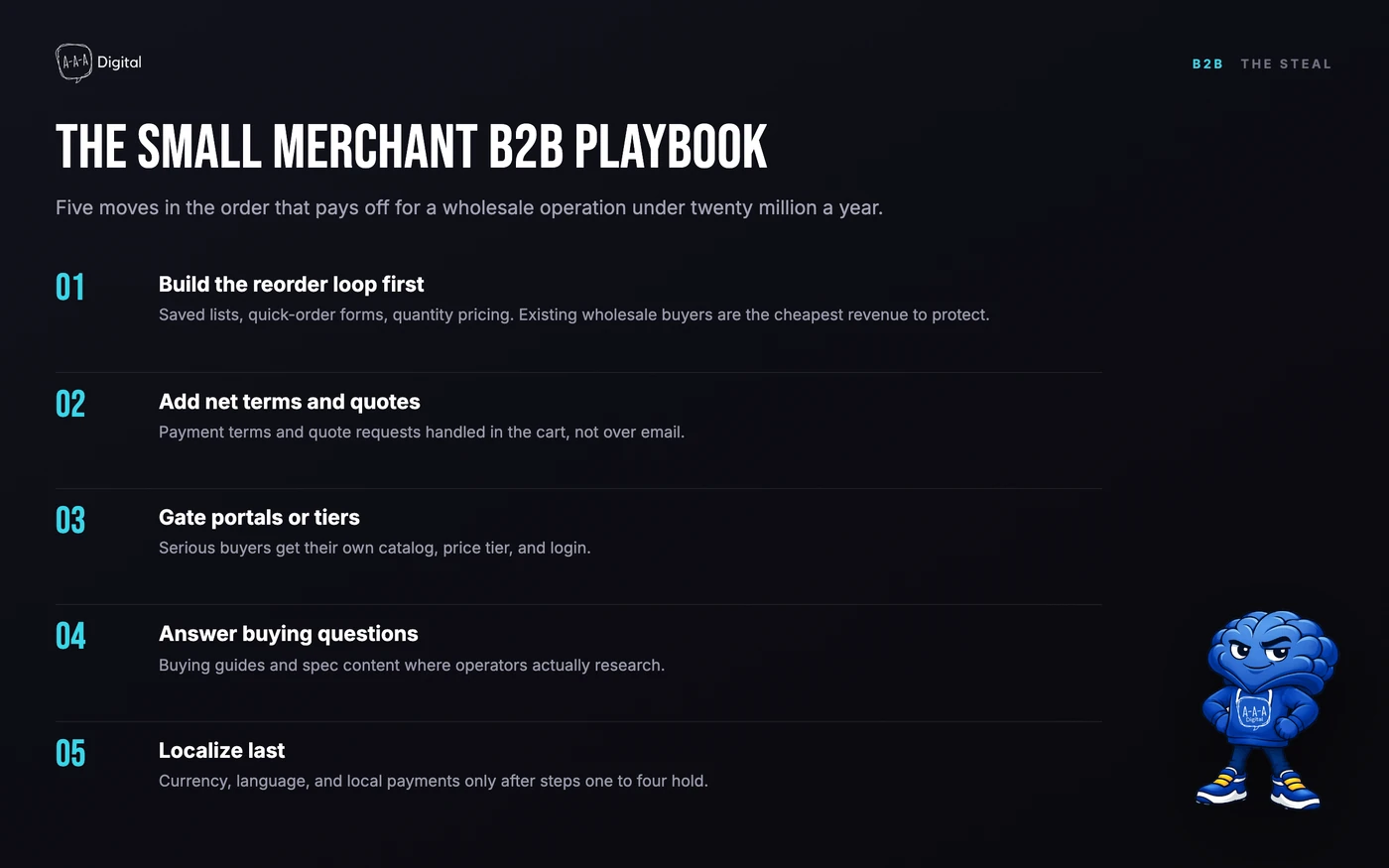
When we scope B2B builds for clients, we rank the work in this order. First, the reorder loop: saved lists, quick-order forms, and quantity pricing, because existing wholesale customers are the cheapest revenue you will ever protect. Second, the terms layer: net payment terms and quote requests handled in the cart, not over email. Third, gated portals or tiers for serious buyers. Fourth, content that answers operational buying questions. Platform choice sits underneath all of it; the honest math on plans and fees is in our Shopify pricing breakdown, and the build order follows the B2B setup guide. This is the sequence our Shopify development team runs on B2B projects, reorder loop before anything cosmetic.
The platform column holds the other lesson: tactics transfer, build cost does not. For most merchants under $20 million in B2B revenue, Shopify's native B2B features cover the list above without custom development.
FAQ
How do you know these companies actually run on Shopify?
Seven entries have a public Shopify signal: Shopify's own case study library (DECKED, The Conran Shop) or its enterprise B2B coverage (Tony's Chocolonely, AMR, Dermalogica Pro, Mokobara, Angelus Direct). BookPal runs on BigCommerce, confirmed directly; the four giants run custom builds where SEC filings matter more than platform labels.
Can a small wholesaler really copy tactics from Grainger or Amazon Business?
Yes, with one rule: copy the mechanic, not the budget. Approval workflows and punchout catalogs are configurations, and Shopify's native B2B features now cover catalogs, company accounts, payment terms, and quantity rules on standard plans. Skip marketplace breadth; depth in one niche beats coverage of ten.
Is Shopify or BigCommerce better for a B2B store?
For most merchants, Shopify, for checkout quality, its app ecosystem, and native B2B features that no longer require Plus. BigCommerce ships more B2B capability in the base plan, including quote management, which is why distributors like BookPal run it well. The answer depends on catalog size, terms complexity, and your stack, the tradeoff our platform comparison walks through.
What is the fastest B2B feature to implement on an existing Shopify store?
Quantity pricing and company profiles. Both are native and use product data you already have, so a gated wholesale price list can be live in a day. Quick-order forms and net terms take a week or two with the right apps. Localization and punchout are quarter-scale projects, which is why they sit at the end of the playbook.
One Last Thing
None of these twelve got there with a prettier homepage. Each made one operational bet and repeated it until the numbers showed up in other people's articles. If you want that bet chosen well and built once, our Shopify development service covers B2B builds end to end, and we will tell you plainly if a feature is a quarter too early. If you would rather build it yourself, start with the Shopify B2B setup guide and the reorder loop, in that order.
