In March, a home fragrance client asked us to look at a loyalty app they had been paying $199 a month for eighteen months. The app was working exactly as designed. Points accrued, emails fired, redemptions processed. The problem sat one level up: their average customer buys twice a year, and no software makes someone burn a candle faster. The program had produced about $340 in repeat orders against $3,580 in fees.
That store did not have a loyalty app problem. It had a purchase frequency problem. Most "best Shopify loyalty apps" articles rank the same tools by feature count and stop there. This one adds the number that actually decides the outcome: the order frequency each app needs to break even. Here are the eight Shopify loyalty apps worth installing in 2026, what each costs at time of writing, and the store each one fits.
When Does a Shopify Loyalty App Pay for Itself?
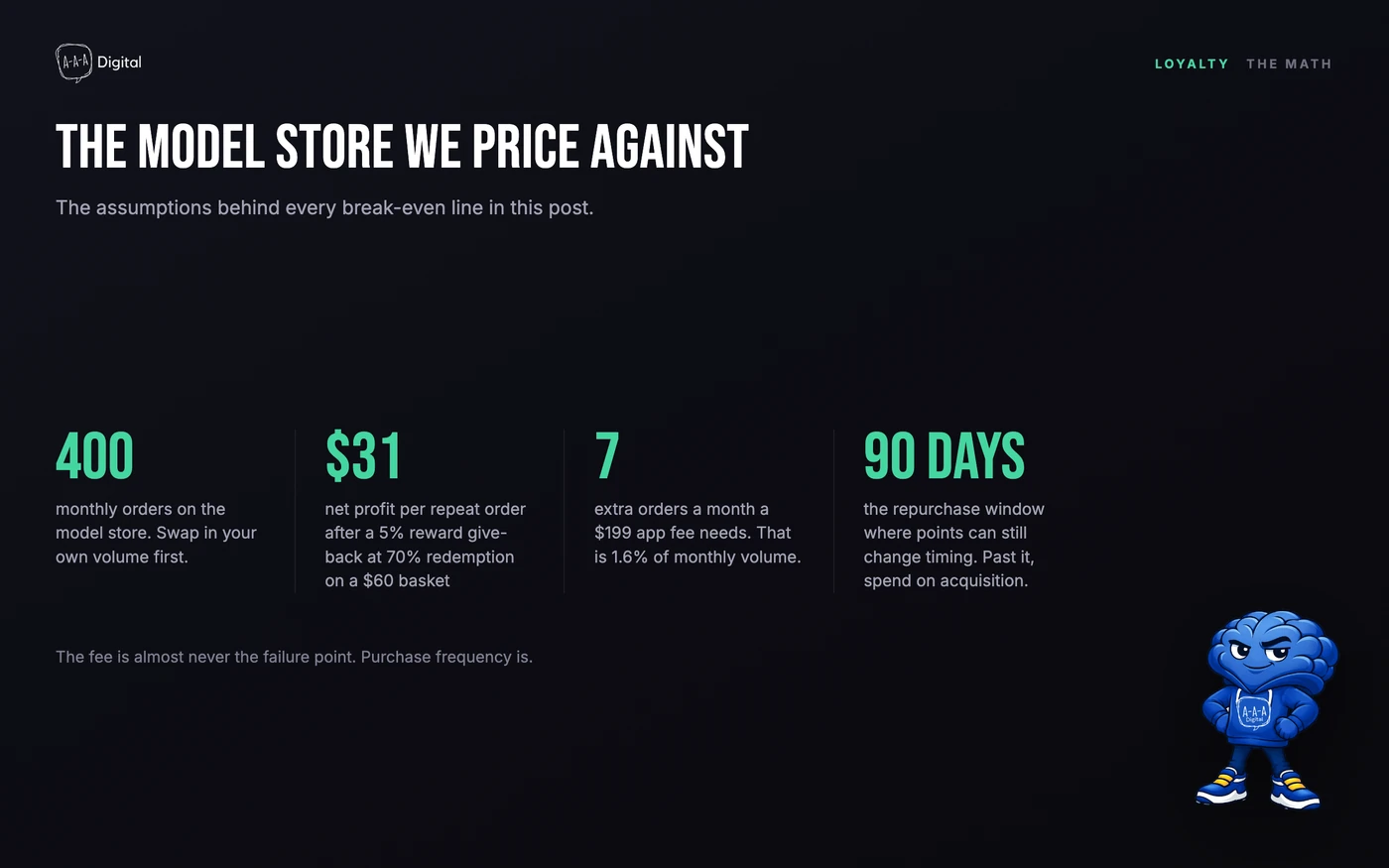
Start with the cost side, because it is smaller than the marketing suggests. A loyalty program costs three things: the app fee, the reward give-back, and the email and creative that support it. The give-back is the big one. A typical program returns points worth about 5% of order value, and not every point gets redeemed. On a $60 average order at a 55% gross margin, a redeemed reward costs about $2.10, leaving roughly $31 of profit on an incremental repeat order.
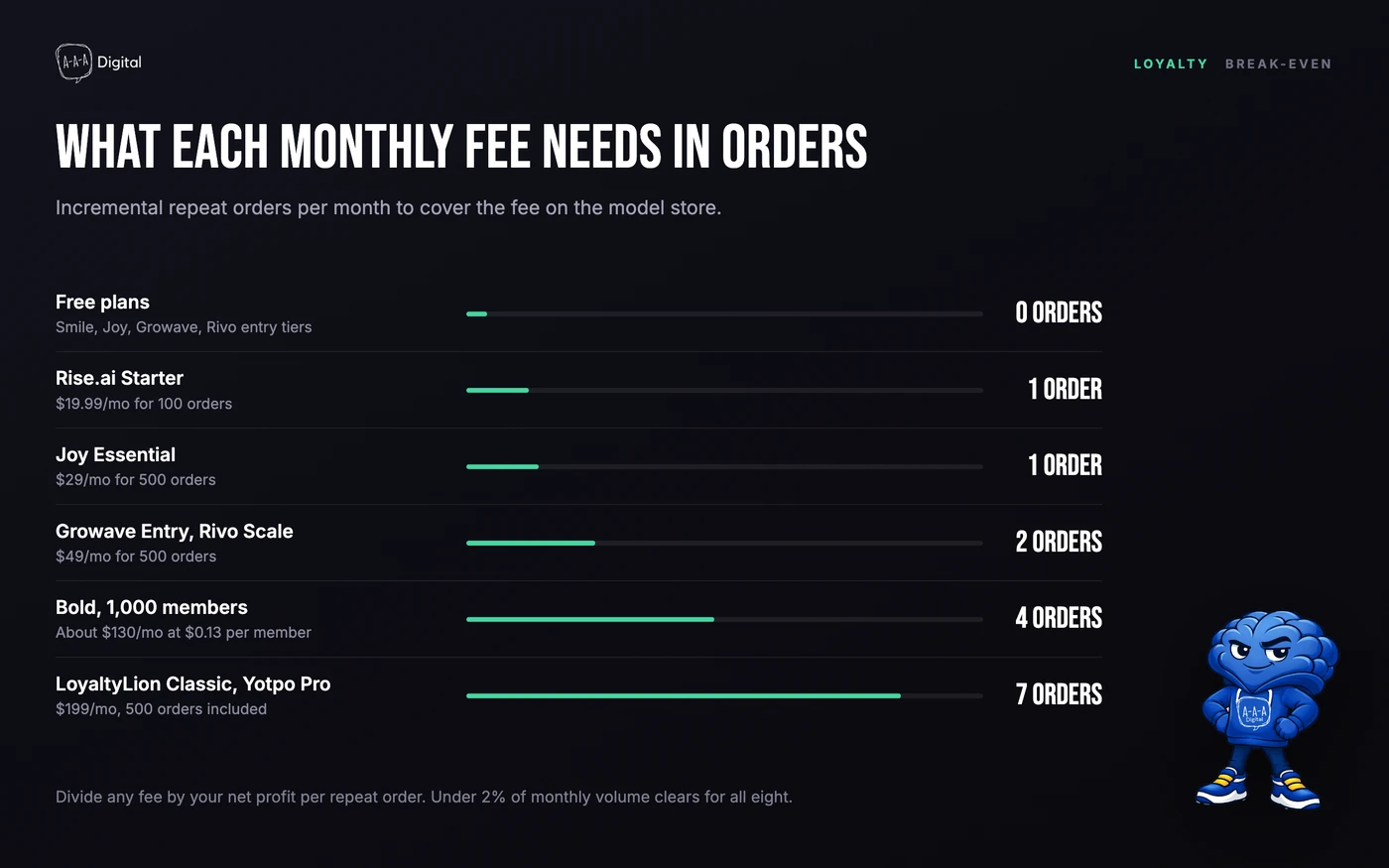
Divide any app fee by $31 and you get the break-even in orders per month. A $29 plan needs one. A $49 plan needs two. A $199 plan needs seven. On a store doing 400 orders a month, seven orders is a 1.6% lift. The fee is almost never the reason a loyalty program fails.
The number that does decide it is how often customers come back without any program at all. If your median buyer repurchases inside 90 days, points can pull orders forward by weeks, and even a $199 plan clears its fee on a handful of orders. If the natural cycle runs six to twelve months, points are decoration; those customers were coming back anyway or not at all. If the cycle runs past a year, put the budget into acquisition and the post-purchase experience instead, because no tier structure changes a mattress cycle.
This is why retention is really margin repair: a repeat order carries almost no acquisition cost, so its profit lands close to full gross margin. We covered the mechanics in our ecommerce margin improvement guide; loyalty is one lever inside a bigger system. And it is why, when I model a program for a retention client, the first number I ask for is not budget. It is the gap between order one and order two, measured in days.
One more baseline: Shopify now includes native store credit on standard plans, which covers the simplest come-back-and-spend mechanic for free. Paid apps earn their fee on points, tiers, referrals, and wallet passes, which is where this list starts.
The 8 Best Shopify Loyalty Apps in 2026
Every app below has a live Shopify App Store listing at time of writing. Each entry covers the mechanic, entry price, who it fits, one weakness, and the order frequency it needs to pay for itself.
1. Smile.io: The Default Pick for Most Stores
Smile is the incumbent for a reason: points, referrals, and VIP tiers that run inside Shopify checkout, customer accounts, POS, and Klaviyo. At time of writing the free plan covers low-volume stores (roughly 100 orders a month), paid plans start at $15 on Essential, and the features most stores actually want, VIP tiers and points expiry, sit on Standard at $79. It holds a 4.9 across 4,100-plus reviews.
It fits: stores from 100 to 2,000 monthly orders that want the safest choice and the deepest integration docs.
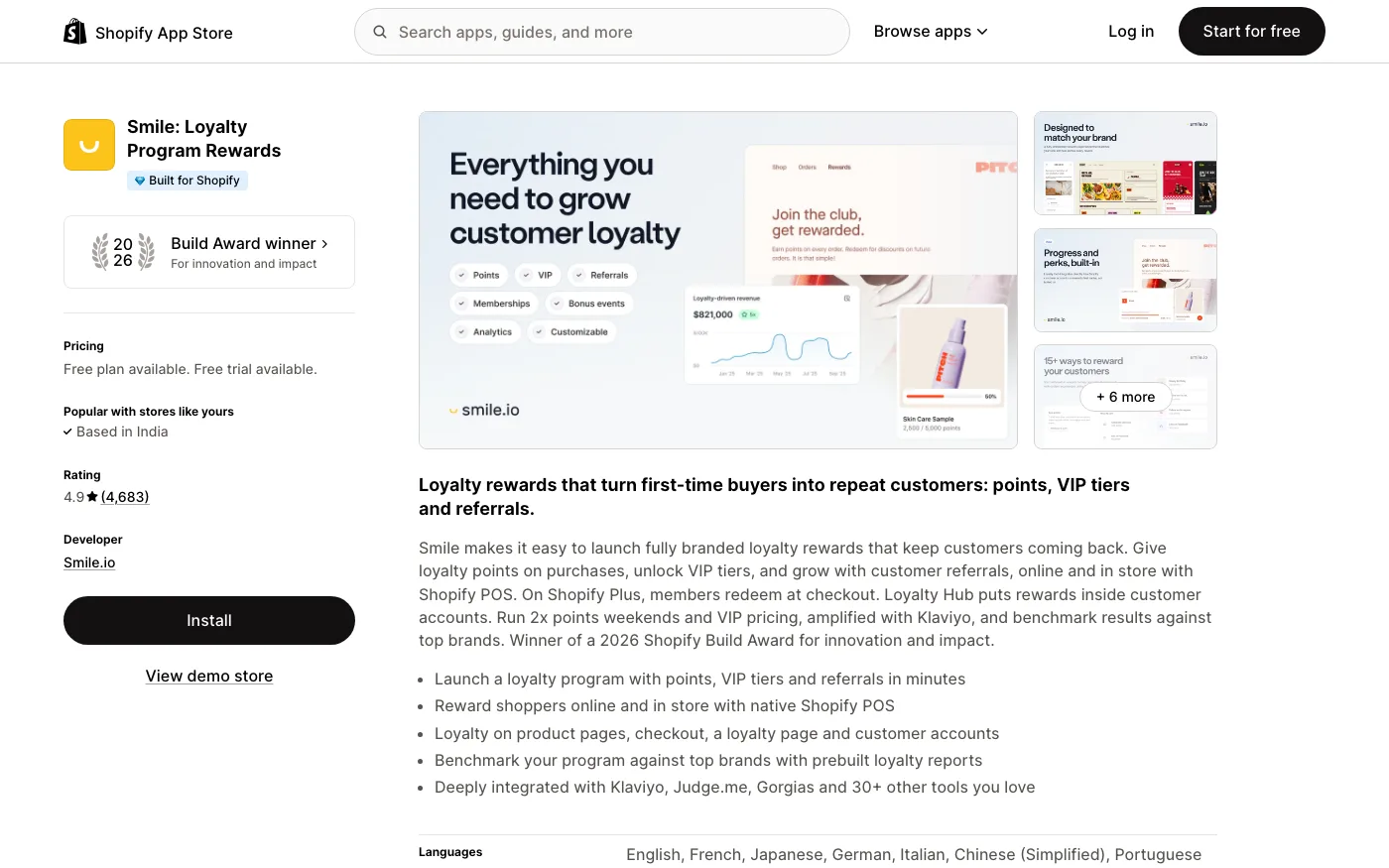
The weakness: the free plan is closer to a trial. The features that make a program feel real live on the $79 and $199 plans, and Smile's own reviews name the pricing gap as the top complaint.
Break-even: the free plan owes you nothing; Standard at $79 needs about three incremental orders a month, a rounding error on a consumables cycle.
2. Joy: Best Value for a First Program
Joy carries the Built for Shopify badge and packs points, referrals, VIP tiers, paid memberships, social rewards, and Apple and Google Wallet passes into a clean admin. At time of writing: free Starter up to 250 orders a month, Essential $29 for 500, Advanced $129, Ultimate $499. Rated 4.9 across about 1,780 reviews.
It fits: newer stores launching a first loyalty program, and brands that want wallet passes without enterprise pricing.
The weakness: it is younger than Smile with a thinner integration ecosystem, and the membership mechanics that make it interesting gate at the higher plans.
Break-even: Essential at $29 needs one incremental order a month. If your store cannot find one extra repeat order in thirty days, the problem sits upstream of any app.
3. Growave: Best When You Want One App, Not Four
Growave bundles loyalty, product reviews, wishlist, and referrals into one subscription, which makes it the consolidation play. At time of writing: free to about 100 orders a month, Entry $49 for 500, Growth $199 for 1,500 orders with VIP tiers and a loyalty page, Plus $499, Unlimited near $999. Watch the overage: extra orders bill at about $15 per hundred.
It fits: stores shrinking an app stack, because loyalty, reviews, and wishlist on one bill usually beat three separate tools on cost and page weight.
The weakness: each module runs a little shallower than the dedicated alternative, and the overage math surprises merchants who outgrow Entry mid-quarter.
Break-even: Entry at $49 needs two incremental orders a month, before you count what removing a separate reviews or wishlist app saves.
4. Rivo: Best for Shopify-Native and Plus Stacks
Rivo is Shopify-exclusive and Built for Shopify, with deep checkout extensions, a customer account portal, and a developer toolkit (REST API, metafields, webhooks) that a dev team can use. At time of writing you can start on a free tier or trial, and Scale runs from $49 a month for 200 to 2,500 orders; Plus is $499. It rates about 4.7 across 1,400-plus reviews and integrates tightly with Klaviyo, Gorgias, and Postscript.
It fits: fast-growing and Plus brands that want loyalty data inside Shopify, and developers who need API access without an enterprise contract.
The weakness: the review base is still well behind Smile's, and the advanced integrations climb tiers quickly.
Break-even: Scale at $49 needs two incremental orders a month, and the checkout extension often pays for itself before the loyalty side does.
5. LoyaltyLion: Best Done-With-You Program
LoyaltyLion's pitch is service, not just software. The free plan covers stores at 400 orders a month or fewer. Classic at $199 includes 500 orders, a branded loyalty page its team builds for you, pre-built Klaviyo email flows, and a dedicated onboarding manager. Advanced and Plus go custom, adding VIP tiers, scheduled bonus campaigns, and AI-timed reward drops.
It fits: strategy-led brands that want the vendor to design and launch the program rather than hand over a dashboard.
The weakness: the pricing cliff. Nothing sits between free and $199, so outgrowing the free plan means a $2,400-a-year commitment.
Break-even: $199 a month needs about seven incremental orders. At 400 orders a month that is under a two-point lift in repeat rate, which is realistic for consumables and a stretch for anything seasonal. If your repeat rate cannot move that far, stay on the free plan and fix email first.
6. Yotpo Loyalty: Best Inside the Yotpo Stack
Yotpo Loyalty and Referrals shares one data layer with Yotpo reviews and SMS, and that is the whole argument. The free plan covers basic points and referrals. Pro starts around $199 a month at time of writing with 500 monthly orders included, then per-order charges above; Premium and Enterprise go custom, adding VIP tiers, targeted campaigns, and dedicated success management.
It fits: mid-market and Plus brands already paying for Yotpo reviews or SMS that want their retention stack under one vendor.
The weakness: outside the Yotpo stack the standalone app is hard to justify at Pro pricing, and the upper tiers hide behind demo requests.
Break-even: standalone, Pro needs about seven incremental orders a month. Bundled with reviews you already pay for, the marginal math improves, and that is exactly who should buy it.
7. Rise.ai: Best Store-Credit Mechanics, Not Points
Rise.ai is the odd one out: a store-credit and gift-card platform rather than a points program. It issues credit on purchases, converts refunds to credit, schedules credit drops, and runs gift cards, which suits brands that would rather hand a customer $5 of credit than a discount code. At time of writing: Starter at $19.99 a month for 100 orders, Small-Business at $59.99 for 400, Pro at $199.99 for 2,000. There is no free plan.
It fits: brands with high refund volume that want refunds to return as second orders, and credit-led winback flows after the purchase.
The weakness: no points, no tiers, no gamification. If you want visible status, this is the wrong tool, and per-order charges stack at volume.
Break-even: Starter needs about one incremental order every six weeks. But the honest math includes the credit you fund on every order, so the app only pays when credit actually converts into a next purchase. Track that conversion, not the fee.
8. Bold Memberships & Loyalty Rewards: The Bold Loyalty Successor
Bold Loyalty Points is gone from the App Store. Bold folded loyalty into Bold Memberships, relaunched in June 2026 as a three-in-one: free and paid membership tiers, loyalty points redeemed as store credit, and access control over products, pricing, and content, plus native POS and wallet passes. Pricing is per member: the first 10 members are free, then $0.13 per member per month, with no flat fee. The relaunched listing holds a 4.3 across about 82 reviews.
It fits: brands flirting with paid memberships, Prime-style perks, or wholesale gating, where loyalty is one layer of a bigger program.
The weakness: the listing is young, so the review base is small, and per-member pricing means a large free-tier member list costs money even in slow months.
Break-even: 1,000 members run about $130 a month, so four incremental orders cover it. If only a few hundred customers would ever join, the per-member model beats a flat fee anyway.
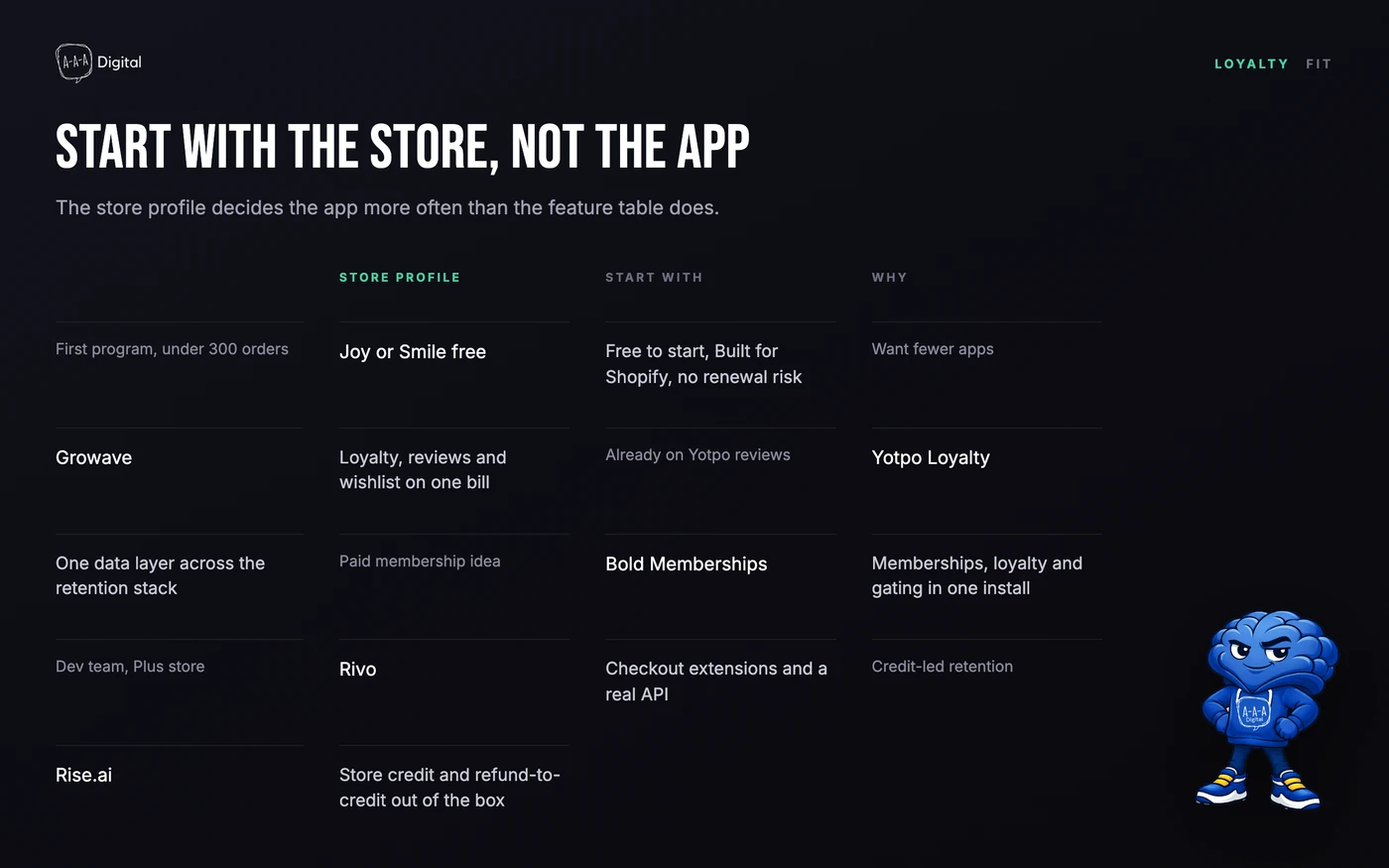
Shopify Loyalty Apps Compared
| App | Loyalty mechanic | Entry price | Best for |
|---|---|---|---|
| Smile.io | Points, referrals, VIP tiers | Free; paid from $15 | Most stores |
| Joy | Points, tiers, memberships, wallet passes | Free; $29 Essential | First program, newer stores |
| Growave | Loyalty plus reviews plus wishlist | Free; $49 Entry | Cutting app count |
| Rivo | Points, store credit, checkout extensions | Free tier; $49 Scale | Plus and dev-led stacks |
| LoyaltyLion | Points with a done-for-you launch | Free to 400 orders; $199 Classic | Full-service buyers |
| Yotpo Loyalty | Points and referrals in the Yotpo suite | Free; Pro from $199 | Existing Yotpo customers |
| Rise.ai | Store credit, gift cards, refund-to-credit | $19.99 Starter | Credit-led retention |
| Bold Memberships | Memberships plus loyalty plus gating | Free to 10 members; per member after | Paid membership models |
All eight adjust pricing regularly; confirm on the listing before you commit a year of fees.
Making Loyalty Pay: Pair Points With Email and Post-Purchase
The apps above are commodities. What separates the programs that pay from the ones that become a monthly donation is everything wrapped around them.
Points create the reason; email creates the visit. A points balance sitting in a customer account does nothing until an email or SMS puts it in front of someone running low. The retention accounts I run pair loyalty with email when the goal is timing, not discounting: a points-balance email lands about a week before the average customer's supply runs out, and the order that follows needs no sale attached. That timing logic is the same one behind a strong post-purchase experience, where loyalty data should plug in.
Use points as campaign ammo, not a permanent discount. Double-points weekends, bonus-points collections, and referral pushes give you promotion headlines that do not train customers to wait for 20% off. Our roundup of Shopify sales promotion examples covers the calendar side, and our discount code ideas cover the offer side.
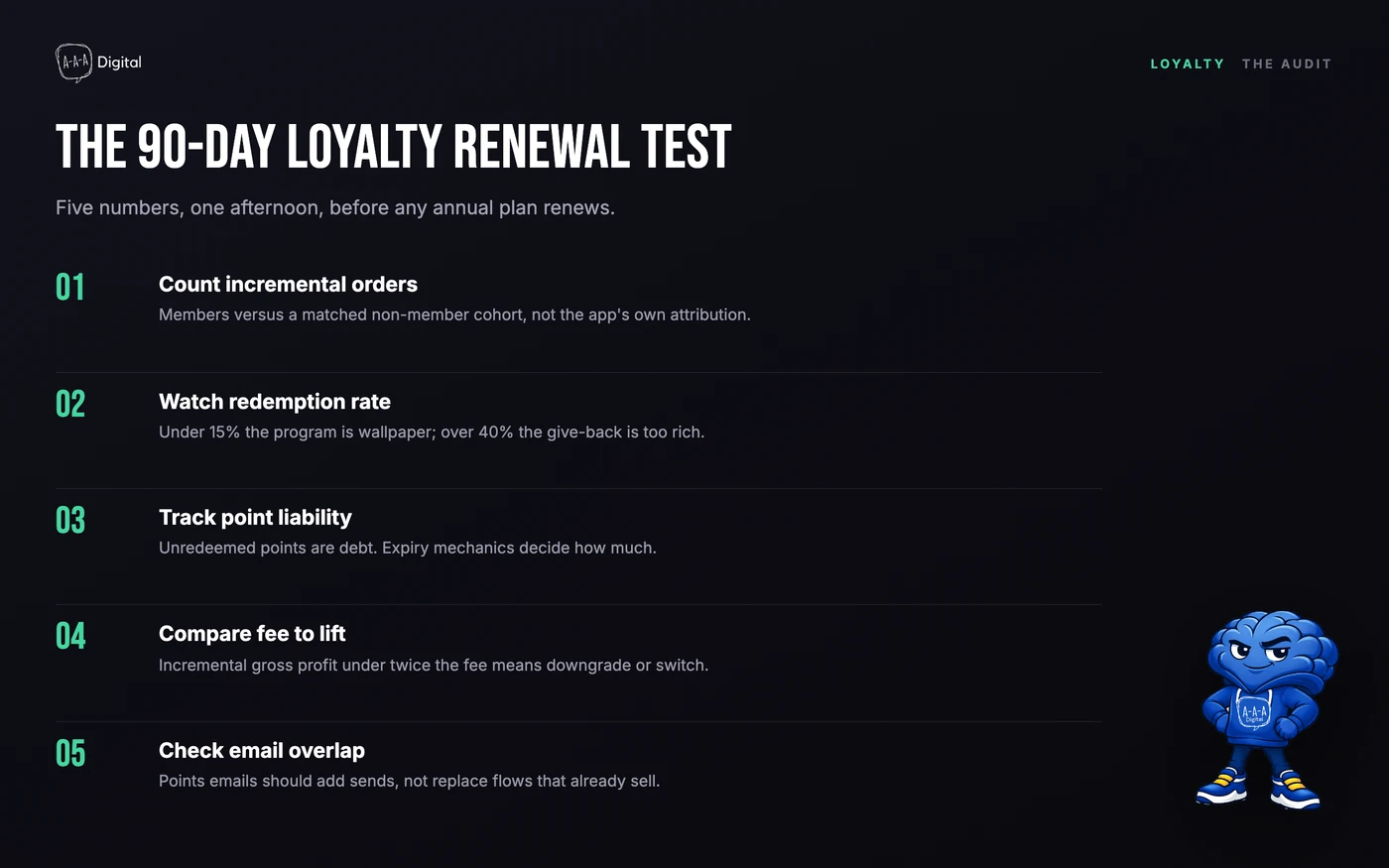
Watch the liability. Unredeemed points are a debt you owe your customers, and programs with expiry mechanics and a sane give-back rate hold less of it. If your redemption rate runs under about 15%, the program is wallpaper. If it runs over 40%, the give-back is too rich and you are buying loyalty you already had.
Measure against a cohort, not the dashboard. The number that matters is incremental orders from members versus a matched non-member group, not the revenue figure inside the app, which credits itself for orders that were coming anyway. When a client asks me whether their loyalty app is working, this cohort check is the first thing I run, and it has talked more than one brand out of a $199 plan they did not need. That measurement layer, built against revenue instead of vibes, is part of our Shopify CRO work.
The Ninety-Day Renewal Test
Before any annual renewal, pull five numbers. They take an afternoon and answer the question the app's dashboard never will: would these orders have happened anyway?
FAQ
Which Shopify loyalty app is best for a small store?
Start free. Joy's Starter plan covers up to 250 monthly orders, Smile's free plan covers low volumes, and Growave's free tier adds reviews and a wishlist. Upgrade only when repeat-rate data shows the program moving orders, not before. At low volume the fee is not the risk; a rewards habit with no repeat behavior to show for it is.
How do I calculate loyalty program break-even?
Take gross profit per order and subtract the expected reward cost: roughly 5% of order value multiplied by your redemption rate. Divide the monthly app fee by what remains. On a store with $31 of net profit per repeat order, a $199 fee needs seven incremental orders a month. Compare that against your repeat purchase rate and you will have your answer in five minutes.
Are loyalty programs worth it for low-frequency products?
Rarely. If customers naturally repurchase once or twice a year at most, points cannot move the calendar enough to matter. Put the budget into the post-purchase experience, email flows, and acquisition instead, and revisit loyalty when the product line adds something consumable.
What is the cheapest way to run loyalty on Shopify?
Shopify's native store credit covers the simplest come-back-and-spend mechanic at no cost. For points and referrals, Joy and Smile both run free plans that stay genuinely functional at low order volumes, and Growave's free tier adds reviews and wishlist on top.
Get Help With This
Loyalty is one retention lever, and it only pays inside a store that already converts and retains well. If you want your program audited against real cohort revenue, or your repeat rate diagnosed before you spend a dollar on apps, talk to us about our Shopify CRO service. We will tell you plainly if the answer is "not yet."
