A store owner we work with opened both pricing pages side by side last October. At 20,000 contacts, Mailchimp Standard came to $285 a month. Klaviyo, for the same list, $400. Her spreadsheet said Mailchimp. She signed with Klaviyo anyway, and a year later email drives roughly a third of her store's revenue. This post is about why that choice keeps happening, and the few cases where it shouldn't.
People search Klaviyo vs Mailchimp for Shopify at one specific moment: email is about to become a real channel for a store that is starting to work, and every comparison they open lists the same features in the same order. Those feature tables are a commodity. What is not a commodity is the money logic. Which platform turns the same list into more revenue? What does each one actually bill you for? And what does switching cost if you pick wrong? That is the comparison worth writing.
Where Klaviyo makes more money on Shopify
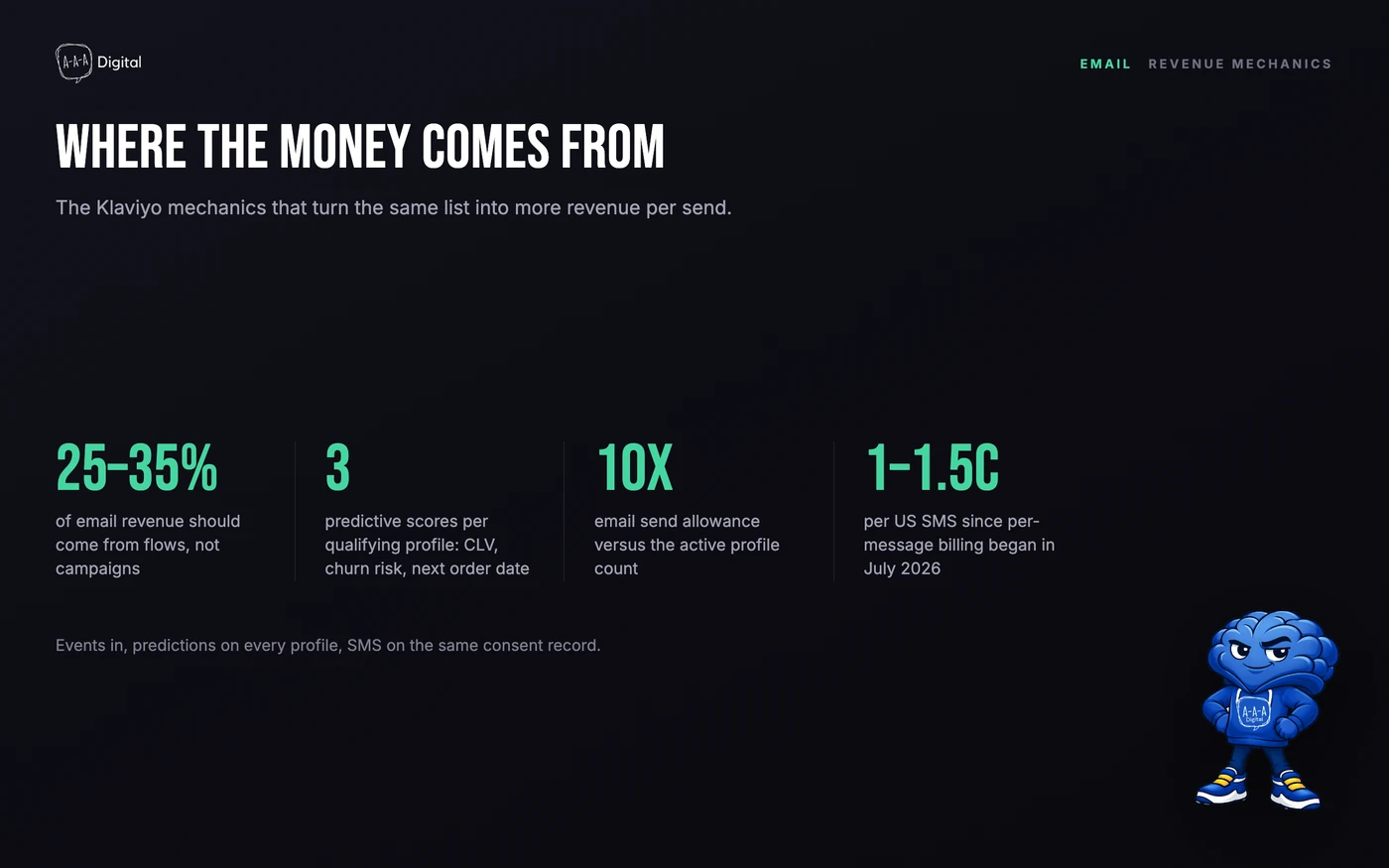
When we audit stores, the Klaviyo accounts that make money all share one trait: the flows went live before the first campaign did. A flow is a triggered sequence that runs on its own: welcome, abandoned cart, post-purchase, win-back. Campaigns are labor; flows are infrastructure, and they routinely produce 25 to 35% of a store's email revenue for a fraction of the sends. The reason Klaviyo wins this game is not the editor. It is the data underneath it.
The Shopify integration is event-level. Viewed Product, Started Checkout, Added to Cart, Placed Order: every event lands in real time, with order value and line items attached, and you can trigger or split on any of it. Klaviyo is a preferred Shopify Plus partner and Shopify holds an equity stake in the company, and it shows in the sync depth.
Flows branch on anything. A Klaviyo flow can split on cart value, specific products, whether the shopper bought before, predicted gender, margin tier, you name it. That is how you get a cart recovery sequence that offers free shipping on high-margin carts and a discount on the rest, automatically. If you are building these from scratch, our guide to the six flows that matter covers the order to build them in. If you would rather have them built and tuned for your store, that is the core of our email marketing service.
Predictive analytics come standard. On qualifying accounts, Klaviyo computes a predicted customer lifetime value, a churn risk score, and a predicted next order date for every profile, and the models retrain weekly. A supplements client of ours uses predicted CLV to decide who gets a text message and who gets silence, because texting a predicted one-time buyer and texting a predicted VIP are two different investments.
SMS lives on the same profile. One consent record, one segment, one revenue report. Since July 2026 Klaviyo bills SMS per message, roughly 1 to 1.5 cents per US text, so you pay for what you send instead of a credit bundle that expires.
Revenue attribution you can act on. Klaviyo attributes orders to the exact flow or campaign that touched them, with optional holdout groups so you can see what email actually caused. Cross-check it against GA4 before you trust either number; the two never match exactly, and the gap is usually tracking, not theft.
And the raw material for all of this is a list that keeps growing. If your signup forms are weak, fix that first: the popup strategy we use on Shopify stores is the difference between a list that buys and a list that just sits there billing you.
Where Mailchimp still makes sense for Shopify stores
Fairness first, because plenty of Klaviyo vs Mailchimp posts are written by people selling Klaviyo migrations.
Content and newsletter brands. If your business is a blog, a media property, or a personal brand where the email is the product, Mailchimp is genuinely good. The editor is friendlier, templates are prettier, and you do not need browse-abandonment triggers to send a weekly essay.
Tiny lists. At 500 contacts, Mailchimp Essentials is $13 a month against Klaviyo's $20. If you send two campaigns a month and nothing automated, that is the correct purchase.
Simpler everything. Fewer menus, fewer meters, faster first campaign. For a store owner wearing five hats, that simplicity has real value.
Where Mailchimp stops making sense for a Shopify store is exactly where ecommerce gets serious. Essentials caps customer journeys at four steps, which is the single biggest reason growing stores get pushed up to Standard, where the price gap with Klaviyo narrows fast. We have told newsletter-first clients to stay on Mailchimp more than once. We have never told a store doing real repeat-purchase revenue to move from Klaviyo to Mailchimp.
Mailchimp and Shopify since the 2019 breakup
In March 2019, Mailchimp asked Shopify to remove its app from the App Store. The dispute was over data: Shopify's updated terms required apps to share more store customer data with merchants, Mailchimp said complying would break its privacy commitments, and Shopify said Mailchimp was withholding data store owners were entitled to. For two and a half years, stores that wanted both platforms bridged them with third-party sync apps like ShopSync.
In October 2021, Mailchimp acquired ShopSync and launched an official direct integration, which is the app you will find today. It syncs customers, orders, and product data, and it covers basic abandoned-cart journeys. What it does not match is Klaviyo's event depth: real-time browse behavior, catalog-level triggers, and the predictive layer. The breakup is fixed on paper. The depth gap is still there, and it matters the moment your flows get ambitious.
Klaviyo vs Mailchimp pricing at 5,000, 20,000, and 50,000 contacts
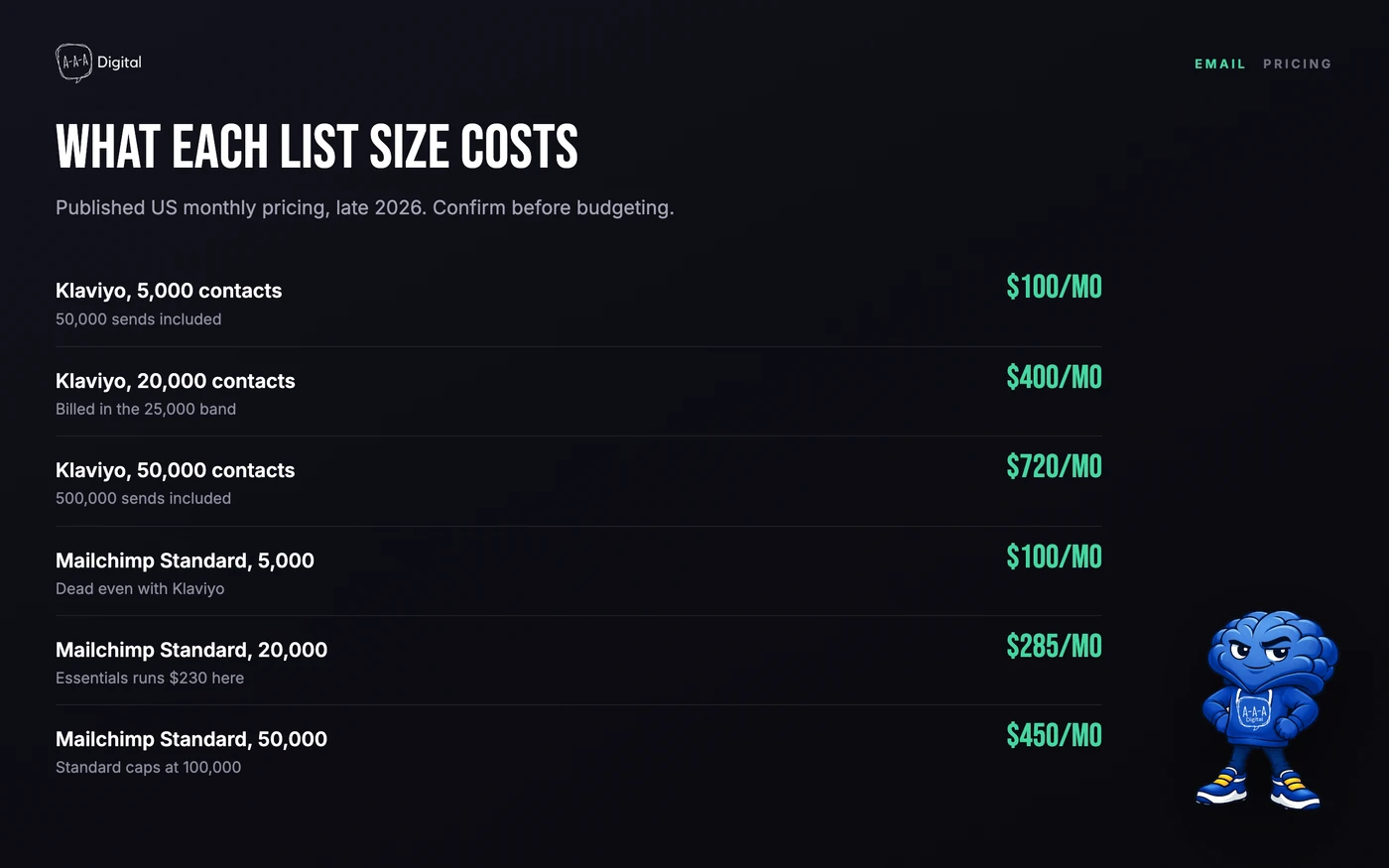
Here is the money table, built from both vendors' published US pricing in late 2026. Prices change and both sites run promos, so confirm your exact tier before budgeting.
Monthly cost for a Shopify store sending normal campaign volume:
| List size | Klaviyo Email | Mailchimp Standard | Sticker gap |
|---|---|---|---|
| 5,000 contacts | $100/mo (50,000 sends) | $100/mo | $0 |
| 20,000 contacts | $400/mo (25,000 band) | $285/mo | Klaviyo +$115/mo |
| 50,000 contacts | $720/mo (500,000 sends) | $450/mo | Klaviyo +$270/mo |
Three things the sticker hides.
Klaviyo bills active profiles. An active profile is any contact that can receive email. Suppressed profiles, the unsubscribed and bounced, do not count. Send allowance is roughly ten times your profile tier, 50,000 sends at 5,000 profiles. One quirk worth knowing: the tiers are uneven, jumping from $150 at 10,000 profiles to $350 at 15,000, so a 20,000-contact store pays the 25,000 band's $400. A list sitting 500 profiles over a breakpoint is worth cleaning back under it.
Mailchimp bills every stored contact. Unsubscribed contacts bill at full rate. The same person in two audiences bills twice. Only manually archived or deleted contacts leave the meter. When we audit Mailchimp accounts, the bill almost never matches the engaged list: one client was paying for 34,000 contacts when barely 19,000 had opened anything in the past year. Add Mailchimp's SMS add-on, from about $20 a month, and the real gap with Klaviyo shrinks further, because Klaviyo's SMS is pay per message with no bundle.
The free tiers are now twins. Both give you 250 contacts and 500 sends a month. Mailchimp cut its free plan to that level in February 2026, with a 250-per-day send cap. Fine for testing, outgrown fast.
The honest summary: Mailchimp Standard beats Klaviyo on sticker at 20,000 and 50,000 contacts. Klaviyo's case is not that it is cheaper. It is that the bill buys the machinery that makes each send worth more, and a cleaner meter underneath it.
Deliverability and support: what the testing actually shows
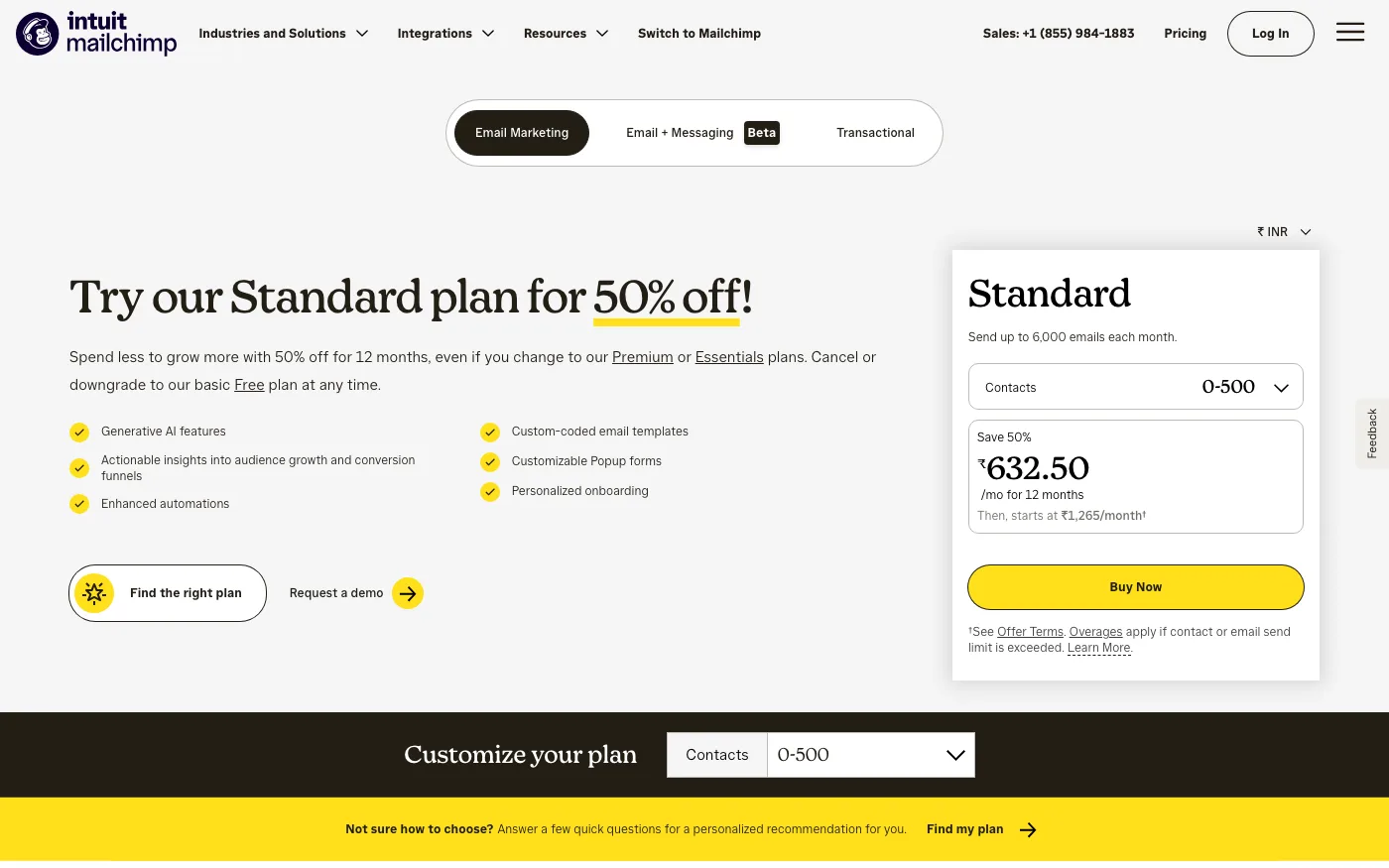
In EmailTooltester's final large seed-list round before it changed methodology in late 2025, Klaviyo landed around 91 to 92% inbox placement and Mailchimp in the high 80s. Independent testing in 2026 put Mailchimp near 89.5%, mid-table among the fifteen platforms tested. Since December 2025, EmailTooltester scores platforms on deliverability features rather than running seed tests, and Klaviyo scores a perfect 5 out of 5 there. Directionally: Klaviyo has an edge, neither is alarming, and the spread between them is smaller than the spread between good and bad list hygiene.
That last part is the one vendors skip. Gmail and Yahoo's bulk sender rules, SPF, DKIM, DMARC, one-click unsubscribe, low complaint rates, now decide your placement more than your ESP's sending pool. A store that mails its whole list weekly with no sunset flow will land in spam on either platform. Keep your list clean and your authentication current, and both tools will deliver.
Support tells a similar story. Mailchimp reserves phone support for Premium, which starts at $350 a month; Standard gets 24/7 chat and email plus an onboarding specialist for the first 90 days. Klaviyo gives paid plans chat and email support, free accounts get email support for the first 60 days, and its partner ecosystem is large if you want done-for-you help. Public review scores for both are grumpy, Klaviyo's Trustpilot sat near 1.7 the last time we checked, which says less about the software than about how SaaS billing surprises breed one-star reviews. Read both vendors' cancellation and billing threads before you sign anything.
Migrating from Mailchimp to Klaviyo without losing revenue
If you are on Mailchimp Standard with 10,000-plus contacts, manually rebuilding abandoned carts, and email contributes under 15% of revenue, the migration pays for itself. Every dollar of email revenue you do not capture gets replaced with paid acquisition, and paid acquisition keeps getting more expensive.
The order of operations matters more than the tools:
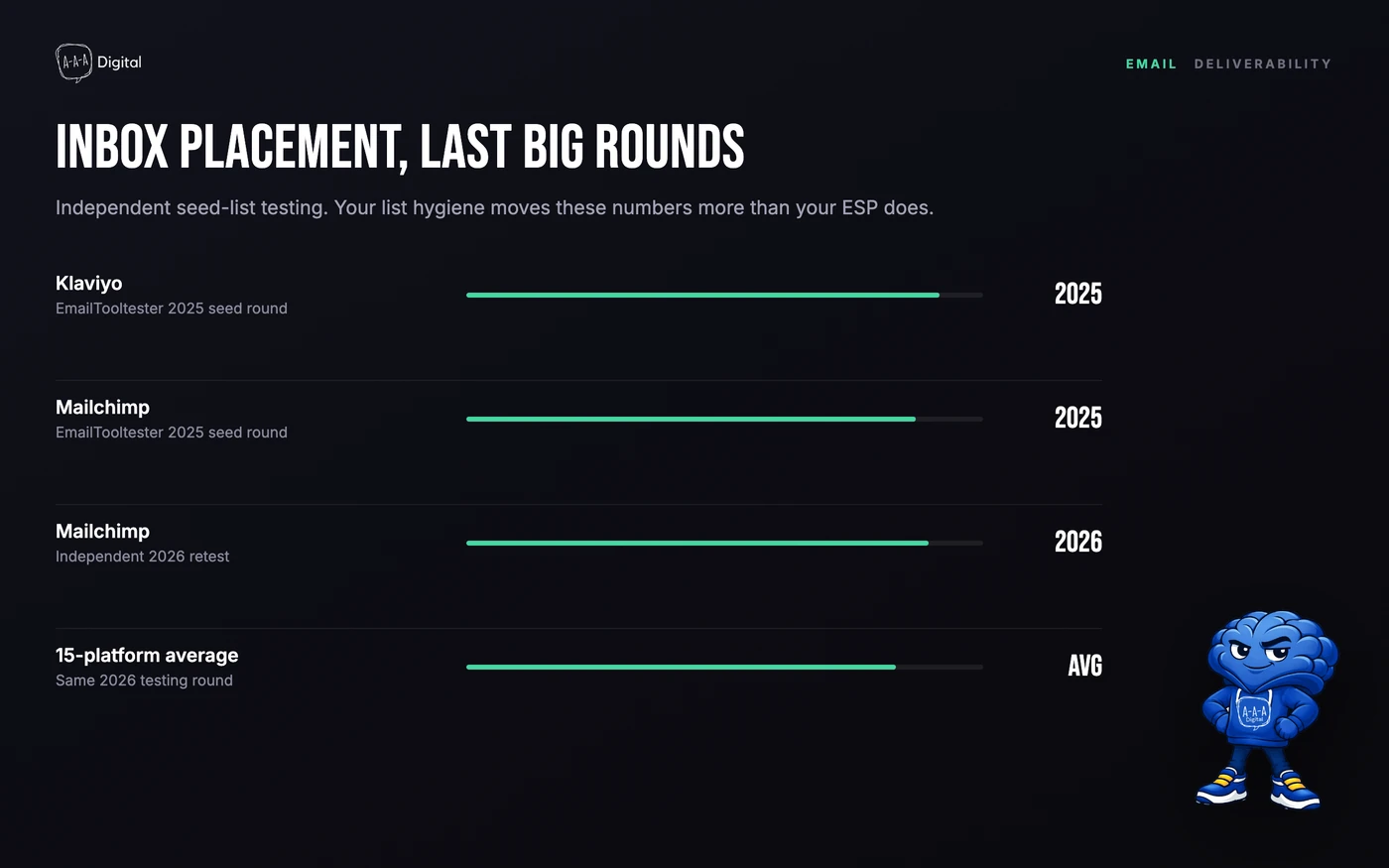
- Export audiences and tags from Mailchimp. Segments do not export, so screenshot the rules of the ones you rely on. You will rebuild them as Klaviyo segments, which are more powerful anyway.
- Clean before you import, not after. Delete contacts with zero engagement in the past year. Mailchimp was billing you for them; do not carry dead weight into a meter that charges for emailable profiles, and do not poison your new sender reputation with a dirty list.
- Connect Shopify inside Klaviyo. Order history, customer records, and the catalog sync in, giving flows real data from day one instead of a cold start.
- Re-authenticate your sending domain. Klaviyo generates DKIM and SPF records; publish them, set DMARC, and keep marketing on a subdomain so a reputation hit never touches order confirmations.
- Recreate your journeys as Klaviyo flows, then warm up. Send only to your engaged segment, roughly anyone active in the last 90 to 120 days, and ramp volume over two to three weeks.
- Run both platforms for two to four weeks. Watch placement and revenue attribution, then downgrade Mailchimp and set your sunset flow in Klaviyo.
Last year we moved a skincare brand off Mailchimp at roughly 20,000 contacts using exactly this sequence. Flows were live the first weekend; email's share of store revenue went from about 12% to 26% within a quarter. That is one result, not a promise, but the pattern repeats across the migrations we run: the revenue was always there, Mailchimp just could not see the triggers.
If you are weighing the migration against the sticker gap, run the table above against your own email revenue for one quarter. The platform rarely loses that argument.
FAQ
Is Klaviyo or Mailchimp cheaper for a Shopify store?
At 500 contacts, Mailchimp: Essentials is $13 a month against Klaviyo's $20. At 5,000 contacts the two Standard-equivalent tiers are dead even at $100. Past 20,000 contacts, Mailchimp's sticker is lower, $285 against Klaviyo's $400. But Mailchimp bills unsubscribed contacts and duplicates across audiences, so your real bill is usually higher than the sticker, and the comparison only matters next to the revenue each platform generates.
Does Mailchimp still work with Shopify?
Yes. After the 2019 App Store removal and two and a half years of third-party bridge apps, Mailchimp acquired ShopSync and launched an official direct integration in October 2021. The current app syncs customers, orders, and product data and handles basic abandoned-cart journeys. It works; it is simply shallower than Klaviyo's event-level sync for advanced flows.
Is Klaviyo worth it for a small Shopify store?
If you will build the flows, yes, even early, because flows compound while campaigns reset every month. If you only plan to send an occasional newsletter under about 1,000 contacts, Klaviyo is overkill and Mailchimp or even Shopify Email will do the job for less. The honest trigger point is your first serious abandoned-cart sequence.
Will switching from Mailchimp to Klaviyo hurt my deliverability?
Not if you migrate in the right order. Clean the list before import, re-authenticate your domain with Klaviyo's DKIM and SPF records, and warm up by sending to your engaged segment for two to three weeks before full volume. The stores that get hurt are the ones that import everything and blast the entire list on day one.
Get Help With This
If this comparison has you realizing your email stack is underbuilt, you are not alone, it is the most common finding in our audits. AAA Digital's content and email marketing team sets up Klaviyo for Shopify stores end to end: migration, the six core flows, SMS, segmentation, and reporting you can cross-check in GA4. Talk to us before your next platform billing cycle, not after it.
