Most lists of "Shopify Plus stores" treat the $2,300-a-month badge as the story. It is not. When we audit Plus stores for brands weighing the upgrade, the interesting part is never the footer logo. It is the checkout code access, the native B2B catalogs, the automation headroom, and the quiet promise that the store stays up when a drop goes viral.
Every store below has a public Plus signal we can point to: Shopify's own case studies, the building agencies' documentation, or technology detection on the live domain. Each scale figure carries a named outlet and year, hedged properly, because private companies do not publish audited accounts. We already ranked the best Shopify stores by reported revenue without a Plus filter; here the filter is the point. If you are weighing the platform itself, our guide to choosing a Shopify Plus agency covers the selection side, and this list gives you reference stores to demand from any partner you shortlist.
Two names we dropped during research. MVMT was the most famous Plus story of the late 2010s, but after Movado acquired it in 2018 its current platform status is not publicly verifiable, so it does not count toward the eight. SHEIN appears in some "big Shopify store" listicles and has never been a Shopify merchant at all. If a list cannot get those two right, be skeptical of the rest.
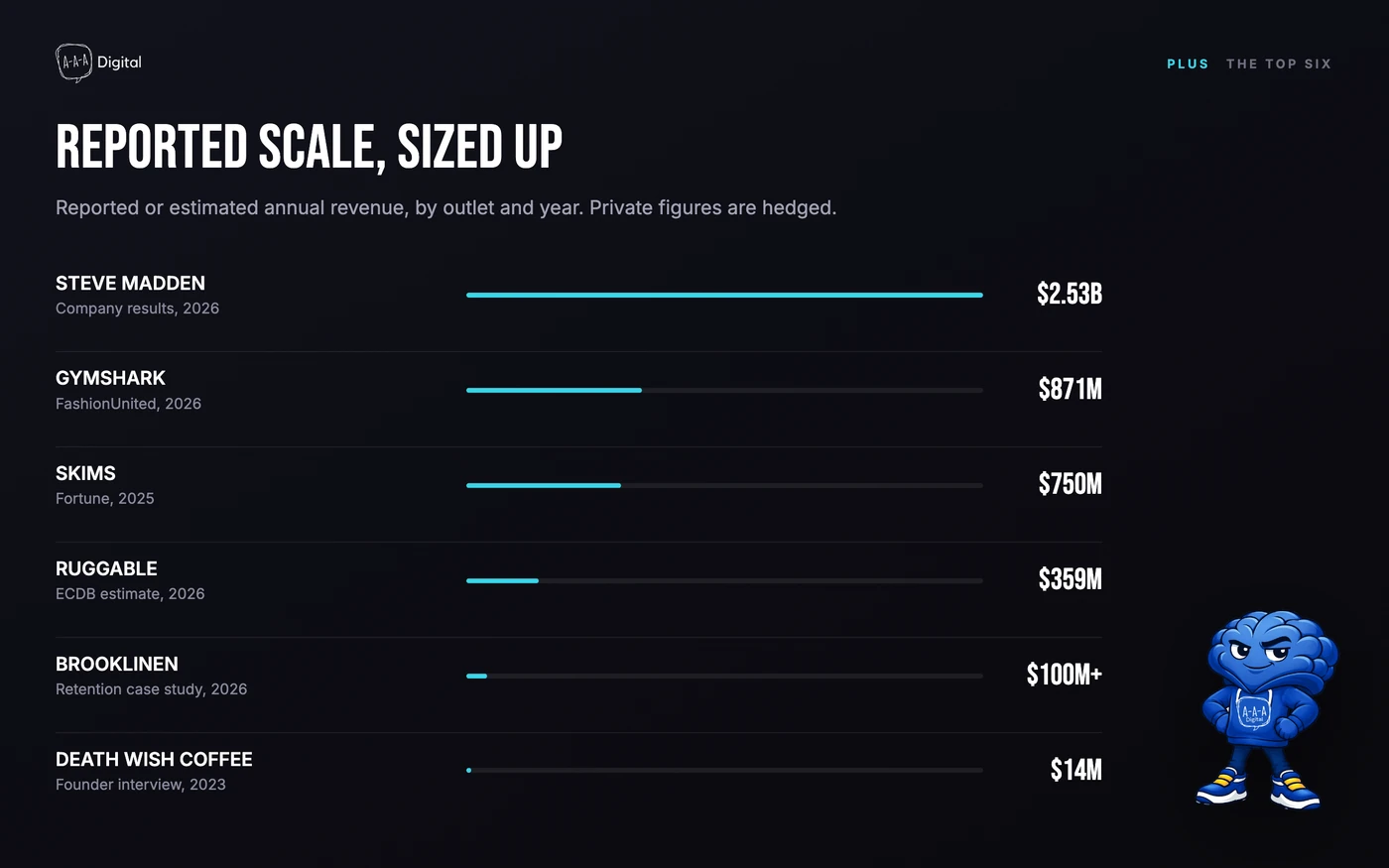
The Comparison Table
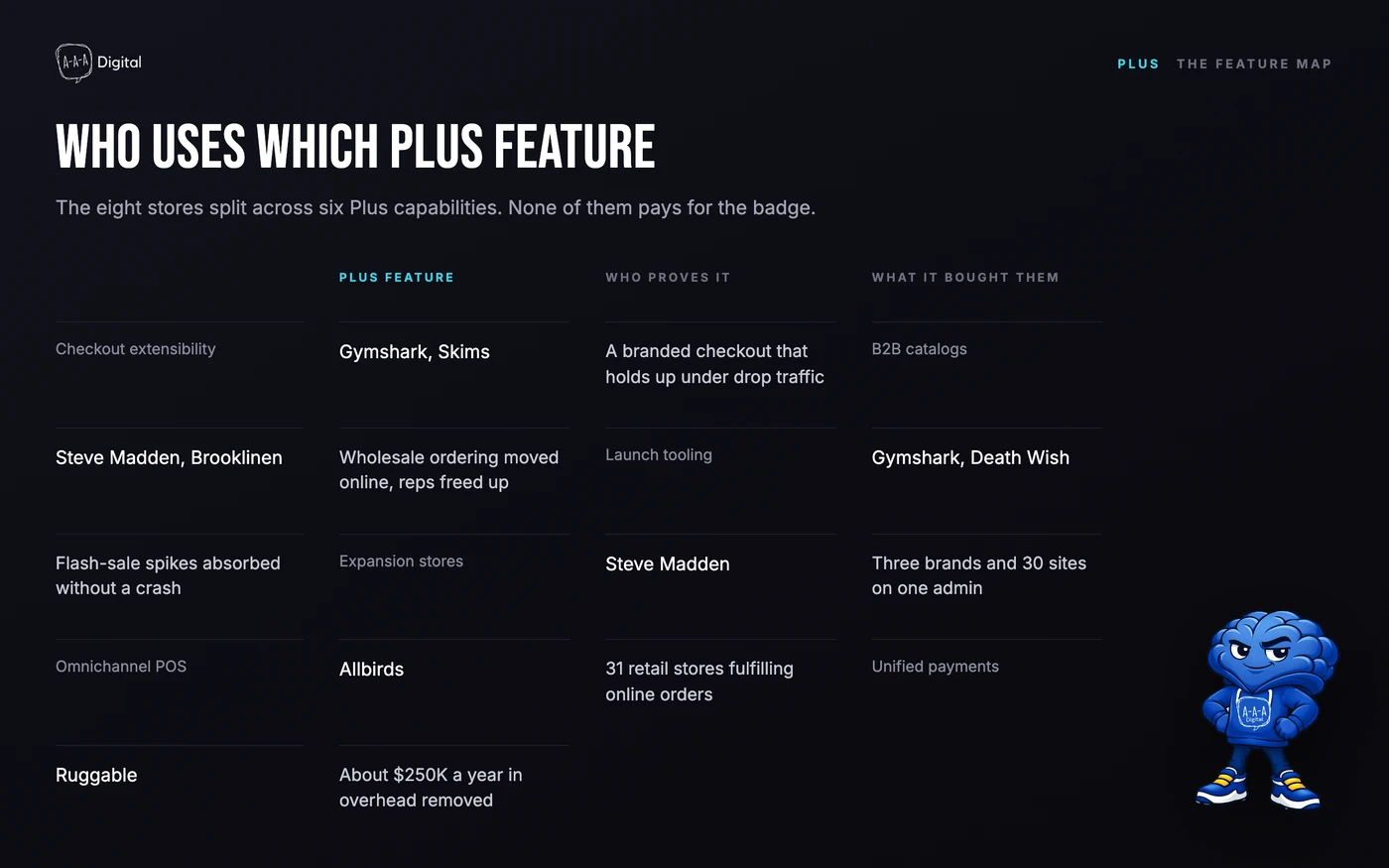
| Store | Niche | Scale evidence (source, year) | Plus feature in use |
|---|---|---|---|
| Steve Madden | Footwear and accessories | $2.53B FY2025 revenue (company results, 2026) | B2B catalogs, expansion stores |
| Gymshark | Fitness apparel | $871M FY2025 (FashionUnited, 2026) | Headless build, checkout extensibility |
| Skims | Shapewear and intimates | ~$750M 2023 sales (Fortune, 2025) | Custom checkout, drop launches |
| Ruggable | Washable home rugs | ~$359M 2025 GMV, estimated (ECDB, 2026) | Unified commerce, Shopify Payments |
| Brooklinen | Bedding and bath | $100M+ business (retention case study, 2026) | B2B storefront, retention automation |
| Kylie Cosmetics | Beauty | $177M verified 2018 revenue (Forbes, 2020) | Flash-drop traffic absorption |
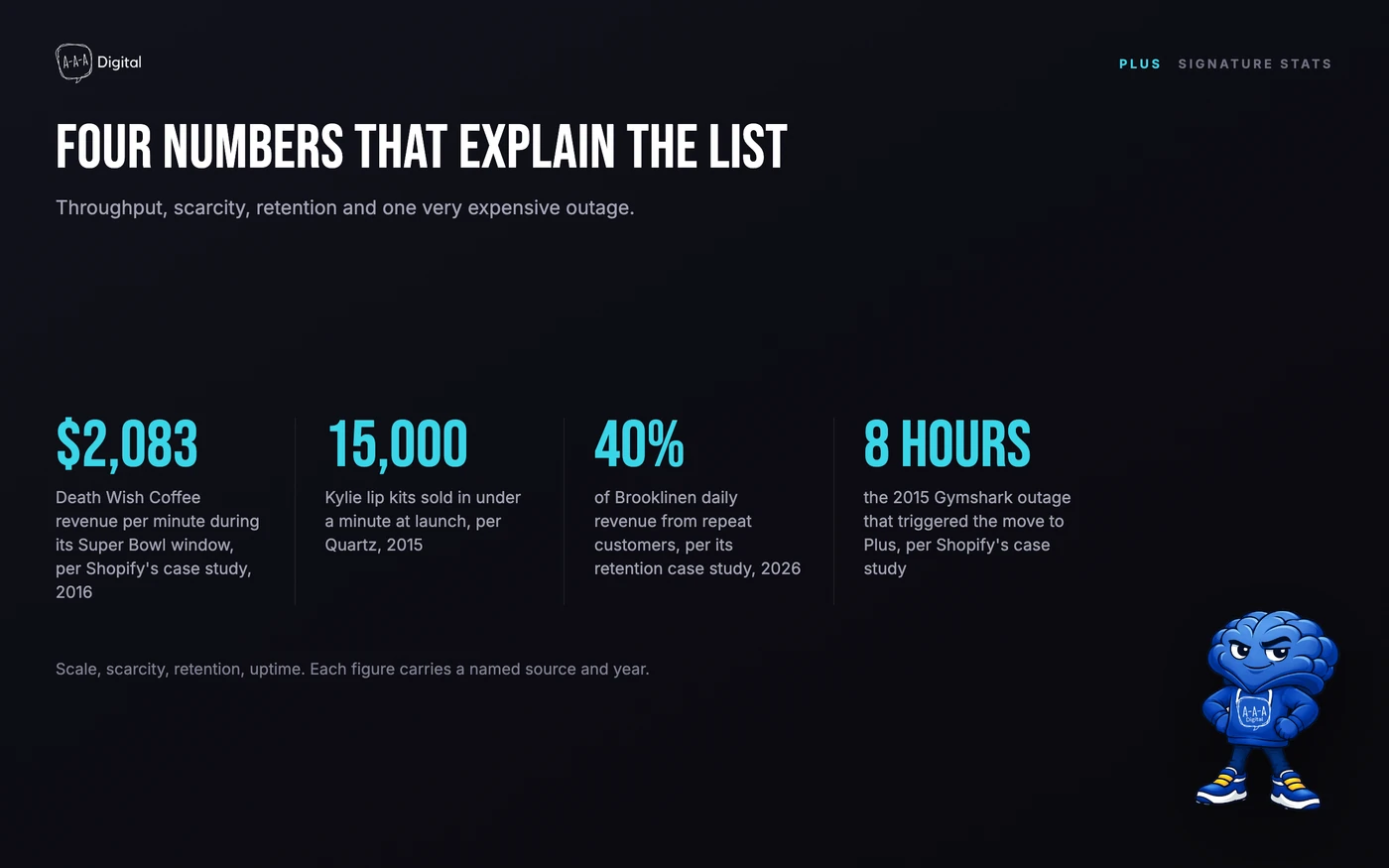
| Death Wish Coffee | Coffee and subscriptions | $250K in two hours (Shopify case study, 2016) | ERP integration, spike tolerance |
| Allbirds | Footwear | $189.8M FY2024, down 25.3% (SEC filing, 2025) | Ship-from-store, Shopify POS |
Two caveats: private company figures are reported or estimated, never audited, so treat the tilde signs seriously. And scale is an outcome, not a tactic; study the specific decision each store made, the one a smaller merchant can copy this quarter.
1. Steve Madden (footwear and accessories)
Steve Madden is the oldest business here and the largest: the public company reported $2,534.1 million in 2025 revenue, up 11 percent year over year, in its February 2026 results. Its replatform to Shopify Plus, built with agency RunDTC and a composable CMS layer, is one of the most documented enterprise moves on the platform.
The Plus decision was not about DTC. It was about running Steve Madden, Dolce Vita, and Betsey Johnson across roughly 30 global sites from one admin, and about wholesale. The rebuild moved B2B ordering online with account-specific pricing and terms, replacing phone-and-email order taking, and it cut a stack that had grown past 260 apps down to a streamlined core. Agency-documented results include a 16 percent conversion lift. If your wholesale channel still runs on inboxes, our Shopify B2B setup guide walks the native catalog approach step by step.
The steal without Plus: one clean master catalog with disciplined product data, so a future B2B or international site is a configuration job, not a rebuild. What requires Plus: native B2B catalogs with company profiles and price lists, plus expansion stores that share a single admin.
2. Gymshark (fitness apparel)
Gymshark is the canonical Plus origin story. In 2015, on Magento, its site went down for eight hours on Black Friday; founder Ben Francis put the loss at roughly £100,000 in Shopify's case study, and the agency involved counted nearer $143,000. Gymshark moved to Shopify Plus within months and later went headless. The company filed £646 million, about $871 million, for the financial year ending July 2025, its thirteenth consecutive year of growth, per FashionUnited's coverage of the filings.
When we scope replatforms, this is the story we tell: the failure was a platform that could not flex into a spike, not the traffic itself. Gymshark's drops now process thousands of orders per minute in industry coverage of its events.
The steal without Plus: the gamified loyalty program, which rewards workouts and reviews alongside purchases, runs on apps available to any plan. What requires Plus: checkout code access and the headless architecture that lets a content-heavy brand serve its community site and store from one system.
3. Skims (shapewear and intimates)
Skims launched on Shopify Plus in 2019 and never left. The custom theme was built by Shopify Plus partner agency King & Partners, a fact the agency has documented, and 2026 detection profiles still show a bespoke build matching no theme store entry. Per Fortune's coverage of its November 2025 funding round, Skims generated about $750 million in 2023 sales, up from roughly $500 million in 2022, and the round valued it at $5 billion.
The Plus feature doing the work is checkout control under engineered scarcity. Limited colorways and celebrity collaborations go live at volume, sell out, and restock on a schedule that keeps the product page behaving like a queue. It is one of the most instructive examples of checkout extensibility in the wild, though the deeper mechanics deserve their own teardown.
The steal without Plus: a monthly limited run with a real cutoff, announced to your email list first and only then to ads. What requires Plus: custom checkout branding and logic, plus the headless setup Skims adopted early for international storefronts.
4. Death Wish Coffee (coffee and subscriptions)
Death Wish Coffee sells aggressively caffeinated beans by subscription, and it is here because of one night. The company won Intuit's contest for a free Super Bowl 50 ad in 2016; before the game, its legacy site had already buckled under a morning-show spike. Shopify's own Plus case study documents the result after replatforming: more than $250,000 in revenue across the two-hour Super Bowl window, about $2,083 per minute, with 150,000-plus simultaneous viewers absorbed and 200 percent year-over-year growth around it. A 2023 podcast interview with founder Mike Brown puts the business at roughly $14 million in annual revenue, which tells you the ad bought a platform upgrade, not a permanent size.
The steal without Plus: a subscription-first offer and a pre-spike checklist. Load test the store, stage a waiting room app, and know your traffic ceiling before your press moment. What requires Plus: the API throughput for ERP and fulfillment integrations, in Death Wish's case with Skubana, at a spike's pace.
5. Ruggable (washable home rugs)
Ruggable sells two-piece machine-washable rugs. Its Plus case study documents the part mid-size merchants should steal: consolidating on Shopify Payments and a unified commerce stack saved roughly $250,000 a year in overhead. Scale estimates vary because Ruggable is private; ECDB puts 2025 GMV near $359 million, which we cite as an estimate, not a filing.
The more interesting lesson is product development. A 2026 Shopify profile credits customer feedback, much of it from public Reddit threads, with a single product improvement that drove 70 percent of revenue within eight weeks. That is a review-mining operation masquerading as a rug store.
The steal without Plus: treat reviews and community threads as a product roadmap with a weekly cadence, and answer the complaint threads competitors ignore. What requires Plus: the payments and checkout consolidation that turns five vendor relationships into one, which is where the $250,000 came from.
6. Brooklinen (bedding and bath)
Brooklinen is the retention discipline case. A 2026 case study of its retention program describes a $100 million-plus business, and the oft-cited internal stat is that about 40 percent of daily revenue comes from repeat customers while promotional email stays near 7 percent of total sends. It also runs its wholesale channel on a Shopify Plus B2B storefront, which agency documentation credits with shifting 80 percent of the wholesale team's time from order processing to actual customers.
The pattern here mirrors what we push on every retention audit: the store trained customers to buy at full price by making the post-purchase experience, referral program, and product quality do the work that discount codes usually pretend to do.
The steal without Plus: audit your promotional email share this month. If it clears a fifth of your sends, you are renting revenue you already own. What requires Plus: the B2B storefront with company accounts and net terms, which does not exist on standard plans.
7. Kylie Cosmetics (beauty)
Kylie Cosmetics is the oldest Shopify story here and the best-documented hype machine. It launched in 2015 on Shopify and reportedly sold 15,000 lip kits in under a minute, per Quartz. When Coty bought 51 percent for $600 million in 2019, Forbes and MarketWatch reported a valuation near $1.2 billion. Then Forbes corrected the record in 2020: verified 2018 revenue was closer to $177 million, not the nine figures the family had claimed. That correction is why this post exists, and it is the most instructive number in the entry.
The store was one of Plus's early showcases, built to absorb launch traffic from an audience of tens of millions of followers. Honesty note: the celebrity flywheel is not copyable, but the launch infrastructure is.
The steal without Plus: drops only work when the audience is yours, so build the email and SMS list before the product. What requires Plus: spike absorption and checkout scale when a launch moment sends six figures of followers at one product page.
8. Allbirds (footwear)
Allbirds closes the list as the honesty case. Shopify's case study documents its ship-from-store rollout on Shopify POS, where 31 retail locations fulfilled online orders, cutting shipping distance and cost. That is textbook Plus omnichannel. But the business itself shrank dramatically: the public company reported $189.8 million in 2024 net revenue, down 25.3 percent, in its March 2025 SEC filing, and in March 2026 it announced a definitive agreement to sell its assets to American Exchange Group for $39 million, per its SEC press release, about a tenth of what it raised at its 2021 IPO.
As of 2026, detection profiles still show Allbirds running Shopify with a custom theme built for its relaunch. The lesson cuts both ways: Plus never saved a brand from product-market drift, but it also made the operational wind-down cheap enough to survive an acquisition.
The steal without Plus: if you have any physical presence, configure store fulfillment before you rent warehouse space. What requires Plus: POS-driven omnichannel at 30-plus locations with shared inventory.
What You Can Steal Without Plus
The pattern across these eight stores is that Plus buys throughput, permissions, and code access, not conversion magic. Every tactic worth copying, the loyalty mechanic, the scarcity drop, the review-mining cadence, the email restraint, runs on a standard plan with discipline.
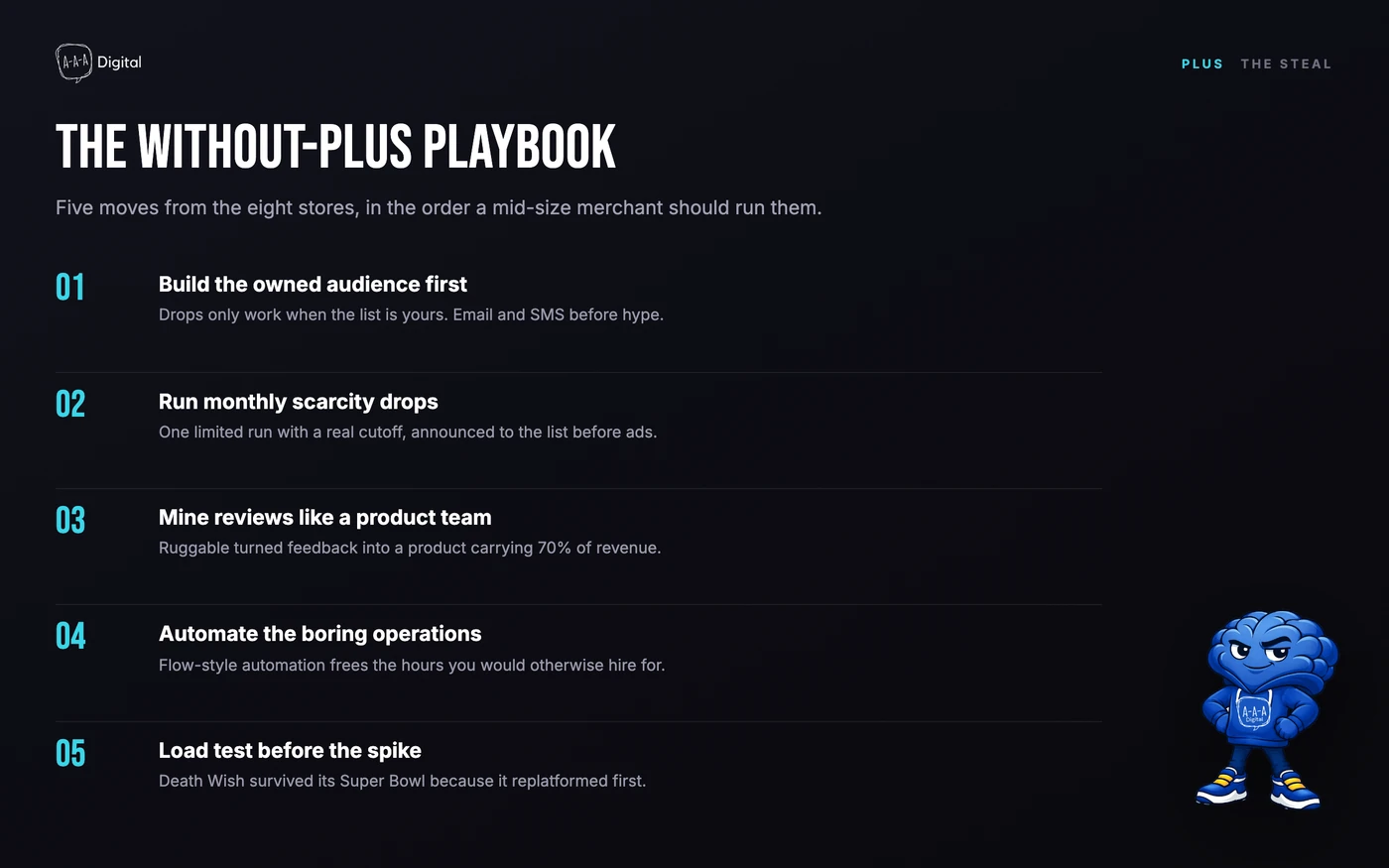
Our suggested order for a store under $5 million a year: build the owned audience first, because Kylie's launches only work on a list she controls. Fix the product page and post-purchase flows before chasing traffic, because Brooklinen's 40 percent repeat revenue sits under the ads. Then run one scarcity mechanic per quarter and load test before any press moment. The Plus ROI math only turns positive when checkout access or B2B catalogs change a number you can name; until then, copy the mechanics. If you want an outside read on which playbook fits, our Shopify experts map teardowns like this one to a store's stage, and will tell you when the honest answer is to stay on your current plan.
What Actually Requires Plus
Draw the line precisely. Custom checkout code, native B2B catalogs with company pricing and net terms, expansion stores under one admin, automation that touches inventory and pricing at volume, API headroom for ERP integrations, and the SLA-backed uptime that lets Gymshark sleep through Black Friday. If none of those moves a metric on your dashboard, you are buying the badge, and the badge does not convert.
FAQ
How do you know these stores actually run on Shopify Plus?
Each entry above carries a named public signal: Shopify's own case studies (Death Wish Coffee, Allbirds, Ruggable), agency build documentation (King & Partners for Skims, RunDTC for Steve Madden, Pattern for the 2026 Allbirds theme), or technology detection on the live domain. Where the evidence is historical rather than current, the entry says so, which is why MVMT, the famous Plus story of 2018, is not counted.
Did any famous store leave Plus or shrink while staying on it?
Allbirds is the documented case. Its revenue fell 25.3 percent in 2024 and it sold its assets for $39 million in 2026, yet it remains on Shopify, because replatforming during a wind-down is the last expense a struggling brand needs. No major store on this list has a verified, public move off Plus; platforms are sticky in both directions.
Can a mid-size store copy these tactics on a standard Shopify plan?
Yes, with one rule: copy the mechanic, not the budget. Scarcity drops, loyalty gamification, review mining, and email restraint are plan-agnostic. The Plus-only zone is checkout code access, native B2B catalogs, expansion stores, and spike-grade infrastructure. If your tactic list does not need any of those, your money is better spent on the tactic itself.
When does upgrading to Plus actually make sense?
Rough markers: around $1 million to $3 million in annual revenue the checkout and automation ROI usually clears the fee, and past $5 million lower transaction rates can make Plus cheaper outright. The honest answer depends on which specific feature you would use first, which is the test we run in every Plus-readiness audit.
Get Help With This
If you want your store's numbers to look more like the left column of that table, talk to our Shopify experts and we will map which of these eight playbooks fits your stage, including an honest "stay on your current plan" when that is the right answer. And if you are already shortlisting partners, read our guide to choosing a Shopify Plus agency next, so you ask candidates about the same checkout, B2B, and uptime questions this list just armed you with.
