In June, a supplement merchant sent me two screenshots from his analytics. Subscriptions were 34% of his revenue, his proudest number. His second proudest decision, the 25% subscriber discount he advertised on every product page, was quietly eating the margin that made the first number worth having. Same store, same quarter, two slides that never got presented in the same meeting.
I have launched subscriptions on about a dozen Shopify stores over the past four years and audited the setup on maybe fifty more. Almost every failed program follows the same pattern: the store picked a product that could not sustain a cadence, bolted on the first app a listicle recommended, and treated churn as a customer-service problem instead of a design decision. This is the build order I would follow again tomorrow, with the shakier industry numbers flagged as estimates rather than passed off as benchmarks.
Which Products Actually Hold a Shopify Subscription
Before any app, pricing model, or landing page, one question decides everything: does the customer run out of this product on a predictable schedule?
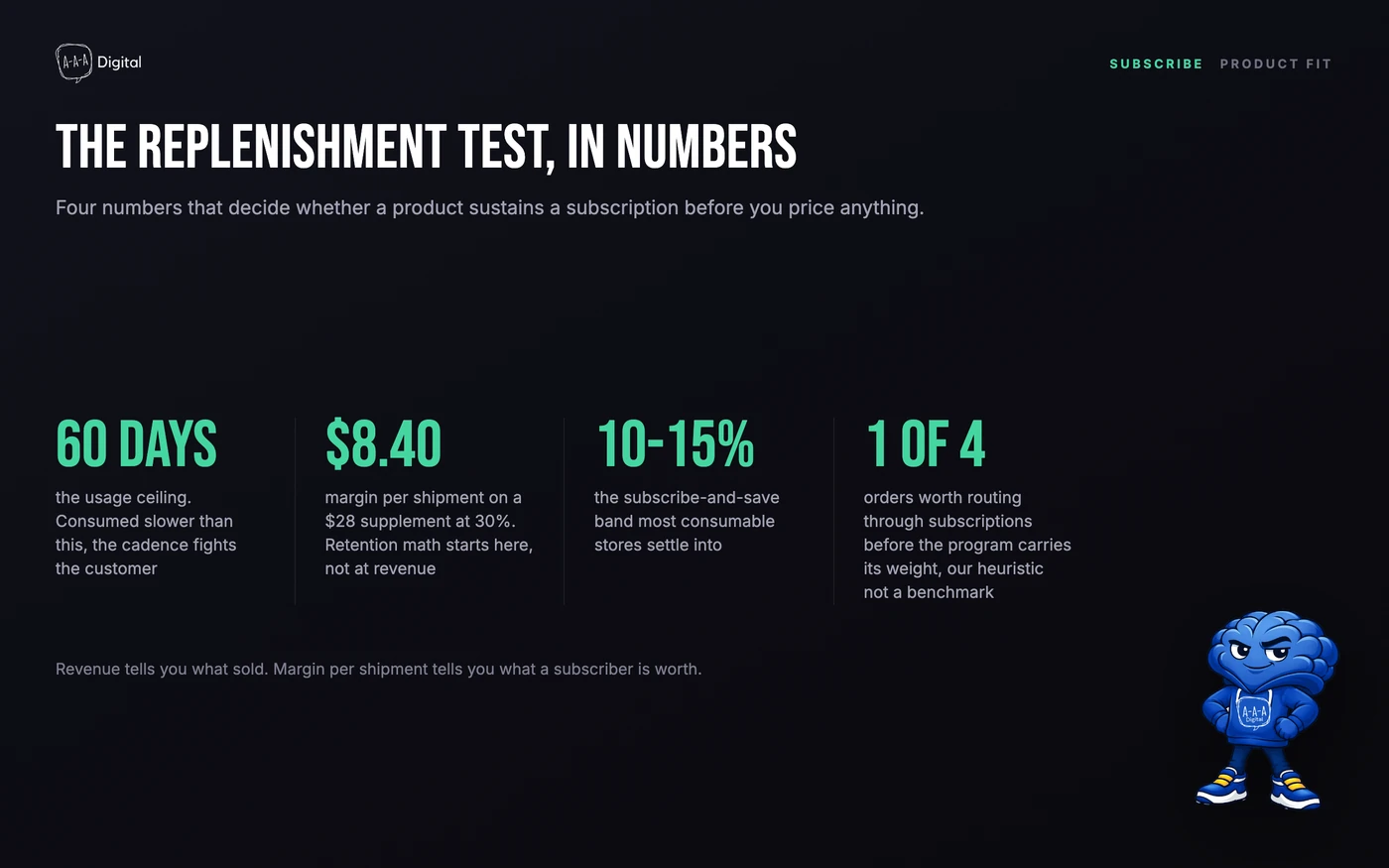
Consumables sustain subscriptions; durables almost never do. Coffee, supplements, pet food, skincare refills, cleaning supplies, razors, protein powder: products consumed inside roughly 60 days fit a natural replenishment cadence. Phone cases, jewelry, furniture, and one-purchase-per-year goods do not. Putting a durable on subscribe-and-save is not a subscription; it is a permanent discount with no retention logic behind it. The one durable exception is the durable that anchors a consumable: the razor handle is the hook, the blades are the subscription. Sell the handle once, subscribe the refill.
The replenishment math comes next, and it is margin math, not revenue math. A $28 supplement at 30% margin contributes $8.40 per shipment. At a 7% monthly churn rate, expected subscriber lifetime runs about 14 months, so one subscriber is worth roughly $118 in contribution. Stack your fully loaded acquisition cost and the subscriber discount on top of that $118 and see what survives. If subscriber lifetime value cannot clear acquisition cost plus discount cost with room to spare, you do not have a growth channel; you have a loyalty program wearing one.
A skincare client I work with had subscribe-and-save toggles on 40 of her 90 SKUs. We cut the program to the six products customers genuinely run out of, and the subscription attach rate nearly doubled in a quarter. The offer stopped competing with itself, and the portal stopped emailing people about products they did not need on a schedule.
Shopify's Native Subscriptions Plumbing, and Where It Runs Out
The platform side is better than most merchants realize, and it is free to start.
Shopify exposes subscriptions natively through its Subscriptions API: apps create selling plans (delivery every 30, 60, 90 days, prepaid cycles, member pricing), attach them to products, and store subscription contracts against the customer. Recurring orders then process through Shopify's own checkout, which matters more than it sounds: the customer manages payment, shipping, and discounts in one flow, and your app is not smuggling orders through a redirect workaround. Two Shopify mechanics bite new builds regularly: an order can carry only one subscription, and orders without a shipping address cannot accept a subscription at all.
The second platform shift to know about: checkout.liquid is gone. Shopify's August 26, 2026 deadline removed legacy checkout customizations for every non-Plus store, so the entire subscription stack now runs on checkout extensibility. Any app you shortlist should say so plainly on its listing. The same deadline applies to any checkout work you commission, which is why the checkout customization surface on Plus stores looks completely different from everything a Basic plan can touch.
Shopify's own free Subscriptions app handles basic subscribe-and-save on weekly, monthly, or yearly cycles with no transaction fee. It is the right first install for a single consumable with one delivery frequency. It runs out fast, though: dunning controls are thin, there is no build-a-box or curation tooling, the customer portal offers little customization, and analytics will not tell you why subscribers leave. The moment you need prepaid cycles, box building, or real cancellation-flow logic, you are shopping third-party apps.
The Shopify Subscription App Stack in 2026
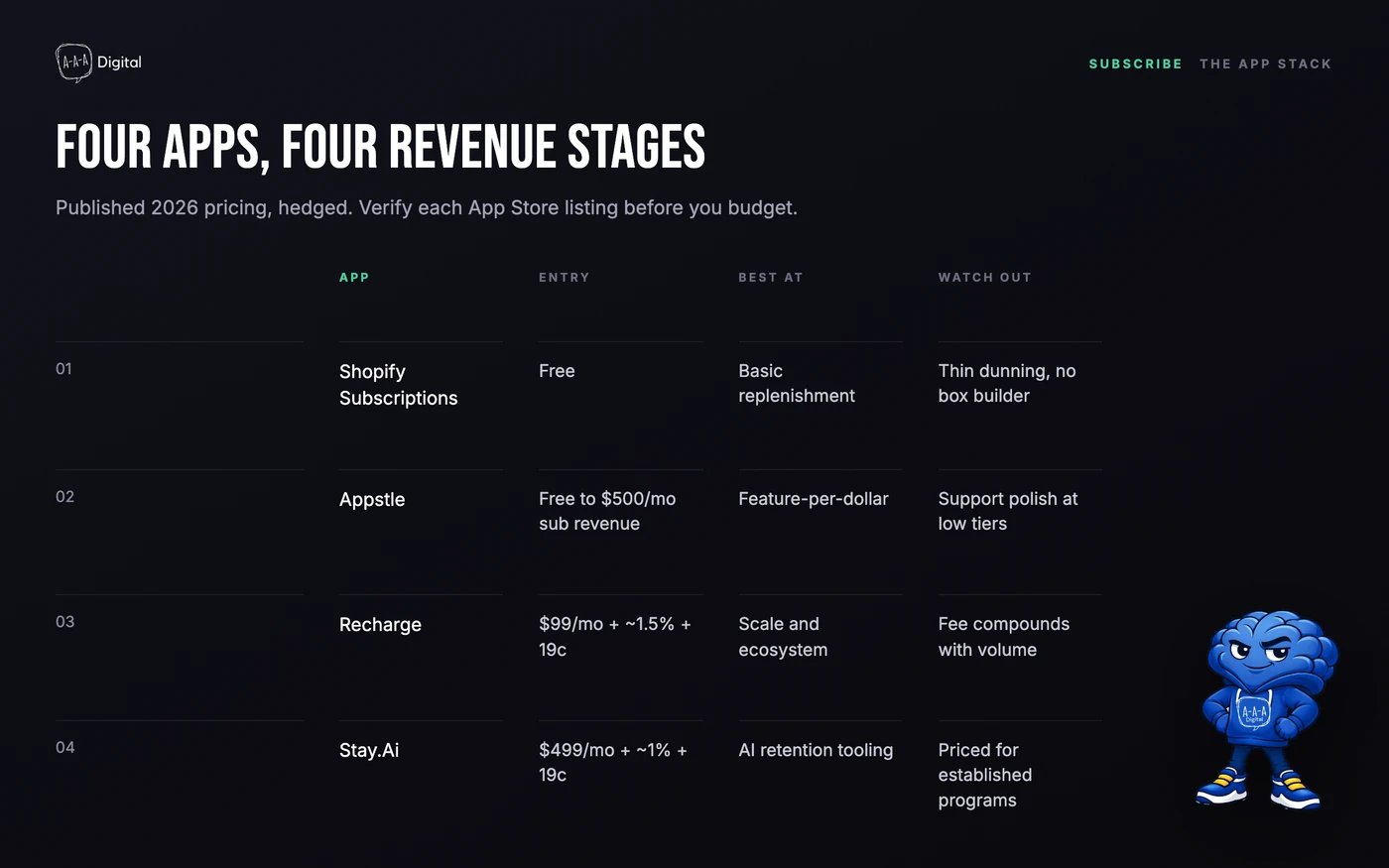
Four options cover most stores. Pricing below is each vendor's published Shopify App Store pricing as of late 2026; these numbers drift, so verify the listing before you budget.
| App | Entry price | Best for | Weakness |
|---|---|---|---|
| Shopify Subscriptions (native) | Free | Basic replenishment, one product, one frequency | Thin dunning, no box builder, shallow portal |
| Appstle | Free to $500/month subscription revenue; 0% transaction fees | Feature-per-dollar at small to mid volume | Support polish reported at lower tiers |
| Recharge | $99/month plus roughly 1.5% + $0.19 per order | Scale, ecosystem, enterprise integrations | Transaction fee compounds with volume |
| Stay.Ai | $499/month plus roughly 1% + $0.19 per order | AI-assisted retention on large catalogs | Entry price suits established programs, not tests |
Recharge remains the safe enterprise default and the name most agencies (including ours) have the deepest migration scar tissue with, which cuts both ways: it integrates with everything and bills for the privilege. Appstle's zero-transaction-fee model flips the economics for stores under roughly $50,000 in monthly subscription revenue, where a percentage fee costs more than the plan. Stay.Ai prices itself for stores where retention tooling, not billing, is the bottleneck; its published OLIPOP case study claims a 26% churn reduction after migrating off Recharge, which is one brand, one setup, and not a forecast. Loop and Skio sit just outside this table and are worth a demo if portal design is your differentiator.
Choosing and wiring this stack is a week of real development work: selling-plan architecture, portal theming, email hooks, analytics events. If you would rather that week be ours than yours, that is exactly what our Shopify development service covers.
Customer Portal UX: Skip, Swap, and Pause Outsave Discounts
Most churn is decided in the portal, not in the product. When a subscriber opens their account to cancel, they are usually saying one of three things: "I have too much right now," "I want something different," or "this costs too much this month." A binary cancel button only answers the third one, badly.
The mechanics that actually retain:
- Skip a shipment covers "I have too much." One click, one cycle, subscription intact.
- Swap the product covers "I want different." Critical for curation and flavor-based consumables.
- Pause instead of cancel covers "not this month." Recurly's 2025 State of Subscriptions report attributes over $200 million in revenue to subscribers who paused and later resumed, which tells you where the money leaks when pause is missing.
- Change frequency or quantity covers slow accumulators before they drown in product.
Build the cancel flow as a save sequence: when someone hits cancel, offer skip first, then swap, then pause, then a one-time discount as the last resort, not the first. This is where most stores invert it, bribing customers who would have accepted a skip. The rest of the post-purchase communication around retention, reviews, and win-backs belongs to the wider post-purchase experience your program sits inside.
One warning from the trenches: dark-pattern portals convert cancel clicks into support tickets, chargebacks, and angry reviews that outlive the retained revenue. Every save is temporary if the customer feels tricked into it.
Pricing Models: Subscribe-and-Save Depth, Prepaid, and Curation
Three models cover most catalogs, and each one prices differently.
Subscribe-and-save is the default. Ten to fifteen percent off is the band most consumable stores settle in; deeper than 20% trains deal-seekers and turns your program into a margin donation. Set the depth from the retention math in the first section, not from what a competitor advertises. The discount is a cost of acquiring the second order; price it like one.
Prepaid cycles (pay for 3, 6, or 12 months upfront) trade a slightly deeper discount for cash now and churn engineered to zero for the term. A coffee client I migrated onto 3-month prepaid took the discount hit on paper and gained three things: prepaid cash to buy inventory, a churn number that stopped moving for a quarter at a time, and a subscriber who had already decided to stay. Budget for refund-policy complexity before you market it.
Curation boxes are the high-variance play: higher AOV, higher churn. The 2026 benchmark compilations put food and beverage boxes at roughly 12-18% monthly churn against under 4% for straight replenishment, because novelty decays. Boxes live or die on quiz funnels, personalization data, and surprise quality, not on discount depth.
Whichever model you run, the program only pays if margin survives it. Our ecommerce margin improvement breakdown covers the levers, and subscription discounting belongs in that conversation from day one, not as an afterthought audit.
Churn Benchmarks and Dunning Mechanics on Shopify
Now the numbers vendors wave around, with the hedges they skip.
Across the 2026 benchmark compilations, ecommerce subscription churn lands around 6.5-8.5% monthly on average, with big spread by category: replenishment products like supplements, coffee, and pet food can run under 4%, while curation and food boxes run 12-18%. Treat any single number as a compass. Roughly a quarter to 40% of that churn is involuntary, meaning the payment failed rather than the customer leaving; Recurly's benchmark research across 1,200+ subscription businesses puts 7.2% of subscribers at risk from payment failures in a given month. That slice is the most recoverable revenue in the entire business, and it is pure dunning mechanics.
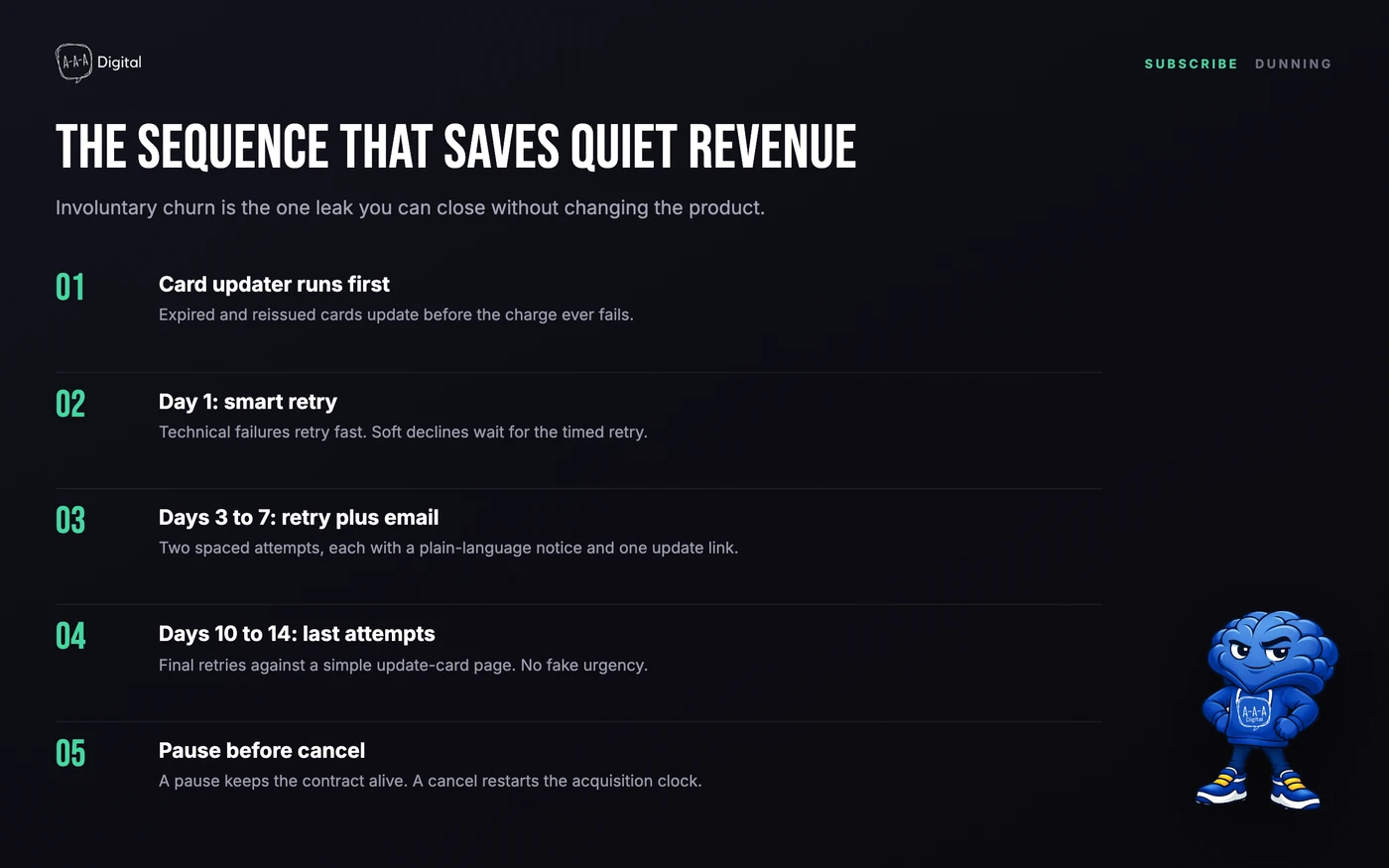
A working dunning stack, in order:
- Card updater first. Networks can update expired or reissued cards before the charge ever fails. Enable it; it is quiet and free money.
- Smart retries. Retry technical failures quickly, but space retries for insufficient funds (Adyen's guidance is the cleanest public version of this): a card that failed on payday minus three may clear on payday plus one.
- A short email sequence. A common 2026 pattern: notice within 24 hours, then retries paired with plain-language emails around days 3, 7, 10, and 14. One link to an update-card page, no fake urgency.
- Pause before cancellation. When recovery fails and the customer engaged with the emails, offer a pause. A paused subscriber resumes; a cancelled one starts the acquisition clock again.
When we migrated one coffee subscription from a patchwork of apps onto a single platform with real dunning, recovered failed payments added back roughly 3% of monthly subscriber revenue in the first two months. One store, directional, but the direction has held on every similar migration I have run.
The SEO and Content Play for Shopify Subscription Stores
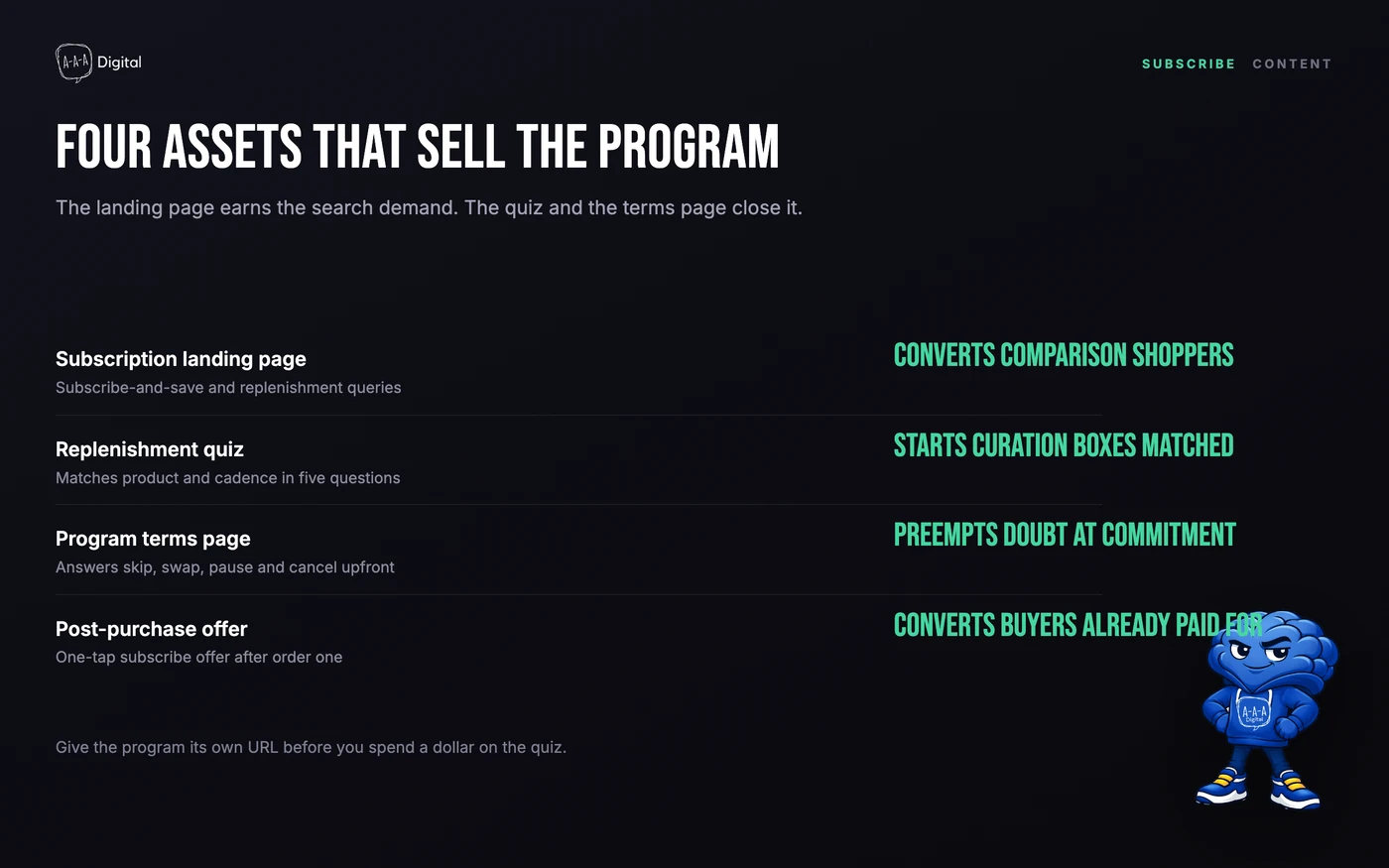
Subscriptions also change what you publish. Four assets do the work:
| Content asset | What it targets | The job it does |
|---|---|---|
| Subscription landing page | "Subscribe and save" plus category replenishment queries | Converts comparison shoppers into subscribers |
| Replenishment quiz | Cadence and fit questions | Starts curation boxes with a matched first box |
| Program terms page | Skip, swap, pause, cancel questions | Preempts doubt at the point of commitment |
| Post-purchase offer | One-time buyers with consumables | Converts order one into a subscription |
The landing page is the priority. Stores that bury the program as a product-page toggle miss the "best coffee subscription" intent entirely; a dedicated page lets you target it, explain the economics honestly, and route quiz takers. The program terms page sounds boring until you watch it lift checkout conversion: subscribers buy the cancellation policy as much as the product. And for converting buyers you already paid to acquire, post-purchase offers overlap directly with subscription mechanics; our post-purchase upsells playbook covers the one-tap flows that turn a first order into a contract without a second checkout.
FAQ
Can you sell subscriptions on Shopify without a paid app?
Yes. Shopify's free native Subscriptions app runs basic subscribe-and-save with no transaction fee, and every serious third-party app builds on the same native Subscriptions API, so no option routes orders outside Shopify's checkout. You pay when you outgrow the basics: prepaid cycles, box building, deep portal customization, and real dunning controls are where paid tiers start.
What churn rate should a Shopify subscription store expect?
The 2026 compilations put the ecommerce average around 6.5-8.5% monthly, but the category spread matters more than the average: straight replenishment can run under 4%, while food and curation boxes run 12-18%. Benchmark against your own trailing 90 days before any vendor benchmark, and split voluntary from involuntary churn, because the involuntary slice is the one dunning can recover.
How deep should a subscribe-and-save discount be?
Ten to fifteen percent is the common band for consumables, and deeper than 20% usually costs more in margin than it buys in retention. Set the depth from the replenishment math: discount plus acquisition cost has to clear the subscriber's lifetime contribution with room to spare, or the program is a donation.
Do subscription apps work with Shopify's new checkout?
Yes, because they have no choice: after Shopify's August 26, 2026 removal of checkout.liquid customizations for non-Plus stores, every subscription app runs on checkout extensibility and renders inside Shopify's native checkout. If an app's listing cannot state its extensibility support plainly, that is your answer about the app.
Get Help With This
You now have the build order: prove the product fits a cadence, start on the free native tier and graduate to the app whose pricing matches your revenue stage, build the portal save flows before the discount bribes, close the dunning leak, and give the program a page worth ranking. The distance between this outline and a live, measured program is about two focused weeks. If you would rather those weeks be ours, talk to us about our Shopify development service and we will spec the stack, wire the portal and dunning, and report retention numbers you can verify in your own admin.
