There are four real routes to a dropshipping supplier: a domestic wholesaler, an overseas marketplace like AliExpress or DHgate, a vertical aggregator like Zendrop or CJ Dropshipping, and a print on demand network like Printful or Printify. For a store in its first 90 days, a vertical aggregator is the right default. It holds stock near your customers, syncs orders with Shopify, and answers support tickets in plain English. This post is the companion to our Shopify dropshipping guide, and it covers the decision that guide assumes you have already made: who actually ships the product, at what cost, and who fixes it when something goes wrong.
The four supplier routes
A route is a bundle of trade-offs: unit cost, delivery time, return handling, and how much manual work sits on you. Here is each one, in the order most stores meet them.
Overseas marketplaces. AliExpress is the largest, DHgate sits beside it, and Alibaba is the same ecosystem at wholesale quantities. Unit prices are the lowest you will find anywhere, listing a product costs nothing, and a growing share of listings carry a "ships from US" badge with stock actually in US warehouses. The route exists for one job: proving a product has demand for close to zero money. It is a poor route for a store with repeat customers, because standard delivery still runs 12 to 20 days, every parcel carries a marketplace return address, and the same listing supplies every competitor you will meet.
Vertical aggregators. CJ Dropshipping, Zendrop, AutoDS, and Spocket sit between the marketplaces and your store. They hold stock in US and EU warehouses, list products at 10% to 30% above the AliExpress price, and push tracking numbers into Shopify without a spreadsheet. Zendrop and AutoDS charge subscriptions from roughly $20 to $50 a month, while CJ leans on per-order margins. What you buy is time: dispatch in 24 to 48 hours, a return address in the customer's country, and a support team that answers within a business day.
Domestic wholesalers. A real wholesaler in your target market sells in case quantities, issues invoices, and ships in 2 to 5 days. You find them through industry directories, trade shows, and plain searches for "distributor" plus the category plus the nearest large city. The minimums are the part beginners miss. A first order of 50 units at $9 a unit is $450 of inventory risk before you know the product will keep selling. This route earns its place when one SKU has sold 15 to 20 units a day for three straight weeks and the aggregator markup costs more than the convenience.
Print on demand. Printful, Printify, and Gelato print your design on a blank product after the order arrives, then ship it direct. Unit costs are high, so a single t-shirt leaves $8 to $12 of margin at typical prices, and delivery runs 5 to 10 days from the nearest facility. You are not sourcing a product here. You are testing designs with zero inventory risk, and the design is yours in a way a listed gadget never is.
| Route | Examples | Delivery | Use it when |
|---|---|---|---|
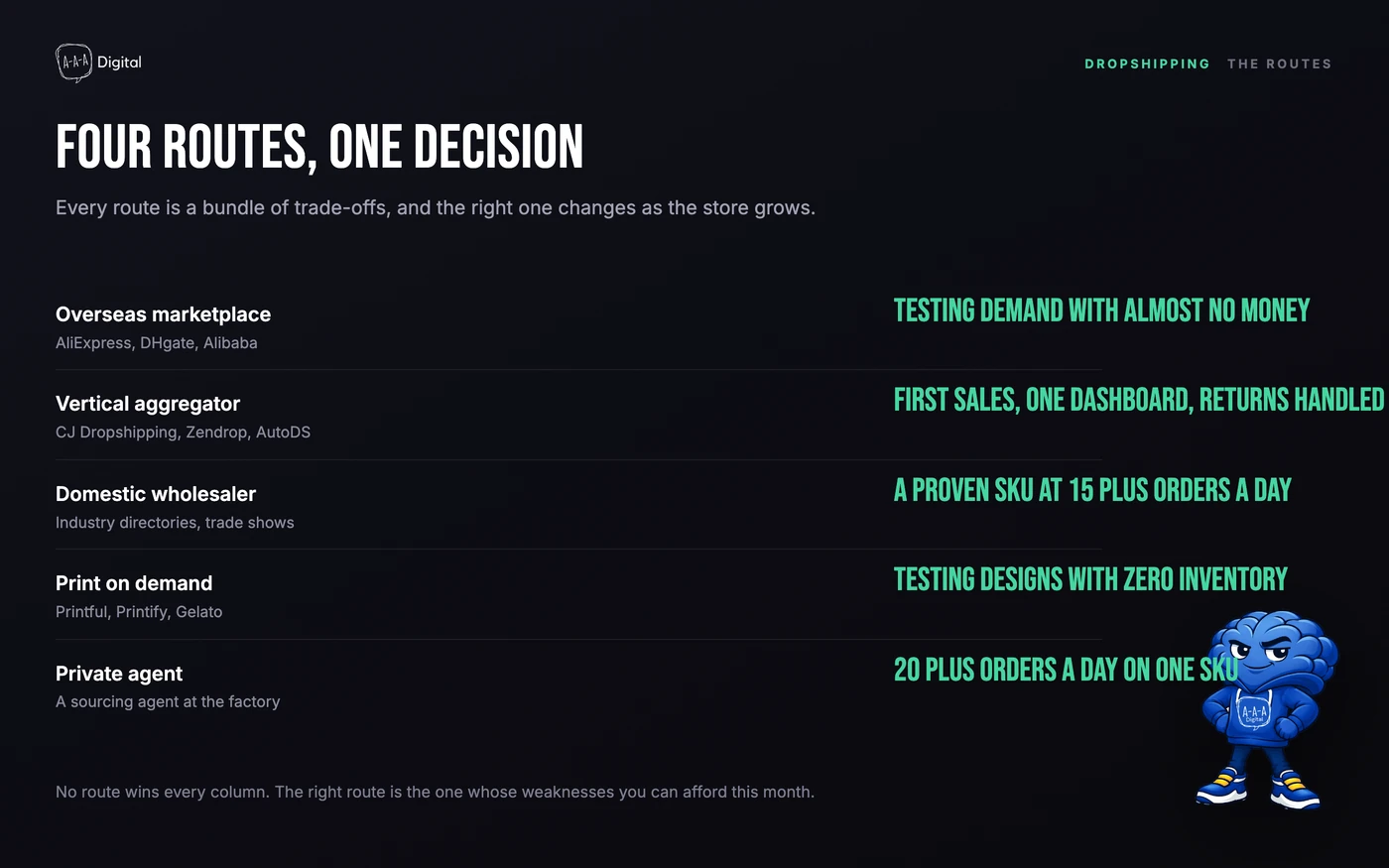
| Overseas marketplace | AliExpress, DHgate, Alibaba | 12 to 20 days standard | Testing demand with almost no money |
| Vertical aggregator | CJ Dropshipping, Zendrop, AutoDS, Spocket | 5 to 10 days | First sales, one dashboard, returns handled |
| Domestic wholesaler | Industry directories, trade shows | 2 to 5 days | A proven SKU at 15 plus orders a day |
| Print on demand | Printful, Printify, Gelato | 5 to 10 days | Testing designs with zero inventory |
| Private agent | A sourcing agent at the factory | 7 to 14 days | 20 plus orders a day on one SKU |
A fifth route, the private agent, appears when one product earns real volume: an agent buys at factory prices, inspects units, and holds stock under your label. And below 20 orders a day, an agent adds cost and risk without buying anything an aggregator cannot.
Where to actually find suppliers
Searching "best dropshipping suppliers" returns lists built for affiliate commissions, not for your store. The routes that work are less glamorous. We shortlist suppliers for client stores every week, and we have never started from one of those lists.
Start at the Shopify App Store, not Google. Every serious aggregator has a Shopify app, and the app listing shows its real review count, its last update date, and the complaints users actually have. An aggregator without a current Shopify app is telling you something.
Use marketplace filters as a sourcing tool. On AliExpress and CJ Dropshipping, filter by "ships from" the country you sell into. A listing with US stock and 95% positive feedback is a shortlist candidate, not just a product page. Open a chat with the seller before you list anything.
Pay for directories only after you know the category. SaleHoo and Worldwide Brands list vetted wholesalers with real contact details. They earn the fee when you know what you want to source and need ten legitimate options to quote against each other, not for browsing.
Find domestic wholesalers the boring way. Search Google Maps for the category plus "wholesale" plus the nearest large city. Call. Ask for a line sheet and opening terms. Real wholesalers still run on email and PDFs, and that is fine, because the boring ones are rarely the scams.
Check the category against the platform rules before shortlisting anything. Supplements with claims, branded goods, and anything battery-powered or ingestible runs into payment and ad restrictions fast. Our post on what you can sell on Shopify covers the categories that cost stores their payment processing.
The vetting checklist
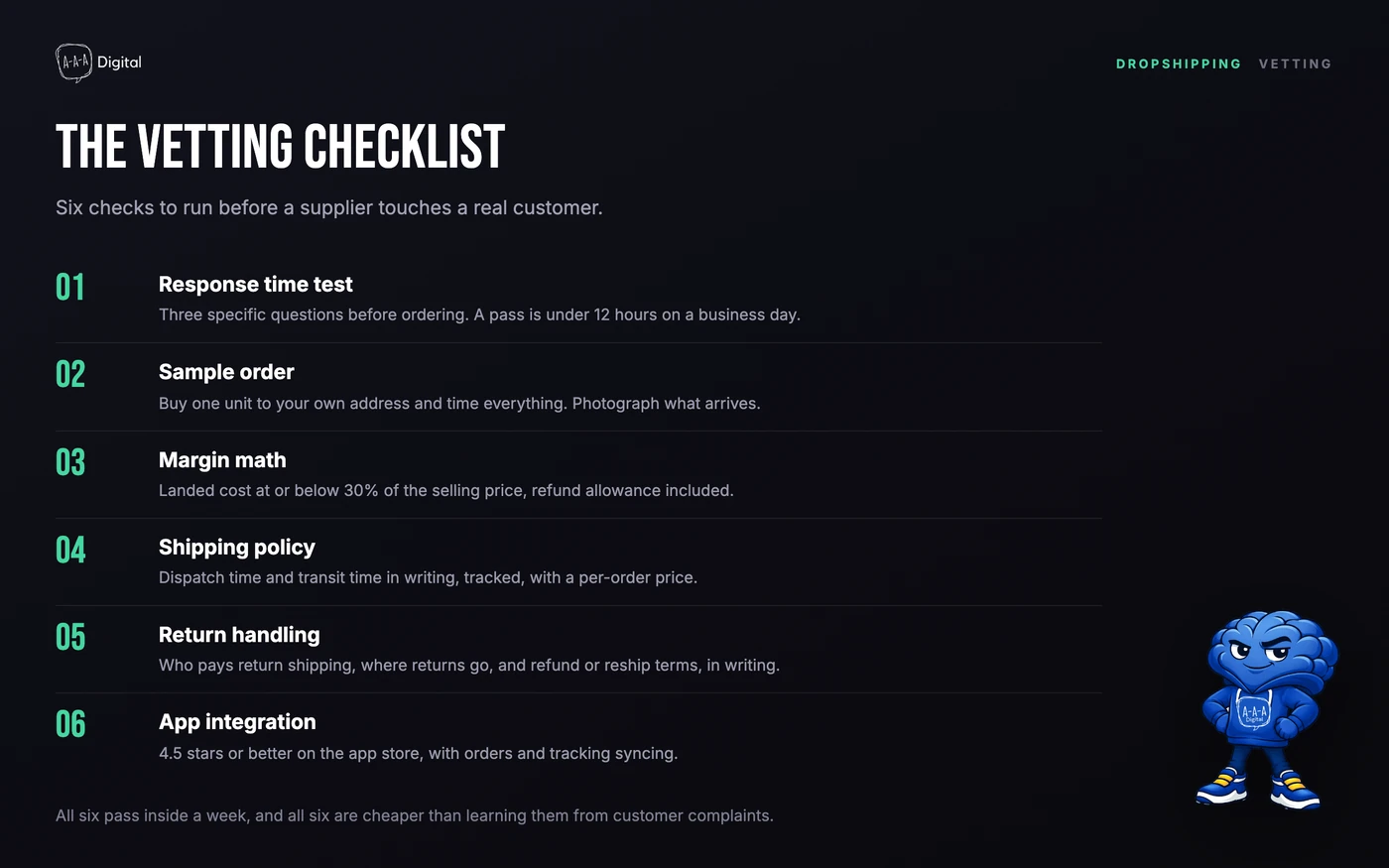
Every supplier fails in the same six places. Test all six before a real customer is involved, because after that the failures happen in public and cost money per occurrence. The full list, with the pass bar for each:
| Check | How to run it | The pass bar |
|---|---|---|
| Response time | Send three specific questions before you order | Answers inside 12 hours on a business day |
| Sample order | Order one unit to your own address | Dispatches in 48 hours, arrives inside the quoted window |
| Margin math | Compare landed cost with your selling price | Landed cost at or below 30% of the price |
| Shipping policy | Ask for dispatch time and transit time in writing | Tracked shipping, a per-order price, no vague ranges |
| Return handling | Ask who pays return shipping and where returns go | A written policy covering refund, reship, and return-to-warehouse |
| App integration | Install the Shopify app on a trial store | 4.5 stars or better, orders sync, tracking pushes automatically |
Two of these deserve more words than a table row. The sample order is the most informative hour in dropshipping. A supplier passed every checklist we had until the sample order took five weeks. That ended the shortlist. Time the dispatch, photograph the parcel and the product, and walk your own checkout first. Whatever annoys you in that parcel will annoy 8% of your customers.
The response time test predicts more than politeness. A supplier answering in two hours will fix a wrong shipment the same day. A supplier answering in two days will spend a week on whose fault it was, and your customer holds you responsible either way.
The app integration check is not cosmetic. A supplier app that fails to push tracking numbers will double your support tickets, and "where is my order" tickets are where dropshipping stores drown. Our Shopify development team builds these integrations to hold past the first hundred orders, and our rundown of Shopify inventory management apps covers the stock sync side, the next failure point once orders flow.
The margin math, before and after a 25% refund rate
Supplier choice is an advertising decision wearing an operations costume. The number that decides whether your ads work is margin per order, and the supplier sets most of it. Here is a worked example at two refund rates.
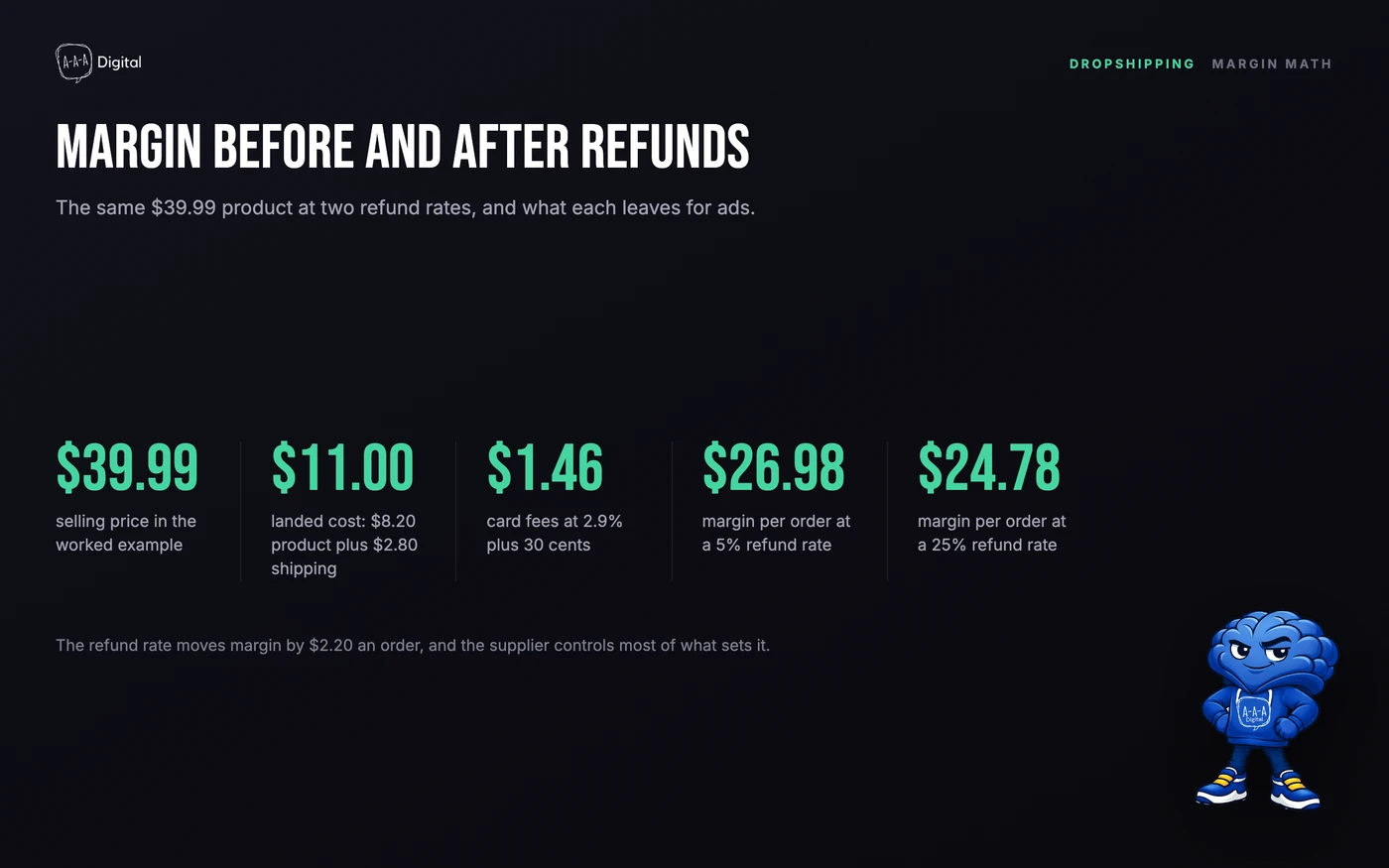
Take a product that sells for $39.99 with free shipping to a US customer. The supplier charges $8.20 for the item and $2.80 for tracked shipping, so $11.00 landed.
| Line | Basis | At a 5% refund rate | At a 25% refund rate |
|---|---|---|---|
| Selling price | What the customer pays | $39.99 | $39.99 |
| Product cost | Supplier charge per order | $8.20 | $8.20 |
| Shipping | Supplier charge per order | $2.80 | $2.80 |
| Card fees | 2.9% plus 30¢ on Basic | $1.46 | $1.46 |
| Refund allowance | Refund rate times $11.00 landed | $0.55 | $2.75 |
| Margin per order | What is left for advertising | $26.98 | $24.78 |
Margin per order is your break-even cost per acquisition. At a 5% refund rate, a $20 CPA leaves $6.98. At 25%, the same $20 CPA leaves $4.78, and a $25 CPA, tolerable in the first scenario, loses money in the second.
The refund allowance assumes the worst honest case: you refund the customer and the supplier returns nothing, so the order costs the full $11.00 landed. At 100 orders a month, moving from 5% to 25% refunds is $220 of margin gone, and if each refunded customer cost $20 in ads, the true bill is closer to $620.
This is why the cheapest supplier is rarely the cheapest. A supplier $1.20 lower on unit cost but shipping in 15 days instead of 6 will raise the refund rate by more than the price difference, and the ad platform notices too. Stores with long delivery estimates convert worse on cold traffic, which raises the CPA on every order, not only the refunded ones. Card fees move with your plan too; the Shopify pricing breakdown covers that side.
Red flags that end stores
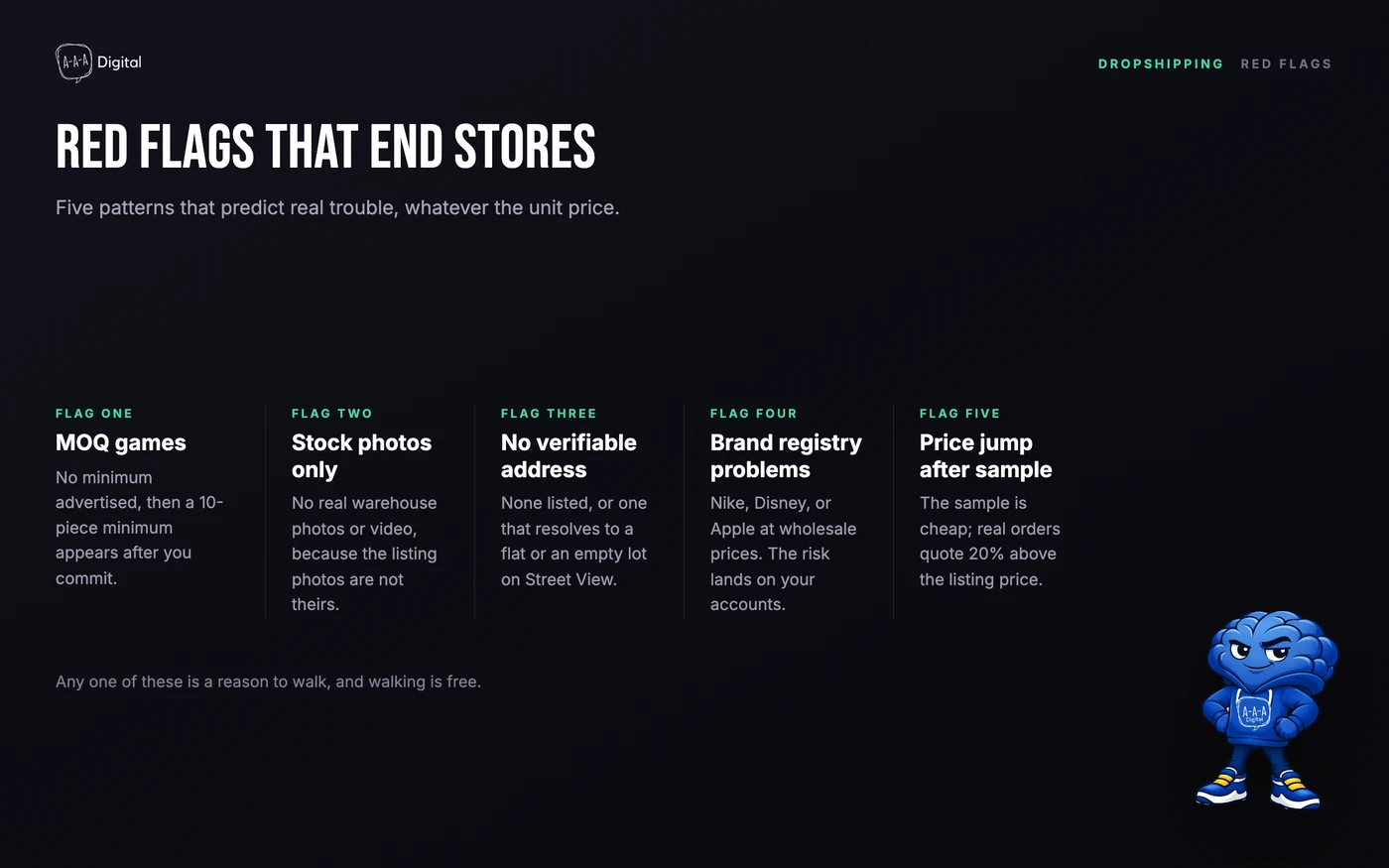
Most bad suppliers are not scams. They are bad at the job in ways that cost you money slowly. Five patterns are different. They predict real trouble, and any one of them is a reason to walk.
- MOQ games. "No minimum order" in the listing, then a 10-piece minimum appears once you have built the store around the product. Walk.
- Stock photos only. They will not send a real photo or a 20-second video of the product in the warehouse. The listing photos were never theirs either.
- No verifiable address. No street address on the site, or one that resolves to a flat or an empty lot on Google Street View. A supplier you cannot find cannot be visited, reported, or sued.
- Brand registry problems. They offer Nike, Disney, or Apple goods at wholesale prices. They are not authorized to, and the risk lands on you: listing takedowns, payment processor reviews, and ad account bans all trace back to counterfeit inventory.
- Price jumps after the sample. The sample order is cheap, then real orders quote 20% above the listing price. The sample was their marketing spend.
Frequently Asked Questions
What is the best dropshipping supplier for beginners?
A vertical aggregator with stock in the country you sell into: CJ Dropshipping, Zendrop, or AutoDS. You pay 10% to 30% more per unit than a marketplace price, and you get dispatch in 24 to 48 hours, a local return address, and a Shopify app that pushes tracking numbers. That combination matters more at the start than the lowest unit cost.
Is AliExpress still good for dropshipping?
For proving demand, yes. List from a "ships from US" listing where possible, quote a real delivery window, and treat it as a 30-day experiment. For running a store past the test phase, no. Delivery times, marketplace return addresses, and identical listings make it a poor home for repeat customers.
How do I know if a dropshipping supplier is legit?
Run the six checks above: response time, sample order, margin math, shipping policy, return handling, and app integration. The sample order plus a verifiable business address catches most fraud. Legitimacy is not a feeling. It is a pass bar on each check.
Should I use one supplier or multiple?
One per store until you have a reason. Two suppliers means two shipping profiles, two return addresses, and twice the vetting. Add a second only when your best seller outgrows the first one's stock or pricing.
Do dropshipping suppliers handle returns?
Most aggregators offer return-to-warehouse with a refund or reship. Most marketplaces expect you to refund and let the customer keep the item on cheap goods. Get the policy in writing before the first order. Whoever pays return shipping decides whether a low-value return is worth the postage, and on items under $20, refunding without a return is usually cheapest.
Print on demand or AliExpress: which should I start with?
Print on demand if you have designs and no audience yet, because the products are yours and quality is consistent. AliExpress if you are testing product demand, because unit costs are lower and the catalogue is larger. The failure modes differ: print on demand fails on thin margins, marketplace dropshipping fails on delivery times and refunds.
The supplier decision looks operational, but it shows up in the ad account. Delivery time moves conversion rate, refund rate moves margin, and margin decides what you can pay per customer. Get the vetting right and the rest of the model has room to work. For the full cost picture of the model, read our Shopify dropshipping guide, and if you want the store built so the supplier, tracking, and checkout integrate cleanly from day one, talk to our Shopify development team.
