A ceramicist came to us last spring with a problem that sounds invented. Her Squarespace site was the best looking store we had seen that quarter, and it had quietly stopped her from selling. Each piece comes in four sizes and six glazes, which is 24 straightforward variants. Squarespace caps a product at six options and 250 variant combinations, and her matrix did not fit. The workaround everyone suggests is splitting one mug into nine listings. That means nine inventory counts, nine review sections and nine URLs competing for the same search query. She did not have a design problem. She had a website builder being asked to behave like a commerce platform.
That is the whole comparison, really. Squarespace is a beautiful website builder with commerce bolted on. Shopify is a commerce platform with design constraints. We have already put Shopify next to Wix and next to BigCommerce, and this post completes the trio buyers actually compare. Here is where Squarespace genuinely wins, where Shopify genuinely wins, the pricing math almost nobody publishes, and what moving between the two really costs.
Shopify vs Squarespace pricing in 2026
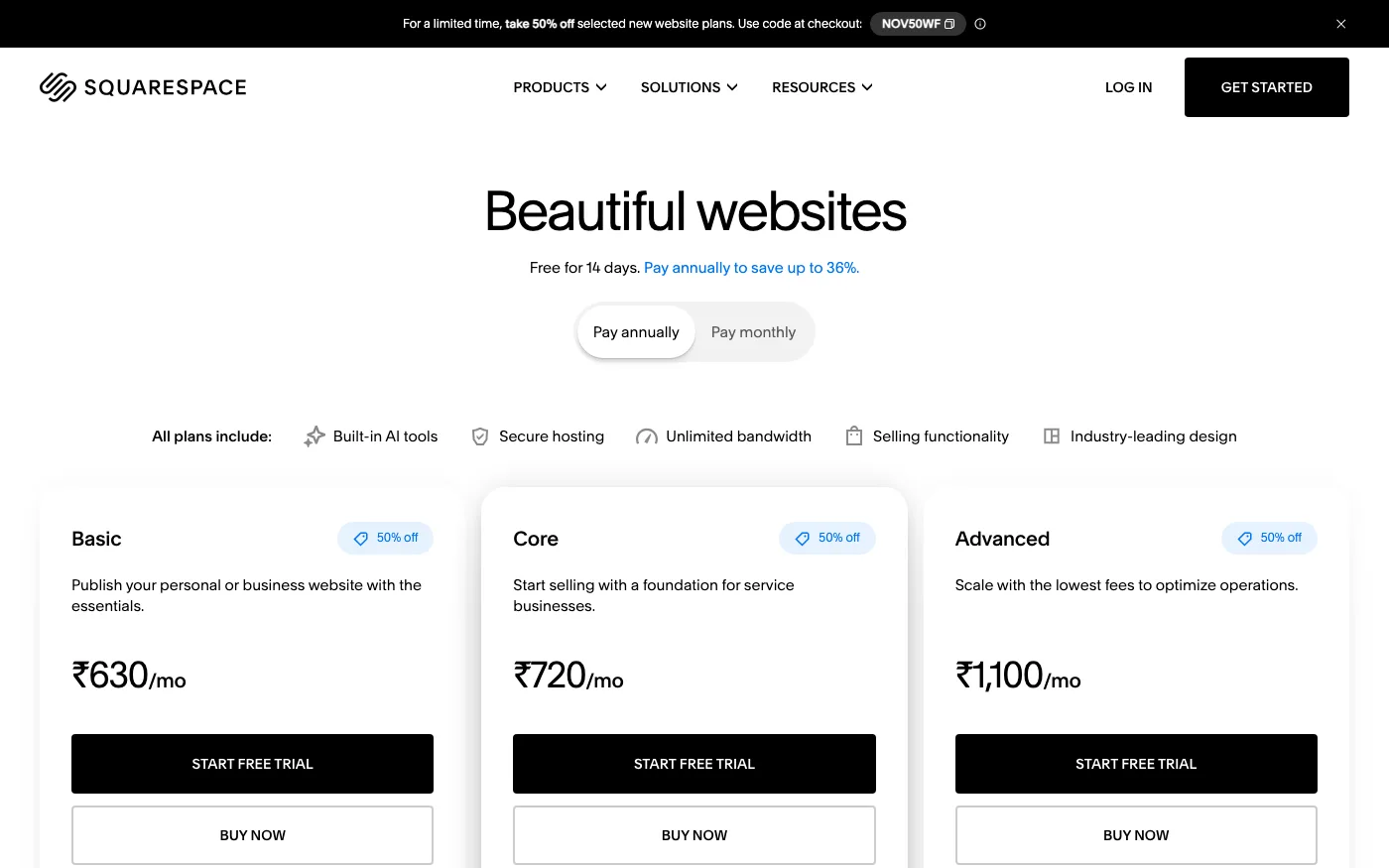
Squarespace replaced its old Personal, Business and Commerce tiers with Basic, Core, Plus and Advanced, a change it announced in early 2025 and rolled out globally through early 2026. Every plan can now take payments, which is new; the old entry tier could not. Shopify still sells three self-serve plans plus Plus. Here is the lineup as both companies publish it, checked in November 2026.
| Shopify | Squarespace | |
|---|---|---|
| Entry plan | Basic: $39/mo, $29/mo billed yearly | Basic: $25/mo, $19/mo billed yearly |
| Entry store fee | 0% with Shopify Payments; 2% with a third-party gateway | 2% on every store sale, plus 7% on digital content and memberships |
| Mid plan | Grow: $105/mo | Core: $39/mo, $29/mo billed yearly |
| Top self-serve | Advanced: $399/mo | Plus: $65/mo ($49/mo yearly); Advanced: $139/mo ($99/mo yearly) |
| Published card rate | 2.9% + 30¢ on Basic, 2.7% on Grow, 2.5% on Advanced | 2.9% + 30¢ on Basic and Core, 2.7% on Plus, 2.5% on Advanced |
| Digital products and memberships | Handled by apps, priced separately | Built in, with a 7%, 5%, 1%, 0% platform fee by plan |
| Enterprise tier | Plus: from about $2,300/mo | None. Advanced is the ceiling |
Shopify also discounts annual billing, by roughly a quarter off list, though the annual figures it shows have shifted during 2026, so model from the live page rather than any screenshot.
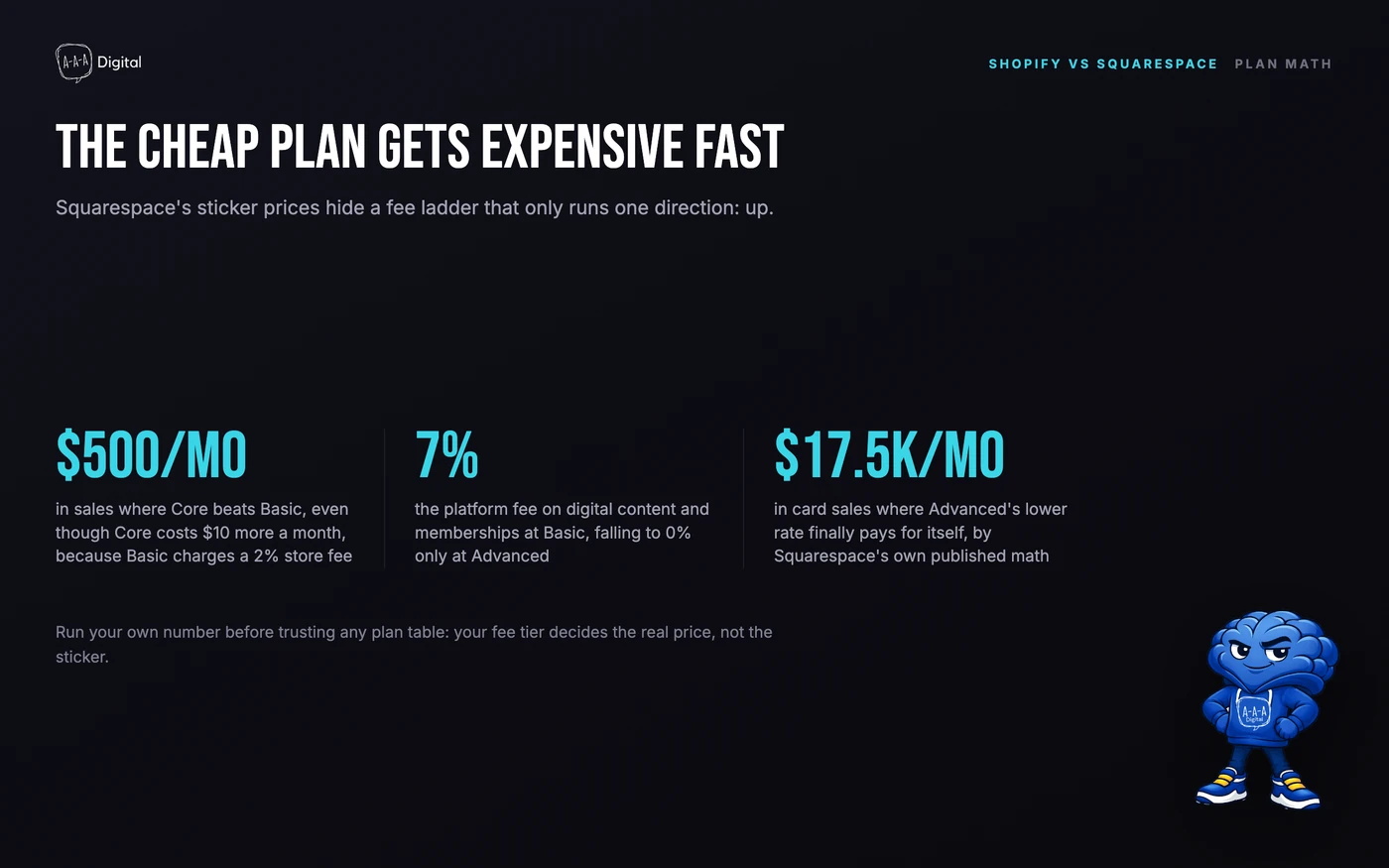
Three details do the real work. First, the entry economics look identical until you read the fee rows. Squarespace Basic charges a 2% store fee on top of card processing; Core drops it to 0%. Core costs $10 more a month on annual billing, so the fee outweighs the savings at about $500 a month in sales. Basic is a trial plan wearing an entry plan's clothes.
Second, both platforms discount processing on higher tiers, and both publish the break-even math if you look for it. Squarespace Advanced saves 0.4% on card rates over Core, and Squarespace's own prices imply it pays for itself around $17,500 a month in card sales. Below that, Advanced is an expensive way to feel serious. For the full Shopify side of this math, our Shopify pricing breakdown keeps the current numbers in one place.
Third, the real cost shows up when you outgrow Squarespace commerce. At a million dollars a year in sales, Squarespace Advanced costs $1,188 a year and Shopify Advanced costs $4,788 at list. That $3,600 gap is less than one good brand photoshoot, and on the Shopify side you get wholesale catalogs, point of sale, a checkout with more than 250 million buyers on file and an app market with an answer for almost any problem. The gap is not the plan fee. The gap is what the plan cannot do, and paying for a migration later costs more than the lifetime difference. Domain-detection crawls tracked roughly 1,200 sites moving from Squarespace to Shopify against about 600 going the other way in a single 90 day window this year. That is a directional number, but it matches what we see on calls: the traffic is mostly one direction.
Where Squarespace genuinely wins
Let us be fair first, because the polished surface is not a trick. Four areas are real wins.
Design polish with zero skill. Squarespace 7.1 templates have the best default typography and spacing in the builder market, full stop. Nothing on Shopify matches them out of the box; you need a designer or a premium theme to get close. If your site is the product, portfolios, restaurants, architects, wedding photographers, Squarespace earns its keep on looks alone.
Content and commerce under one roof. Blog, email campaigns, scheduling, gated member areas and the store share one login and one bill. On Shopify the blog is basic, email is pay per send, and courses or memberships need apps. A creator selling a course alongside prints has a genuinely simpler life on Squarespace.
Memberships are native, with a fee ladder. Selling digital content on Squarespace costs 7% of sales on Basic, falling to 0% on Advanced. On Shopify, subscriptions and courses run through apps that typically cost $30 to $100 a month. At modest volume the Squarespace fee is cheaper; at scale the apps win. Know which side of that line you are on before you commit.
Price for non-commerce sites. A service business that sells almost nothing online has no reason to pay commerce platform money. Squarespace Basic at $19 a month on annual billing is the honest price for that business.
The reverse move exists and we make it a few times a year, always with the same profile: a services business that stopped selling products. A photographer we work with moved from Shopify to Squarespace last year and it was the right call. Her shop shrank from dozens of products to a handful of prints, and she got a better site for less money.
Where Shopify genuinely wins
Now the longer list, and for a reason.
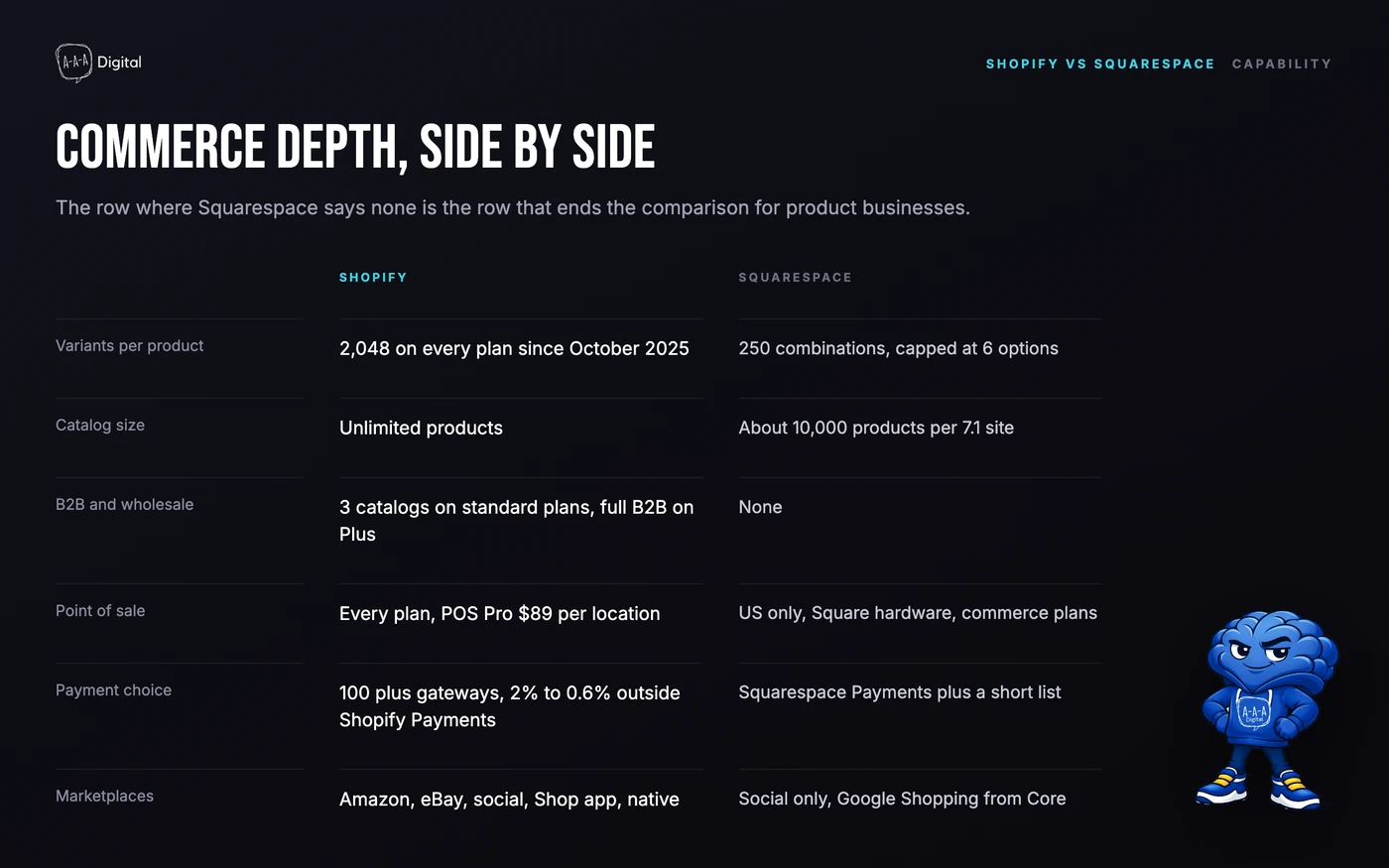
Catalog depth. Shopify raised its variant ceiling from 100 to 2,048 per product in October 2025, on every plan. Squarespace stops at six options and 250 combinations per product, and a 7.1 site caps out around 10,000 products. Configurable goods, made to order pieces, size and color matrices: this is the wall the ceramicist hit, and she is not unusual.
Checkout conversion. Shop Pay has more than 250 million buyers on file, by Shopify's own count, and it turns a returning customer's checkout into a two tap affair. Squarespace has a clean, competent checkout. It has no network behind it. When your traffic is paid for, checkout conversion is the metric that pays the platform bills.
Point of sale. Shopify includes casual in-person selling on every plan, and POS Pro runs $89 a month per location for serious retail. Squarespace POS exists, but it is US only, runs on Square hardware and requires a commerce tier plan. Multi-location or non-US retail is not a contest.
B2B and wholesale. Standard Shopify plans now include up to three B2B catalogs, and Plus does full wholesale with price lists and net terms. Squarespace has nothing. A stationery brand came to us doing about $340K a year and invoicing 40 retail stockists by hand, because their Squarespace store could not show a retailer a different price. They did not need a prettier website. They needed a platform with a wholesale concept in it.
Channels and currency. Amazon, eBay, social channels, the Shop app and multi-currency selling through Shopify Markets are built in. Squarespace covers social promotion on every plan, adds Google Shopping from Core, and its multi-currency options are limited.
The ecosystem. Shopify's app store lists somewhere between 14,000 and 16,000 apps depending on the crawl. Squarespace's extension marketplace is a few dozen deep. When you need a 3PL, an ERP connection, subscription billing or loyalty, Shopify has three options and an agency that has integrated each. On Squarespace you are often stitching Zapier together and hoping.
If you are still weighing whether a dedicated commerce platform is even worth it for a business like yours, whether Shopify is worth it is the shorter read that answers that question first.
SEO reality: clean basics vs a real ceiling
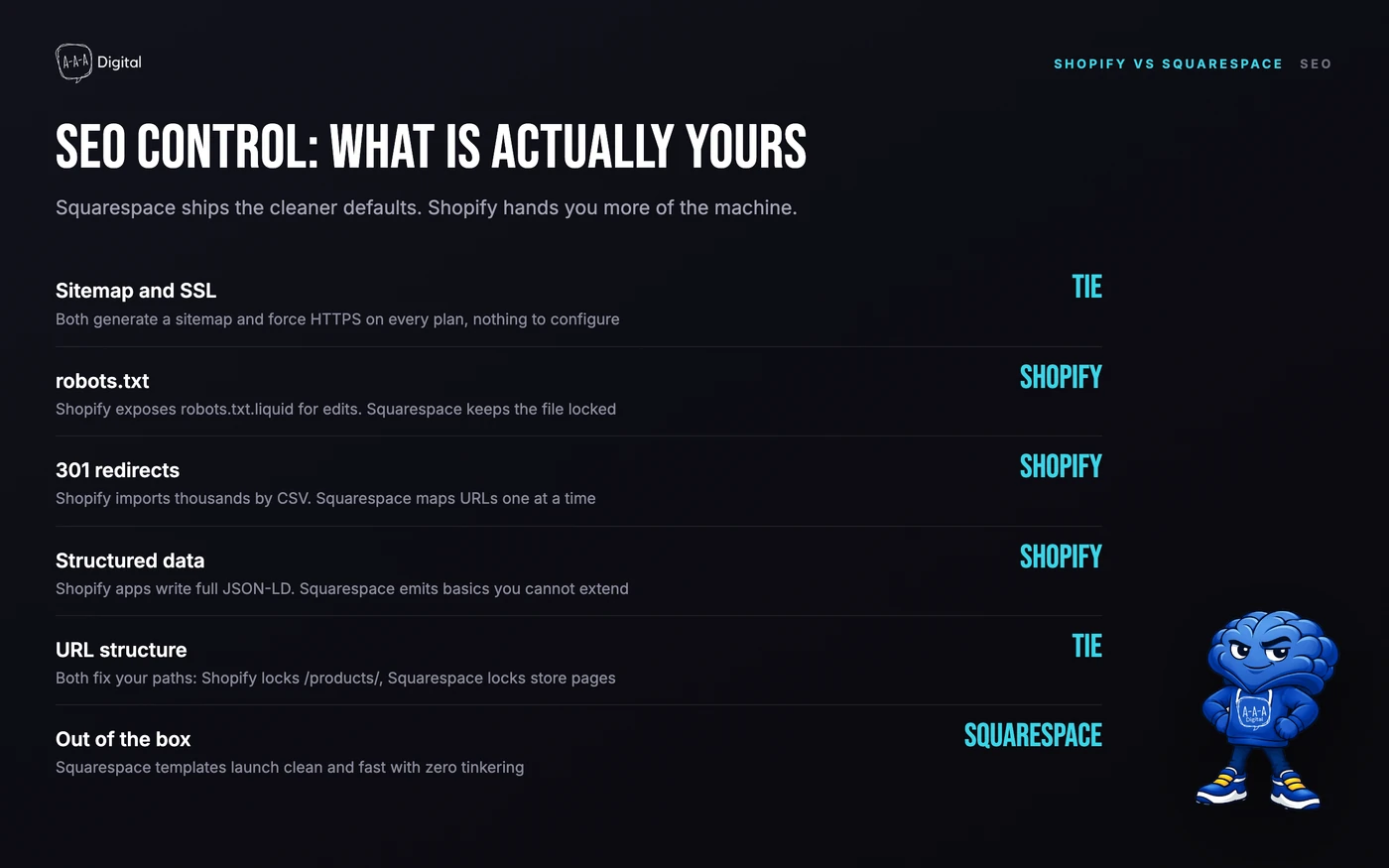
Most posts get this backwards, so let us state the frame plainly. Squarespace has the better SEO defaults. Shopify has the higher SEO ceiling.
Squarespace generates your sitemap, forces SSL, and gives you clean control of titles, descriptions, slugs and alt text on templates that render fast. For a portfolio or a local services site that is 95% of SEO, and it works on day one. The limits appear when you need control. You cannot edit robots.txt. Structured data is auto-emitted and cannot be extended. Redirects are managed one URL at a time, with no bulk import, which is how Squarespace store owners lose entire afternoons to a redirect list a Shopify owner would have uploaded as a CSV in minutes.
Shopify has its own quirks, and we do not pretend otherwise. Product URLs sit under a fixed /products/ path, collection pagination creates duplicate URLs Shopify handles with canonicals, and a careless app stack will slow any theme down. The difference is that the machine is reachable: robots.txt is editable through robots.txt.liquid, redirects import in bulk, apps write full JSON-LD schema, and Markets with Translate and Adapt handles hreflang across regions.
Here is the honest verdict for both platforms. Rankings come from content, speed and links long before the CMS matters. Squarespace's ceiling bites when you scale content, run a migration or fight for rich results. Shopify's ceiling is higher, and mostly reachable without a developer. If SEO is a serious channel for you, pick the platform whose ceiling you will not hit in two years.
Design flexibility vs conversion
Squarespace's constrained editor is a feature. You cannot easily break its design system, which is why Squarespace sites look good even in amateur hands. Shopify gives you more rope: sections on every page type, premium themes running from about $100 to $500, metafields and metaobjects for structured custom content, and a fully custom ceiling if you hire well.
The question that matters is not which editor is nicer to use. It is what the design is for. Squarespace optimizes for looking right. Shopify themes optimize for buying: sticky add to cart, quick view, cross-sells, urgency and trust modules, all tuned across thousands of stores. A pretty site that converts at 1.2% loses to a decent site converting at 1.8% every single month, and at $50K a month in sales that half point is the entire platform fee bill several times over.
Who should choose which
The decision gets clearer once you accept that the two products are good at different businesses.
Choose Squarespace if:
- You sell services, and products are a side dish rather than the meal.
- Your catalog is small, under about 100 products, with simple options.
- Content is your marketing engine and you want blog, email and memberships in one place.
- You need the site live this week and have no design budget.
- Your business is portfolio or local driven, and the store is 10% of revenue.
Choose Shopify if:
- Products are the business, or you intend them to become the business.
- Your products carry real option matrices, configurations or made to order paths.
- You sell online and in person, now or soon.
- Wholesale, retail stockists or net terms appear anywhere in your two year plan.
- You want to hire developers, agencies and ops people from a deep, liquid talent pool.
For smaller businesses still weighing platforms beyond this pair, we compared ecommerce platforms for small business on three year cost of ownership.
One honest note about both lists: roughly half the stores we audit run more platform than they need, paying commerce prices for a catalog a $19 plan would carry comfortably. The other half are duct-taping a platform that stopped fitting two years ago because a rebuild feels risky. Both problems are cheaper to fix the earlier you name them.
Moving from Squarespace to Shopify
The migration I see most often is a services business that started on Squarespace, added a small shop, and watched the shop become the business while the platform stayed the same.
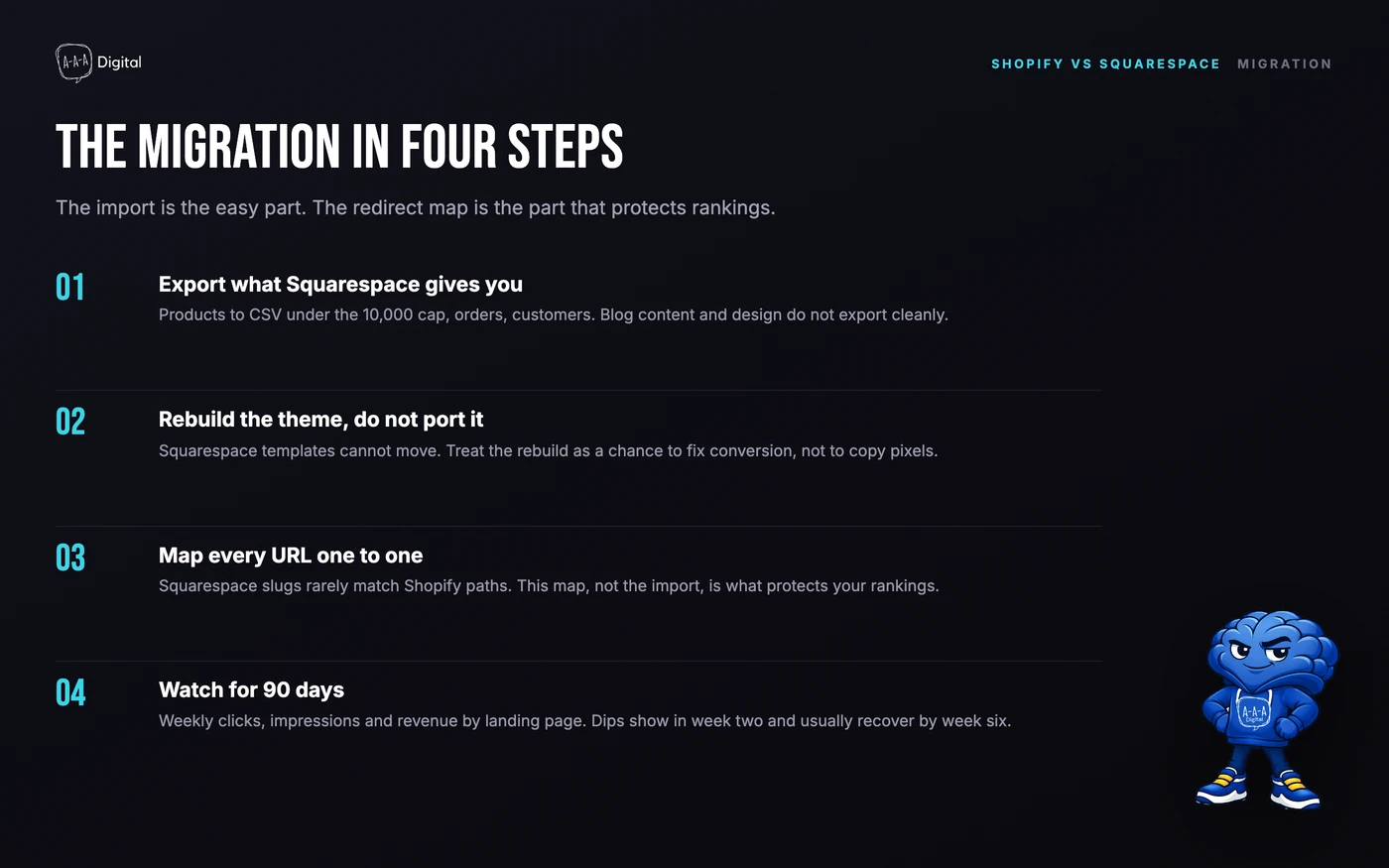
The mechanics deserve precision. Products export to CSV up to the 10,000 product cap, and orders and customers go with them. Blog posts have no clean native export, so plan to carry content over manually or through a WordPress export workaround. The theme never ports, which we treat as a feature: rebuild for conversion instead of copying pixels. URLs change because Squarespace slugs rarely match Shopify's fixed paths, so every indexed page needs a one-to-one 301 built before launch from crawl and Search Console data. Customer passwords never migrate on any platform; plan a reset flow instead. If you do make the move, our guide to setting up a Shopify store covers the build order we recommend to newcomers.
Budget honestly for it. A clean Squarespace to Shopify migration typically runs a few thousand dollars and four to eight weeks including the rebuild, more with a large catalog. That sounds like real money until you compare it with the fee drag and lost sales of staying two years past the ceiling. If you are weighing the switch, our Shopify migration service runs the audit, redirect map, build and 90 day watch, and we will tell you honestly if your case is a bad candidate.
FAQ
Is Squarespace or Shopify better for a small business? If the business sells services or a handful of simple products, Squarespace is usually the cheaper and easier fit. If products are the core of the business, or wholesale and in-person sales are anywhere in the plan, Shopify's higher price buys capability you will actually use.
Can Squarespace handle a growing online store? Up to a point. The practical ceilings are 250 variant combinations per product, around 10,000 products per site, and no native wholesale, limited multi-currency and no marketplace channels. Past a few hundred orders a month, most growing stores we see hit at least one of those walls.
Which is better for SEO, Squarespace or Shopify? Both cover the fundamentals: sitemaps, SSL, titles and descriptions. Squarespace launches cleaner but caps your control, with locked robots.txt and no structured data editing. Shopify has fixed URL quirks, but a much higher ceiling through editable robots.txt, bulk redirects and schema apps. Rankings will be decided by content, speed and links long before the platform does.
Will migrating from Squarespace to Shopify hurt my SEO? Not if every indexed URL gets a one-to-one 301 redirect, built before launch from crawl and Search Console data, and content ships with the same titles and structure. Expect a two to four week dip while Google processes the change. Rankings that have not recovered after about six weeks point to a redirect problem, not a platform problem.
If your Squarespace store has quietly become the business, the useful conversation is what the move costs and when to time it. Read how our Shopify migration service runs end to end, or book a strategy call and we will map your catalog, your variants and your redirects before you commit to a date.
